


There are no studies on efficacy of tofacitinib for moderate-severe ulcerative colitis (UC) in pediatric patients in Latin America. The aim of this study was to describe the efficacy and safety, in real world, treated with tofacitinib in our setting.
Materials and methodsCase series of pediatric patients with UC who received treatment with tofacitinib in induction phase for 8 weeks and then maintenance therapy between November 2021 and February 2023.
Results4 female patients, median age 14.5 (SD 2.1; RIQ12.5–16.5) years, all with prior biologic exposure, all 4 with prior use of anti-TNF, and 2/4 with prior use of anti-integrin. Clinical, biochemical and endoscopic remission was obtained in 3/4 at induction. Information was obtained from 3 patients in 6-month maintenance, 2/3 remained in clinical, biochemical and endoscopic remission and 1/3 has not achieved biochemical or endoscopic remission. Information was obtained from 1 patient in 12-month maintenance, achieving clinical and biochemical remission, however, endoscopic remission has not been achieved. One patient was initiated for severe acute UC with risk of colectomy, with significant improvement after 7 days, reaching therapeutic objectives at induction. No serious adverse events were reported in any of the cases.
ConclusionsEfficacy and safety are demonstrated with tofacitinib in pediatric patients. With high percentage of response in induction treatment, sustained over time, and safe. In the context of severe acute hospitalized UC, it has a role as a potential rescue therapy due to its rapid action.
No hay estudios sobre eficacia de tofacitinib para colitis ulcerosa (CU) moderada-grave en pacientes pediátricos en Latinoamérica. Se plantea como objetivo describir la eficacia y seguridad, en mundo real, tratados con tofacitinib en nuestro medio.
Materiales y métodosSerie de casos de pacientes pediátricos con CU que recibieron tratamiento con tofacitinib en fase de inducción por 8 semanas y luego, terapia de mantenimiento, entre noviembre 2021 y febrero 2023.
Resultados4 pacientes femeninas, mediana de edad 14,5 (DE 2,1; RIQ12,5–16,5) años, todas con exposición previa a biológico, las 4 con uso previo de anti-TNF, y 2/4 uso previo de anti-integrina. En 3/4 se obtuvo remisión clínica, bioquímica y endoscópica en la inducción. Se obtuvo información de 3 paciente en mantenimiento a 6 meses, 2/3 permanecieron en remisión clínica, bioquímica y endoscópica y 1/3 no ha alcanzado remisión bioquímica ni endoscópica. se obtuvo información de un paciente en el mantenimiento a 12 meses, alcanzando remisión clínica, bioquímica, sin embargo, no se ha logrado remisión endoscópica. Una paciente le fue iniciado por cuadro de CU aguda grave con riesgo de colectomía, con mejoría significativa a los 7 días, alcanzado objetivos terapéuticos en la inducción. No se reportaron eventos adversos graves en ninguno de los casos.
ConclusionesSe demuestra eficacia y seguridad con tofacitinib en pacientes pediátricos. Con alto porcentaje de respuesta en el tratamiento de inducción, sostenida con el tiempo, y segura. En contexto de CU aguda grave hospitalizado tiene un rol como potencial terapia de rescate por su rápida acción.

Ulcerative colitis (UC) is a multifactorial chronic disease with no definitive cure, which involves relapses and remissions, with patients requiring long-term therapy to remain in remission. The average age of onset is between 15 and 30 years. It can, however, affect paediatric and older adult patients, although it is uncommon in these age groups.1 In infants and adolescents, onset is characterised by rapid progression, with more extensive forms of the disease, which makes treatment challenging.2 While in adults, biological therapy is recommended for cases of moderate/severe UC, including tumour necrosis factor inhibitors (anti-TNF), anti-integrin alpha-4-beta-7 (vedolizumab) and anti-interleukin-12-interleukin-23 (ustekinumab), for paediatric patients, the available therapeutic arsenal is narrower, given that neither vedolizumab nor ustekinumab are approved, and most of the evidence regarding these therapies is observational, making for a somewhat more complicated outlook.
Patients with UC require lifelong medical therapy to control symptoms and avoid disease progression, hospitalisation and colectomy.3 The introduction of biological therapy has increased the chances of achieving these objectives. However, no more than 60% of patients achieve sustained clinical remission beyond 14 weeks, and between 20% and 40% of those who respond to anti-TNF will experience a secondary loss of response.4 Active substances called small-molecule inhibitors have since been developed. One such innovative therapy is the oral drug tofacitinib, which preferentially inhibits transduction signals activated by heterodimeric cytokine receptors that bind to JAK-3 and/or JAK-1, with a functional selectivity superior to that of cytokine receptors, which activate transduction signals through pairs of JAK-2. The efficacy and safety of tofacitinib in adults is known from the pivotal phase 3 clinical trial programme, OCTAVE.5 Clinical remission of 18.5% and endoscopic improvement of 31.3% were demonstrated for the induction phase (8 weeks) in OCTAVE I with 10 mg twice a day; and clinical remission of 16.6% and endoscopic improvement of 28.4% were demonstrated in OCTAVE 2. In OCTAVE Sustain, for maintenance (52 weeks), clinical and endoscopic remission of 34.3% and 37.4%, respectively, was found with 5 mg twice a day, and 40.6% and 45.7%, respectively, with 10 mg twice a day. However, in the paediatric population its use is “off-label”, and information about its effectiveness and safety is very limited.
Tofacitinib has been approved in Colombia by the Instituto Nacional de Vigilancia de Medicamentos y Alimentos (INVIMA) [National Food and Drug Surveillance Institute] since 2019 as an induction and maintenance therapy in adults with moderate/severe UC with inadequate response, loss of response or intolerance to corticosteroids, azathioprine, 6-mercaptopurine or anti-TNF (INVIMA 2019M-0014423-R1).6 Data on the epidemiological characteristics of UC in the paediatric population are extremely limited, but we do know that pancolitis is predominant, the need for biological therapy is at less than 20%, less than 1% have moderate to severe activity, and the need for colectomy and admission to hospital is low.7 Decision-making in terms of therapy in this age group in the worst clinical context still involves uncertainty. Information about the real-world use of tofacitinib for moderate/severe UC in the paediatric population is limited, comes from different regions of the world and is purely descriptive.8–12 Interesting is the observational study by Moore et al., which included 18/21 paediatric patients with moderate/severe UC; at induction (12 weeks), the authors found a clinical response rate of 42.9% and a steroid-free remission rate of 33.3%, and at 52 weeks, clinical response and steroid-free remission rates of 42.9%.11 There are no data specifically for Latin America and Colombia. Our aim is therefore to describe our initial experience with tofacitinib in a sample of paediatric patients, while also discussing its efficacy and safety.
Material and methodsCase series: sociodemographic and clinical variables were collected from paediatric patients (aged 2–17 years, according to national legislation) with moderate/severe UC, treated both in outpatient clinics and during admission to hospital from November 2021 to February 2023 in paediatric gastroenterology referral centres for inflammatory bowel disease (IBD), in different cities in Colombia.
UC activity was defined by the Pediatric Ulcerative Colitis Activity Index (PUCAI). The PUCAI is a 6-item disease activity index exclusive to paediatric UC, with a score ranging from 0 to 8 5, with scores of 0 to 9 points considered as remission, 10 to 34 points as mild disease, 35 to 64 points as moderate disease and 65 to 85 points as severe disease.13 The decision to use tofacitinib was based on clinical judgement and discussion with the patient and their legal guardian. Information was obtained prior to starting tofacitinib, such as gender, age, distribution of UC (E1: proctitis; E2: left-sided colitis, distal to the splenic flexure; E3: extensive colitis, distal to the hepatic flexure; and E4: pancolitis, proximal to the hepatic flexure) according to the Paris classification,14 age at diagnosis of UC, age when starting tofacitinib, time between onset of UC and starting tofacitinib and severity measurement according to the Montreal classification. For assessing the extent and severity of the disease, the scale with the largest number of classification subgroups was considered the scale of preference. For the extent of the disease, we chose the Paris classification, as it has a larger number of classification subgroups (four: E1, E2, E3 and E414 than the Montreal classification (three: E1, E2 and E3).15 Meanwhile, we chose the Montreal classification15 for disease severity, as it has a larger number of classification subgroups (four: S0, S1, S2 and S3) than the Paris classification (S0 and S1).14
We also considered other variables, such as previous use of anti-TNF and/or anti-integrin alpha4-beta7, classification of UC severity according to the PUCAI,13 as well as biochemical values (C-reactive protein [CRP], erythrocyte sedimentation rate [ESR], faecal calprotectin and haemoglobin [Hb]). Therapeutic response was assessed at different time points, which included on completion of induction, and at 26 and 52 weeks during maintenance. At the time of data collection, patients were in different treatment phases. Clinical parameters were measured (absence of abdominal pain, diarrhoea and rectal bleeding), in clinical and biochemical remission; as well as endoscopic remission, including the variables that make up the Ulcerative Colitis Endoscopic Index of Severity (UCEIS).16 The UCEIS assesses the endoscopic severity of ulcerative colitis and evaluates the vascular pattern, the presence of bleeding, erosions and ulcers, attributing a score of 0–8 points, with 0–1 considered as remission, 2–4 as mild, 5–6 as moderate and 7–8 as severe. Adverse events, use of steroids, presence of extraintestinal manifestations (EIM), requirement for surgery for IBD, hospitalisations and changes in the tofacitinib treatment regimen were also evaluated.
For the descriptive analysis of the quantitative variables, we used the arithmetic mean, minimum, maximum and standard deviation (SD); for qualitative variables, absolute and relative frequencies were used. Adverse events were considered according to FDA criteria.17 This research was reviewed and approved by the participating institutions' Independent Ethics Committees. The requirements established in the Declaration of Helsinki, version 2013, in Fortaleza, Brazil, were taken into account for the research's design,18 as well as resolution 8430 of 1993 of the National Ministry of Health of Colombia,19 so it was considered to be research without risk, and confidentiality and preservation of the information collected was guaranteed. Informed consent was therefore not required. The participants and their legal guardians were told what the research consisted of during the application of the instrument.
ResultsBaseline characteristicsFour subjects were included, all female, with a median age of 14.5 years (SD: 2.1; IQR: 12.5–16.5), and a median age at IBD diagnosis of 13.9 years (SD: 2.8; IQR: 10.12–15). All the patients had moderate/severe UC; 3/4 had pancolitis and 1/4 left-sided colitis. The median time from UC diagnosis to starting tofacitinib was 1.5 years (SD: 0.93; IQR: 0.9–2.65). The clinical, biological and endoscopic baseline characteristics are shown in Table 1.
Baseline characteristics of paediatric patients with moderate to severe UC treated with tofacitinib.
| Characteristics, n = 4 | |
| Female, n (%) | 4 (100) |
| Age at diagnosis, mean (SD) | 14.5 (2.8) |
| Paris classification of UC | |
| Age at diagnosis, n (A1b) | 4 |
| Extent, n (E2: E3: E4) | 1: 0: 3 |
| BMI (kg/m2), mean ± SD (range) | 16.7 ± 2.53 (14−19.9) |
| Previous anti-TNF use, n (%) | 4 (100) |
| Previous anti-integrin use, n (%) | 2 (50) |
| Previous exposure to biologicals | |
| 0 biologicals, n (%) | 0 |
| 1 biological, n (%) | 3 (75) |
| 2 biologicals, n (%) | 1 (25) |
| Reason for using tofacitinib | |
| Primary anti-TNF failure, n (%) | 2 (50) |
| Anti-TNF and anti-integrin failure, n (%) | 2 (50) |
| PUCAI classification | |
| Moderate, n (%) | 1 (25) |
| Severe, n (%) | 3 (75) |
| UCEIS Score | |
| Severe, n (%) | 4 (100) |
| Paraclinical tests | |
| CRP, mean (SD) | 32.9 (18.1) |
| ESR, mean (SD) | 36 (26.2) |
| Haemoglobin, mean (SD) | 9.5 (5.3) |
| Calprotectin, mean (SD) | 760 (262) |
Measurements used: calprotectin (μg/g); CRP (mg/l); ESR (mm/h) and haemoglobin (g/dl).
anti-TNF: tumour necrosis factor inhibitors; CRP: C-reactive protein; ESR: erythrocyte sedimentation rate; n: number of patients; PUCAI: Pediatric Ulcerative Colitis Activity Index; SD: standard deviation; UC: ulcerative colitis; UCEIS: Ulcerative Colitis Endoscopic Index of Severity.
All four patients had previous exposure to biological therapy and all four had previously failed with anti-TNF: one patient with two anti-TNF and three patients with one anti-TNF. In terms of anti-TNF, infliximab was used in all cases and adalimumab in one case. Two of the four had previous exposure to anti-integrin alpha-4/beta-7 (vedolizumab). No cases of EIM were documented before starting tofacitinib.
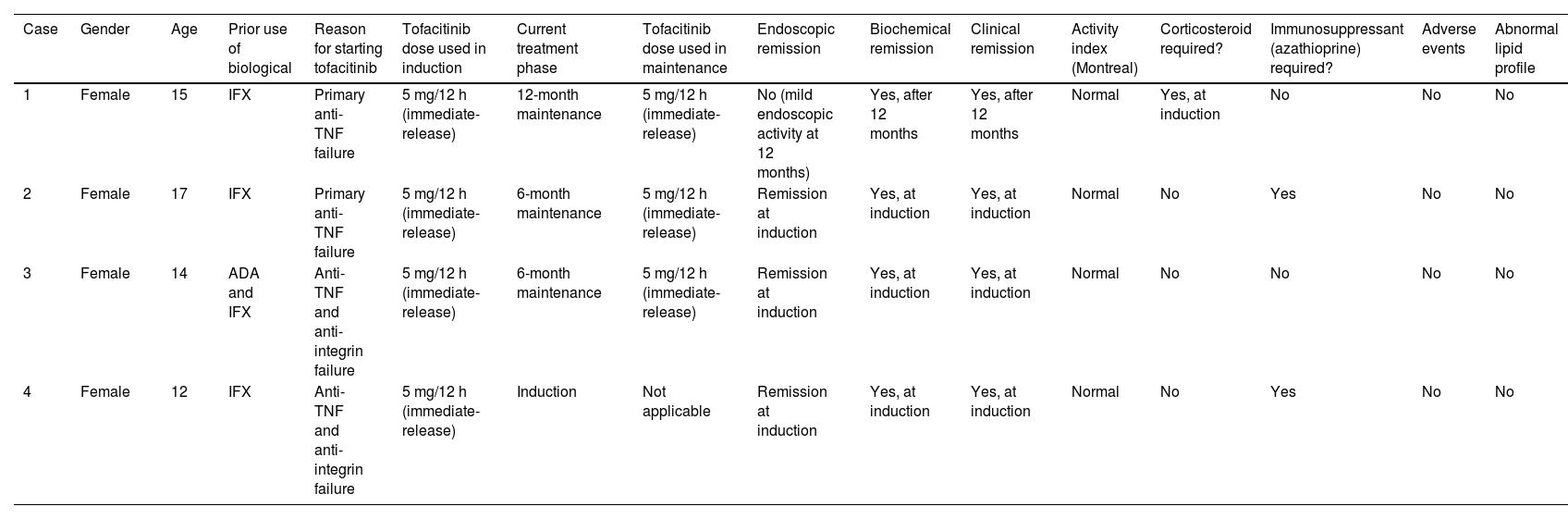
Overall effectivenessAfter the induction phase, three of the four patients achieved clinical, biochemical and endoscopic remission with PUCAI in remission and a UCEIS score of 0 or 1 point. Only in one case was clinical, biochemical and endoscopic remission not achieved, with PUCAI indicating severe activity and a UCEIS score of 7 points. Tables 2 and 3 show the results in the induction phase. In one case, the use of steroids was required during induction, but they were subsequently stopped. No cases of non-responders were documented.
Clinical and therapeutic characteristics, clinical outcomes and safety in patients with UC.
| Case | Gender | Age | Prior use of biological | Reason for starting tofacitinib | Tofacitinib dose used in induction | Current treatment phase | Tofacitinib dose used in maintenance | Endoscopic remission | Biochemical remission | Clinical remission | Activity index (Montreal) | Corticosteroid required? | Immunosuppressant (azathioprine) required? | Adverse events | Abnormal lipid profile |
|---|---|---|---|---|---|---|---|---|---|---|---|---|---|---|---|
| 1 | Female | 15 | IFX | Primary anti-TNF failure | 5 mg/12 h (immediate-release) | 12-month maintenance | 5 mg/12 h (immediate-release) | No (mild endoscopic activity at 12 months) | Yes, after 12 months | Yes, after 12 months | Normal | Yes, at induction | No | No | No |
| 2 | Female | 17 | IFX | Primary anti-TNF failure | 5 mg/12 h (immediate-release) | 6-month maintenance | 5 mg/12 h (immediate-release) | Remission at induction | Yes, at induction | Yes, at induction | Normal | No | Yes | No | No |
| 3 | Female | 14 | ADA and IFX | Anti-TNF and anti-integrin failure | 5 mg/12 h (immediate-release) | 6-month maintenance | 5 mg/12 h (immediate-release) | Remission at induction | Yes, at induction | Yes, at induction | Normal | No | No | No | No |
| 4 | Female | 12 | IFX | Anti-TNF and anti-integrin failure | 5 mg/12 h (immediate-release) | Induction | Not applicable | Remission at induction | Yes, at induction | Yes, at induction | Normal | No | Yes | No | No |
ADA: adalimumab; anti-TNF: tumour necrosis factor inhibitors; IFX: infliximab.
Summary of paraclinical test measures evaluated during the different treatment phases.
| Clinical and endoscopic follow-up | |||
|---|---|---|---|
| Patient | Induction (n = 4) | 26-week maintenance phase (n = 3) | 52-week maintenance phase (n = 1) |
| 1 | PUCAI severe; UCEIS 7 points | PUCAI mild activity; UCEIS 4 points | PUCAI remission; UCEIS 4 points |
| 2 | PUCAI remission; UCEIS 0 points | PUCAI remission; UCEIS 0 points | Not applicable |
| 3 | PUCAI remission; UCEIS 1 point | PUCAI remission; UCEIS 1 point | Not applicable |
| 4 | PUCAI remission; UCEIS 0 points | Not applicable | Not applicable |
| Patient | Biochemical parameters | ||
| 1 | CRP 2; ESR 10; haemoglobin 13.2; calprotectin 350 | CRP 6; ESR 10; haemoglobin 13; calprotectin 120 | CRP 1.2; ESR 5; haemoglobin 13.3; calprotectin 30 |
| 2 | CRP 1; ESR 5; haemoglobin 13.5; calprotectin 40 | CRP 1; ESR 5; haemoglobin 13.5; calprotectin 30 | Not applicable |
| 3 | CRP 1; ESR 5; haemoglobin 13.8; calprotectin 100 | CRP 1; ESR 5; haemoglobin 13.9; calprotectin 30 | Not applicable |
| 4 | CRP 0; ESR 5; haemoglobin 13.9; calprotectin 30 | Not applicable | Not applicable |
CRP: C-reactive protein; ESR: erythrocyte sedimentation rate; PUCAI: Pediatric Ulcerative Colitis Activity Index; UCEIS: Ulcerative Colitis Endoscopic Index of Severity.
Measurements used: calprotectin (μg/g); CRP (mg/l); ESR (mm/h); haemoglobin (g/dl).
During the 26-week maintenance phase, information was obtained from three patients. The two patients who went into remission at induction remained in clinical and biological remission, according to the PUCAI, and also endoscopic remission, with a UCEIS score of 0 or 1 point. Meanwhile, the patient who had not achieved remission at induction managed to achieve only mild activity according to the PUCAI score, as well as mild endoscopic activity, with a score of 4 points. Tables 2 and 3 show the results in the maintenance phase at 26 weeks.
Information was obtained from the maintenance phase at 52 weeks in one patient (Tables 2 and 3), reporting clinical and biochemical remission. However, mild endoscopic activity persisted with a UCEIS of 4 points.
Of the three patients for whom information was obtained in maintenance phases, none required the use of corticosteroids; two of the four required immunosuppressant therapy with azathioprine.
Withdrawal of tofacitinib was not required in any of the patients, and in all cases tofacitinib (immediate release) was used at a dose of 5 mg/12 h, both in induction and maintenance. None of the patients required hospital admission for IBD, or colectomy, during the treatment.
Safety profileNo adverse events were documented throughout the different phases of treatment in any of the four patients. None of the patients required permanent withdrawal of tofacitinib due to adverse events. No thromboembolic or cardiovascular events or leucopenia were reported. No cases of herpes zoster were reported.
Patient hospitalised with severe acute ulcerative colitisOne patient, a 15-year-old with a history of ulcerative colitis Paris E4S1 (Montreal S3), confirmed in May 2021, was initially on immunosuppressive therapy with intravenous steroids for five days, then changed to oral prednisone, azathioprine and oral and intra-rectal mesalazine, with relapse of the disease two days after switching to the oral route. She was then considered corticosteroid-resistant and management was started with infliximab biological therapy, achieving induction of remission with doses of 5 mg/kg/dose every four weeks, completing four doses, and then every eight weeks, completing 13 doses. Six months after diagnosis, the patient had an episode of severe acute UC, with a PUCAI of 85, Montreal S3, UCEIS 8. She had previously received infliximab, but irregularly, so on admission to hospital, she was given accelerated induction with infliximab at doses of 10 mg/kg (two doses in total) with no response, persisting with PUCAI 45, calprotectin 845 μg/g, Montreal S2, Mayo index 2 and UCEIS 7. As a result, she was started on tofacitinib, with induction at 5 mg BID, given that it was an "off-label" indication and that is the dose authorised in other therapeutic indications in the paediatric age group. Remission of symptoms was evident after a week, with PUCAI 0. It was decided to continue maintenance with 5 mg BID, and she showed sustained clinical and biochemical remission with mild endoscopic activity up to one year after the start of therapy.
DiscussionThis case series documents that tofacitinib is effective and safe in paediatric patients with moderate to severe UC. Characterisation of the paediatric population with IBD in Latin American countries has barely begun and the evidence regarding the use of tofacitinib in these patients is recent. The findings of this case series include meeting therapeutic goals with clinical and endoscopic remission at an early stage, showing tofacitinib to be an alternative to consider in this population.
The patients included in this case series consisted of adolescents with refractory disease, with a mean age in the final stages of their adolescence and close to the transition point of adult life (18 years). Most of them had shown no response to at least two biologicals, with failure to achieve steroid-free remission after a mean disease duration of less than two years before starting tofacitinib. All our patients had a previous history of hospital admission on at least one occasion prior to starting tofacitinib, and a mean PUCAI score above 20 points. These characteristics are consistent with previous observational studies in other regions,10–12 and are data to be considered in a population about whom we have limited information.
The efficacy and safety data with tofacitinib in paediatric patients were established through FDA approval of the drug in patients with juvenile idiopathic arthritis and psoriatic arthritis.20 In the specific indication of paediatric patients with moderate to severe UC, a phase 3 study that began in July 2021 is still ongoing and expected to be completed in August 2026.21 In this series of cases, data showing optimal therapeutic response are corroborated at induction and sustained clinical, biochemical and endoscopic remission during maintenance, steroid-free and without requiring colectomy. Despite the small number of subjects included, these results are similar to the study by Moore et al.11 in which at the end of a 12-week induction period, 9/21 subjects (42.9%) achieved clinical response and 7/21 (33.3%) remained steroid-free, while at the end of the 24-week maintenance period, 12/17 (70.6%) showed clinical response and 7/17 (41.2%) were steroid-free. This confirms the efficacy and safety in the short term, as well as in periods beyond induction and, compared to other observational studies, shows that patients were less refractory to immunosuppressive therapies.10,11
It should be noted that the treatment of UC in steroid-dependent paediatric patients includes alternatives such as thiopurines and biologicals, like infliximab, adalimumab, golimumab and vedolizumab.22 Although the patient sample was small compared to other studies, the subjects had previous exposure to biological therapy, representing more advanced phenotypes of the disease. The baseline PUCAI score indicated severe disease, and the biochemical and endoscopic parameters showed data for severe disease. Other clinical variables, such as the early age of onset and the extent of the disease, were indicative of a high risk of colectomy.23 To date, none of the patients in this case series have required colectomy, with a sustained response on maintenance and steroid-free. Being "off-label", it is a useful medication due to its rapid onset of action and rapid and sustained achievement of therapeutic goals, with encouraging results in a population sample of these characteristics.
Information about tofacitinib in paediatric patients with severe acute UC is very limited, so we have discussed outcomes in detail, describing the case of a hospitalised patient with severe acute UC after failure of accelerated induction with infliximab. These patients usually require additional therapies to decrease colectomy rates. In our patient, immediate-release tofacitinib was used after confirming the lack of effect of infliximab after therapeutic failure with corticosteroid therapy, administering a dose of 5 mg/12 h. These results are encouraging, and support the findings of the study by Constant et al.,12 which shows evidence of the benefit of tofacitinib in preventing colectomy among hospitalised patients with severe acute UC. Without tofacitinib, this patient would most likely have required a colectomy prior to hospital discharge, as she had not responded to intravenous corticosteroid and anti-TNF therapy when she was started on tofacitinib.
The recommended dose of tofacitinib in adults with moderate to severe UC is 10 mg twice a day (immediate-release), or 22 mg per day (extended-release) for eight to 16 weeks in induction, and 5 mg twice a day (immediate-release) or 11 mg (extended-release) every 24 h in maintenance.24 In our case series, immediate-release tofacitinib was used in all cases, both in induction and maintenance, at doses of 5 mg twice a day, with the patients remaining steroid-free and only two of the four requiring immunosuppression with thiopurine. These results are not in line with those of Moore et al.,11 who reported that 81% (17/21 subjects) received doses of 10 mg twice a day; in 5/17 cases (29.4%), the dose was reduced to 5 mg twice a day after induction and, of these, the majority (4/5 subjects) had to be escalated to 10 mg twice a day for recurrence of symptoms, with subsequent improvement and remaining at that dose up to 52 weeks. In our case series, lower-intensity doses were used, achieving optimal therapeutic goals in shorter periods of time. However, it should be mentioned that the number of subjects was limited, all with moderate/severe UC, with more advanced phenotypes of the disease and previous exposure to biological therapy. They are not therefore comparable to those of the Moore et al. study,11 which included subjects with Crohn's disease and indeterminate IBD, in addition to having an older median age at IBD diagnosis and a longer period between diagnosis and starting tofacitinib.
In terms of adverse events, clinical trials in adults suggest an increased risk of cardiovascular events, infections and elevated lipids.5,25 The risk of pulmonary embolism and death was also later reported in adults with comorbidities who received high doses of tofacitinib, as well as cardiovascular events and cancers, regardless of the dose.26 In our case series, no adverse events were documented. This could be due to the fact that they were young patients without other comorbidities, with access to and compliance with the nationally established vaccination plan for children and adolescents. These results are consistent with previous observational studies and case reports,8,9,11 which included patients with a dosage of 10 mg twice a day most of the time, with no reports of cases of thrombosis, clinically significant hyperlipidaemia or other adverse cardiovascular or oncological events. In adults, Deepak et al.27 reported a dose-dependent increased risk of herpes zoster infection and venous thromboembolism, and that the tofacitinib dose should be reduced to lower the clinical risk of these events. In the paediatric population, there are no conclusive data regarding the reduction of the administered dose of tofacitinib as a necessary measure to reduce the risk of adverse events, and the maintenance dose may be introduced from the beginning. All of the above suggests an acceptable safety profile in children and adolescents, which, compared to adults, may be more favourable. However, this needs to be clarified in studies that include larger cohorts of paediatric patients.
ConclusionsThis first case series describes the efficacy and safety of tofacitinib in moderate to severe UC in paediatric patients in Latin America, and its results are consistent with the literature. Our series shows that despite being an “off-label” drug, tofacitinib is an effective and safe alternative in the treatment of moderate/severe UC in paediatric patients. It is effective in patients with a history of biological use, with a high response rate in induction treatment that is sustained over time, and it is safe. Moreover, in the context of paediatric patients hospitalised with severe acute UC, the rapid onset of action of this medication and its potential role as rescue therapy must be taken into account, especially in patients with prior therapeutic failure to infliximab. Prospective studies with a larger number of subjects are required to better characterise its effectiveness in this population group.
Ethical approval and consent for participationThis research was reviewed and approved by the Independent Ethics Committee of each participating institution.
Ethical responsibilitiesThe requirements established in the Declaration of Helsinki, version 2013, in Fortaleza, Brazil, were taken into account for the research's design, as well as resolution 8430 of 1993 of the National Ministry of Health of Colombia, so it was considered to be research without risk, and confidentiality and preservation of the information collected was guaranteed. Informed consent was therefore not required.
FundingThe authors declare that they received no funding to conduct this study.
AuthorsVPI, JSFO, CC, MV, JVC, CRS and CFS contributed to all stages of the research (literature review, data collection and composition). All authors approved the final version of the manuscript.
Conflicts of interestThe authors declare that they have no conflicts of interest.


