


metricas
Gastroenterología y Hepatología (English Edition) De-escalating therapy in inflammatory bowel disease: Results from an observation...
Journal Information
Vol. 47. Issue 7.
Pages 673-792 (August - September 2024)
Cite
Cite
Share
Download PDF
More article options
Visits
1049
Vol. 47. Issue 7.
Pages 673-792 (August - September 2024)
Original article
Full text access

De-escalating therapy in inflammatory bowel disease: Results from an observational study in clinical practice

Desescalada terapéutica en la enfermedad inflamatoria intestinal: resultados de un estudio observacional en la práctica clínica
Visits
1049
Alex Arenasa,b,c, María José Moretad, Ingrid Ordása,d,e, Agnès Fernández-Cloteta,d,e, Berta Caballola,d,e, Marta Gallegoa,d, Alejandro Varaa,d, Rebeca Barasteguia,d, Angel Ginera,d, Cristina Prietoa,d, Maria Carme Masamunta,d,e, Roberto Candiaf, Elena Ricarta,d,e,
Corresponding author
ericart@clinic.cat

Corresponding author.
a Inflammatory Bowel Disease Unit, Hospital Clínic, Barcelona, Spain
b Complejo Asistencial Dr. Sótero del Río, Unidad de Gastroenterología, Santiago, Chile
c Facultad de Medicina Clínica Alemana-Universidad del Desarrollo, Gastroenterología, Santiago, Chile
d Gastroenterology Department, Hospital Clínic, Barcelona, Spain
e Institut d’Investigacions Biomèdiques Pi i Sunyer (IDIBAPS), Centro de Investigación Médica en Red (CIBER-EHD), Barcelona, Spain
f Departamento de Gastroenterología, Facultad de Medicina, Pontificia Universidad Católica de Chile, Chile
This item has received
Article information
Abstract
Full Text
Bibliography
Download PDF
Statistics
Figures (1)
fig0005
Tables (3)
Table 1. Baseline characteristics of the patients.
Tables
Table 2. Baseline characteristics of patients at the time of discontinuation.
Tables
Table 3. Factors associated with relapse after discontinuation of IMM or anti-TNF therapy in multivariate analysis.
Tables
Additional material (2)
Abstract
Background and objectives

Combination therapy with an immunomodulator (IMM) and an anti-TNF is commonly recommended in Crohn's disease (CD) and ulcerative colitis (UC) patients. However, little is known about relapse rates after therapeutic de-escalation. This study aimed to evaluate the risk of relapse in a cohort of UC and CD patients with long-standing clinical remission after discontinuation of IMM or anti-TNF and to identify predictive factors for relapse.

Methods

This retrospective study included patients with UC or CD on combination therapy and clinical remission for at least 6 months. IMM or anti-TNF was stopped upon physician decision. Primary objective was to evaluate the relapse rates after discontinuation of IMM or anti-TNF and to analyze predictors of relapse.

Results

The study included 88 patients, 48 patients (54.5%) discontinued IMM and 40 (45.5%) anti-TNF. During follow-up, relapse rates were 16.7% and 52.5% in the IMM discontinuation group and anti-TNF discontinuation group, respectively (p<0.001). Multivariate analysis showed that anti-TNF discontinuation (HR=3.01; 95% CI=1.22–7.43) and ileal CD location (HR=2.36; 95% CI=1.02–5.47) were predictive factors for relapse while inflammatory CD phenotype was a protective factor (HR=0.32; 95% CI=0.11–0.90). Reintroduction of anti-TNF upon relapse was effective and safe.

Conclusion

Anti-TNF discontinuation led to significantly higher relapse rates compared to IMM discontinuation in UC and CD patients on combination therapy. Anti-TNF discontinuation and ileal CD location were identified as predictive factors for relapse while inflammatory CD phenotype was a protective factor. Retreatment after anti-TNF discontinuation was effective and safe.

Keywords:
Crohn's disease
Ulcerative colitis
Inflammatory bowel disease
Discontinuation
Anti-TNF
Immunomodulators
Resumen
Antecedentes y objetivos

La terapia combinada de un inmunomodulador (IMM) y un anti-TNF se recomienda comúnmente en pacientes con enfermedad de Crohn (EC) y colitis ulcerosa (CU). Sin embargo, se sabe poco sobre las tasas de recaída después de la desescalada terapéutica. Este estudio tuvo como objetivo evaluar el riesgo de recaída en una cohorte de pacientes con CU y EC con remisión clínica prolongada después de la interrupción de IMM o anti-TNF, e identificar factores predictivos de recaída.

Métodos

Este estudio retrospectivo incluyó pacientes con CU o EC en terapia combinada y remisión clínica durante al menos 6 meses. El tratamiento con IMM o anti-TNF se detuvo por decisión del médico. El objetivo principal fue evaluar las tasas de recaída después de la interrupción de IMM o anti-TNF y analizar los predictores de recaída.

Resultados

El estudio incluyó 88 pacientes, 48 (54,5%) suspendieron IMM y 40 (45,5%) anti-TNF. Durante el seguimiento, las tasas de recaída fueron del 16,7 y el 52,5% en el grupo de suspensión de IMM y el grupo de suspensión de anti-TNF, respectivamente (p<0,001). El análisis multivariado mostró que la suspensión del anti-TNF (HR=3,01; IC 95%=1,22-7,43) y la localización de la EC en el íleon (HR=2,36; IC 95%=1,02-5,47) fueron factores predictores de recaída, mientras que el fenotipo inflamatorio de la EC fue un factor protector (HR=0,32; IC 95%=0,11-0,90). La reintroducción de anti-TNF tras la recaída fue eficaz y segura.

Conclusión

La interrupción del anti-TNF condujo a unas tasas de recaída significativamente más altas en comparación con la interrupción del IMM en pacientes con CU y EC en terapia combinada. La interrupción del anti-TNF y la localización ileal de la EC se identificaron como factores predictores de recaída, mientras que el fenotipo inflamatorio de la EC fue un factor protector. El retratamiento tras la suspensión del anti-TNF fue eficaz y seguro.


Palabras clave:
Enfermedad de Crohn
Colitis ulcerosa
Enfermedad inflamatoria intestinal
Discontinuación
Anti-TNF
Inmunomoduladores
Full Text
Introduction

Treatment with anti-tumor necrosis factor-α (anti-TNF) agents has demonstrated efficacy in the induction and remission of inflammatory bowel disease (IBD), including ulcerative colitis (UC) and Crohn's disease (CD).1–3 Combination therapy with an immunomodulator (IMM) and an anti-TNF agent (especially infliximab) is recommended in CD and UC patients to improve efficacy and reduce anti-TNF immunogenicity. While the combination of adalimumab and IMM is controversial, American guidelines suggest its use.4–7 Clinicians and patients should consider the associated costs and adverse effects of combination therapy. In a cohort study by Lemaitre et al. long-term exposure to monotherapy with thiopurines and anti-TNF was associated with a small risk of developing lymphoma. However, the risk was higher in patients exposed to combination therapy compared to those exposed to thiopurines or anti-TNF monotherapy.8 Additionally, prolonged use of thiopurines has been associated with an increased risk of non-melanoma skin cancer and cancer of the urinary tract.9 Although the safety of immunomodulator therapies is a critical issue for clinicians and patients, the risk must be balanced against the detrimental effects of IBD relapse.

A meta-analysis by Boyapati et al. suggested that discontinuation of azathioprine from combination therapy may not lead to a difference in relapse rates compared to continuation of combination therapy in patients with quiescent Crohn's disease (CD).10 In the open randomized controlled trial DIAMOND 2, withdrawal of thiopurines in CD patients on combination therapy with adalimumab in clinical remission without steroids for at least 6 months did not result in clinical or endoscopic differences in comparison with the group with combination therapy at 52 follow-up weeks.11 However, limited evidence exists regarding withdrawal of anti-TNF from combination therapy with evidence only available when used in combination with an IMM. In the STORI trial, CD patients treated for at least 1 year with infliximab and an IMM had a relapse rate of 43.9% at 12 months and 52.2% at 24 months when they stopped infliximab.12 After a follow-up of 7 years only 21.6% of patients were in remission.13 More recently, the SPARE study, a multicenter, open-label, randomized controlled trial included 207 patients with CD in steroid-free clinical remission for more than 6 months, on combination therapy with infliximab and immunomodulator therapy for at least 8 months who were randomly assigned to either continue combination therapy, discontinue infliximab, or discontinue immunomodulator therapy. At 2 years, a significantly higher relapse rate in the infliximab-discontinuation group (36%) was observed compared to the immunomodulator discontinuation group (10%) (p=0.0004).14 In addition, a number of studies assessing the risk of relapse after anti-TNF discontinuation in clinical practice have been published.15–19 The aim of this study was to assess the risk of relapse in a cohort of UC and CD patients with long-standing remission after discontinuation of IMM or anti-TNF and to identify predictive factor for relapse.

MethodsStudy design and patients

This is a retrospective unicentric study that included patients with UC and CD on combination therapy with an immunomodulator (thiopurines or methotrexate) and an anti-TNF (either infliximab or adalimumab). All included patients received standard induction therapy with anti-TNF (infliximab 5mg/kg at weeks 0-2-6; adalimumab 160mg at week 0, 80mg at week 2). Patients were on clinical remission for a minimum of 6 months while receiving stable doses of anti-TNF (infliximab 5mg/kg every 8 weeks or adalimumab 40mg every two weeks) and IMMs (azathioprine 2mg/kg, 6-mercaptopurine 1.5mg/kg, methotrexate 15mg subcutaneously or intramuscularly every week). The decision to discontinue either the IMM or anti-TNF medication was taken by the treating physician. Data were collected until relapse occurred or until last follow-up.

Patients who discontinued combination therapy due to an adverse event and/or due to secondary loss of response were excluded from the study. Other exclusion criteria included: use of corticosteroids within 6 months before withdrawal, intensification of anti-TNF or IMM dose increments before discontinuation, ostomy, ileo-anal pouch, perianal disease, or pregnancy. The analysis considered only patients on the first combination therapy and the initial attempt to discontinue the anti-TNF or IMM medication. After discontinuation of either the anti-TNF or IMM, patients were required to continue with the other drug of the combination therapy.

Data collection and definitions

All data were obtained from medical records. The collected data included demographic information, CD phenotype, UC disease extent, disease duration, smoking habit, previous IBD medical treatments and previous disease-related surgery. Biochemical, endoscopic, and radiological data were collected at the time of discontinuation of the anti-TNF or IMM. Results of endoscopy and/or magnetic resonance imaging (MRI) performed within six months prior to de-escalation were included when available. Biomarkers were collected up to 30 days before withdrawal. Relapse was defined as the onset of clinical, biological, endoscopic, or radiological activity, leading to therapeutic intervention, both pharmacological (including intensification) or surgical.

Clinical remission was defined as a partial Mayo score of ≤2 points in patients with UC20 and a Harvey–Bradshaw index of ≤4 points in CD patients.21 Endoscopic remission was defined by absence of ulcers or strictures in CD patients, and by an endoscopic Mayo index subscore of 0–1 for UC patients.20 Radiological remission in CD patients was defined as the absence of inflammatory findings without disease-related complications (stenosis, fistula and/or abscesses).

Statistical analysis

Descriptive statistics and the Kolmogorov–Smirnov test to check for normal distribution of study variables were used. For continuous variables, medians with interquartile ranges (IQR) and the Mann–Whitney U test to determine significance were used, while categorical variables were analyzed using Chi-square tests. A p-value of <0.05 was considered statistically significant. Kaplan–Meier curves were plotted to represent survival without relapse and used log-rank tests for analysis.

To identify predictive factors of relapse, a Cox proportional hazards model was applied. Variables with a univariate analysis p-value<0.10 were included in the multivariate analysis (p<0.05). Results were reported as hazard ratios (HRs) with 95% confidence intervals (CIs). All statistical analyses were performed by using IBM SPSS package version 29.

ResultsStudy population

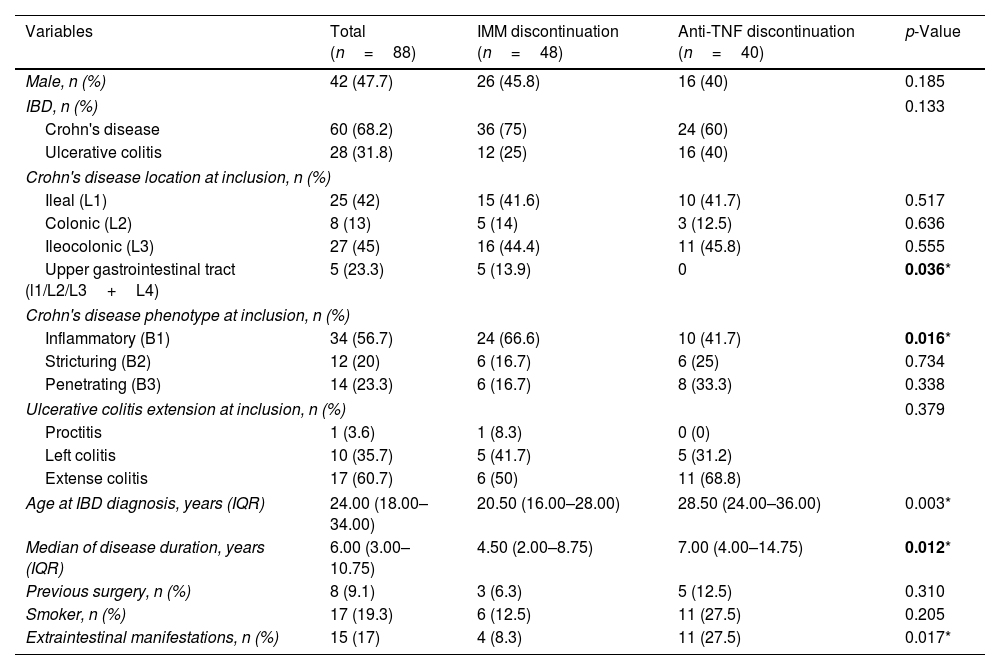
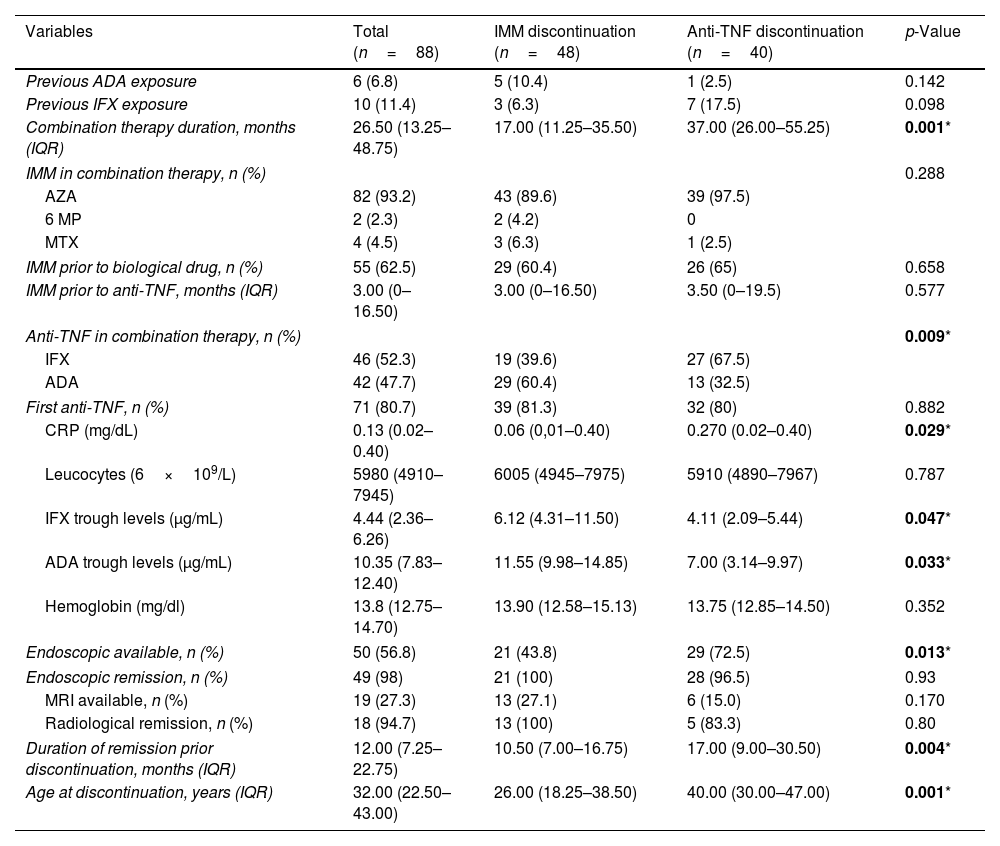
The study included 88 patients, 60 CD patients (68.2%) and 28 UC patients (31.8%). Median age at IBD diagnosis was 24 years (IQR 18–34) and median disease duration was 6 years (IQR 3–10.75). Fifty-five patients (62.5%) were already on IMM prior to initiating anti-TNF therapy whereas 33 patients (37.5%) were started on IMM and anti-TNF simultaneously. Combination therapy included thiopurines (95.5%) and methotrexate (4.5%) as IMM, and infliximab (52.3%) and adalimumab (47.7%) as anti-TNF. Most of the patients (80.7%) included in the study were on their first anti-TNF. At the time of de-escalation, 19.3% of patients were smokers. Demographic data and clinical characteristics are shown in Tables 1 and 2, respectively.

Table 1.

Baseline characteristics of the patients.

Variables  Total (n=88)  IMM discontinuation (n=48)  Anti-TNF discontinuation (n=40)  p-Value 
Male, n (%)  42 (47.7)  26 (45.8)  16 (40)  0.185 
IBD, n (%)0.133 
Crohn's disease  60 (68.2)  36 (75)  24 (60)   
Ulcerative colitis  28 (31.8)  12 (25)  16 (40)   
Crohn's disease location at inclusion, n (%)
Ileal (L1)  25 (42)  15 (41.6)  10 (41.7)  0.517 
Colonic (L2)  8 (13)  5 (14)  3 (12.5)  0.636 
Ileocolonic (L3)  27 (45)  16 (44.4)  11 (45.8)  0.555 
Upper gastrointestinal tract (l1/L2/L3+L4)  5 (23.3)  5 (13.9)  0.036* 
Crohn's disease phenotype at inclusion, n (%)
Inflammatory (B1)  34 (56.7)  24 (66.6)  10 (41.7)  0.016* 
Stricturing (B2)  12 (20)  6 (16.7)  6 (25)  0.734 
Penetrating (B3)  14 (23.3)  6 (16.7)  8 (33.3)  0.338 
Ulcerative colitis extension at inclusion, n (%)0.379 
Proctitis  1 (3.6)  1 (8.3)  0 (0)   
Left colitis  10 (35.7)  5 (41.7)  5 (31.2)   
Extense colitis  17 (60.7)  6 (50)  11 (68.8)   
Age at IBD diagnosis, years (IQR)  24.00 (18.00–34.00)  20.50 (16.00–28.00)  28.50 (24.00–36.00)  0.003* 
Median of disease duration, years (IQR)  6.00 (3.00–10.75)  4.50 (2.00–8.75)  7.00 (4.00–14.75)  0.012* 
Previous surgery, n (%)  8 (9.1)  3 (6.3)  5 (12.5)  0.310 
Smoker, n (%)  17 (19.3)  6 (12.5)  11 (27.5)  0.205 
Extraintestinal manifestations, n (%)  15 (17)  4 (8.3)  11 (27.5)  0.017* 

IBD, inflammatory bowel disease.

*

Significant at p<0.05.

Table 2.

Baseline characteristics of patients at the time of discontinuation.

Variables  Total (n=88)  IMM discontinuation (n=48)  Anti-TNF discontinuation (n=40)  p-Value 
Previous ADA exposure  6 (6.8)  5 (10.4)  1 (2.5)  0.142 
Previous IFX exposure  10 (11.4)  3 (6.3)  7 (17.5)  0.098 
Combination therapy duration, months (IQR)  26.50 (13.25–48.75)  17.00 (11.25–35.50)  37.00 (26.00–55.25)  0.001* 
IMM in combination therapy, n (%)0.288 
AZA  82 (93.2)  43 (89.6)  39 (97.5)   
6 MP  2 (2.3)  2 (4.2)   
MTX  4 (4.5)  3 (6.3)  1 (2.5)   
IMM prior to biological drug, n (%)  55 (62.5)  29 (60.4)  26 (65)  0.658 
IMM prior to anti-TNF, months (IQR)  3.00 (0–16.50)  3.00 (0–16.50)  3.50 (0–19.5)  0.577 
Anti-TNF in combination therapy, n (%)0.009* 
IFX  46 (52.3)  19 (39.6)  27 (67.5)   
ADA  42 (47.7)  29 (60.4)  13 (32.5)   
First anti-TNF, n (%)  71 (80.7)  39 (81.3)  32 (80)  0.882 
CRP (mg/dL)  0.13 (0.02–0.40)  0.06 (0,01–0.40)  0.270 (0.02–0.40)  0.029* 
Leucocytes (6×10⁹/L)  5980 (4910–7945)  6005 (4945–7975)  5910 (4890–7967)  0.787 
IFX trough levels (μg/mL)  4.44 (2.36–6.26)  6.12 (4.31–11.50)  4.11 (2.09–5.44)  0.047* 
ADA trough levels (μg/mL)  10.35 (7.83–12.40)  11.55 (9.98–14.85)  7.00 (3.14–9.97)  0.033* 
Hemoglobin (mg/dl)  13.8 (12.75–14.70)  13.90 (12.58–15.13)  13.75 (12.85–14.50)  0.352 
Endoscopic available, n (%)  50 (56.8)  21 (43.8)  29 (72.5)  0.013* 
Endoscopic remission, n (%)  49 (98)  21 (100)  28 (96.5)  0.93 
MRI available, n (%)  19 (27.3)  13 (27.1)  6 (15.0)  0.170 
Radiological remission, n (%)  18 (94.7)  13 (100)  5 (83.3)  0.80 
Duration of remission prior discontinuation, months (IQR)  12.00 (7.25–22.75)  10.50 (7.00–16.75)  17.00 (9.00–30.50)  0.004* 
Age at discontinuation, years (IQR)  32.00 (22.50–43.00)  26.00 (18.25–38.50)  40.00 (30.00–47.00)  0.001* 

IMM, immunomodulator; ADA, adalimumab; IFX, infliximab; anti-TNF, anti-tumor necrosis factor; MTX, methotrexate; AZA, azathioprine; 6 MP, 6 mercaptopurine; CRP, C-reactive protein; MRI, magnetic resonance imaging.

*

Significant at p<0.05.

Out of the 88 patients included in the study, 48 (54.5%) discontinued IMM and 40 (45.5%) anti-TNF. The anti-TNF discontinuation group had a longer disease duration [4.50 years (IQR 2.00–8.75)] versus 7 years (IQR 4.00–14.75) (p=0.012), a longer duration of combination therapy [17.00 months (IQR 11.25–35.50)] versus 37 months (IQR 26.00–55.25) (p=0.001), and a longer time on remission [10.50 months (IQR 7.00–16.75)] versus 17 months (IQR 9.00–30.50) (p=0.004), compared to the IMM discontinuation group, respectively. Additionally, the anti-TNF discontinuation group had a higher age at IBD diagnosis [28.50 years (IQR 24.00–36.00)] versus 20.50 years (IQR 16.00–28.00) (p=0.003) and a lower age at discontinuation [26 years (IQR 18.25–38.50)] versus 40 years (IQR 30–47) (p=0.001) compared to the IMM discontinuation group. Among the 88 patients, endoscopic and radiological data showing remission, as previously defined, were available in 50 (56.8%) and 19 (27.3%), respectively.

Relapse rates after de-escalation

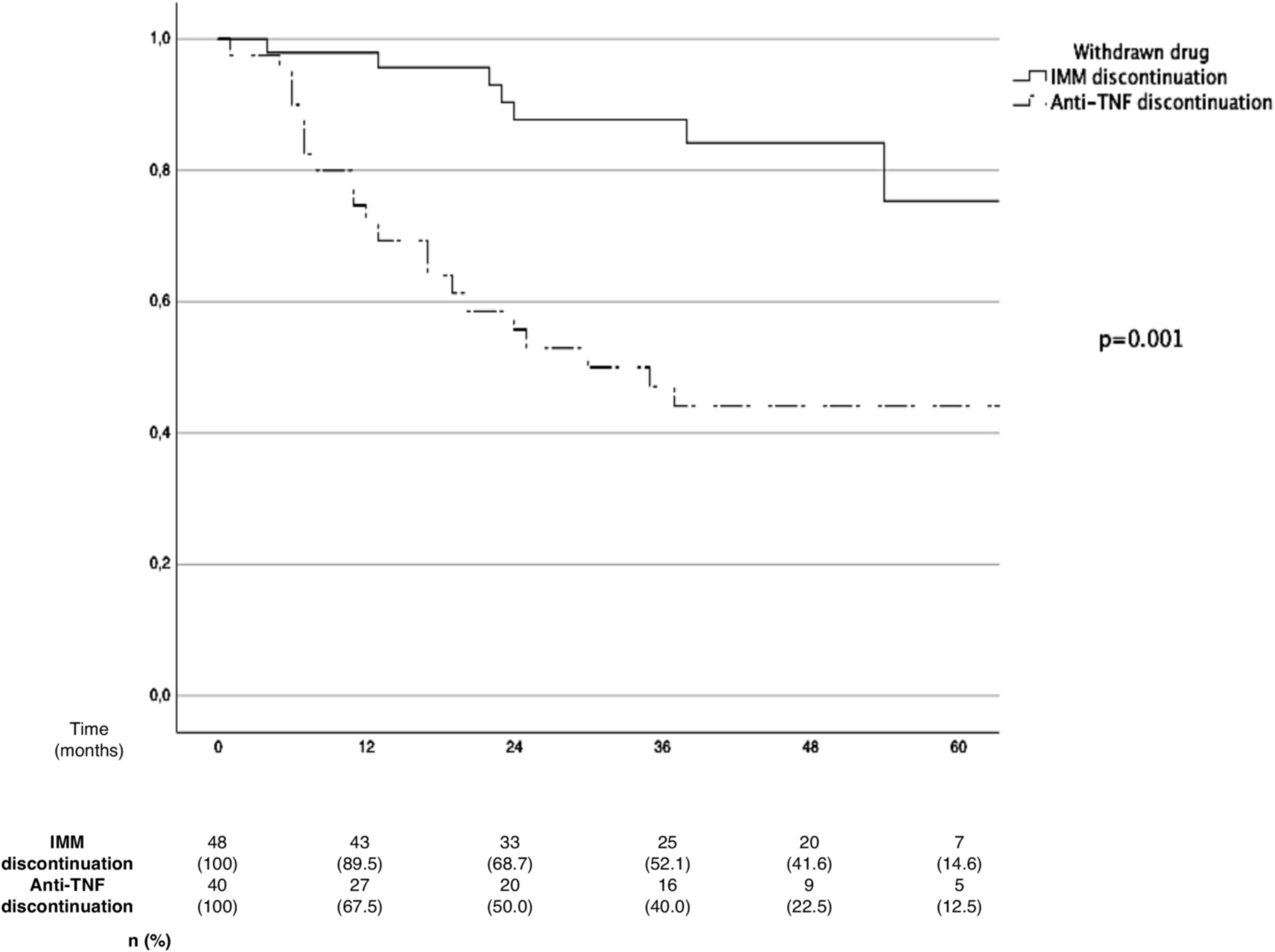
Patients were followed-up for a median of 33 months (IQR 18.00–55.75). During follow-up, the relapse rate was 16.7% (8/48) in the IMM discontinuation group and 52.5% (21/40) in the anti-TNF discontinuation group (p=0.001). According to diagnosis, relapse rates were 42.9% (12/28) in UC and 28.3% (17/60) in CD, respectively (p=0.346). The difference in the proportion of patients who had a relapse was more pronounced at one year and gradually closed by the fifth year. The median time without relapse after de-escalation was significantly longer in the IMM discontinuation group [38.50 months (IQR 19.75–58.5)] compared to the anti-TNF discontinuation group [24.50 months (IQR 10.25–42.75)] (p=0.036) (Fig. 1).

Figure 1.

Kaplan–Meier curves showing the probability of survival without relapse after immunomodulator (IMM) or anti-tumor necrosis factor (anti-TNF) discontinuation in IBD patients on combination therapy.

Predictors of relapse

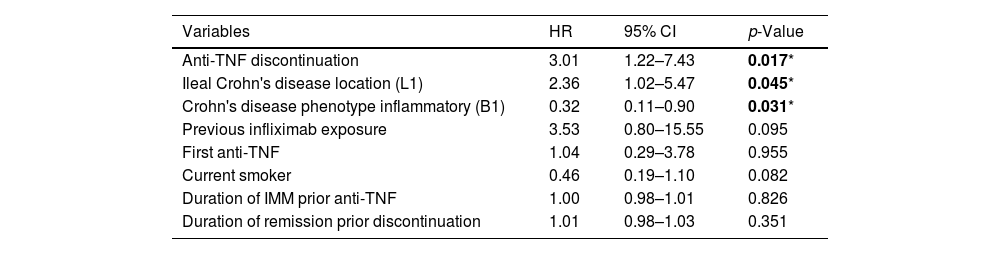
In the univariate analysis, anti-TNF discontinuation, ileal CD location, previous infliximab exposure, time on IMM prior to anti-TNF therapy, and time in remission prior to de-escalation were associated with an increased risk of relapse. On the contrary, inflammatory CD phenotype, current smoker status, and first anti-TNF therapy were found to be protective factors for relapse. No significant differences were observed in CD compared to UC, gender, age at IBD diagnosis, previous surgery, extraintestinal manifestations, UC extension, previous adalimumab exposure, previous use of thiopurines, time on combination therapy, type of anti-TNF and IMM, biomarkers, infliximab or adalimumab trough levels prior to withdrawal, endoscopic or radiological available/remission, or age at discontinuation (Supplementary material 1). In the multivariate analysis, anti-TNF discontinuation (HR=3.01; 95% CI=1.22–7.43) and ileal CD location (HR=2.36; 95% CI=1.02–5.47) were predictive factors for relapse while inflammatory CD phenotype was associated with a lower risk of relapse (HR=0.32; 95% CI=0.11–0.90). Previous infliximab exposure, first anti-TNF, current smoking habit, time on IMM prior anti-TNF initiation and time in remission prior discontinuation had no impact on the risk of relapse (Table 3).

Table 3.

Factors associated with relapse after discontinuation of IMM or anti-TNF therapy in multivariate analysis.

Variables  HR  95% CI  p-Value 
Anti-TNF discontinuation  3.01  1.22–7.43  0.017* 
Ileal Crohn's disease location (L1)  2.36  1.02–5.47  0.045* 
Crohn's disease phenotype inflammatory (B1)  0.32  0.11–0.90  0.031* 
Previous infliximab exposure  3.53  0.80–15.55  0.095 
First anti-TNF  1.04  0.29–3.78  0.955 
Current smoker  0.46  0.19–1.10  0.082 
Duration of IMM prior anti-TNF  1.00  0.98–1.01  0.826 
Duration of remission prior discontinuation  1.01  0.98–1.03  0.351 

IMM, immunomodulator; anti-tumor necrosis factor.

*

Significant at p<0.05.

Among those patients who relapsed after anti-TNF discontinuation, 78.6% (11/14) achieved clinical remission after reintroduction of the drug. In all patients, clinical response was observed early and none experienced adverse events. Among the 8 patients who relapsed after IMM discontinuation, anti-TNF dose intensification was necessary in 6 patients, with clinical remission achieved in 3 patients. Regarding other biologics, they were used in 3 patients after relapse, including 2 patients who started ustekinumab in the IMM discontinuation group and 1 patient who was put on vedolizumab in the anti-TNF discontinuation group. All of them presented successful outcomes.

Discussion

In this observational study, we investigated the risk of relapse in IBD patients in long-standing remission who discontinued either IMM or anti-TNF therapy while on combination therapy. Our findings demonstrated a significantly higher relapse rate in the anti-TNF discontinuation group (52.5%) compared to the IMM discontinuation group (16.7%). These results are consistent with previous studies reporting similar relapse rates after anti-TNF discontinuation.16–19 Casanova et al. described the largest series of patients from real clinical practice published to date (n=1055) in a multicenter retrospective study showing a cumulative relapse of 44% (95% CI: 41–46) after anti-TNF discontinuation.19 Similarly, an observational cohort study by Bots et al. including 101 patients, reported 55% of relapse after anti-TNF discontinuation with a median time to relapse of 32 months in CD and 18 months in UC patients.17 On the other hand, our study reported a low relapse rate (16.7%) after IMM discontinuation, which is also consistent with the findings of previous studies. A recent retrospective cohort study showed that IMM withdrawal from combination therapy did not increase the relapse rate up to 2 years of follow-up.22,23 Moreover, a systematic review and meta-analysis by Dohos et al. showed that IMM discontinuation did not increase the risk of relapse compared to the continuation of combo therapy (RR=1.30, 95% CI: 0.81–2.08).24 Our results are comparable with those from the SPARE study that aimed to evaluate the effectiveness and safety of stopping infliximab treatment after achieving sustained remission in patients with CD.14 The study included 207 patients with CD who had been in remission on infliximab and an immunosuppressant for at least one year. The results of the study showed that stopping infliximab treatment after achieving sustained remission led to a significantly higher relapse rate compared to patients who continued infliximab treatment. Specifically, 36% of patients in the infliximab-discontinuation group experienced relapse within 2 years, compared to 10% in the immunosuppressant discontinuation group and 12% in the group that continued combination therapy. Similar results were observed in a multicenter, randomized, double-blind, placebo-controlled withdrawal study of infliximab in CD patients who were in deep remission after infliximab maintenance therapy for at least 1 year. At week 48, relapse-free survival was 51% in the infliximab-discontinuation group.25 In addition, a recently published European Crohn's and Colitis Organisation (ECCO) Topical Review stated that the risk of relapse after anti-TNF discontinuation in CD patients who were in sustained remission (>6 months), was 40% at 1 year, and 50% at 2 years.26 So far, although a trend toward a higher frequency of relapse when anti-TNF is discontinued compared to IMM discontinuation, a randomized clinical trial of GETECCU (EXIT) showed conflicting results.27 In this study, 140 patients with CD or UC in clinical remission for >6 months and endoscopic/radiologic remission (within 3 months of inclusion) were randomized to maintain anti-TNF (maintenance arm) or to withdraw it (withdrawal arm). At one year, clinical remission was 84% and 76%, respectively (p-value not statistically significant) suggesting that anti-TNF discontinuation might be feasible and safe in selected IBD patients.

There is conflicting data regarding risk factors for relapse in IBD patients on combo therapy who discontinue anti-TNF. The prospective STORI trial included 115 patients with CD who were treated for at least 1 year with scheduled infliximab and an antimetabolite with corticosteroid-free remission for at least 6 months. Infliximab was stopped, and patients were followed-up for at least 1 year. In this study, male gender, absence of surgical resection, leukocyte counts6.0×109/L, hemoglobin145g/L, CRP5.0mg/L and fecal calprotectin 300g/g were identified as risk factors for relapse in the multivariable analysis. In this study, a predictive risk model was developed showing that patients with no more than 2 of the above risk factors had a 15% risk of relapse within 1 year.12 In a review on treatment withdrawal by Doherty et al., elevated markers of disease activity, disease extent and localization (perianal disease and ileocolonic in CD; extensive disease in UC), and complicated disease (previous stricture/fistula in CD) were identified as predictive factors for relapse.28 Other studies have confirmed a higher risk of relapse in patients with complicated (stricturing–penetrating) CD phenotype.29 There is also conflicting evidence regarding the specific location of CD as a risk factor for relapse. Brooks et al. found that ileocolonic involvement was a risk factor in their prospective observational study,30 Casanova et al. reported a higher risk of relapse in CD patients with colonic location,19 while Torres et al. identified ileal, jejunal, or ileocolonic disease location as predictive factors for relapse in their systematic review.31 The ECCO Topical Review establishes that data on predictors of relapse after biological treatment discontinuation is heterogeneous but that signs of any residual disease activity may be a predictor of relapse. Other risk factors such as perianal disease, stricturing phenotype, smoking and intestinal resection should be taken also into consideration before taking clinical decisions.26 In our study, anti-TNF discontinuation and ileal CD location were predictive factors for relapse, while inflammatory CD phenotype was a protective factor. It is worth noting that in our cohort, 64% of the patients with ileal CD location had a complicated phenotype. In addition, it should be stated that patients with perianal fistulizing disease were excluded from the study since treating physician considered these patients not suitable for de-escalating therapy.

Gisbert et al. conducted a meta-analysis of 27 studies which showed that achieving clinical and endoscopic remission before discontinuation of anti-TNF significantly decreased the risk of relapse from 42% to 26%, in both CD and UC patients.32 This suggests that mucosal healing should be objectively documented before considering de-escalating therapy. However, in a multicentre, open-label, randomized controlled trial (HAYABUSA) that included UC patients in clinical and endoscopic remission, a Nancy index of less than 2 was significantly associated with no relapse after discontinuing infliximab. This suggests that endoscopic remission alone may not be sufficient, and histology could play a role in predicting relapse of UC upon anti-TNF discontinuation. Additionally, Kobayashi et al. identified elevated CRP as a predictive factor for relapse in patients who discontinued infliximab.33 In our study, endoscopic data were available in 56.8% of patients. All patients fulfilled the definition of endoscopic remission (absence of ulcers or strictures in CD patients, and endoscopic Mayo index subscore of 0–1 for UC patients) with no significant differences between the IMM and anti-TNF discontinuation groups. Histology analysis was not included since data were not systematically available in the medical records.

There is still no clear consensus on the ideal duration of combination therapy before de-escalation in long-standing remission patients. Previous trials and retrospective studies have suggested an average of 6–12 months on combination therapy and at least 6 months of corticosteroid-free clinical remission before considering de-escalation.12,19,25,28 In this study, we included patients with sustained clinical remission for at least 6 months with a median time on combination therapy of 26.50 months (IQR 13.25–48.75). Retreatment is an important consideration when de-escalating therapy, particularly regarding the choice of treatment and the likelihood of success. In this study, we observed a high remission rate and no safety concerns when reintroducing anti-TNF therapy upon relapse. This is consistent with previous prospective studies that have reported successful outcomes with the reintroduction of anti-TNF therapy.12,33,34 A meta-analysis conducted by Gisbert et al. also found a high rate of remission (80%, 95% CI 68–91, p<0.00001) with the reintroduction of the same anti-TNF therapy, with no significant differences between CD and UC patients.32 In the SPARE study most patients who experienced relapse after infliximab withdrawal rapidly responded to retreatment and maintained remission over 2 years.14 These data support the concept that the reintroduction of anti-TNF therapy is a viable option for retreatment as a first-line option in de-escalation strategies. However, further research is needed to determine the optimal timing and duration of treatment for de-escalation, as well as the most effective retreatment strategies for patients who experience relapse after de-escalation.

Our study has several limitations that need to be addressed. Firstly, the retrospective design and the variability in de-escalation decisions made by individual clinicians based on their own clinical judgment may have introduced bias into the study. In addition, assessment of clinical, endoscopic, and radiological activities was conducted retrospectively through a review of medical records. While most patients had clinical and biochemical information available, only half of them underwent endoscopic examination and only one-third had radiological imaging at discontinuation, which may have impacted the assessment of mucosal healing and radiological remission as predictors of low risk of relapse. Furthermore, the limited availability of fecal calprotectin, which is increasingly recommended for follow-up after withdrawal, is another aspect that needs to be considered.22 Another limitation is the small sample size and the higher proportion of CD patients, which may affect the identification of predictive factors of relapse. Furthermore, due to the low proportion of patients on methotrexate, we could not assess its influence on outcomes. However, one of the strengths of our study is that it reflects a real-world clinical setting, providing valuable information for clinical practice.

Conclusion

In summary, this retrospective study found that discontinuation of anti-TNF therapy in patients with CD and UC and long-standing remission on combination therapy with immunomodulators and anti-TNF had a significantly higher risk of relapse compared to discontinuation of immunomodulators. The study also identified anti-TNF discontinuation and ileal Crohn's disease location as predictive factors for relapse, while inflammatory CD phenotype was found to be a protective factor. Additionally, the study found that retreatment after anti-TNF discontinuation was effective and safe. The retrospective nature of the study, limited number of subjects, and incomplete availability of endoscopic and radiological data are important limitations to consider. Further studies are needed to better understand the clinical scenarios in IBD where discontinuation of anti-TNF therapy is safe and effective.

Authors’ contributions

A.A. contributed to conceptualization, collection of data, methodology, statistical analysis and writing. M.J.M. contributed to collection of data and review of the manuscript. I.O., A.F.-C., B.C., M.G., A.V., R.B., A.G., C.P. and M.C.M. contributed to methodology and review of the manuscript. E.R. contributed to conceptualization, methodology, supervision, and review of final manuscript.

Ethical considerations

The study was approved by the Ethics Committee for Drug Research of the Hospital Clínic from Barcelona and was performed following the European Medicines Agency good clinical practice guidelines. The ethical precepts formulated in the Declaration of Helsinki of the World Medical Association on ethical principles for medical research in humans and in its subsequent revisions are complied. The study has been performed in accordance with the STROBE recommendations for this type of studies (Supplementary material 2).

Funding

No funding has been received for this study.

Conflicts of interest

E. Ricart has provided scientific advice, participated in medical meetings, received research funding, received payment for presentations and advice from: MSD, Schering-Plough, Ferring, Abbvie, Takeda, Janssen, Fresenius Kabi, Pfizer, Kern Pharma.

B. Caballol has received payment for presentations from Kern Pharma.

I. Ordás has served as speaker and/or consultant for MSD, Abbvie, Pfizer, Takeda, Janssen, Faes Farma and Chiesi, and has received research funding from Abbvie and Faes Farma.

A. Fernández-Clotet has served as speaker, or has received educational funding for Dr. Falk, Janssen, Takeda, Chiesi and Pfizer.

Acknowledgments

The authors would like to thank the IBD team of Hospital Clínic, Barcelona.

Appendix A
Supplementary data

The following are the supplementary data to this article:

Supplementary data is available at Inflammatory Bowel Diseases online.

Icono mmc1.doc
Icono mmc2.pdf

References
[1]
S.B. Hanauer, B.G. Feagan, G.R. Lichtenstein, L.F. Mayer, S. Schreiber, J.F. Colombel, et al.
Maintenance infliximab for Crohn's disease: the ACCENT I randomised trial.
Lancet, 359 (2002), pp. 1541-1549
[2]
B.E. Sands, F.H. Anderson, C.N. Bernstein, W.Y. Chey, B.G. Feagan, R.N. Fedorak, et al.
Infliximab maintenance therapy for fistulizing Crohn's disease.
N Engl J Med, 350 (2004), pp. 876-885
[3]
P. Rutgeerts, W.J. Sandborn, B.G. Feagan, W. Reinisch, A. Olson, J. Johanns, et al.
Infliximab for induction and maintenance therapy for ulcerative colitis.
N Engl J Med, 353 (2005), pp. 2462-2476
[4]
J.F. Colombel, W.J. Sandborn, W. Reinisch, G.J. Mantzaris, A. Kornbluth, D. Rachmilewitz, et al.
Infliximab, azathioprine, or combination therapy for Crohn's disease.
N Engl J Med, 362 (2010), pp. 1383-1395
[5]
J.D. Feuerstein, K.L. Isaacs, Y. Schneider, S.M. Siddique, Y. Falck-Ytter, S. Singh.
AGA clinical practice guidelines on the management of moderate to severe ulcerative colitis.
Gastroenterology, 158 (2020), pp. 1450-1461
[6]
J. Torres, S. Bonovas, G. Doherty, T. Kucharzik, J.P. Gisbert, T. Raine, et al.
ECCO guidelines on therapeutics in Crohn's disease: medical treatment.
J Crohns Colitis, 14 (2020), pp. 4-22
[7]
T. Raine, S. Bonovas, J. Burisch, T. Kucharzik, M. Adamina, V. Annese, et al.
ECCO guidelines on therapeutics in ulcerative colitis: medical treatment.
J Crohns Colitis, 16 (2022), pp. 2-17
[8]
M. Lemaitre, J. Kirchgesner, A. Rudnichi, F. Carrat, M. Zureik, F. Carbonnel, et al.
Association between use of thiopurines or tumor necrosis factor antagonists alone or in combination and risk of lymphoma in patients with inflammatory bowel disease.
[9]
J.W. Hagen, M.A. Pugliano-Mauro.
Nonmelanoma skin cancer risk in patients with inflammatory bowel disease undergoing thiopurine therapy: a systematic review of the literature.
Dermatol Surg, 44 (2018), pp. 469-480
[10]
R.K. Boyapati, J. Torres, C. Palmela, C.E. Parker, O.M. Silverberg, S.D. Upadhyaya, et al.
Withdrawal of immunosuppressant or biologic therapy for patients with quiescent Crohn's disease.
Cochrane Database Syst Rev, 5 (2018), pp. CD012540
[11]
T. Matsumoto, S. Motoya, K. Watanabe, T. Hisamatsu, H. Nakase, N. Yoshimura, et al.
Adalimumab monotherapy and a combination with azathioprine for crohn's disease: a prospective, randomized trial.
J Crohns Colitis, 10 (2016), pp. 1259-1266
[12]
E. Louis, J.Y. Mary, G. Vernier-Massouille, J.C. Grimaud, Y. Bouhnik, D. Laharie, et al.
Maintenance of remission among patients with Crohn's disease on antimetabolite therapy after infliximab therapy is stopped.
Gastroenterology, 142 (2012), pp. 63-70.e5
[13]
C. Reenaers, J.Y. Mary, M. Nachury, Y. Bouhnik, D. Laharie, M. Allez, et al.
Outcomes 7 years after infliximab withdrawal for patients with Crohn's disease in sustained remission.
Clin Gastroenterol Hepatol, 16 (2018), pp. 234-243
[14]
E. Louis, M. Resche-Rigon, D. Laharie, J. Satsangi, N. Ding, B. Siegmund, et al.
Withdrawal of infliximab or concomitant immunosuppressant therapy in patients with Crohn's disease on combination therapy (SPARE): a multicentre, open-label, randomised controlled trial.
Lancet Gastroenterol Hepatol, 8 (2023), pp. 215-227
[15]
M. Bortlik, D. Duricova, N. Machkova, V. Hruba, M. Lukas, K. Mitrova, et al.
Discontinuation of anti-tumor necrosis factor therapy in inflammatory bowel disease patients: a prospective observation.
Scand J Gastroenterol, 51 (2016), pp. 196-202
[16]
J.M. Lee, Y.J. Kim, K.M. Lee, H. Yoon, B.I. Lee, D.B. Kim, et al.
Long-term clinical outcome after infliximab discontinuation in patients with inflammatory bowel disease.
Scand J Gastroenterol, 53 (2018), pp. 1280-1285
[17]
S.J. Bots, S. Kuin, C.Y. Ponsioen, K.B. Gecse, M. Duijvestein, G.R. D’Haens, et al.
Relapse rates and predictors for relapse in a real life cohort of IBD patients after discontinuation of anti-TNF therapy.
Scand J Gastroenterol, 54 (2019), pp. 281-288
[18]
A.M.H. Stoker, L. Logghe, M.C.M. van der Ende-van Loon, E.J. Schoon, R.M. Schreuder, et al.
Relapse rates after withdrawal versus maintaining biologic therapy in IBD patients with prolonged remission.
Clin Exp Med, (2023), pp. 1-9
[19]
M.J. Casanova, M. Chaparro, V. García-Sánchez, O. Nantes, E. Leo, M. Rojas-Feria, et al.
Evolution after anti-TNF discontinuation in patients with inflammatory bowel disease: a multicenter long-term follow-up study.
Am J Gastroenterol, 112 (2017), pp. 120-131
[20]
K.W. Schroeder, W.J. Tremaine, D.M. Ilstrup.
Coated oral 5-aminosalicylic acid therapy for mildly to moderately active ulcerative colitis.
N Engl J Med, 317 (1987), pp. 1625-1629
[21]
R.F. Harvey, J.M. Bradshaw.
A simple index of Crohn's disease activity.
Lancet, 315 (1980), pp. 514
[22]
T.P. Chapman, C.F. Gomes, E. Louis, J.F. Colombel, J. Satsangi.
De-escalation of immunomodulator and biological therapy in inflammatory bowel disease.
Lancet Gastroenterol Hepatol, 5 (2020), pp. 63-79
[23]
R. Mahmoud, H.P. Schultheiss, J. Louwers, M. van der Kaaij, B. van Hellemondt, N. Mahmmod, et al.
Immunomodulator withdrawal from anti-TNF therapy is not associated with loss of response in inflammatory bowel disease.
Clin Gastroenterol Hepatol, 20 (2022), pp. 2577-2587
[24]
D. Dohos, L. Hanák, Z. Szakács, S. Kiss, A. Párniczky, B. Erőss, et al.
Systematic review with meta-analysis: the effects of immunomodulator or biological withdrawal from mono- or combination therapy in inflammatory bowel disease.
Aliment Pharmacol Ther, 53 (2021), pp. 220-233
[25]
S. Buhl, C. Steenholdt, J. Brynskov, K.R. Christensen, M. Dorn-Rasmussen, O.Ø. Thomsen, et al.
Discontinuation of infliximab therapy in patients with Crohn's disease.
[26]
N.M. Noor, P. Sousa, D. Bettenworth, F. Gomollón, T. Lobaton, P. Bossuyt, et al.
ECCO topical review on biological treatment cycles in Crohn's disease.
J Crohns Colitis, 17 (2023), pp. 1031-1045
[27]
M. Chaparro, M. García Donday, S. Riestra, A.J. Lucendo, J.M. Benítez, M. Navarro-Llavat, et al.
OP37 is the withdrawal of anti-tumour necrosis factor in inflammatory bowel disease patients in remission feasible without increasing the risk of relapse? Results from the randomised clinical trial of GETECCU (EXIT).
J Crohns Colitis, 17 (2023), pp. i50-i54
[28]
G. Doherty, K.H. Katsanos, J. Burisch, M. Allez, K. Papamichael, A. Stallmach, et al.
European Crohn's and colitis organisation topical review on treatment withdrawal [‘exit strategies’] in inflammatory bowel disease.
J Crohns Colitis, 12 (2018), pp. 17-31
[29]
N.A. Kennedy, B. Warner, E.L. Johnston, L. Flanders, P. Hendy, N.S. Ding, et al.
Relapse after withdrawal from anti-TNF therapy for inflammatory bowel disease: an observational study, plus systematic review and meta-analysis.
Aliment Pharmacol Ther, 43 (2016), pp. 910-923
[30]
A.J. Brooks, S. Sebastian, S.S. Cross, K. Robinson, L. Warren, A. Wright, et al.
Outcome of elective withdrawal of anti-tumour necrosis factor-α therapy in patients with Crohn's disease in established remission.
J Crohns Colitis, 11 (2017), pp. 1456-1462
[31]
J. Torres, R.K. Boyapati, N.A. Kennedy, E. Louis, J.F. Colombel, J. Satsangi.
Systematic review of effects of withdrawal of immunomodulators or biologic agents from patients with inflammatory bowel disease.
Gastroenterology, 149 (2015), pp. 1716-1730
[32]
J.P. Gisbert, A.C. Marín, M. Chaparro.
The risk of relapse after anti-TNF discontinuation in inflammatory bowel disease: systematic review and meta-analysis.
Am J Gastroenterol, 111 (2016), pp. 632-647
[33]
T. Kobayashi, S. Motoya, S. Nakamura, T. Yamamoto, M. Nagahori, S. Tanaka, et al.
Discontinuation of infliximab in patients with ulcerative colitis in remission (HAYABUSA): a multicentre, open label, randomised controlled trial.
Lancet Gastroenterol Hepatol, 6 (2021), pp. 429-437
[34]
P. Molander, M. Färkkilä, H. Kemppainen, T. Blomster, A. Jussila, H. Mustonen, et al.
Long-term outcome of inflammatory bowel disease patients with deep remission after discontinuation of TNFα-blocking agents.
Scand J Gastroenterol, 52 (2017), pp. 284-290
Copyright © 2023. Elsevier España, S.L.U.. All rights reserved
asdasdasd
Article options
Tools
Supplemental materials