



Tofacitinib is indicated in patients with moderate to severe ulcerative colitis (UC); however, given its rapid onset of action, it may constitute an alternative in patients with hospitalized severe acute UC. There are few data on this indication in the literature. The aim of this study was to describe the efficacy and safety of tofacitinib in the management of patients with hospitalized UC, as well as its clinical characteristics and other treatment patterns.
Materials and methodsDescriptive observational study of adults and children with CUAG treated with tofacitinib between June 2019 and December 2022 in Colombia. Sociodemographic and clinical variables were collected, therapeutic response was evaluated in different periods of time and descriptive analysis of quantitative and qualitative variables was performed.
ResultsSix patients (five adults and one pediatric), mean age 33.2 (SD: 8.5) years, with CUAG. Symptom remission was obtained in 100% of patients at day 7 after tofacitinib initiation. In three patients information was obtained beyond 6 months, with 100% clinical, biochemical, and endoscopic remission and without requiring colectomy. In the case of the pediatric patient, symptom remission was achieved one week after starting tofacitinib, remaining in clinical, biochemical and endoscopic remission beyond 6 months. No serious adverse events were reported in any of the cases.
ConclusionsTofacitinib represents a rescue therapeutic alternative in CUAG, with rapid clinical response, adequate tolerance and less need for colectomy, being sustained for periods beyond 6 months.
Tofacitinib está indicado en pacientes con colitis ulcerosa (CU) moderada a grave, no obstante, dado su rápido inicio de acción, puede constituir una alternativa en pacientes con CU aguda grave (CUAG) hospitalizado. Sobre esta indicación hay pocos datos en la literatura. Se plantea como objetivo describir la eficacia y seguridad de tofacitinib, en el manejo de pacientes con CUAG hospitalizado, así como sus características clínicas y otros patrones de tratamiento.
Materiales y métodosEstudio observacional descriptivo de adultos y niños con CUAG, tratados con tofacitinib entre junio 2019 hasta diciembre 2022 en Colombia. Se recolectaron variables sociodemográficas y clínicas, se evaluó respuesta terapéutica en diferentes períodos de tiempo y se procedió a análisis descriptivo de variables cuantitativas y cualitativas.
ResultadosSeis pacientes (5 adultos y un pediátrico), con edad 33,2 promedio (SD: 8,5) años, con CUAG. Se obtuvo remisión de síntomas en el 100% de los pacientes al día 7 posterior al inicio del tofacitinib. En 3 pacientes se obtuvo información más allá de 6 meses, con remisión clínica, bioquímica, y endoscópica del 100% y sin requerir colectomía. En el caso de la paciente pediátrica se logró remisión de síntomas a la semana del inicio del tofacitinib, permaneciendo en remisión clínica, bioquímica y endoscópica más allá de 6 meses. No se reportaron eventos adversos graves en ninguno de los casos.
ConclusionesTofacitinib representa una alternativa terapéutica de rescate en CUAG, con respuesta clínica rápida, tolerancia adecuada y menor necesidad de colectomía, siendo sostenida por períodos más allá de 6 meses.

Acute severe ulcerative colitis (ASUC) is a medical emergency requiring rapid and effective treatment, affects up to 25% of patients with ulcerative colitis (UC) and is a major cause of morbidity and mortality. ASUC involves a high risk of colectomy, with surgery required in 20% of patients during the first admission, increasing to 40% in the second admission.1 Standard therapy includes the use of high-dose intravenous corticosteroids for at least three days. However, up to a third of patients are refractory to corticosteroids.2 Pharmacological options for salvage therapy are limited to infliximab and ciclosporin, but these two drugs have helped reduce the need for colectomy in patients hospitalised for acute moderate/severe UC.3,4 In light of the above, treatment failure leading to the need for colectomy continues to be an important issue that needs to be resolved, and highlights the need for more effective treatments for patients hospitalised with ASUC.5
Tofacitinib, a non-selective inhibitory immunosuppressant that acts on Janus kinase (JAK) 1 and 3, was approved by the US Food and Drug Administration (FDA) for induction and maintenance treatment of moderate to severe UC unresponsive to conventional treatment.6 Some of its pharmacokinetic properties have sparked interest in its use as salvage therapy for ASUC. These include its rapid absorption (maximum plasma concentration is reached in 1 h)7 and short half-life (approximately 3.2 h).8 In addition, being a small molecule, it is less susceptible to drug loss associated with hypoalbuminaemia and colonic protein loss compared to biological medicinal products.9 The role of tofacitinib for ASUC arises from the OCTAVE study6 in which, although patients with ASUC were excluded in a post-hoc analysis, a reduction in clinical symptoms was observed on day three after starting tofacitinib in patients with moderate/severe UC.7 Most real-life experience of its use comes from case series10–14 and, since the study by Uzzan et al.,15 more has been learned about the safety and efficacy of tofacitinib in this context; they found clinical response, clinical remission and steroid freedom in induction in 41.8%, 34.5% and 32.7%, respectively, with a three-month colectomy-free survival rate of 78.9% (95% CI: 68.5–90.9).
In Latin America, more has been reported about the clinical characteristics and treatment of patients with inflammatory bowel disease (IBD), with IBD phenotypes associated with greater extent of the disease, steroid dependence, extraintestinal manifestations (EIM) and need for surgery. In the particular case of UC, compared to other regions of the world, a considerable proportion of patients are under the age of 40 at diagnosis and have EIM, moderate/severe activity according to the Mayo score and more extensive disease, and are more refractory to biological therapy,16,17 with this being a difficult scenario to manage. Information on the real-world use of tofacitinib for severe UC remains limited at the regional level, and there are no data on its use in ASUC. Therefore, the main aim of this study is to describe the efficacy and safety of tofacitinib in the management of patients hospitalised with ASUC, and to discuss its clinical characteristics and other treatment patterns.
Material and methodsStudy design and data extractionWe conducted a descriptive, observational study; using convenience sampling, we included both adult and paediatric patients with ASUC who were admitted to hospital from June 2019 to December 2022 in three gastroenterology and colorectal IBD referral centres in different cities in Colombia.
The eligibility criteria were: 1) diagnosis of UC according to clinical, endoscopic and histological criteria; 2) hospital admission for ASUC, defined as a UC flare-up (meeting the Truelove and Witts criteria or having endoscopic or laboratory characteristics of severe disease) according to the American College of Gastroenterology (ACG) UC severity classification (in adults),18 and Pediatric Ulcerative Colitis Activity Index (PUCAI)19 requiring in-hospital management and intravenous corticosteroids, according to medical criteria; and 3) that patients had received and were refractory to standard treatment according to the ACG guidelines18 and the Colombian Gastroenterology Guidelines,20 or that they did not have availability of in-hospital treatment with infliximab and in the case of paediatric patients corresponded to an off-label indication. The decision to use tofacitinib was based on clinical judgement and it was a decision shared with the patient. Cases of active C. difficile infection, enteric infection or cytomegalovirus infection were excluded. Patients diagnosed with Crohn's disease or indeterminate colitis were also excluded.
Patients 18 years of age or older were considered adults, and the paediatric population was defined as two to 17 years of age. Regarding eligibility, we considered both naïve subjects and those with prior exposure to biological therapy and who had been started on tofacitinib as in-patients. Patients on tofacitinib treatment prior to admission were considered ineligible.
Treatment regimenTofacitinib was administered at standard induction doses of 10 mg twice a day (BID) orally throughout the hospital stay or in a high-intensity, off-label dose of 10 mg three times a day (TID) orally for nine doses followed by 10 mg twice a day. Where the 10-mg TID dose was chosen, the decision was based on its short half-life (∼3.2 h), the 78% clinical response efficacy at induction reported with the 15-mg BID dose in the OCTAVE phase 2 clinical trial6 and the favourable outcomes described in the case series by Berinstein et al. with nine doses of 10 mg/8 h.10 In paediatric patients, as it was an off-label indication, the dose of 5 mg/12 h approved in the paediatric age group in other immune-mediated diseases was prescribed.
Data collectionWe used medical records as the primary source of information. Sociodemographic and clinical variables were collected prior to starting tofacitinib, including gender, age, distribution of UC (E1: proctitis, E2: left-sided, and E3: extensive or pancolitis) according to the Montreal classification,21 age at diagnosis of UC, age when starting tofacitinib, time from onset of UC to starting tofacitinib, measurement of extent according to the Montreal score,21 previous use of tumour necrosis factor inhibitors (anti-TNF) and/or anti-alpha4beta7 integrin, classification of the severity of UC according to the ACG (in adults) and PUCAI22 in paediatric patients; Mayo endoscopic score,23 as well as biochemical values (C-reactive protein [CRP], erythrocyte sedimentation rate [ESR], faecal calprotectin [FC] and haemoglobin [Hb]).
Therapeutic response was assessed at different time points, which included at seven days, on completion of induction (8–16 weeks), and during the maintenance phase at six months. Clinical parameters were measured (absence of abdominal pain, diarrhoea and rectal bleeding), in clinical and biochemical remission; and endoscopic remission, including the variables that make up the Mayo endoscopic score,23 as well as rate of requiring colectomy. The frequency of adverse events, use of steroids, identification of extraintestinal manifestations (EIM), re-admission to hospital and changes in the tofacitinib treatment regimen were also measured.
DefinitionsEndoscopic remission was considered as a Mayo endoscopic subscore of 0 or 124; biochemical remission as having normal levels of CRP (below 5 mg/l), ESR (below 20 mm/h) and calprotectin (below 250 µg/g), without anaemia (defined in females: haemoglobin < 11.9 g/dl [119 g/l] or haematocrit < 35%; males: haemoglobin < 13.6 g/dl [136 g/l] or haematocrit < 40%)24; and clinical or symptomatic remission as Mayo total score ≤ 2, with no sub-scores > 1 and rectal bleeding subscore of 0.25 Patients who had to discontinue tofacitinib due to adverse events before week eight were considered non-responders.25
Statistical analysisExcel® version 2019 was used to prepare the database. Confidentiality of information was guaranteed and none of the records contained sensitive information on patient identity. The information obtained was reviewed by three different people. Information was processed in the social sciences program SPSS® version 25.0. For the descriptive analysis of quantitative variables, the arithmetic mean, minimum, maximum and standard deviation were used, and for qualitative variables, absolute and relative frequencies.
Ethical considerationsFor the design of this research study, we took into account the requirements established in the Declaration of Helsinki, version 2013, in Fortaleza, Brazil,26 and resolution 8430 of 1993 of the National Ministry of Health of Colombia,27 such that it was considered to be an investigation without risk, and confidentiality and preservation of the information collected was guaranteed. As this was an observational case series study, informed consent was not required. The participants were told what the research consisted of during the application of the instrument.
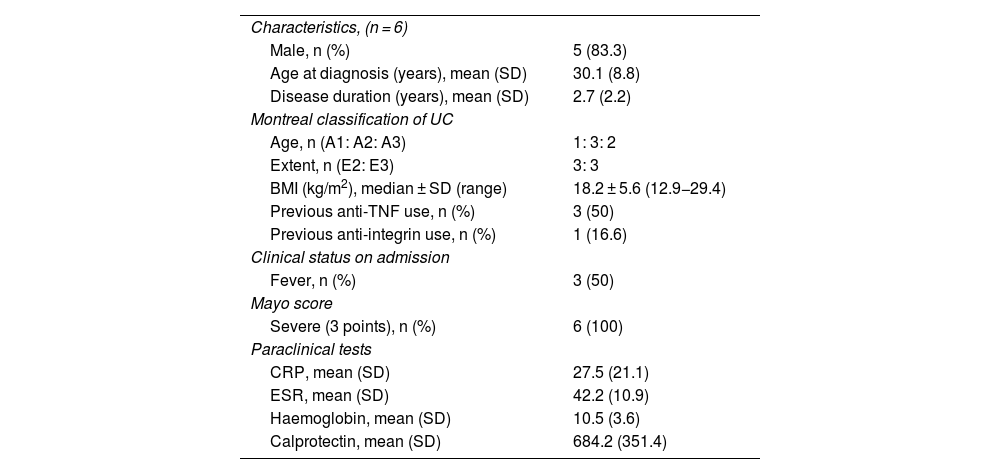
ResultsBaseline characteristics of the patientsSix subjects met the selection criteria; five adults and one paediatric patient, one of whom was female, with a median age of 34 years (range: 15–42). All had ASUC, with severe symptoms and elevated biochemical markers; 4/6 patients had pancolitis and 2/6 left-sided colitis. The mean time from diagnosis of UC to starting tofacitinib was 30.1 months (SD: 27.6) (range: 0–73.2). The baseline clinical, biological and endoscopic characteristics are shown in Tables 1 and 2. All patients received thromboprophylaxis while in hospital.
Baseline clinical characteristics of patients with ASUC treated with tofacitinib.
| Characteristics, (n = 6) | |
| Male, n (%) | 5 (83.3) |
| Age at diagnosis (years), mean (SD) | 30.1 (8.8) |
| Disease duration (years), mean (SD) | 2.7 (2.2) |
| Montreal classification of UC | |
| Age, n (A1: A2: A3) | 1: 3: 2 |
| Extent, n (E2: E3) | 3: 3 |
| BMI (kg/m2), median ± SD (range) | 18.2 ± 5.6 (12.9−29.4) |
| Previous anti-TNF use, n (%) | 3 (50) |
| Previous anti-integrin use, n (%) | 1 (16.6) |
| Clinical status on admission | |
| Fever, n (%) | 3 (50) |
| Mayo score | |
| Severe (3 points), n (%) | 6 (100) |
| Paraclinical tests | |
| CRP, mean (SD) | 27.5 (21.1) |
| ESR, mean (SD) | 42.2 (10.9) |
| Haemoglobin, mean (SD) | 10.5 (3.6) |
| Calprotectin, mean (SD) | 684.2 (351.4) |
ACG: American College of Gastroenterology Ulcerative Colitis Activity Index; anti-TNF: tumour necrosis factor inhibitors; ASUC: acute, severe ulcerative colitis; CRP: C-reactive protein; ESR: erythrocyte sedimentation rate; n: number of patients; SD: standard deviation.
Baseline therapeutic characteristics of patients with ASUC treated with tofacitinib.
| Previous exposure to biologicals | |
| 0 biologicals, n (%) | 3 (50) |
| 1 biological, n (%) | 2 (33.3) |
| 2 biologicals, n (%) | 1 (16.6) |
| Reason for using tofacitinib | |
| Primary anti-TNF failure, n (%) | 2 (33.3) |
| Anti-TNF and anti-integrin failure, n (%) | 1 (16.6) |
| Naïve to biological therapy (%) | 3 (50) |
anti-TNF: tumour necrosis factor inhibitors; ASUC: acute severe ulcerative colitis.
Prior to their hospital admission, 50% of the patients were naïve to biological therapy, 50% of the patients had been on anti-TNF therapy before starting treatment with tofacitinib and 16.7% had previous exposure to anti-integrin (Tables 1 and 2). The two patients who started anti-TNF therapy during their admission received infliximab (IFX) at an induction dose of 10 mg/kg (Table 2) over at least two hours (in a single dose).
General effectiveness, frequency of colectomy, need for readmission and steroid requirementFor induction, 66.6% of patients received tofacitinib 10 mg BID, one patient received 10 mg TID for three days followed by 10 mg BID, and one patient (paediatric age) received 5 mg BID. The average time between admission and starting tofacitinib in the patients who received sequential corticosteroids and IFX was nine days (SD: 3.7), considering anti-TNF treatment failure in relation to the use of IFX as salvage therapy at a starting dose of 10 mg/kg. For those patients who received corticosteroid therapy only before starting tofacitinib, corticosteroid failure was considered after three days of use without clinical response. Clinical improvement was observed in all subjects on day seven after starting tofacitinib (Tables 1 and 3).
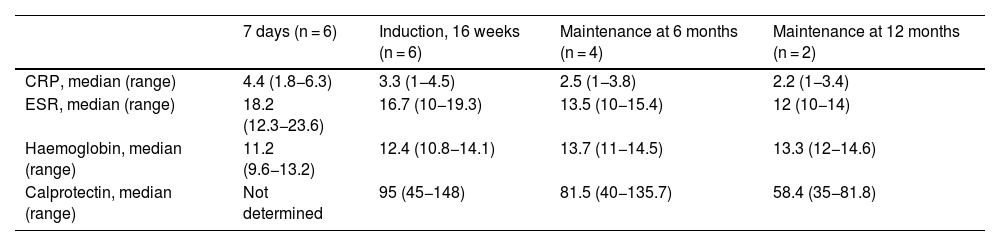
Summary of paraclinical test measures evaluated during the different treatment phases.
| 7 days (n = 6) | Induction, 16 weeks (n = 6) | Maintenance at 6 months (n = 4) | Maintenance at 12 months (n = 2) | |
|---|---|---|---|---|
| CRP, median (range) | 4.4 (1.8−6.3) | 3.3 (1−4.5) | 2.5 (1−3.8) | 2.2 (1−3.4) |
| ESR, median (range) | 18.2 (12.3−23.6) | 16.7 (10−19.3) | 13.5 (10−15.4) | 12 (10−14) |
| Haemoglobin, median (range) | 11.2 (9.6−13.2) | 12.4 (10.8−14.1) | 13.7 (11−14.5) | 13.3 (12−14.6) |
| Calprotectin, median (range) | Not determined | 95 (45−148) | 81.5 (40−135.7) | 58.4 (35−81.8) |
CRP: C-reactive protein; ESR: erythrocyte sedimentation rate. n: number of patients.
After the first seven days of the induction phase, all patients remained in clinical remission and achieved biochemical remission in induction, and 83.3% achieved endoscopic remission in induction, with a Mayo endoscopic subscore of 0 or 1 points. In all cases, the induction dose was maintained until week 16. According to the ACG score, all subjects had only mild activity or were in remission. Table 3 shows paraclinical test results in the first seven days, for the induction phase, and maintenance phases at six and 12 months.
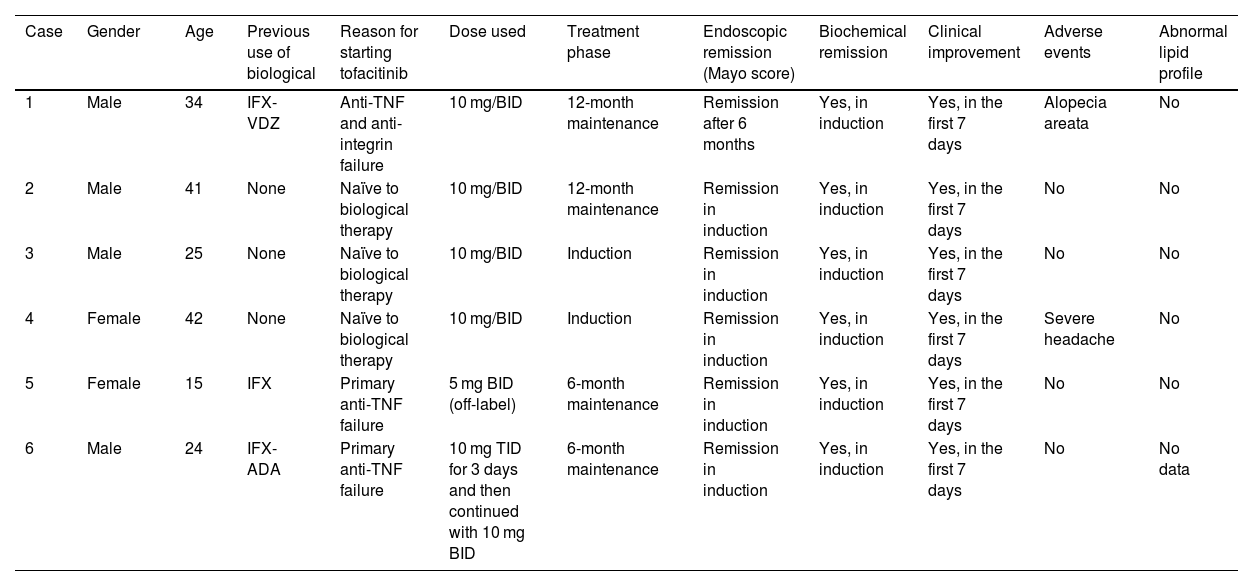
All patients received corticosteroids before starting treatment with tofacitinib (Table 4). Of those patients who required corticosteroids during the induction phase (4/6), 50% were able to discontinue them and 50% to reduce the dose after eight weeks. No cases of non-responders were documented. In the patients evaluated, there was no requirement for colectomy or readmission to hospital, either at seven days or during induction.
Clinical and therapeutic characteristics, clinical outcomes and safety in patients with ASUC.
| Case | Gender | Age | Previous use of biological | Reason for starting tofacitinib | Dose used | Treatment phase | Endoscopic remission (Mayo score) | Biochemical remission | Clinical improvement | Adverse events | Abnormal lipid profile |
|---|---|---|---|---|---|---|---|---|---|---|---|
| 1 | Male | 34 | IFX-VDZ | Anti-TNF and anti-integrin failure | 10 mg/BID | 12-month maintenance | Remission after 6 months | Yes, in induction | Yes, in the first 7 days | Alopecia areata | No |
| 2 | Male | 41 | None | Naïve to biological therapy | 10 mg/BID | 12-month maintenance | Remission in induction | Yes, in induction | Yes, in the first 7 days | No | No |
| 3 | Male | 25 | None | Naïve to biological therapy | 10 mg/BID | Induction | Remission in induction | Yes, in induction | Yes, in the first 7 days | No | No |
| 4 | Female | 42 | None | Naïve to biological therapy | 10 mg/BID | Induction | Remission in induction | Yes, in induction | Yes, in the first 7 days | Severe headache | No |
| 5 | Female | 15 | IFX | Primary anti-TNF failure | 5 mg BID (off-label) | 6-month maintenance | Remission in induction | Yes, in induction | Yes, in the first 7 days | No | No |
| 6 | Male | 24 | IFX-ADA | Primary anti-TNF failure | 10 mg TID for 3 days and then continued with 10 mg BID | 6-month maintenance | Remission in induction | Yes, in induction | Yes, in the first 7 days | No | No data |
anti-TNF: tumour necrosis factor inhibitors; ASUC: acute severe ulcerative colitis; BID: twice a day; IFX: infliximab; TID: three times a day; VDZ: vedolizumab.
During the six-month maintenance phase, information was gathered on four patients, with clinical, biochemical and endoscopic remission reported in all four (Table 4) according to the ACG score, with 25% achieving mild activity and 75% remaining in remission. In total, 75% had a Mayo endoscopic score of 1 point and 25% had a score of 0. None required colectomy or readmission to hospital. The two patients who required the use of corticosteroids in the maintenance phase were able to discontinue them.
Paediatric patientOne female paediatric patient was included (Table 4) (15 years old; at baseline: ASUC, PUCAI 85, Paris E2S1, Mayo index 3, UCEIS 8). This patient was previously receiving infliximab, but irregularly, so on admission to hospital, accelerated induction was given with infliximab at a dose of 10 mg/kg, two doses in total at week 0 and week 1, without response. She persisted with PUCAI 45, calprotectin 845 μg/g, Paris E2S1, Mayo index 2 and UCEIS 7, so she was started on tofacitinib. As this was an off-label indication and the dose authorised in other therapeutic indications in the paediatric age group is 5 mg BID, she was given this dose in induction, showing remission of symptoms after a week, with PUCAI 0. Currently in the six-month maintenance phase, she is in steroid-free remission of the disease and has not required colectomy.
Extraintestinal manifestationsTwo patients had a history of EIM before starting tofacitinib; one case had three EIM concomitantly (uveitis, peripheral arthritis and erythema nodosum) and the other only one (peripheral arthralgia). In both of these subjects, the EIM resolved with tofacitinib in induction. In terms of therapeutic goals, both subjects achieved symptom remission at seven days and biochemical and endoscopic remission in induction.
Safety profileAdverse events were documented in 2/6 patients (33.3%). One case involved severe headache, occurred one week after starting tofacitinib and resolved after eight weeks with medical management. The other case developed alopecia areata and resolved four weeks after injection with corticosteroids. Both patients were adults. No cases of infection, including herpes zoster infection, or abnormal lipid profile were reported in the patients for whom this information was available (Table 4). The case of alopecia areata occurred in a patient with previous exposure to biological therapy, while the severe headache occurred in a naïve patient (Table 4). None of the patients required permanent withdrawal of tofacitinib due to adverse events. No thromboembolic or cardiovascular events or leucopenia were reported.
DiscussionIn this study, tofacitinib showed safety and rapid clinical response in patients with ASUC, corroborating the results of previous studies.10–12,14,15 Although our findings are merely descriptive and retrospective in a small number of patients, steroid-free remission and a lower requirement for colectomy for a period of three to six months was observed, with good outcomes for a sample of subjects refractory to standard medical therapy and at high risk for colectomy, which is also in line with previous studies.5,14,28
In one patient, tofacitinib was administered at a high-intensity dose (10 mg TID), this being an off-label therapeutic regimen for which there is published evidence on efficacy and safety. This regimen is known from the Berinstein et al. case series,10 in which daily intravenous methylprednisolone 60 mg in combination with tofacitinib 10 mg TID for nine doses (three days) was associated with clinical remission and a reduction in the requirement for colectomy in subjects refractory to medical therapy with corticosteroids or infliximab. In a case-control study by the same author,5 the multivariate analysis, which included 24 subjects with this dose, demonstrated that tofacitinib 10 mg TID is protective against colectomy, with statistical significance (HR: 0.11; 95% CI: 0.02; 0.56; P = .008). Our patient was a subject with previous exposure to a biological medicinal product and refractory to standard medical therapy. Using the regimen proposed by Berinstein et al.,10 early clinical remission was observed three days after starting treatment and it was found to be safe. However, these findings should be interpreted with caution considering that it was only a single case and studies with a larger number of patients and a better design are required to determine its efficacy and safety compared to other doses.
The evidence for tofacitinib in paediatric patients with ASUC is just emerging and the results are optimistic in a population with disease onset at an earlier stage in life. The cohort study by Constant et al.29 found that use of tofacitinib for paediatric patients refractory to corticosteroids and anti-TNF with ASUC was associated with a decrease in the 90-day colectomy rate of 73%, and no serious adverse events related to the drug were observed during follow-up. The paediatric patient in our series had primary anti-TNF failure, without response to infliximab, for which she was started on treatment with tofacitinib (5 mg BID), with satisfactory clinical outcomes and no requirement for colectomy at her last follow-up beyond six months of therapy. Although we had only one single paediatric subject in our study, these findings support the use of tofacitinib in patients refractory to anti-TNF therapy in the paediatric population, due to its efficacy and safety in difficult-to-manage patients refractory to medical therapy and at high risk of colectomy. This provides the impetus for future studies to assess whether or not these therapies have a synergistic effect and whether clinical outcomes can be improved if tofacitinib is started at in earlier phase of the treatment.
In our study, the beneficial effects of tofacitinib were pronounced and rapid in both patients naïve to biological therapy and those previously treated with anti-TNF regimens. The decision to use tofacitinib directly in patients naïve to biological therapy was based on their age, disease severity and the need to quickly achieve outcomes of interest in subjects at high risk for colectomy. Patients with prior exposure to biologicals are considered more difficult to treat than patients without prior anti-TNF treatment30 and, from a network meta-analysis with indirect comparison, it was found that tofacitinib was more effective in patients with prior exposure to anti-TNF than adalimumab and vedolizumab.31 However, there are no solid data that directly compare clinical outcomes of tofacitinib use in subjects with prior exposure to biologicals to those naïve to biological therapy, as the evidence for the use of tofacitinib in naïve patients is just emerging now. Therefore, our findings should be interpreted with caution, because the methodological design means that differences between subgroups (naïve to biological therapy vs previous exposure to biologicals) cannot be detected and, as it is a descriptive and observational study, estimates of remission and colectomy-free rate are imprecise.
In the patients included in this study, both those naïve to biological therapy and those with previous use, we found an appropriate rate of fulfilment of therapeutic goals in induction and a low percentage of adverse events, with none developing infections or thrombotic or cardiovascular events, or requiring admission to hospital. In addition, high-intensity dose induction therapy was given to one subject, who achieved clinical and endoscopic remission. These results are consistent with those described in several recent studies on tofacitinib for ASUC.5,10,14,28,29 However, given the small sample size in our study, with subjects under 45 years of age and without cardiovascular risk factors, long-term safety, including in subjects over 45 years of age, with cardiovascular risk factors and prior exposure to biologicals, is a topic to consider for future studies.
Our study has certain limitations, including the sample size, the absence of a comparator group and the inability to find significant associations. However, it was possible to describe in detail the baseline characteristics of a sample of patients with heterogeneous characteristics from an age, clinical and therapeutic point of view. Also, all the subjects we included met ASUC criteria, requiring admission to hospital and showing indicators of serious illness. Additionally, subjects with follow-up periods greater than six months were included in this series, which supports clinical outcomes and safety in periods greater than 180 days.
ConclusionsIn this study, which included a sample of patients from a Latin American country with ASUC treated with tofacitinib, efficacy and safety results were similar to those reported in the literature. Tofacitinib is an alternative option for salvage therapy that has adequate tolerance and leads to a rapid clinical response and a reduced need for colectomy, both in patients with therapeutic failure to anti-TNF and where anti-TNF is not available.
Prospective randomised, comparative efficacy studies are required to determine the optimal dose and outcomes for longer periods of time compared to current evidence.
Ethical responsibilitiesAs this was an observational case series study, informed consent was not required. The participants were told what the research consisted of during the application of the instrument.
Consent for publicationFor the design of this research study, we took into account the requirements established in the Declaration of Helsinki, version 2013, in Fortaleza, Brazil, and resolution 8430 of 1993 of the National Ministry of Health of Colombia, such that it was considered to be an investigation without risk, and confidentiality and preservation of the information collected was guaranteed. Informed consent was not therefore required.
FundingThe authors declare that they received no funding to conduct this study.
AuthorsVPI, JSFO, FJB, CC, CRS and CFS contributed to all stages of the research (literature review, data collection and composition). All authors approved the final version of the manuscript.
Conflicts of interestThe authors declare that they have no conflicts of interest


