


Pediatric Critical Care has undergone important changes in the last decades. In order to adapt pediatric care to the patient-family binomial and guarantee its quality, the evaluation of the needs perceived by family members during hospital stay is becoming increasingly relevant.
ObjectiveTo determine the perception of the needs of the relatives of patients admitted to the Pediatric Critical Care Units (PCCU) in a tertiary level hospital.
MethodsCross-sectional descriptive observational quantitative study was run through the distribution of the modified version of the Critical Care Family Needs Inventory (CCFNI). Population: Parents or legal caregivers of patients admitted to two CCUs with >48 h stay between September 2023 and January 2024. Descriptive analysis, Mann–Whitney U and Kruskal–Wallis tests were performed.
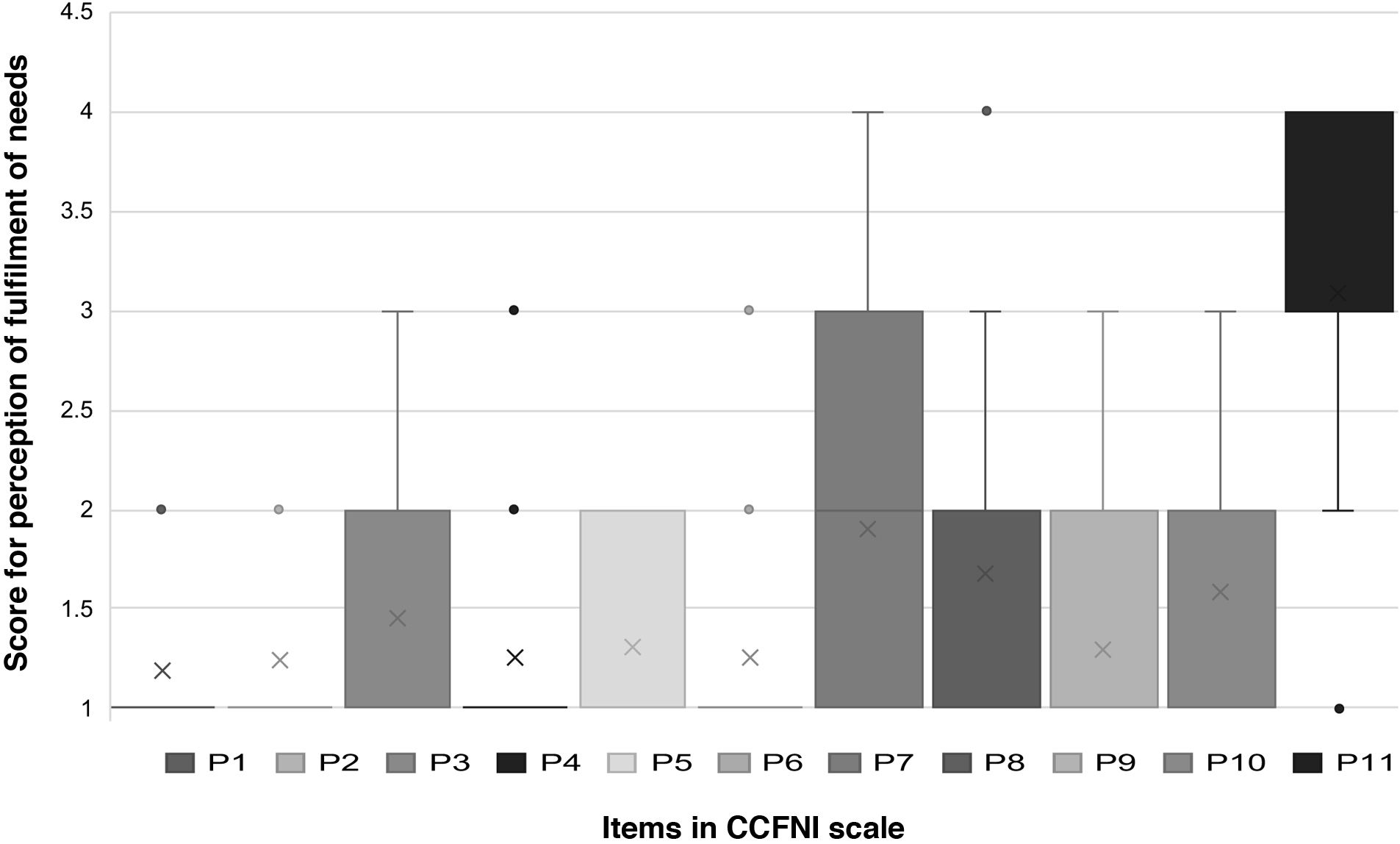
ResultsEighty-four questionnaires were completed. The median total score on the questionnaire was 15.00, corresponding to a high perception of fulfillment of needs. The subscale with the highest degree of compliance of the needs was “Patient care” (3.00), followed by “Information and communication” (3.00) and “Family care” (4.50); the subscale “Possible perceived improvements” (4.50) was the one with the worst results.
Statistically significant differences were found when comparing the total score between units (p = 0.046) and according to the type of room (p = 0.016) and the educational level of the relatives (p = 0.049). No significant differences were found during the analysis of the remaining variables.
ConclusionsThe findings suggest that the hospital environment, specifically type of room, have a significant impact on the perception of family members’ needs fulfillment. It is considered essential to adapt pediatric critical care units in order to suit today’s family-centered care approach.
Los Cuidados Críticos Pediátricos han experimentado importantes cambios en las últimas décadas. Con el fin de adaptar la atención al binomio paciente-familia y garantizar la calidad de la misma, adquiere cada vez más relevancia la evaluación de la percepción de necesidades por los familiares durante la hospitalización.
Objetivodeterminar el grado de cumplimiento de las necesidades de los familiares de pacientes ingresados en las Unidades de Cuidados Críticos Pediátricos (UCCP) de un hospital de tercer nivel.
MétodoEstudio observacional, descriptivo, cuantitativo y transversal a través de la distribución de la versión modificada del Cuestionario de Necesidades de los Familiares de Pacientes de Cuidados Intensivos (CCFNI). Población: padres o cuidadores legales de los pacientes ingresados en dos UCC con estancia >48 h entre los meses de septiembre de 2023 y enero de 2024. Se realizó análisis descriptivo, test de U de Mann–Whitney y prueba de Kruskal–Wallis.
ResultadosOchenta y cuatro cuestionarios fueron cumplimentados. La mediana de la puntuación total en el cuestionario fue de 15,00; correspondiéndose con una percepción alta del cumplimiento de necesidades. La subescala con un mayor grado de cumplimiento fue “Atención al paciente” (3,00), seguida por “Información y comunicación” (3,00) y “Atención al familiar” (4,50); siendo la subescala “Posibles mejoras percibidas” (4,50) la que obtuvo peores resultados. Se encontraron diferencias significativas al comparar la puntuación total entre unidades (p = 0,046) y en función del tipo de habitación (p = 0,016) y el nivel de estudios de los familiares (0,049). No se encontraron diferencias significativas durante el análisis del resto de variables.
ConclusionesLos hallazgos sugieren que el entorno hospitalario, concretamente el tipo de habitación, tienen un impacto significativo en la percepción del cumplimiento de necesidades de los familiares. Se considera fundamental adaptar las unidades de cuidados críticos pediátricos para adecuarlas al enfoque de atención centrada en la familia actual.
Article
Diríjase al área de socios de la web de la SEEIUC, (https://seeiuc.org/mi-cuenta/iniciar-sesion/) y autentifíquese.