


metricas
covid
Cirugía Española (English Edition) Implementation of a “minor surgery program in primary care”: Impact on the r...
Journal Information
Vol. 103. Issue 8.
(August 2025)
Special article
Implementation of a “minor surgery program in primary care”: Impact on the reduction of the surgical waiting list in a healthcare area
Implementación de un programa de «cirugía menor en atención primaria». Impacto en la reducción de la lista de espera quirúrgica en un área sanitaria
Génesis Parra Eslavaa,
Corresponding author
parra_genesl@gva.es

Corresponding author.
, Ana María Sarrión Bosqueb, Fernando Carvajal Lópeza, Natalia Uribe Quintanac
a Cirugía General y del Aparato Digestivo, Hospital de Llíria, Llíria, Valencia, Spain
b Family and Community Medicine, Primary Care Center of Bétera, Bétera, Valencia, Spain
c Cirugía General y del Aparato Digestivo, Hospital Arnau de Vilanova, Valencia, Spain
Article information
Abstract
Full Text
Bibliography
Download PDF
Statistics
Figures (6)
Show moreShow less
Abstract
Introduction

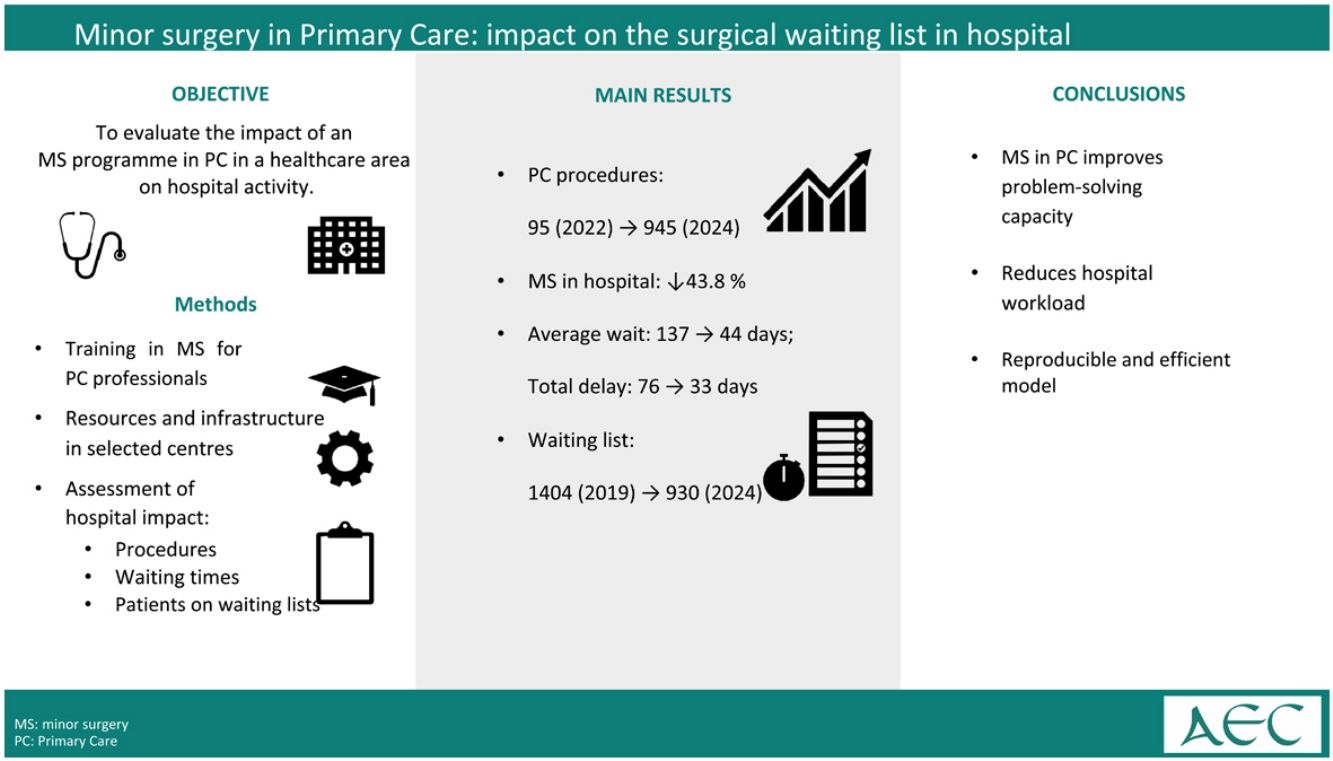
This study analyzes the implementation of a Minor Surgery programme in Primary Care within a healthcare area and its impact on hospital activity indicators.

Materials and methods

A clinical training programme was designed for Primary Care professionals. The number of minor procedures performed in Primary Care and in the General Surgery Department was assessed, along with the evolution of hospital activity indicators: average waiting time, mean accumulated delay, and the number of patients on the surgical waiting list.

Results

The number of minor procedures in Primary Care increased from 95 in 2022 to 945 in 2024, resulting in a 43.8% reduction in hospital-based minor surgery and a decrease in average waiting time, total delay, and number of patients on the surgical waiting list.

Conclusions

The implementation of minor surgery in Primary Care has improved healthcare delivery by increasing its problem-solving capacity and reducing the hospital workload.

Keywords:
Minor surgery
Primary care
Resource optimization
Surgical waiting list
Clinical training
Resumen
Introducción

Este estudio analiza la implementación de un programa de Cirugía Menor en Atención Primaria en un área de salud y su impacto en los indicadores de actividad hospitalaria.

Material y métodos

Se diseñó un programa de formación para profesionales de atención primaria. Se evaluó el número de intervenciones cirugía menor en primaria y en el Servicio de Cirugía General, así como la evolución de los indicadores de actividad hospitalaria: tiempo medio de espera, demora total y número de pacientes en lista de espera quirúrgica.

Resultados

El número de intervenciones menores en Atención Primaria aumentó de 95 en 2022 a 945 en 2024, reduciéndose en un 43,8 % la cirugía menor hospitalaria y disminuyendo los tiempos de espera, la demora total y el número de pacientes en la lista de espera hospitalaria.

Conclusiones

La implementación de cirugía menor en atención primaria ha mejorado la atención asistencial, aumentando su capacidad resolutiva y reduciendo la carga hospitalaria.


Palabras clave:
Cirugía menor
Atención primaria
Optimización de recursos
Lista de espera quirúrgica
Formación
Graphical abstract

Article

These are the options to access the full texts of the publication Cirugía Española (English Edition)
Subscriber
Subscriber

If you already have your login data, please click here .

If you have forgotten your password you can you can recover it by clicking here and selecting the option “I have forgotten my password”
Subscribe
Subscribe to

Cirugía Española (English Edition)

Purchase
Purchase article

Purchasing article the PDF version will be downloaded

Purchase now
Contact
Phone for subscriptions and reporting of errors
From Monday to Friday from 9 a.m. to 6 p.m. (GMT + 1) except for the months of July and August which will be from 9 a.m. to 3 p.m.
Calls from Spain
932 415 960
Calls from outside Spain
+34 932 415 960
E-mail
Article options
Tools
