



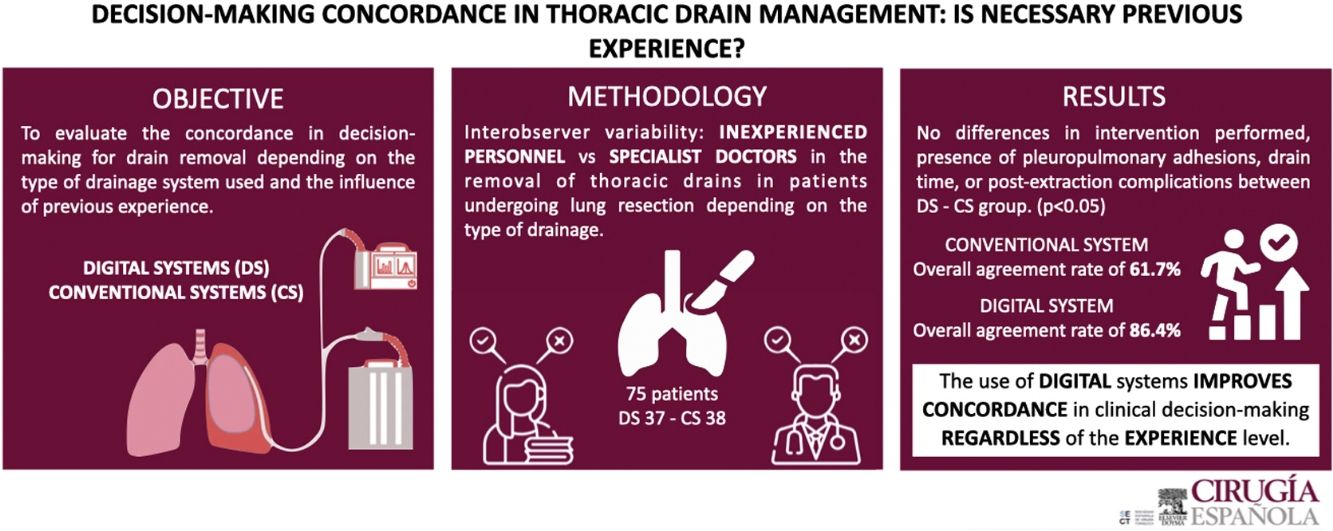
Proper management of thoracic drainages is essential in the recovery of patients after lung resection. This study evaluates the concordance in decision-making for drain removal depending on the type of drainage system used and the previous experience of the personnel.
Material and methodsProspective, comparative, and stratified randomization study on interobserver variability between senior specialist doctors and inexperienced healthcare personnel in the removal of thoracic drains in patients undergoing lung resection connected to conventional systems (CS) or digital systems (DS) with continuous recording. The withdrawal criteria were established before the study, and decisions were recorded during three postoperative days.
Results75 patients were included, 38 CS and 37 DS, with no statistically significant differences in sex distribution, age, intervention performed, presence of pleuropulmonary adhesions, drain time, or post-extraction complications between the groups. The overall concordance in drain removal decisions was moderate (kappa = 0.452), with notable variations in concordance depending on the drainage system used: CS (kappa = 0.188) with an overall agreement rate of 61.7% compared to DS (kappa = 0.716) with an overall agreement rate of 86.4%. Digital systems showed substantial concordance regardless of the operator's experience, with kappa values indicating high concordance on all postoperative days.
ConclusionsThe use of digital systems for managing thoracic drains significantly improves concordance in clinical decision-making regardless of the experience level. These findings suggest that adopting digital systems not only optimizes patient safety but also reduces the dependence on highly specialized healthcare professionals.
El manejo adecuado de los drenajes torácicos es esencial en la recuperación de los pacientes tras una resección pulmonar. Este estudio evalúa la concordancia en la toma de decisiones de su retirada dependiendo del sistema de drenaje utilizado y la experiencia previa del personal.
Material y métodosEstudio prospectivo, comparativo, de la variabilidad interobservador entre médico especialista senior y personal no experimentado en la retirada de drenajes torácicos en pacientes sometidos a resección pulmonar conectados a sistema convencional (SC) o sistema digitales (SD). Los criterios de retirada se establecieron antes del estudio y las decisiones se registraron durante tres días postoperatorios.
ResultadosSe incluyeron 75 pacientes, 38 SC / 37 SD, sin encontrarse diferencias estadísticamente significativas en la distribución de sexo, edad, intervención realizada, adherencias pleuropulmonares, tiempo con drenaje o complicaciones postextracción. La concordancia global en las decisiones de retirada del drenaje fue moderada (kappa = 0.452), observándose variaciones en la toma de decisiones dependiendo del sistema de drenaje utilizado: SC (kappa = 0.188) con tasa de acuerdo de 61.7% frente al SD (kappa = 0.716) con tasa de acuerdo de 86.4%. Los sistemas digitales demostraron una concordancia sustancial independientemente de la experiencia del operador.
ConclusionesLa utilización de sistemas digitales para el manejo de drenajes torácicos mejora significativamente la concordancia en la toma de decisiones clínicas, independientemente del nivel de experiencia previa. Estos hallazgos sugieren que la adopción de sistemas digitales no solo optimiza la seguridad del paciente sino que también reduce la dependencia de personal altamente especializado.
Appropriate management of thoracic drainages is essential in the recovery of patients after lung resection. Maintaining thoracic drainages in the postoperative period of patients undergoing elective lung resection surgery is the main predictor of hospital stay.1,2 Scientific evidence suggests that early removal of thoracic drainages after lung resection reduces postoperative pain and improves lung function, which facilitates adherence to functional rehabilitation protocols.3
There are two main thoracic drainage systems in clinical practice: the conventional systems (CS) and the electronic or digital systems (DS). The conventional systems are widely used due to their simplicity and low cost, but they require the health professional to have certain experience for removal decision-making since this depends on subjective interpretation, which implies high interobserver variability among the different professionals.4 Digital systems offer major advantages, such as continuous recording of parameters and more accurate monitoring which may improve clinical decision-making.5
In recent years multiple studies have shown differences in the drainage duration time and hospital stay, depending on the collection system connected to the thoracic drainage. The evidence suggests that connecting the thoracic drainage to a digital system offers advantages compared to the conventional thoracic drainage, including shorter drain maintenance time, reduced drain collocation technique, shorter hospital stay, and improved cost-effectiveness.6–9
Dependence on experienced personnel for decision-making regarding thoracic drainage removal represents a suboptimal use of available resources. Compared to traditional devices, electronic systems have been reported to have a short learning curve and do not affect system efficiency, with beneficial results being obtained from their initial application.10
The main aim of this study was to assess the concordance in decision-making for thoracic drainage removal between specialist physicians and inexperienced healthcare personnel, using conventional systems and digital systems with continuous recording. The hypothesis was that digital systems improve uniformity and precision in clinical decision-making, reducing interobserver variability independently of previous experience.
Material and methodsA prospective comparative study was conducted to assess inter-observer variability between a senior specialist physician (>10 years' experience as a licensed thoracic surgeon) and inexperienced healthcare personnel (in this case, a 6th year female undergraduate medical student with no prior experience in thoracic drainage management) in thoracic drainage removal in patients undergoing anatomical and non-anatomical lung resections. Patients were sequentially assigned to one of two intervention groups (conventional drainage system [CS] or digital drainage system [DS] with continuous recording (Thopaz + TM, Medela), based on the availability of the drainage system at the time of surgery. The recruitment period ran from November 1, 2023, to March 31, 2024.
The study included 75 consecutive patients, aged over 18 years, who had undergone a scheduled lung resection. Exclusion criteria included: the absence of evidence of air leak at 16 h after surgery and those patients who required continued intensive care and mechanical ventilation measures in the postoperative period (>24 h)
Before the start of the study, a specific protocol for thoracic drainage removal was established, which included the following criteria:
- "04"
Absence of air leak (or evidence of intermittent air leak <20 ml/min in patients with electronic devices).
- "04"
Drainage volume less than 400 ml in the previous 24 h.
Training of inexperienced personnel was carried out by means of joint interpretation of 5 cases prior to the study initiation.
During the three postoperative days, drain removal decisions made by the senior specialist physician and the inexperienced healthcare personnel were recorded, always by the same individuals. To avoid learning bias during the study, the inexperienced healthcare personnel were not informed at any time about the removal decision made by the specialist physician. The decisions of both observers were made within the same time frame.
Statistical analysisStatistical analysis was performed using SPSS software version 25.0. The following tests were applied: Chi-square and Fisher's exact tests: To compare categorical variables between the CS and DS groups. Student's t test: To compare the means of normally distributed continuous variables. Mann-Whitney U test: To compare the medians of non-normally distributed continuous variables. A p value <.05 was considered statistically significant.
Interobserver variability in drain removal decision-making was assessed using Cohen's kappa coefficient, which measures agreement between observers beyond chance. A kappa coefficient of .20 or less is considered poor, .21–.40 fair, .41–.60 moderate, .61–.80 substantial, and .81–1.00 almost perfect.
Ethical considerationsAll patients participating in the study gave their consent. This study was conducted in accordance with the Declaration of Helsinki (revised in 2013). This study was approved by the Clinical Research Ethics Committee of our hospital (PI 23-3398).
ResultsStudy population characteristics:
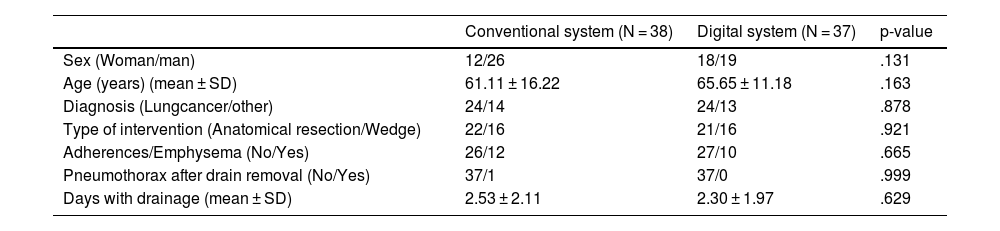
A total of 75 patients undergoing lung resection were included, divided into two groups: 38 patients connected to a conventional drainage system (CS) and 37 patients to a digital drainage system (DS). No statistically significant differences were found between the groups regarding demographic and clinical characteristics: distribution by sex, age, diagnosis, type of intervention, presence of adhesions or emphysema, need for repositioning of thoracic drainage after removal and days with thoracic drainage (Table 1). There were no losses during follow-up.
Demographic and clinical characteristics of the patients in the conventional and digital drainage groups.
| Conventional system (N = 38) | Digital system (N = 37) | p-value | |
|---|---|---|---|
| Sex (Woman/man) | 12/26 | 18/19 | .131 |
| Age (years) (mean ± SD) | 61.11 ± 16.22 | 65.65 ± 11.18 | .163 |
| Diagnosis (Lungcancer/other) | 24/14 | 24/13 | .878 |
| Type of intervention (Anatomical resection/Wedge) | 22/16 | 21/16 | .921 |
| Adherences/Emphysema (No/Yes) | 26/12 | 27/10 | .665 |
| Pneumothorax after drain removal (No/Yes) | 37/1 | 37/0 | .999 |
| Days with drainage (mean ± SD) | 2.53 ± 2.11 | 2.30 ± 1.97 | .629 |
Concordance in drainage removal decisions:
Overall concordance (Table 2):
Overall concordance in thoracic drainage removal among specialist surgeons and students for conventional and digital drainage.
| Overall | Undergraduate student | Conventional system | Undergraduate student | Digital system | Undergraduate student | |||||||||
| Senior physician | Removed | Not removed | Total | Senior physician | Removed | Not removed | Total | Senior physician | Removed | Not removed | Total | |||
| Removed | 58 | 11 | 69 | Removed | 26 | 14 | 40 | Removed | 32 | 6 | 38 | |||
| Not removed | 20 | 30 | 50 | Not removed | 9 | 11 | 20 | Not removed | 2 | 19 | 21 | |||
| Total | 78 | 41 | 119 | Total | 35 | 25 | 60 | Total | 34 | 25 | 59 | |||
| Kappa: .452 (.289, .614) | Kappa: .188 (−.06, .437) | Kappa: .716 (.536, .897) | ||||||||||||
| Overall agreement: .739 (.654, .810) | Overall agreement: .617 (.490, .729) | Overall agreement: .864 (.754, .929) | ||||||||||||
| Positive agreement: .789 (.708, .853) | Positive agreement: .693 (.561, .798) | Positive agreement: .889 (.792, .947) | ||||||||||||
| Negative agreement: .659 (.537, .760) | Negative agreement: .489 (.307, .654) | Negative agreement: .826 (.679, .917) | ||||||||||||
When considering all decision analyses between senior specialist physician (>10 years experience as a licensed specialist) and inexperienced healthcare personnel regardless of day and system type, overall agreement was kappa = .452, with an overall agreement of 73.9%.
Concordance by system type:
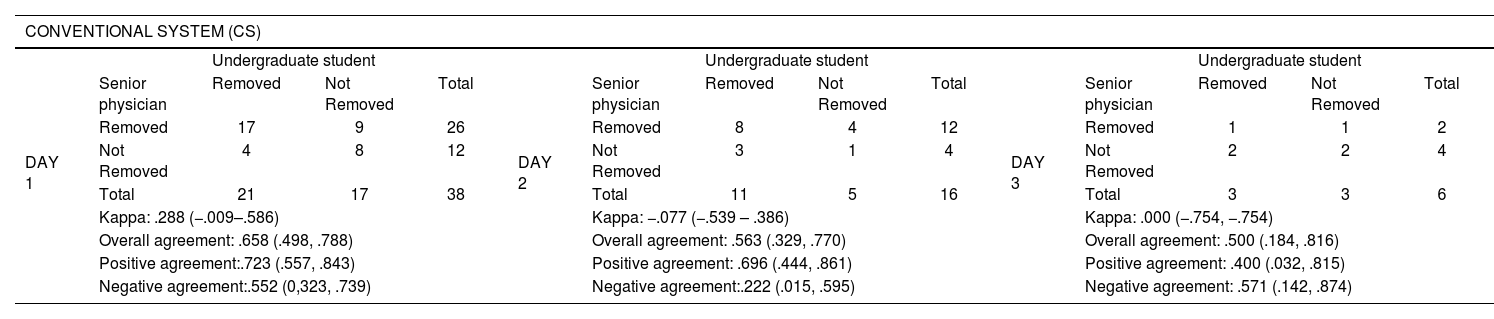
Conventional system (Table 3): kappa = 0.188, overall concordance of 61.7%, positive concordance of 69.3% and negative concordance of 48.9%.
- "06"
Day one: kappa = .288, overall concordance of 65.8%, positive concordance of 72.3% and negative concordance of 55.2%.
- "06"
Day two: kappa = −0.077, overall concordance of 56.3%, positive concordance of 69.6% and negative concordance of 22.2%.
- "06"
Day three: kappa = .000, overall concordance of 50.0%, positive concordance of 40.0% and negative concordance of 57.1%.
Concordance in thoracic drainage removal among specialist surgeons and students for conventional drainage on postoperative days 1, 2 and 3.
| CONVENTIONAL SYSTEM (CS) | ||||||||||||||
|---|---|---|---|---|---|---|---|---|---|---|---|---|---|---|
| DAY 1 | Undergraduate student | DAY 2 | Undergraduate student | DAY 3 | Undergraduate student | |||||||||
| Senior physician | Removed | Not Removed | Total | Senior physician | Removed | Not Removed | Total | Senior physician | Removed | Not Removed | Total | |||
| Removed | 17 | 9 | 26 | Removed | 8 | 4 | 12 | Removed | 1 | 1 | 2 | |||
| Not Removed | 4 | 8 | 12 | Not Removed | 3 | 1 | 4 | Not Removed | 2 | 2 | 4 | |||
| Total | 21 | 17 | 38 | Total | 11 | 5 | 16 | Total | 3 | 3 | 6 | |||
| Kappa: .288 (−.009–.586) | Kappa: −.077 (−.539 – .386) | Kappa: .000 (−.754, −.754) | ||||||||||||
| Overall agreement: .658 (.498, .788) | Overall agreement: .563 (.329, .770) | Overall agreement: .500 (.184, .816) | ||||||||||||
| Positive agreement:.723 (.557, .843) | Positive agreement: .696 (.444, .861) | Positive agreement: .400 (.032, .815) | ||||||||||||
| Negative agreement:.552 (0,323, .739) | Negative agreement:.222 (.015, .595) | Negative agreement: .571 (.142, .874) | ||||||||||||
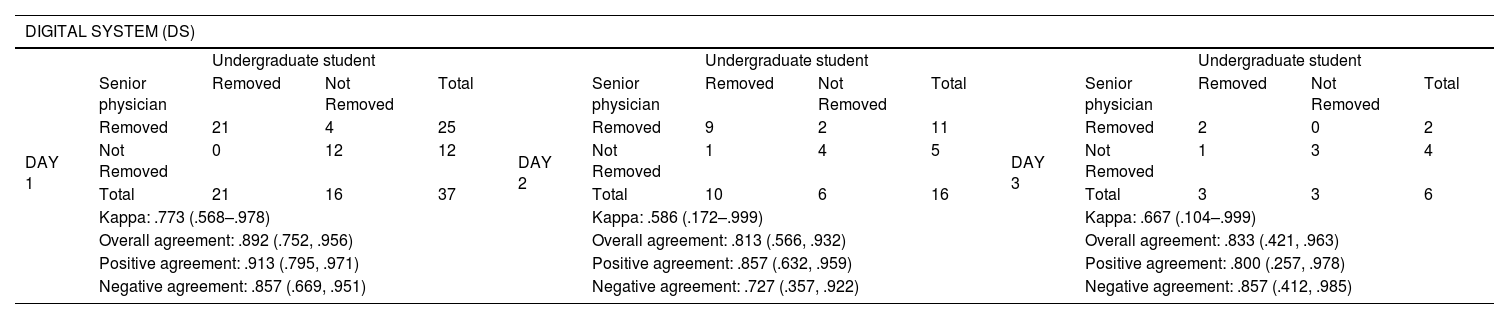
Digital system (Table 4): kappa = .716, overall concordance of 86.4%, positive concordance of 88.9% and negative concordance of 82.6%.
- "08"
Day one: kappa = .773, overall concordance of 89.2%, positive concordance of 91.3% and negative concordance of 85.7%.
- "08"
Day two: kappa = .586, overall concordance of 81.3%, positive concordance of 85.7% and negative concordance of 72.7%.
- "08"
Day three: kappa = .667, overall concordance of 83.3%, positive concordance of 80.0% and negative concordance of 85.7%.
Concordance in thoracic drainage removal among specialist surgeons and students for digital drainage on postoperative days 1, 2 and 3.
| DIGITAL SYSTEM (DS) | ||||||||||||||
|---|---|---|---|---|---|---|---|---|---|---|---|---|---|---|
| DAY 1 | Undergraduate student | DAY 2 | Undergraduate student | DAY 3 | Undergraduate student | |||||||||
| Senior physician | Removed | Not Removed | Total | Senior physician | Removed | Not Removed | Total | Senior physician | Removed | Not Removed | Total | |||
| Removed | 21 | 4 | 25 | Removed | 9 | 2 | 11 | Removed | 2 | 0 | 2 | |||
| Not Removed | 0 | 12 | 12 | Not Removed | 1 | 4 | 5 | Not Removed | 1 | 3 | 4 | |||
| Total | 21 | 16 | 37 | Total | 10 | 6 | 16 | Total | 3 | 3 | 6 | |||
| Kappa: .773 (.568–.978) | Kappa: .586 (.172–.999) | Kappa: .667 (.104–.999) | ||||||||||||
| Overall agreement: .892 (.752, .956) | Overall agreement: .813 (.566, .932) | Overall agreement: .833 (.421, .963) | ||||||||||||
| Positive agreement: .913 (.795, .971) | Positive agreement: .857 (.632, .959) | Positive agreement: .800 (.257, .978) | ||||||||||||
| Negative agreement: .857 (.669, .951) | Negative agreement: .727 (.357, .922) | Negative agreement: .857 (.412, .985) | ||||||||||||
Our study reflects a greater concordance in decisions to remove thoracic drainages when using an electronic system, compared to a conventional system, in keeping with previously published literature.4
Also observed was that this reduction in variability is independent of the health personnel’s previous experience, allowing professionals with minimal training to present a high concordance with highly experienced personnel in making decisions to remove thoracic drainages.
This high concordance in thoracic drainage management with electronic systems, without the need for previous experience, has important clinical implications. This finding suggests that the implementation of these devices in clinical practice can standardise and optimise thoracic drainage management, benefiting both patients and the health institutions themselves. In particular, these systems could facilitate precision in decision-making, reducing the risk of complications associated with the maintenance and thoracic drainage removal.
Under the establishment of an appropriate protocol, these tools are able to provide a uniform interpretation that is relevant in the field of thoracic surgery, but can also be extrapolated to other areas of action where the thoracic drainage management is necessary. Their application could be especially useful in environments where the availability of experienced personnel is limited, thereby reducing the dependence on the specialist physician or experienced personnel, and improving patient safety thanks to the increase in confidence in clinical decision-making secondary to the objective quantification provided by these electronic systems.
Although in our study no significant differences were found in the duration of thoracic drainage between both types of collection system, the published literature suggests that the implementation of electronic systems optimises hospital resources by reducing the in-hospital stay,6,7 consequently also potentially reducing costs.
The limitations of our study are inherent to its design and must be considered when interpreting the results. These include: a small sample size and the absence of a pre-calculation of the sample size, as recruitment was based on the availability of consecutive cases during the study period; the sequential assignment of patients to groups based on the availability of the drainage system, without a randomisation process; and the study being conducted at a single centre, which could limit extrapolation of the findings to other clinical settings.
In our clinical setting, in the context of early recovery and early discharge programmes, these digital tools lead to a redistribution of responsibilities regarding thoracic drainage management. Nursing staff could be responsible for monitoring and managing the drainages on a shift basis, which could lead to its earlier removal compared to the current decision-making process dependent on the availability of the specialist physician. Clinical outcomes and hospital efficiency would therefore improve.
ConclusionOur study supports that the use of electronic systems in thoracic drainage management significantly improves concordance in clinical decision-making regardless of staff experience level. These findings suggest that the adoption of digital systems not only increases confidence in clinical decision-making through objective digital quantification, but also reduces dependence on the specialist physician or highly experienced staff in its management.
FundingThis study is part of a research project awarded in 2023 by the Castilian-Leonese and Cantabrian Society of Respiratory Pathology. The authors have had full freedom in carrying out the research and total control of the study design, methods used, data analysis and the reported scientific production. There was no external influence at any stage of the research process.
Declaration of Generative AI and AI-assisted technologies in the writing processDuring the preparation of this work, the authors used the Generative Pre-trained Transformer 4 (ChatGPT-4) for grammar review and translation. After using this tool, the authors reviewed and edited the content as necessary and take full responsibility for the content of the publication.



