


metricas
Cirugía Española (English Edition) Antithrombotic prophylaxis use and incidence of venous thromboembolism in lung c...
Journal Information
Visits
505
Vol. 103. Issue 4.
Pages 179-254 (April 2025)
Original article
Full text access

Antithrombotic prophylaxis use and incidence of venous thromboembolism in lung cancer surgery: An observational retrospective study

Profilaxis antitrombótica e incidencia de tromboembolismo venoso en cirugía de cáncer de pulmón: estudio observacional retrospectivo
Visits
505
Tomás Rubioa, María Ibáñezb, Clara Fernández-Ariasb, Manuel Carrascob, Alma Queraltb, María Rodríguezc, Pedro Ruiz-Artachod,e, Ramón Lecumberrib,f,
Corresponding author
rlecumber@unav.es

Corresponding author.
a School of Medicine, University of Navarra, Pamplona, Spain
b Hematology Service, Clínica Universidad de Navarra, Pamplona, Spain
c Thoracic Surgery Department, Clínica Universidad de Navarra, Madrid, Spain
d Internal Medicine Department, Clínica Universidad de Navarra, Madrid, Spain
e Consorcio de Investigación Biomédica en Red Enfermedades Respiratorias (CIBERES), Instituto de Salud Carlos III, Madrid, Spain
f Instituto de Investigación Sanitaria de Navarra (IDISNA), Pamplona, Spain
This item has received
Article information
Abstract
Full Text
Bibliography
Download PDF
Statistics
Figures (1)
fig0005
Tables (2)
Table 1. Baseline characteristics and outcomes.
Tables
Table 2. Characteristics of VTE episodes.
Tables
Abstract
Introduction

Extended thromboprophylaxis with low-molecular-weight heparin (LMWH) for 28 days is recommended in patients undergoing major abdominal or pelvic cancer surgery, but the evidence for thoracic cancer surgery is weak. We aimed to evaluate the use of pharmacological thromboprophylaxis and incidence of venous thromboembolism (VTE) in adult patients undergoing lung cancer surgery in daily clinical practice.

Methods

Retrospective evaluation of a cohort of consecutive adult patients who had undergone lung cancer surgery. Patients were followed for 90 days after surgery.

Results

From 2000 to 2023, 405 patients were included (69% males; mean age 63.5 ± 10.1 years). Overall, 97.3% of the patients received LMWH thromboprophylaxis, with a median duration of 6 days (range, 1–30 days). Thromboprophylaxis use increased over time (from 94.9% in the period 2000–2012 to 99.1% in the period 2013–2023). During follow-up, 6 patients (1.5%) developed a VTE event: 3 isolated lower-limb deep vein thrombosis, and 3 non-fatal pulmonary embolism. Median time between surgery and the thrombotic event was 17.5 days (range, 4–78 days). Concomitant epidural analgesia and shorter hospital stay were associated with a lower risk of VTE. Three patients (0.7%) died during follow-up, none of them due to a VTE event.

Conclusions

While extended thromboprophylaxis could be considered for certain high-risk thoracic surgery cancer patients, our results do not support its widespread use due to the low rate of VTE after lung cancer surgery. More studies are needed to identify subgroups of patients that could benefit from tailored thromboprophylaxis strategies.

Keywords:
Lung cancer
Surgery
Venous thrombosis
Pulmonary embolism
Prophylaxis
Resumen
Introducción

La trombropofilaxis extendida con heparina de bajo peso molecular (HBPM) durante 28 días está recomendada en cirugía oncológica mayor abdominal o pélvica. La evidencia en cirugía oncológica torácica es débil. Hemos evaluado el uso de tromboprofilaxis farmacológica y la incidencia de tromboembolismo venoso (TEV) en condiciones de práctica clínica habitual en pacientes intervenidos por cáncer de pulmón.

Métodos

Estudio retrospectivo unicéntrico de pacientes adultos consecutivos intervenidos por cáncer de pulmón, seguidos durante 90 días tras la cirugía.

Resultados

Entre 2000 y 2023 se incluyeron 405 pacientes (69% varones; edad media 63,5 ± 10,1 años). Globalmente, el 97,3% de los pacientes recibieron tromboprofilaxis con HBPM, con una mediana de duración de 6 días (rango, 1-30 días). El uso de la tromboprofilaxis aumentó a lo largo del tiempo (de 94,9% en el periodo 2000-2012 a 99,1% en el periodo 2013-2023). Durante el seguimiento 6 pacientes (1,5%) desarrollaron un episodio de TEV, 3 trombosis venosas profundas aisladas de extremidades inferiores y 3 embolias de pulmón no fatales. La mediana de tiempo entre la cirugía y el evento trombótico fue 17,5 días (rango, 4-78 días). El empleo de anestesia epidural y la menor estancia hospitalaria se asociaron con un menor riesgo de TEV. Durante el seguimiento fallecieron 3 pacientes (0,7%), ninguno de ellos como consecuencia de una complicación trombótica.

Conclusiones

Nuestros resultados no apoyan el empleo sistemático de la tromboprofilaxis farmacológica extendida tras cirugía por cáncer de pulmón. Se precisan estudios adicionales para identificar subgrupos de pacientes que se beneficiarían de estrategias de tromboprofilaxis individualizadas.


Palabras clave:
Cáncer de pulmón
Cirugía
Trombosis venosa
Embolia pulmonar
Profilaxis
Full Text
Introduction

Venous thromboembolism (VTE) risk increases after surgery. Clinical practice guidelines (CPG) uniformly recommend pharmacological thromboprophylaxis with parenteral or oral anticoagulants (depending on the type of surgery) in high-risk patients in accordance with validated risk scores, such as the Caprini Score.1

In cancer patients, the risk of VTE after major surgery is higher than in non-cancer patients and it may persist for several weeks. Several clinical trials have shown that extended thromboprophylaxis with low-molecular-weight heparin (LMWH) for 4 weeks, compared to 10–14 days, was associated with a reduction in the incidence of VTE without increasing major bleeding in patients undergoing abdominal or pelvic cancer surgery. Therefore, CPG uniformly recommend extended thromboprophylaxis with LMWH in this scenario.2–4

The optimal duration of pharmacological thromboprophylaxis in thoracic cancer surgery is less clear. The 2022 ESTS/AATS joint guidelines for the prevention of cancer-associated venous thromboembolism in thoracic surgery suggest extended prophylaxis in patients undergoing pneumonectomy or extended resections. In patients undergoing lobectomy or segmentectomy, extended thromboprophylaxis is suggested in moderate-high risk patients (the Caprini score is described as a useful tool for risk assessment). In both cases, the quality of the evidence that supports the recommendations is low.5

Our aim was to evaluate the use of pharmacological thromboprophylaxis and VTE incidence in daily clinical practice in a cohort of patients undergoing lung cancer surgery.

MethodsStudy design

Consecutive adult patients (≥18 years) who had undergone thoracic surgery or lung cancer at the Clínica Universidad de Navarra (a tertiary teaching hospital) between August 2000 and February 2023 were evaluated retrospectively. Patients receiving chronic anticoagulant or antiplatelet therapy were excluded. The study was approved by the Institutional Review Board (Project 2023.226), waiving the need for informed consent. This study adheres to the Strengthening the Reporting of Observational Studies in Epidemiology (STROBE) reporting guidelines.

Variables and outcomes

Clinical data, including demographic and cancer characteristics, risk factors for thrombosis and use of thromboprophylaxis (type, dose and duration), were obtained from electronic health records. The main outcome was the incidence of any VTE event diagnosed objectively (either by compression ultrasonography, computed tomography or angiography) in the 90 days after surgery. The secondary outcome was 90-day mortality.

Statistical analysis

Quantitative variables were expressed as mean ± standard deviation (SD) or median and range, depending on their distribution. Those with normal distribution were compared with the Student’s t-test for independent samples. Variables that did not follow normal distribution were compared with the Mann-Whitney U test. Qualitative variables were compared using the chi-square test or Fisher exact test, as necessary. A P-value <.05 was deemed statistically significant. Analyses were performed with SPSS software (version 20, SPSS Inc, Chicago, Illinois, United States).

Results

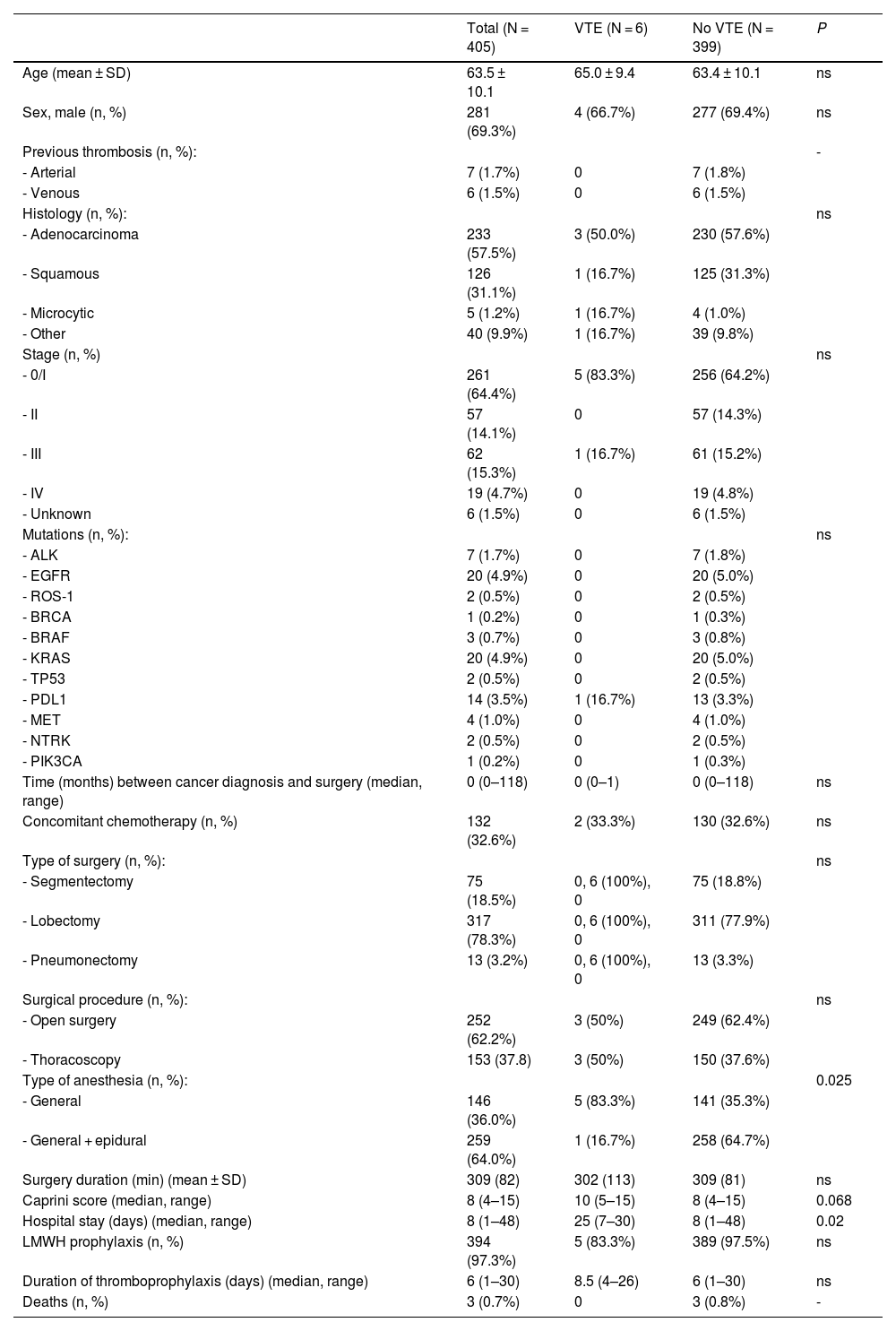
A total of 405 patients (281 [69%] males) with a mean age of 63.5 ± 10.1 years were included in the study. Baseline characteristics of the study population are shown in Table 1. The most frequent lung cancer histologies were adenocarcinoma (58%) and squamous cell carcinoma (31%). In almost two-thirds of the patients, the tumor stage was 0 or 1, while only 20% of the patients presented with stages III or IV. Among patients harboring somatic mutations, EGFR and KRAS were the most frequently involved genes (5% of the patients in both cases). Median time between cancer diagnosis and surgery was less than one month. One-third of the patients had received chemotherapy before surgery or had started it during the 90-day follow-up period. Thirteen patients (3.2%) had a previous history of arterial or venous thrombosis. All patients except one were classified as high or very high-risk of VTE according to the Caprini score.

Table 1.

Baseline characteristics and outcomes.

  Total (N = 405)  VTE (N = 6)  No VTE (N = 399)  P 
Age (mean ± SD)  63.5 ± 10.1  65.0 ± 9.4  63.4 ± 10.1  ns 
Sex, male (n, %)  281 (69.3%)  4 (66.7%)  277 (69.4%)  ns 
Previous thrombosis (n, %):       
- Arterial  7 (1.7%)  7 (1.8%)   
- Venous  6 (1.5%)  6 (1.5%)   
Histology (n, %):        ns 
- Adenocarcinoma  233 (57.5%)  3 (50.0%)  230 (57.6%)   
- Squamous  126 (31.1%)  1 (16.7%)  125 (31.3%)   
- Microcytic  5 (1.2%)  1 (16.7%)  4 (1.0%)   
- Other  40 (9.9%)  1 (16.7%)  39 (9.8%)   
Stage (n, %)        ns 
- 0/I  261 (64.4%)  5 (83.3%)  256 (64.2%)   
- II  57 (14.1%)  57 (14.3%)   
- III  62 (15.3%)  1 (16.7%)  61 (15.2%)   
- IV  19 (4.7%)  19 (4.8%)   
- Unknown  6 (1.5%)  6 (1.5%)   
Mutations (n, %):        ns 
- ALK  7 (1.7%)  7 (1.8%)   
- EGFR  20 (4.9%)  20 (5.0%)   
- ROS-1  2 (0.5%)  2 (0.5%)   
- BRCA  1 (0.2%)  1 (0.3%)   
- BRAF  3 (0.7%)  3 (0.8%)   
- KRAS  20 (4.9%)  20 (5.0%)   
- TP53  2 (0.5%)  2 (0.5%)   
- PDL1  14 (3.5%)  1 (16.7%)  13 (3.3%)   
- MET  4 (1.0%)  4 (1.0%)   
- NTRK  2 (0.5%)  2 (0.5%)   
- PIK3CA  1 (0.2%)  1 (0.3%)   
Time (months) between cancer diagnosis and surgery (median, range)  0 (0–118)  0 (0–1)  0 (0–118)  ns 
Concomitant chemotherapy (n, %)  132 (32.6%)  2 (33.3%)  130 (32.6%)  ns 
Type of surgery (n, %):        ns 
- Segmentectomy  75 (18.5%)  0, 6 (100%), 0  75 (18.8%)   
- Lobectomy  317 (78.3%)  0, 6 (100%), 0  311 (77.9%)   
- Pneumonectomy  13 (3.2%)  0, 6 (100%), 0  13 (3.3%)   
Surgical procedure (n, %):        ns 
- Open surgery  252 (62.2%)  3 (50%)  249 (62.4%)   
- Thoracoscopy  153 (37.8)  3 (50%)  150 (37.6%)   
Type of anesthesia (n, %):        0.025 
- General  146 (36.0%)  5 (83.3%)  141 (35.3%)   
- General + epidural  259 (64.0%)  1 (16.7%)  258 (64.7%)   
Surgery duration (min) (mean ± SD)  309 (82)  302 (113)  309 (81)  ns 
Caprini score (median, range)  8 (4–15)  10 (5–15)  8 (4–15)  0.068 
Hospital stay (days) (median, range)  8 (1–48)  25 (7–30)  8 (1–48)  0.02 
LMWH prophylaxis (n, %)  394 (97.3%)  5 (83.3%)  389 (97.5%)  ns 
Duration of thromboprophylaxis (days) (median, range)  6 (1–30)  8.5 (4–26)  6 (1–30)  ns 
Deaths (n, %)  3 (0.7%)  3 (0.8%) 

Segmentectomy was performed in 75 patients (18.5%), 6 of whom had multiple segmentectomies during in the same surgery. Lobectomy was performed in 317 patients (78.3%), and pneumonectomy was performed in 13 patients (3.2%) (Table 1). The surgical techniques used were open thoracotomy in 252 patients (62.2%) and thoracoscopy in 153 (37.8%). Median length of hospital stay after surgery was 8 days (range, 1–48 days). At our institution, below-knee compression stockings are used for all surgical inpatients until discharge. Almost all patients (97.3%) received pharmacological thromboprophylaxis with LMWH (bemiparin 3,500 IU daily). Median duration of LMWH thromboprophylaxis was 6 days (range, 1–30) (Table 1). Only 5 patients (1.2%) completed more than 3 weeks with prophylactic LMWH after surgery.

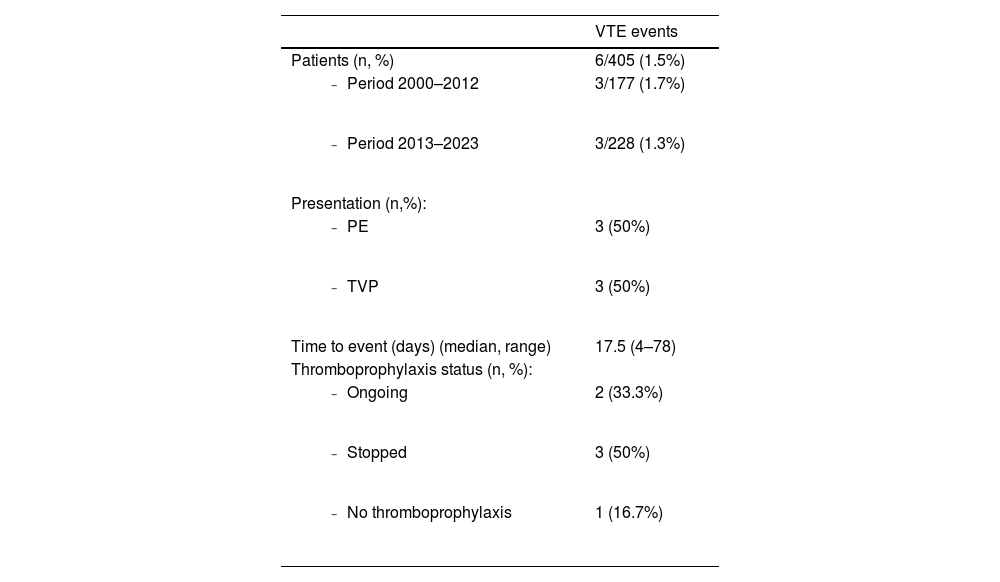
Among the 11 patients not receiving LMWH, a clear contraindication (i.e., active bleeding or thrombocytopenia) was identified in 4 (36%). Nine of the patients not receiving LMWH were treated surgically in the study period from 2000–2012 (9/177 patients; 5.1%) compared to 2 in the study period from 2013–2023 (2/228 patients; 0.9%); P = .013.

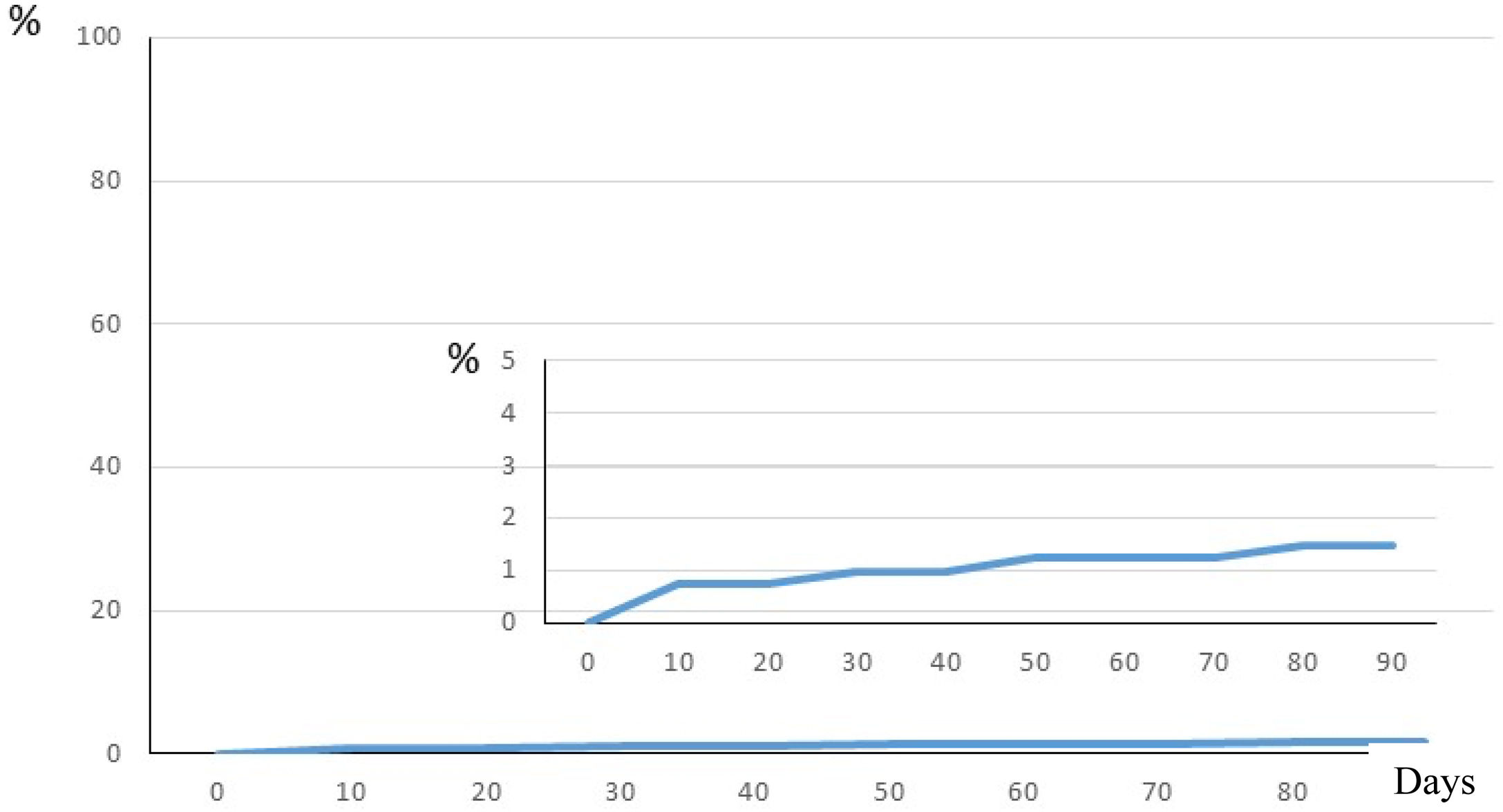
During follow-up, 6 patients (1.5%) developed a VTE event: 3 isolated lower-limb deep vein thrombosis (DVT), and 3 non-fatal pulmonary embolisms (PE), 2 of which were incidental findings. Median time between surgery and the diagnosis of the thrombotic event was 17.5 days (range, 4–78) (Fig. 1). Two events occurred during anticoagulant prophylaxis, followed by 3 events once it had been completed, and one event was recorded in a patient who had not received LMWH prophylaxis (Table 2). Patients with VTE after surgery had less often received concomitant epidural analgesia (16.7% vs 64.7%; P = .025) and tended to have higher Caprini scores as well as longer postoperative hospital stays than patients without VTE (25 days vs 8 days, respectively; P = .02) (Table 1). No other differences in baseline variables were identified.

Figure 1.

Cumulative incidence of VTE.

Table 2.

Characteristics of VTE episodes.

  VTE events 
Patients (n, %)  6/405 (1.5%) 
  • -

    Period 2000–2012

 
3/177 (1.7%) 
  • -

    Period 2013–2023

 
3/228 (1.3%) 
Presentation (n,%):   
  • -

    PE

 
3 (50%) 
  • -

    TVP

 
3 (50%) 
Time to event (days) (median, range)  17.5 (4–78) 
Thromboprophylaxis status (n, %):   
  • -

    Ongoing

 
2 (33.3%) 
  • -

    Stopped

 
3 (50%) 
  • -

    No thromboprophylaxis

 
1 (16.7%) 

No arterial thrombotic events were registered during follow-up. Three patients (0.7%) died during the 90-day follow-up, although none of the deaths was related with a VTE event.

Discussion

When we examined a large real-world series of patients who had undergone lung cancer surgery, we found high adherence rates with pharmacological thromboprophylaxis (which increased from 95% in the 2000–2012 period to over 99% in the 2013–2023 period) and a low rate of VTE events (1.5%) within the 3 months following surgery.

The increase in the use of LMWH prophylaxis in the second period of the study could be partially explained by a deeper awareness about its importance in both medical and surgical inpatients. Indeed, the 2012 ACCP guidelines on antithrombotic therapy and prevention of thrombosis encouraged the use of validated risk scores to prevent VTE, including the Caprini score (for surgical patients) or the Padua score (for acute medical patients).6 These scores and others could be incorporated into electronic alert systems, resulting in significantly reduced VTE rates among hospitalized patients.7

Although the need to use antithrombotic therapy in hospitalized patients seems clear, the optimal duration of antithrombotic prophylaxis after discharge in thoracic oncologic interventions is a matter of debate. Several randomized clinical trials support a strong recommendation of extended prophylaxis (4 weeks) in abdominal or pelvic cancer surgery, either open or laparoscopic.2 Some experts advocate expanding this recommendation to other high-risk surgeries such as lung cancer surgery, although specific randomized clinical trials are lacking.5 Under these circumstances, individualized evaluation is recommended, taking into account not only the surgery itself but also other patient factors. In a recent international survey among thoracic surgeons, only a minority of respondents routinely recommended extended thromboprophylaxis, with little agreement regarding the most relevant risk factors for decision-making.8

In our study of high-risk and very high-risk patients, the median duration of LMWH prophylaxis was 6 days, which was prolonged for more than 2 weeks in a minority of patients. After 3 months, the global rate of VTE among our patients was 1.5%, with no registered fatal events. Only 3 thrombotic events (0.7%) occurred after postoperative day 10. Making a simple estimation, and assuming a 50% reduction in the risk of VTE with extended thromboprophylaxis,9 the number of treated patients needed to prevent a VTE event would be 266.

The published rates of VTE after lung cancer surgery are highly variable, reaching 15% in certain studies performed before the generalized use of antithrombotic prophylaxis. In a Chinese study published in 2018, the rate of VTE without antithrombotic prophylaxis was 11.5%.10 In our series, among the 11 patients who did not receive LMWH, one (9.1%) developed VTE during follow-up. The prevalence of VTE in another Spanish study of patients undergoing elective thoracic surgery was 0.18% (1.31% in pneumonectomy patients).11 In a recent study based on a Swedish administrative database, the rates of PE and DVT 90 days after lung cancer surgery were 1.18% and 0.76%, respectively, which is very similar to our findings. No information was given about the thromboprophylaxis regimens used.12 Another recent non-randomized study examined the incidence of VTE after lung cancer surgery depending on the duration of antitrombotic prophylaxis. In patients receiving in-hospital thromboprophylaxis alone, the 6-month rate of VTE was 4%, compared to 1.2% in patients with extended thromboprophylaxis for 4 weeks.13 However, 4 out of 10 VTE events in the first group occurred 3 to 6 months after surgery, and it is seeming unlikely that extended thromboprophylaxis would have prevented those late events. The overall VTE rate at 3 months was 1.6% (again, similar to ours), with no significant differences between groups. Finally, in a recent randomized study that compared nadroparin vs rivaroxaban as in-hospital VTE prophylaxis (median duration 3 days) after lung cancer surgery, the 30-day rates of VTE were 17.7% and 12.5, respectively.14 In this study, however, a screening ultrasonography was performed at discharge and on postoperative day 30. The rate of major VTE (including proximal DVT and PE) was 0.5% in both groups.

Regarding predictive factors of VTE, the low number of events recorded have limited the analysis. Patients developing VTE showed a trend towards higher Caprini scores. Notably, concomitant epidural analgesia was associated with a significantly lower risk of VTE. Indeed, better pain control can facilitate early mobilization. As confirmed in a meta-analysis published in 2014, this benefit must be weighed against potential adverse effects and technical failures of epidural analgesia.15 In addition, hospital stay after surgery was longer in patients developing VTE. Hospitalization is a risk factor for VTE and could also increase the period of immobilization and, subsequently, the risk of VTE. Nevertheless, a causal relationship cannot be established, since prolonged hospitalization could be a consequence of the thrombosis itself.

There are some limitations of the present study to acknowledge. First, the exclusion of patients under chronic anticoagulant or antiplatelet therapy implies the exclusion of a subgroup of patients at particularly high risk. However, these patients usually resume their antithrombotic therapy in the first 48–72 hours after surgery, which would also influence thrombosis rates. Second, due to the retrospective design of the study, some VTE events could have been missed, particularly when non-symptomatic. However, in routine clinical practice, imaging techniques to screen for VTE (i.e., compression ultrasound) are not systematically performed in the postoperative period. Finally, we do not have data on the rates of major or clinically relevant non-major bleeding that may have influenced the use of thromboprophylaxis. These outcomes, particularly after hospital discharge, are not consistently recorded in the clinical records.

In conclusion, while extended thromboprophylaxis could be considered for certain high-risk thoracic surgical oncology patients, our results do not support its widespread use due to the low rate of VTE after lung cancer surgery. More studies are needed to identify subgroups of patients that could benefit from tailored thromboprophylaxis strategies.

CRediT authorship contribution statement

TR and RL designed the study. TR, MI, CFA, MC, AQ, MR and RL extracted the data from the clinical records. TR and RL drafted the manuscript. MM, PRA and MR critically reviewed and edited the manuscript. All authors approved the final version of the manuscript.

Funding

This research received no specific grants from funding agencies in the public, commercial, or non-profit sectors.

References
[1]
D.R. Anderson, G.P. Morgano, C. Bennett, F. Dentali, C.W. Francis, D.A. Garcia, et al.
American Society of Hematology 2019 guidelines for management of venous thromboembolism: prevention of venous thromboembolism in surgical hospitalized patients.
Blood Adv, 3 (2019), pp. 3898-3944
[2]
A. Falanga, C. Ay, M. Di Nisio, G. Gerotziafas, L. Jara-Palomares, F. Langer, et al.
Venous thromboembolism in cancer patients: ESMO Clinical Practice Guideline.
Ann Oncol, 34 (2023), pp. 452-467
[3]
N.S. Key, A.A. Khorana, N.M. Kuderer, K. Bohlke, A.Y.Y. Lee, J.I. Arcelus, et al.
Venous thromboembolism prophylaxis and treatment in patients with cancer: ASCO guideline update.
J Clin Oncol, 41 (2023), pp. 3063-3071
[4]
D. Farge, C. Frere, J.M. Connors, A.A. Khorana, A. Kakkar, C. Ay, et al.
2022 international clinical practice guidelines for the treatment and prophylaxis of venous thromboembolism in patients with cancer, including patients with COVID-19.
Lancet Oncol, 23 (2022), pp. e334-e347
[5]
Y. Shargall, W. Wiercioch, A. Brunelli, S. Murthy, W. Hofstetter, J. Lin, et al.
Joint 2022 European Society of Thoracic Surgeons and The American Association for Thoracic Surgery guidelines for the prevention of cancer-associated venous thromboembolism in thoracic surgery.
Eur J Cardiothorac Surg, 63 (2022), pp. ezac488
[6]
J.D. Douketis, A.C. Spyropoulos, F.A. Spencer, M. Mayr, A.K. Jaffer, M.H. Eckman, et al.
Perioperative management of antithrombotic therapy: Antithrombotic Therapy and Prevention of Thrombosis, 9th ed: American College of Chest Physicians Evidence-Based Clinical Practice Guidelines.
Chest, 141 (2012), pp. e326S-e350S
[7]
R. Lecumberri, E. Panizo, A. Gomez-Guiu, S. Varea, E. García-Quetglas, M. Serrano, et al.
Economic impact of an electronic alert system to prevent venous thromboembolism in hospitalised patients.
J Thromb Haemost, 9 (2011), pp. 1108-1115
[8]
Y. Shargall, A. Brunelli, S. Murthy, L. Schneider, F. Minervini, L. Bertolaccini, et al.
Venous thromboembolism prophylaxis in thoracic surgery patients: an international survey.
Eur J Cardiothorac Surg, 57 (2020), pp. 331-337
[9]
W. Knoll, N. Fergusson, V. Ivankovic, T.F. Wang, L. Caiano, R. Auer, et al.
Extended thromboprophylaxis following major abdominal/pelvic cancer-related surgery: a systematic review and meta-analysis of the literature.
Thromb Res, 204 (2021), pp. 114-122
[10]
C. Song, Y. Shargall, H. Li, B. Tian, S. Chen, J. Miao, et al.
Prevalence of venous thromboembolism after lung surgery in China: a single-centre, prospective cohort study involving patients undergoing lung resections without perioperative venous thromboembolism prophylaxis.
Eur J Cardiothorac Surg, 55 (2019), pp. 455-460
[11]
M.T. Gómez-Hernández, M. Rodríguez-Pérez, N. Novoa-Valentín, M. Jiménez-López, J.L. Aranda-Alcaide, G. Varela-Simó.
Prevalence of venous thromboembolism in elective thoracic surgery.
Arch Bronconeumol, 49 (2013), pp. 297-302
[12]
J. Björklund, J. Rautiola, R. Zelic, G. Edgren, M. Bottai, M. Nilsson, et al.
Risk of venous thromboembolic events after surgery for cancer.
[13]
J. Kho, J. Mitchell, N. Curry, F. Di Chiara, D. Stavroulias, E. Belcher.
Should all patients receive extended thromboprophylaxis after resection of primary lung cancer?.
J Thorac Cardiovasc Surg, 164 (2022), pp. 1603-1611.e1
[14]
M. Zhao, Y. Bao, C. Jiang, L. Chen, L. Xu, X. Liu, et al.
Rivaroxaban versus nadroparin for thromboprophylaxis following thoracic surgery for lung cancer: a randomized, noninferiority trial.
Am J Hematol, 98 (2023), pp. 1185-1195
[15]
D.M. Pöpping, N. Elia, H.K. Van Aken, E. Marret, S.A. Schug, P. Kranke, et al.
Impact of epidural analgesia on mortality and morbidity after surgery: systematic review and meta-analysis of randomized controlled trials.
Ann Surg, 259 (2014), pp. 1056-1067
Copyright © 2025. AEC
Article options
Tools