







Laparoscopic cholecystectomy is widely performed in ambulatory surgery, whereas minilaparotomy approaches remain underreported. This study evaluates the outcomes of transcylindrical cholecystectomy (TCC), performed with a cylindrical retractor, in an outpatient setting under different anesthetic techniques.
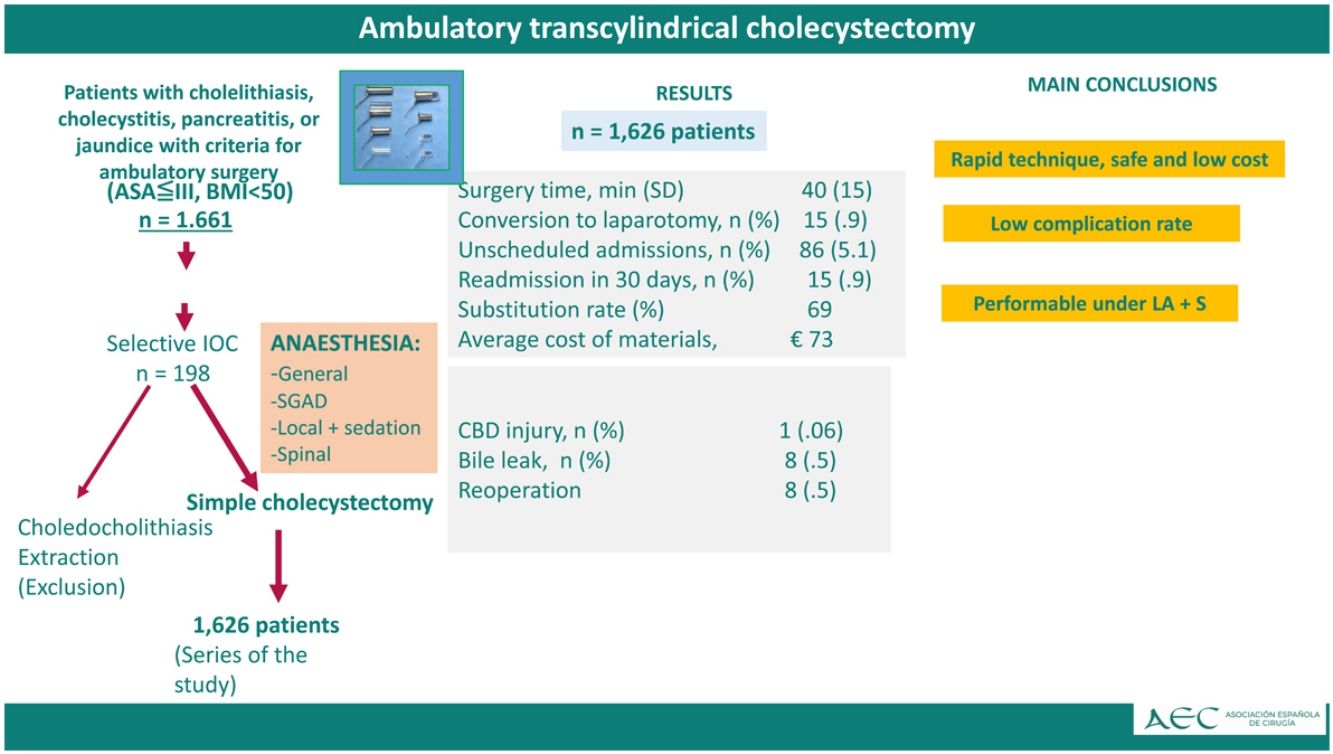
MethodsProspective observational study of 1626 patients with cholelithiasis or related complications who underwent right transrectal epigastric minilaparotomy (4.5 cm), using a cylindrical retractor with a methacrylate plunger for direct visualization and stable exposure of the hepatocystic triangle. Anesthetic modality (general, supraglottic device, local with sedation, or spinal) was tailored to each patient. Intraoperative cholangiography was selectively performed.
ResultsA total of 1626 patients underwent TCC: 916 with orotracheal intubation, 152 with supraglottic device, 503 under local anaesthesia with sedation, and 55 with spinal anaesthesia. Mean age: 59 years; BMI: 30; operative time: 40 min. The substitution index was 69%. Conversion occurred in 15 cases (0.9%), with 90 unplanned admissions (5.5%), 8 postoperative bile leaks (0.5%), 37 wound infections (2.2%), 2 deaths (0.1%), and 1 major bile duct injury (0.06%). There were 15 readmissions (0.9%) and 8 reoperations (0.5%). At 24 h, 78% of patients reported good or excellent physical condition.
ConclusionsTranscylindrical cholecystectomy is a fast, safe, and cost-effective technique for treating cholelithiasis in the ambulatory setting. It is feasible under minimally invasive anaesthesia, with low complication rates, and may be particularly valuable in resource-limited environments.
La colecistectomía laparoscópica es habitual en cirugía mayor ambulatoria (CMA), mientras que por minilaparotomía ha sido poco explorada. Este estudio analiza los resultados de la colecistectomía transcilíndrica (CTC), realizada mediante un separador cilíndrico, en régimen de CMA y bajo distintas técnicas anestésicas.
MétodoEstudio observacional prospectivo de 1.626 pacientes con colelitiasis o complicaciones, intervenidos mediante minilaparotomía epigástrica transrectal de 4,5 cm, con introducción de un separador cilíndrico provisto de émbolo de metacrilato, que permite visión directa y exposición estable del triángulo hepatocístico. El tipo de anestesia (general, supraglótica, local con sedación o espinal) fue individualizado. Se realizó colangiografía intraoperatoria de forma selectiva.
ResultadosSe operaron 1.626 pacientes: 916 con intubación orotraqueal, 152 con dispositivo supraglótico, 503 bajo anestesia local y sedación, y 55 con anestesia espinal. Edad media: 59 años; IMC: 30; tiempo quirúrgico: 40 min. El índice de sustitución fue del 69%. Hubo 15 conversiones (0,9%), 90 ingresos no programados (5,5%), 8 fugas biliares postoperatorias (0,5%), 37 infecciones de herida (2,2%), 2 fallecimientos (0,1%) y 1 lesión de vía biliar (0,06%). Reingresos: 15 (0,9%); reintervenciones: 8 (0,5%). El 78% refirió estado bueno o excelente a las 24 horas.
ConclusionesLa CTC es una técnica rápida, segura y coste-efectiva para el tratamiento de la colelitiasis en CMA. Puede realizarse con anestesia mínimamente invasiva, presenta bajas tasas de complicaciones y constituye una alternativa útil en centros con recursos limitados.


