


metricas
covid
Cirugía Española (English Edition) Towards ambulatorization of appendectomy: Lessons learned during the pandemic
Journal Information
Visits
6
Vol. 103. Issue 7.
(July 2025)
Original article
Towards ambulatorization of appendectomy: Lessons learned during the pandemic
Hacia la ambulatorización de la apendicectomía: lecciones aprendidas durante la pandemia
Visits
6
Rebeca González Peredoa,1, Víctor Jacinto Ovejero Gómezb,1, Patrizio Petronec,h,
Corresponding author
patrizio.petrone@gmail.com

Corresponding author.
, Corrado P. Marinid, María Dolores Prieto Salcedae, José Manuel Bernal Marcof, Dieter Morales-Garcíag
a Servicio de Urgencias, Hospital Sierrallana, Torrelavega, Cantabria, Spain
b Servicio de Cirugía General, Hospital Universitario Marqués de Valdecilla, Facultad de Medicina, Universidad de Cantabria, Santander, Cantabria, Spain
c NYU Grossman Long Island School of Medicine, New York, NY, United States
d Jacobi Medical Center, Bronx, NY, United States
e Observatorio de Salud Pública, Fundación Marqués de Valdecilla, Santander, Cantabria, Spain
f Departamento de Ciencias Médicas y Quirúrgicas, Facultad de Medicina, Universidad de Cantabria, Santander, Cantabria, Spain
g Servicio de Cirugía, Hospital Clínico Universitario Virgen de la Victoria, Instituto Biomédico de Investigación de Málaga (IBIMA), Facultad de Medicina, Universidad de Málaga, Málaga, Spain
h Chair, Research Committee, Panamerican Trauma Society
This item has received
Article information
Abstract
Full Text
Bibliography
Download PDF
Statistics
Tables (4)
Table 1. Demographic and clinical characteristics of the sample.
Tables
Table 2. Binary logistic regression with complicated acute appendicitis as the dependent variable and sex, age, comorbidities, pre-SOE/SOE, and duration of symptoms as independent variables.
Tables
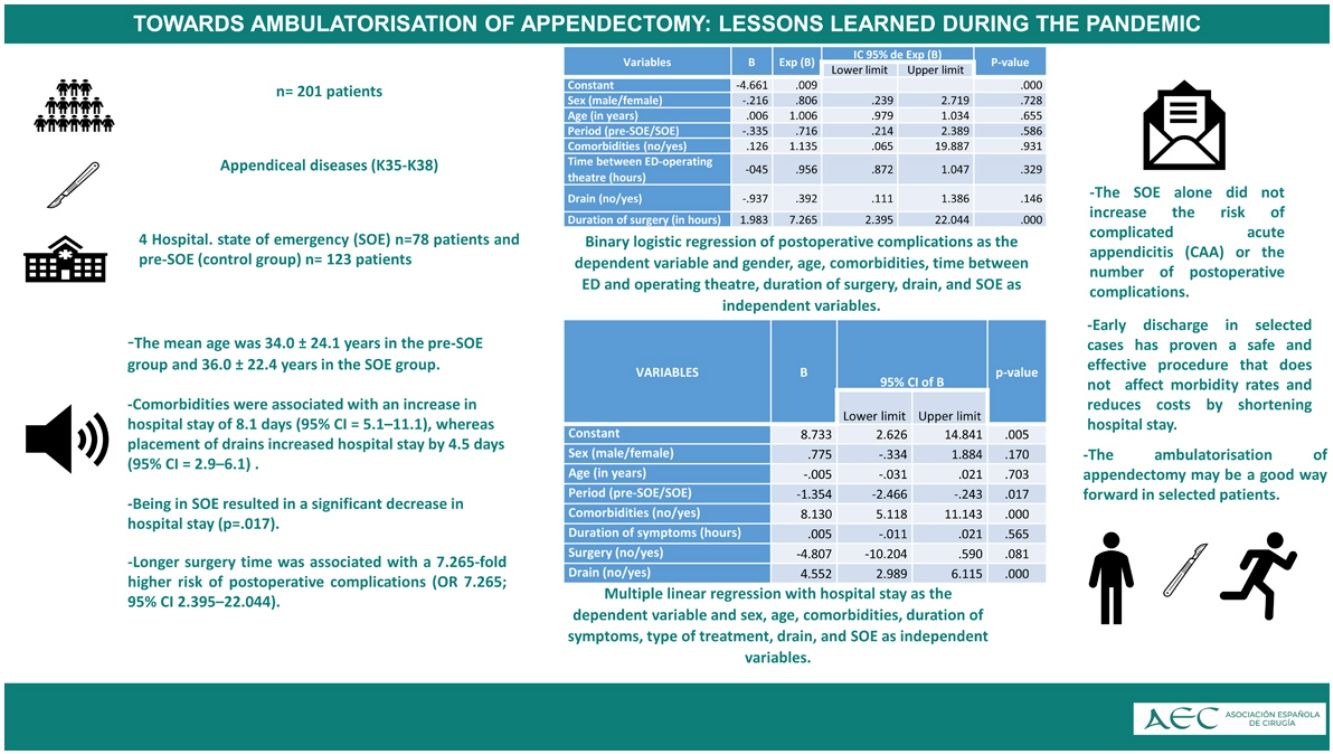
Table 3. Binary logistic regression of postoperative complications as the dependent variable and sex, age, comorbidities, time between ED and operating theatre, duration of surgery, drain, and SOE as independent variables.
Tables
Table 4. Multiple linear regression with hospital stay as the dependent variable and sex, age, comorbidities, duration of symptoms, type of treatment, drain, and SOE as independent variables.
Tables
Show moreShow less
Figures (1)
Abstract
Background

Acute appendicitis is the most common abdominal surgical emergency worldwide. Researchers from various countries have evaluated the impact of the COVID-19 pandemic on its diagnosis and treatment, as well as a possible change in its management, such as outpatient treatment. The objective of this study was to describe the characteristics of acute appendicitis treated during the COVID-19 State of Emergency (SOE) and to assess whether it could be included in an ambulatory surgery program.

Methods

Retrospective observational study involving patients treated at public hospitals for appendix diseases (K35–K38). We collected sociodemographic and clinical data. The influence of the lockdown on each variable was evaluated with a multivariate analysis.

Results

201 patients were included. The SOE period group comprised 78 patients, and the pre-SOE period (control) included 123 patients who met the same inclusion criteria. The risk of complicated acute appendicitis increased by 1.015 times with age (p = 0.000). The longer surgery time was associated with a 7.265 times higher risk of postsurgical complications (p = 0.000). No differences were observed with respect to drain placement (p = 0.281), although the percentage was higher in 2020 (13.9% vs 19.7%). The length of hospital stay decreased significantly during the lockdown (p = 0.017).

Conclusion

The lockdown did not influence the outcome of complicated acute appendicitis from the standpoint of morbidity and mortality, reducing the hospital stay, facilitating the path towards outpatient treatment.

Keywords:
COVID-19
Lockdown
Appendicitis
Surgery
Emergency
Ambulatory surgery
Resumen
Introducción

la apendicitis aguda es la urgencia quirúrgica abdominal más común. Investigadores de varios países han evaluado el impacto de la pandemia de COVID-19 en su diagnóstico y tratamiento, así como un posible cambio de paradigma en su manejo, como es la ambulatorización. El objetivo de este estudio fue describir las características de la apendicitis aguda tratada durante el Estado de Alarma por COVID-19 y determinar los factores que influyen para su inclusión en un programa de cirugía mayor ambulatoria.

Métodos

Estudio observacional retrospectivo de pacientes atendidos en hospitales públicos por enfermedades del apéndice (K35-K38). Se recopilaron datos sociodemográficos y clínicos. La influencia del confinamiento en cada variable se evaluó mediante un análisis multivariado.

Resultados

Se incluyeron 201 pacientes. El grupo del período de alarma estuvo compuesto por 78 pacientes y el período de pre-alarma (control) incluyó a 123 pacientes que cumplieron los mismos criterios de inclusión. El riesgo de apendicitis aguda complicada aumentó 1,015 veces con la edad (p = 0,000). La mayor duración de la cirugía se asoció con un riesgo 7,265 veces mayor de complicaciones posquirúrgicas (p = 0,000). No se observaron diferencias respecto a la colocación de drenajes (p = 0,281), aunque el porcentaje fue mayor en 2020 (13,9% vs 19,7%). La duración de la estancia hospitalaria disminuyó significativamente durante el confinamiento (p = 0,017).

Conclusión

El confinamiento no influyó en el resultado de la apendicitis aguda complicada desde el punto de vista de la morbilidad y la mortalidad, reduciéndose la estancia hospitalaria, facilitando el camino hacia la ambulatorización de la misma.


Palabras clave:
COVID-19
Confinamiento
Apendicitis
Cirugía
Emergencia
Cirugía mayor ambulatoria
Graphical abstract

Article

These are the options to access the full texts of the publication Cirugía Española (English Edition)
Subscriber
Subscriber

If you already have your login data, please click here .

If you have forgotten your password you can you can recover it by clicking here and selecting the option “I have forgotten my password”
Subscribe
Subscribe to

Cirugía Española (English Edition)

Purchase
Purchase article

Purchasing article the PDF version will be downloaded

Purchase now
Contact
Phone for subscriptions and reporting of errors
From Monday to Friday from 9 a.m. to 6 p.m. (GMT + 1) except for the months of July and August which will be from 9 a.m. to 3 p.m.
Calls from Spain
932 415 960
Calls from outside Spain
+34 932 415 960
E-mail
Article options
Tools
