


metricas
covid
Archivos de la Sociedad Española de Oftalmología (English Edition) Management of bilateral oculomotor paralysis after traumatic head injury: a case...
Journal Information
Vol. 100. Issue 8.
Pages 504-507 (August 2025)
Vol. 100. Issue 8.
Pages 504-507 (August 2025)
Short communication
Management of bilateral oculomotor paralysis after traumatic head injury: a case report
Manejo de las parálisis oculomotoras bilaterales tras un traumatismo craneoencefálico: a propósito de un caso
P. Talavero González
Corresponding author
paulatalaverogonzalez@gmail.com

Corresponding author.
, J. García Bella, E. Hernández García, E. Vico Ruiz, Á. Romo López, R. Gómez de Liaño Sánchez
Departamento de Oftalmología, Hospital Clínico San Carlos, Calle del Profesor Martín Lagos s/n. 28040, Madrid, Spain
Article information
Abstract
Full Text
Bibliography
Download PDF
Statistics
Figures (3)
Show moreShow less
Abstract

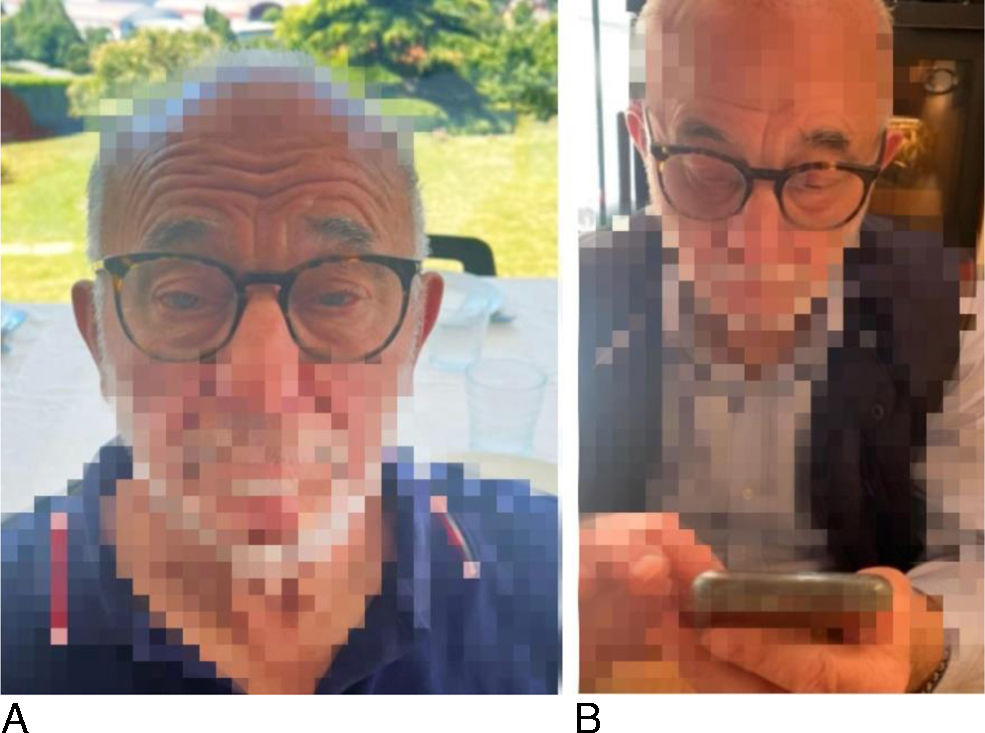
A 73-year-old male with disabling torticollis. He suffered a severe traumatic head injury when he had 36 years old, affecting multiple cranial nerves, including III, IV and VI bilaterally. On actual examination he presented a large torticollis left head turn that compensates the diplopía. In the right eye, −4 limitation of adduction, −1 limitation of elevation and horizontal nystagmus on abduction. In the left eye, −6 limitation of abduction, −2 limitation of adduction, −1 limitation of elevation and −2 limitation of depression (0–8 scale). The right eye underwent Nasal Nishida procedure and the left eye underwent a Temporal Nishida. One year after the surgery the patient was no longer maintaining a head turn but had a mild tilt to the right and inttermitent diplopía.

Nishida procedure can be a good option in cases of complex bilateral oculomotor paralysis.

Keywords:
Oculomotor paralysis
Torticollis
Adduction
Abduction
Nishida procedure
Resumen

Varón de 73 años con tortícolis incapacitante; que con 36 años sufrió un traumatismo craneoencefálico severo afectándose múltiples pares craneales, incluyendo III, IV y VI de forma bilateral. Presenta tortícolis cabeza a la izquierda de gran magnitud que compensa la diplopia. En el ojo derecho limitación de la aducción de −4, de la elevación de −1 y nistagmo horizontal en abducción. En el ojo izquierdo limitación de la abducción de −6, de la aducción de −2, de la elevación de −1 y de la depresión de −2 (Escala de 0 a −8). Se realiza en el ojo derecho una técnica de Nishida nasal, y en el ojo izquierdo una técnica de Nishida temporal. Al año presenta mínima inclinación de la cabeza a la derecha y leve diplopia intermitente.

El procedimiento de Nishida puede ser una buena solución en casos de parálisis bilaterales complejas.


Palabras clave:
Parálisis oculomotora
Tortícolis
Aducción
Abducción
Técnica de Nishida

Article

These are the options to access the full texts of the publication Archivos de la Sociedad Española de Oftalmología (English Edition)
Subscriber
Subscriber

If you already have your login data, please click here .

If you have forgotten your password you can you can recover it by clicking here and selecting the option “I have forgotten my password”
Subscribe
Subscribe to

Archivos de la Sociedad Española de Oftalmología (English Edition)

Purchase
Purchase article

Purchasing article the PDF version will be downloaded

Purchase now
Contact
Phone for subscriptions and reporting of errors
From Monday to Friday from 9 a.m. to 6 p.m. (GMT + 1) except for the months of July and August which will be from 9 a.m. to 3 p.m.
Calls from Spain
932 415 960
Calls from outside Spain
+34 932 415 960
E-mail
Article options
Tools