







Hypopharyngeal squamous cell carcinoma (HPSCC) is a highly aggressive malignancy with poor prognosis due to late-stage diagnosis and complex anatomical challenges. Advances in minimally invasive techniques, particularly transoral laser microsurgery (CO2TOLMS), have demonstrated promise in improving oncologic and functional outcomes while preserving organ function.
Materials and methodsA retrospective study analyzed 25 patients with histologically confirmed HPSCC treated with CO2TOLMS at a tertiary academic hospital (2016–2021). Patients underwent curative-intent CO2TOLMS, with outcomes assessed for survival, recurrence, and functional recovery.
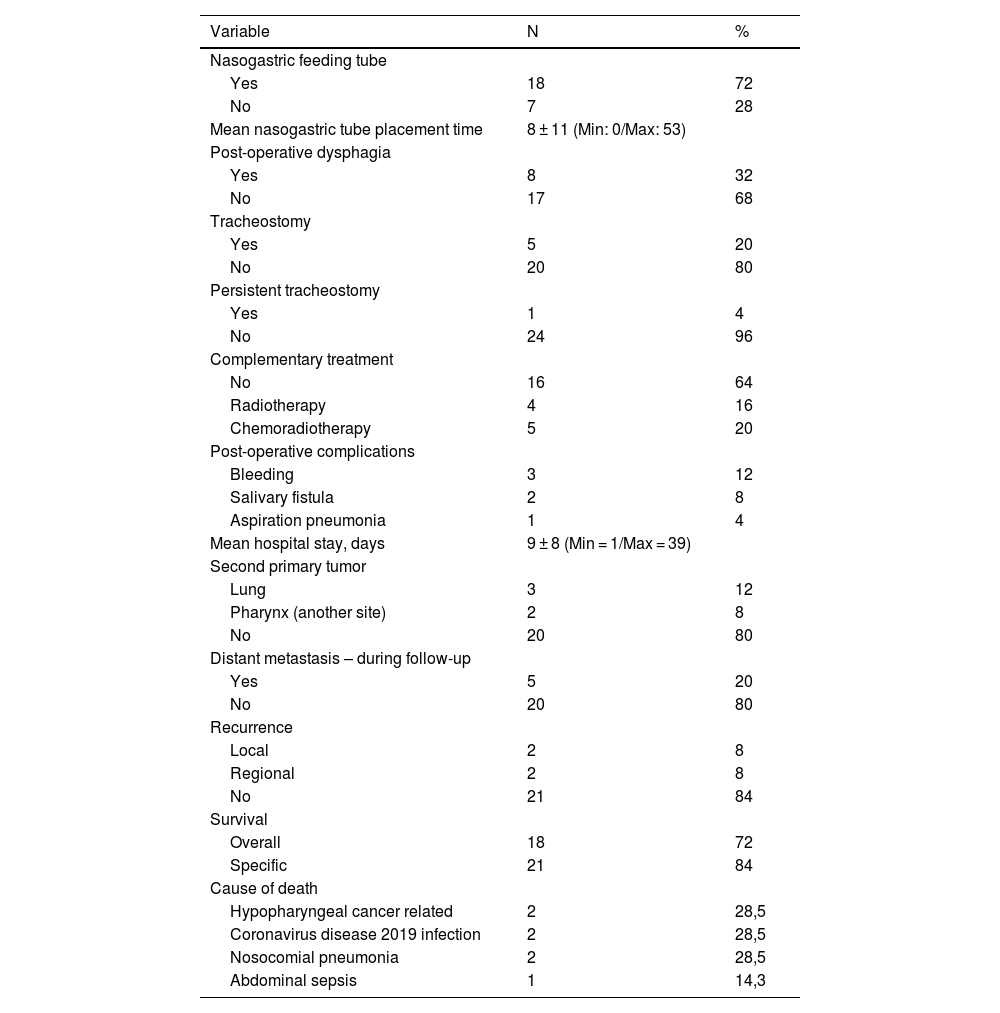
ResultsThe 3-year overall survival and disease-specific survival rates were 72% and 84%, respectively. Surgical margins were disease-free in 76% of patients, while postoperative complications were minimal (persistent tracheostomy in 4%, long-term nasogastric feeding tube dependency in 4%). Local and regional recurrence rates were each 8%. Laryngeal preservation was achieved in 95% of cases, significantly enhancing quality of life. Histologic grade correlated with recurrence risk, though survival outcomes were consistent across tumor stages and surgical margin status.
ConclusionsCO2TOLMS offers an effective and minimally invasive treatment for early-stage HPSCC, achieving good oncological and functional outcomes. While it provides low morbidity and high organ preservation rates, further research is needed to refine multimodal treatment strategies for advanced-stage disease.
El carcinoma escamoso de hipofaringe (HPSCC) constituye una neoplasia altamente agresiva, caracterizada por un pronóstico desfavorable debido a su diagnóstico en estadios avanzados y a las dificultades anatómicas inherentes a la región. Los avances en técnicas mínimamente invasivas, en particular la microcirugía transoral con láser de CO₂ (CO₂TOLMS), han demostrado resultados oncológicos y funcionales prometedores, a la vez que favorecen la preservación orgánica.
Material y métodosSe llevó a cabo un estudio retrospectivo que incluyó a 25 pacientes con diagnóstico histológico de HPSCC tratados mediante CO2TOLMS en un hospital universitario de tercer nivel durante el periodo 2016–2021. Todos los pacientes fueron sometidos a cirugía con intención curativa. Se evaluaron las tasas de supervivencia, recurrencia y recuperación funcional.
ResultadosLas tasas de supervivencia global y supervivencia específica por enfermedad a tres años fueron del 72% y 84%, respectivamente. Los márgenes quirúrgicos estuvieron libres de enfermedad en el 76% de los casos. Las complicaciones postoperatorias fueron mínimas (traqueostomía persistente en un 4% y dependencia prolongada de sonda nasogástrica en un 4% de los pacientes). Las tasas de recurrencia local y regional fueron ambas del 8%. La preservación laríngea se alcanzó en el 95% de los pacientes, lo cual se tradujo en una mejora significativa de la calidad de vida. Se observó que el grado histológico se correlacionó con el riesgo de recurrencia, mientras que el estadio tumoral o los márgenes quirúrgicos no afectaron la supervivencia.
ConclusionesLa CO₂TOLMS representa una alternativa terapéutica eficaz y mínimamente invasiva para el tratamiento del HPSCC en estadios iniciales. Además de proporcionar baja morbilidad y elevadas tasas de preservación de orgáno. Sin embargo, son necesarios nuevos estudios que nos ayuden a optimizar las estrategias de tratamiento multimodales en estadios avanzados.
