



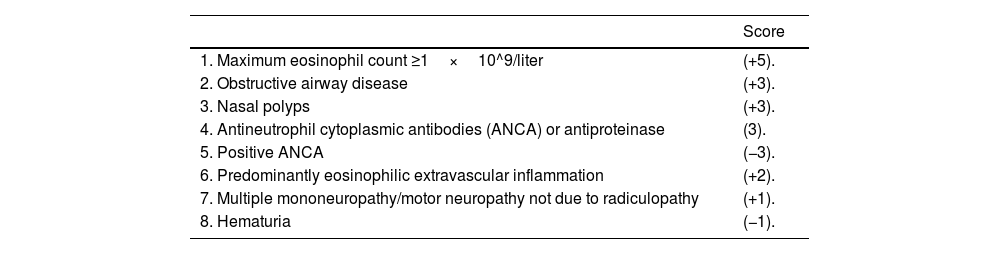


Eosinophilic granulomatosis with polyangiitis (EGPA) is an ANCA-associated vasculitis affecting multiple systems, with common ear, nose and throat (ENT) manifestations. This study aimed to evaluate the most frequent ENT manifestations in EGPA patients and the relationship between nasal polyps and other clinical findings such as ANCA tests and eosinophilia.
Materials and methodsA retrospective observational study was conducted on EGPA patients diagnosed between 2000 and 2024 at a tertiary hospital using the 2022 ACR/EULAR criteria. Head and neck examinations, including audiometry, and their imaging and histopathological studies were reviewed. Patients were classified based on the presence or absence of nasal polyps, and the relationship between ANCA positivity and eosinophilia was assessed.
ResultsOf 173 patients with ANCA vasculitis, 22 met EGPA criteria, with a prevalence of 3.6 per 100,000 in Cantabria. Head and neck manifestations were observed in 90.5% of patients (19/21). Sinonasal involvement was the most frequent (82%), with otological manifestations in 31.8% (7/21). Nasal polyps were the most common manifestation (7/21). Head and neck biopsies were performed in 7 cases (32%), which showed no evidence of vasculitis. There was no statistically significant association between nasal polyps, ANCA positivity, and eosinophilia.
ConclusionsSinonasal involvement is prevalent in EGPA, often presenting as chronic rhinitis or rhinosinusitis with or without polyps. Otological issues, such as eustachian tube dysfunction and sensorineural hearing loss, are also common. No laryngeal, oral, or salivary gland lesions were observed. There was no significant correlation between the presence of polyps and ANCA positivity or eosinophilia.
La granulomatosis eosinofílica con poliangitis (GEPA) es una vasculitis asociada a ANCA que afecta a múltiples sistemas, con manifestaciones otorrinolaringológicas frecuentes. El objetivo de este estudio fue evaluar las manifestaciones ORL más frecuentes en pacientes con GEPA y la relación entre los pólipos nasales y otros hallazgos clínicos como las pruebas ANCA y la eosinofilia.
Material y métodosSe realizó un estudio observacional retrospectivo en pacientes con GEPA diagnosticados entre 2000 y 2024 en un hospital terciario utilizando los criterios ACR/EULAR de 2022. Se revisaron los exámenes de cabeza y cuello, incluida la audiometría, y sus estudios de imagen e histopatológicos. Los pacientes se clasificaron en función de la presencia o ausencia de pólipos nasales, y se evaluó la relación entre la positividad ANCA y la eosinofilia.
ResultadosDe 173 pacientes con vasculitis ANCA, 22 cumplían criterios GEPA, con una prevalencia de 3,6 por 100.000 en Cantabria. Las manifestaciones en cabeza y cuello se observaron en el 90,5% de los pacientes (19/21). La afectación nasosinusal fue la más frecuente (82%), con manifestaciones otológicas en el 31,8% (7/21). Los pólipos nasales fueron la manifestación más frecuente (7/21). Se realizaron biopsias de cabeza y cuello en 7 casos (32%), que no mostraron evidencia de vasculitis. No hubo asociación estadísticamente significativa entre pólipos nasales, positividad ANCA y eosinofilia.
ConclusionesLa afectación nasosinusal es prevalente en la GEPA, presentándose a menudo como rinitis crónica o rinosinusitis con o sin pólipos. También son frecuentes los problemas otológicos, como la disfunción de la trompa de Eustaquio y la hipoacusia neurosensorial. No se observaron lesiones laríngeas, orales o de las glándulas salivales. No hubo correlación significativa entre la presencia de pólipos y la positividad para ANCA o la eosinofilia.
