



metricas
covid
Acta Otorrinolaringológica Española Assessment of the impact of post-COVID-19 olfactory dysfunction on quality of li...
Journal Information
Share
Download PDF
More article options
Visits
35
Original article
Uncorrected Proof. Available online 22 December 2025
Assessment of the impact of post-COVID-19 olfactory dysfunction on quality of life: Comparison of specific questionnaires
Evaluación del impacto de la disfunción olfativa post-COVID-19 en la calidad de vida: comparación de cuestionarios específicos
Visits
35
Carlota Rovira-Martíneza, Mariana Campos-Motamayora, Aina Sansa-Pernaa, Elios Yustea, Laura Gelaberta, Josep de Haro-Licerb,c, Alda Cardesín-Revillaa, Miguel Caballero-Borregod,e,
Corresponding author
mcaba@clinic.cat

Corresponding author.
a Unidad de Rinologia y Trastornos del Sueño, Departamento de Otorrinolaringología, Hospital ParcTaulí, Sabadell, Spain
b Departamento de Otorrinolaringología, Hospital Municipal Badalona, Badalona, Spain
c Director del Grupo Investigación Interdisciplinar de Asesoramiento de la Percepción (GIIASP), Spain
d Departamento de Otorrinolaringología, Hospital Clínicde Barcelona, Barcelona, Spain
e Departament de Cirurgia, Facultat de Medicina, Universitat de Barcelona, Barcelona, Spain
This item has received
Article information
Abstract
Full Text
Bibliography
Download PDF
Statistics
Figures (2)
Tables (5)
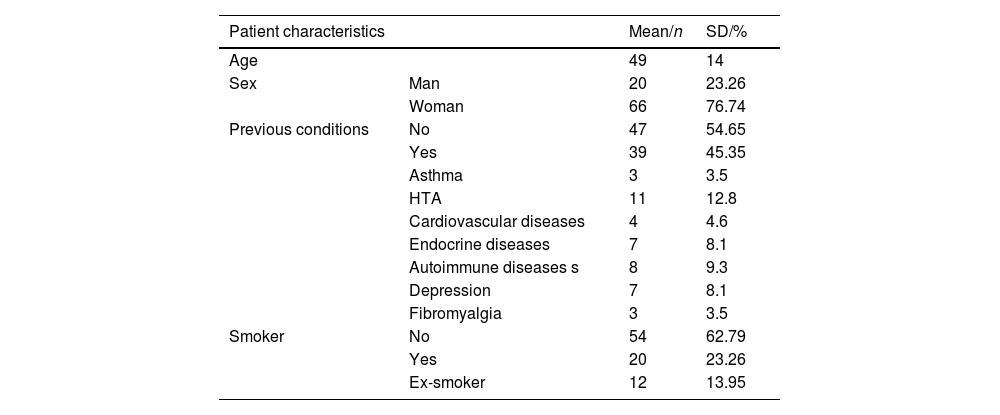
Table 1. Characteristics of the patients included in the study.
Tables
Table 2. Classification of olfactory dysfunction according to the Visual Analog Scale (VAS).
Tables
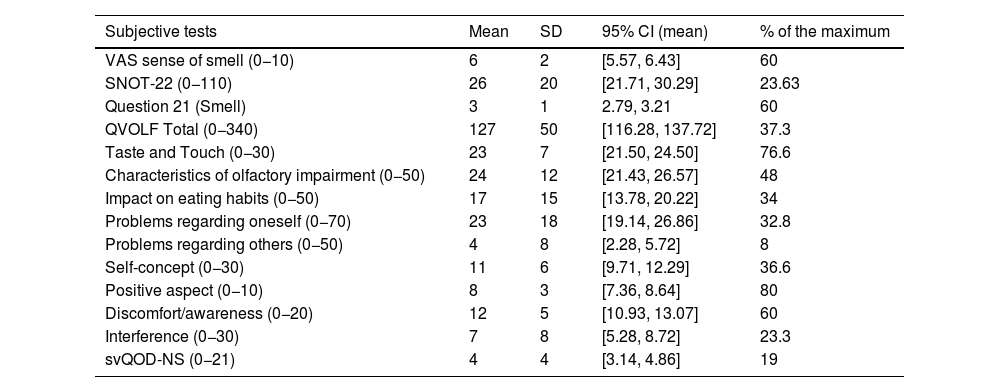
Table 3. Mean scores obtained on the subjective tests: SNOT-22 (including the breakdown of question 21, specific to smell), VAS, QVOLF (with its different descriptive groups), and svQOD-NS. The percentage impact of the score obtained with respect to the maximum possible score.
Tables
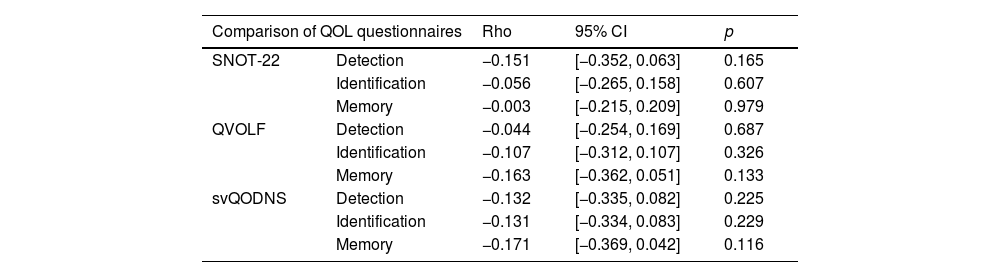
Table 4. Correlation between the SNOT-22, QVOLF, and svQOD-NS quality of life questionnaires and the three domains of the BAST-24 psychophysical test (Detection, Identification, and Memory).
Tables
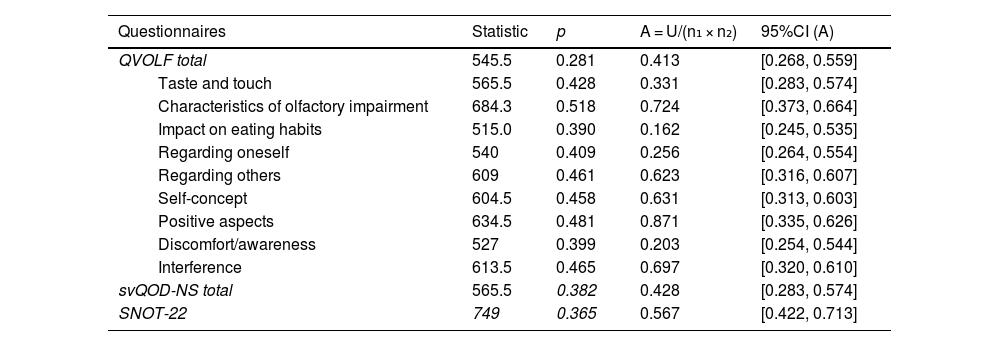
Table 5. Differences between sexes in the responses to the 3 quality-of-life questionnaires (QVOLF, svQOD-NS, and QVOLF), breaking down the QVOLF into descriptive subgroups. The results of the U statistic, p, and 95% CI of the effect size A = U/(n₁ × n₂) are presented.
Tables
Show moreShow less
Additional material (5)
Abstract
Background and objectives

Post-COVID-19 olfactory dysfunction persists in many patients and significantly affects quality of life. The primary objective was to evaluate olfactory function using psychophysical tests (BAST-24) and quality-of-life questionnaires. Secondary objectives included analysing correlations between questionnaires and the relationship between subjective and psychophysical measures.

Materials and methods

A prospective study was conducted including 86 adults with olfactory dysfunction ≥ 6 months after SARS-CoV-2 infection. Clinical and demographic data and scores from the Visual Analog Scale for smell (VAS-smell) and the SNOT-22, svQOD-NS, and QVOLF questionnaires were collected. Olfactory function was assessed using the BAST-24 (detection, identification, and olfactory memory). Descriptive statistics, Spearman’s correlation coefficient, and the Mann-Whitney U test were used (p < 0.05).

Results

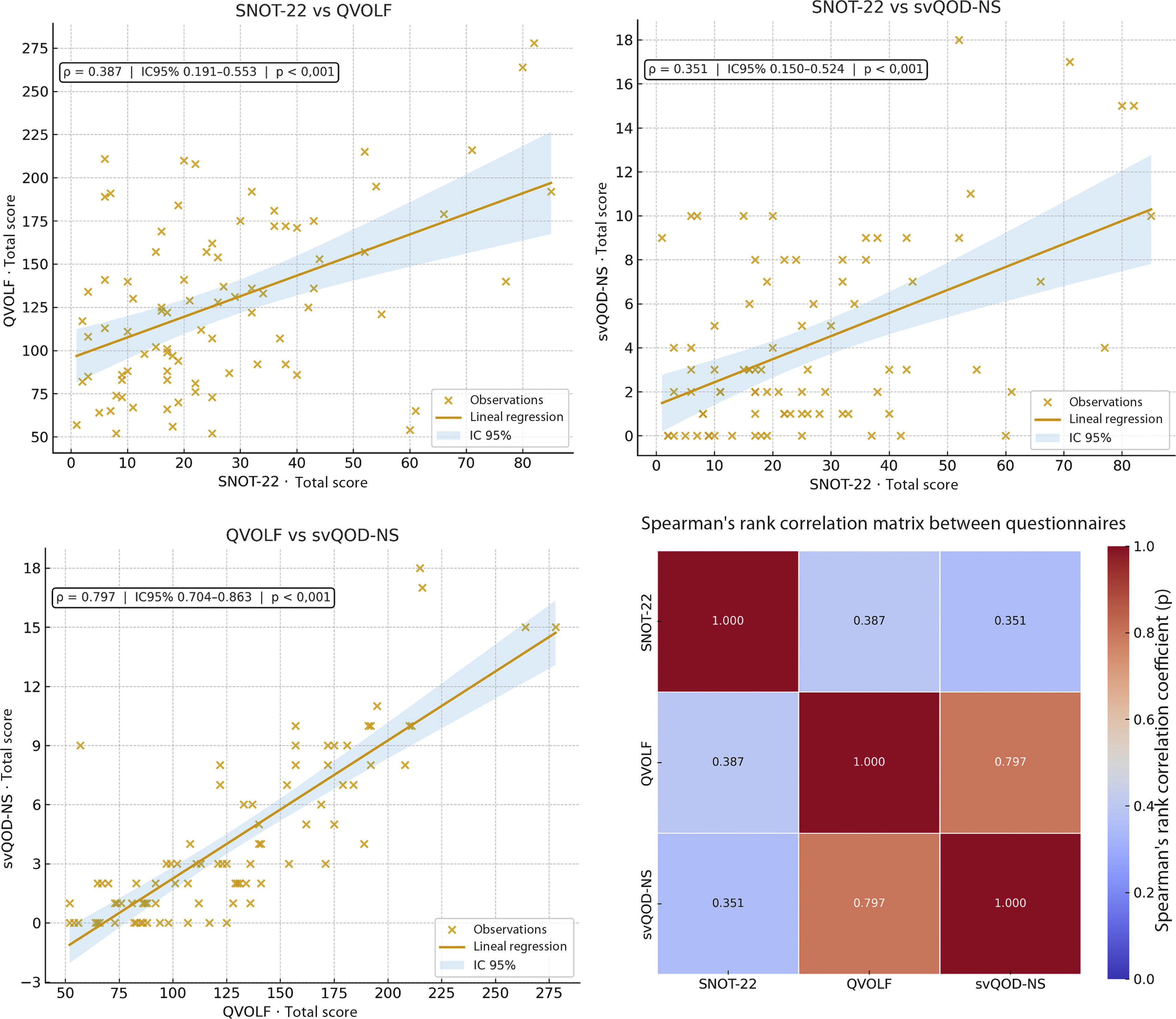
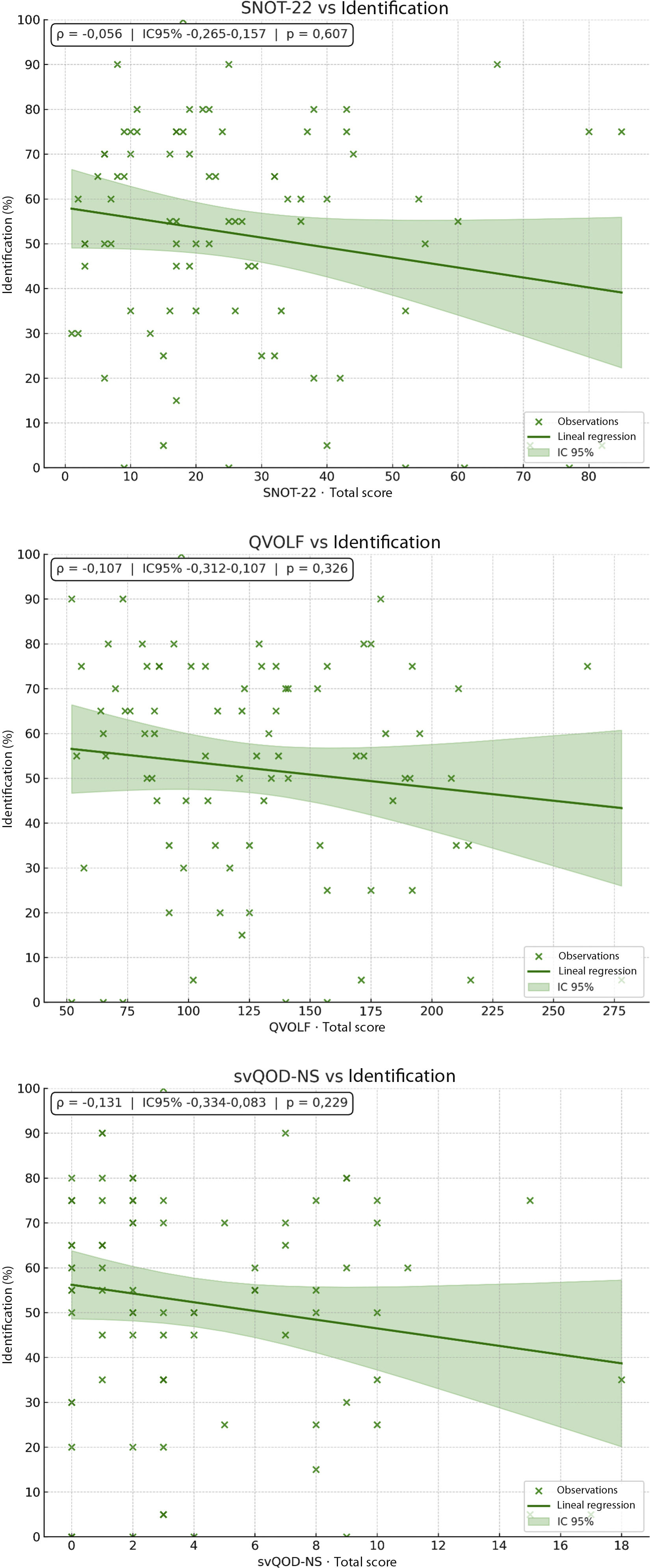
Mean age was 49 years (SD = 14); 76.7% were women. According to the VAS, 90.7% had hyposmia and 8.1% anosmia. Mean scores (SD) were: VAS 6 (2), SNOT-22 26 (20), svQOD-NS 4 (4), and QVOLF 127 (50), suggesting a moderate impact on quality of life. BAST-24 scores: detection 91% (22), identification 52% (25), and memory 35% (20). QVOLF and svQOD-NS showed a strong correlation (ρ = 0.797; p < 0.001), while SNOT-22 correlated moderately with both. No significant correlations were found between any questionnaire and BAST-24.

Conclusions

QVOLF and svQOD-NS questionnaires are more sensitive than SNOT-22 for assessing olfactory dysfunction. The lack of correlation with psychophysical tests highlights the need to combine both approaches fora comprehensive evaluation.

Keywords:
Olfactory dysfunction
COVID-19
Quality of life
Specific questionnaires
BAST-24
SNOT-22
Resumen
Antecedentes y objetivo

La disfunción olfativa post-COVID-19 persiste en muchos pacientes y afecta significativamente la calidad de vida. El objetivo principal fue evaluar la función olfativa con pruebas psicofísicas (BAST-24) y cuestionarios de calidad de vida. Como objetivos secundarios, se analizó la correlación entre los cuestionarios y explorar la relación entre medidas subjetivas y psicofísicas.

Material y métodos

Se realizó un estudio prospectivo en 86 adultos con disfunción olfativa ≥6 meses tras infección por SARS-CoV-2. Se recogieron datos clínico-demográficos, y puntuaciones de la Escala Visual Analógica para el olfato (EVA-olfato) y de los cuestionarios de calidad de vida SNOT-22, svQOD-NS y QVOLF. La función olfativa se evaluó con elBAST-24 (detección, identificación y memoria olfativa). Se usaron estadísticos descriptivos, coeficiente de correlación de Spearman y prueba de Mann-Whitney U (p < 0,05).

Resultados

La edad media fue 49 años (DE = 14; IC95% 46,0–52,0); el 76,7% eran mujeres. Según la EVA, el 90,7% presentó hiposmia y el 8,1% anosmia. Las puntuaciones medias (DE) fueron: EVA 6 (2), SNOT-22 26 (20), svQOD-NS 4 (4) y QVOLF 127 (50), sugiriendo impacto moderado en la calidad de vida. BAST-24: detección 91%, (22) identificación 52% (25) y memoria 35% (20). QVOLF y svQOD-NS mostraron fuerte correlación (ρ = 0,797; p < 0,001) mientras que SNOT-22 correlacionó moderadamente con ambos. No hubo correlaciones significativas entre cuestionarios y BAST-24.

Conclusiones

QVOLF y svQOD-NS son más sensibles que SNOT-22 para evaluarla disfunción olfativa. La ausencia de correlación con pruebas psicofísicas resalta la necesidad de combinar ambas para una evaluación integral.

Palabras clave:
Disfunción olfativa
COVID-19
Calidad de vida
Cuestionarios específicos
BAST-24
SNOT-22

Article

These are the options to access the full texts of the publication Acta Otorrinolaringológica Española
Subscriber
Subscriber

If you already have your login data, please click here .

If you have forgotten your password you can you can recover it by clicking here and selecting the option “I have forgotten my password”
Subscribe
Subscribe to

Acta Otorrinolaringológica Española

Purchase
Purchase article

Purchasing article the PDF version will be downloaded

Purchase now
Contact
Phone for subscriptions and reporting of errors
From Monday to Friday from 9 a.m. to 6 p.m. (GMT + 1) except for the months of July and August which will be from 9 a.m. to 3 p.m.
Calls from Spain
932 415 960
Calls from outside Spain
+34 932 415 960
E-mail