
metricas
covid
Spanish Journal of Psychiatry and Mental Health The influence of reward sensitivity on weight in treatment-resistant chronic sch...
Journal Information
Letter to the Editor
Full text access
Available online 15 February 2024
The influence of reward sensitivity on weight in treatment-resistant chronic schizophrenia
Visits
707
Isaac Jarratt Barnhama,b,
Corresponding author
icjb1@hotmail.co.uk

Corresponding author.
, Youssuf Salehc, Masud Hussainc,d, Emilio Fernandez-Egeaa,e
a Cambridge Psychosis Centre, Cambridgeshire and Peterborough NHS Foundation Trust, Cambridge, UK
b Medical Sciences Division, University of Oxford, John Radcliffe Hospital, Oxford OX3 9DU, UK
c Nuffield Department of Clinical Neurosciences, University of Oxford, Level 6, West Wing, John Radcliffe Hospital, Oxford OX3 9DU, UK
d Department of Experimental Psychology, University of Oxford, Oxford, UK
e Department of Psychiatry, University of Cambridge, Herchel Smith Building for Brain & Mind Sciences, Forvie Site, Robinson Way, Cambridge CB2 0SZ, UK
This item has received
Article information
Full Text
Bibliography
Download PDF
Statistics
Figures (1)
Full Text

Obesity affects 70% of patients with schizophrenia, contributing substantially to this cohort's high risk of cardiovascular mortality.1 Genetics, developmental features, pharmacological factors, and poor lifestyle are all associated with metabolic complications in schizophrenia.1,2 Some studies have also identified an association between lower levels of Schizophrenia's negative symptoms, particularly anhedonia, and higher body mass index (BMI).3,4

We previously hypothesised that this arose due to food representing an easily accessible pleasure source for patients with preserved hedonic capacity (i.e., no anhedonia), leading to excessive eating. Greater negative symptoms, however, might reduce patients’ capacity for food-associated reward, limiting food-seeking behaviour and leading to a lower BMI than amongst patients with preserved hedonic experience.4

This proposal is supported by evidence that, during early psychosis, weight gain is associated with ‘reward sensitivity’ – the degree to which change in the reward associated with an action alters willingness to perform that action.5,6 However, no work has replicated this finding in chronic, treatment-resistant schizophrenia.

To explore this association, we utilised a novel, computer-based cognitive task assessing the motivational aspects of negative symptomology using an effort-based decision-making framework.6,7 This conceptualises decision-making as the weighing of the rewards and costs of different actions to evaluate the optimal behavioural course – a process known as ‘option selection’. Behavioural data generated through asking participants to accept or reject a series of ‘offers’ comprising various reward/effort combinations allows computation of reward and effort sensitivity measures. These reflect, on an individual basis, participant willingness to accept offers as reward and effort magnitude changes.

Our sample included 40 outpatients with treatment-resistant schizophrenia (TRS) managed with atypical antipsychotics, recruited in and around Cambridge, UK, during 2017–18. Inclusion criteria were: (a) aged 18–65, (b) TRS diagnosis (defined as patients refractory to management with two different anti-psychotics), and (c) clinical stability (no antidepressant or antipsychotic medication changes within the last 8 weeks). All participants provided written consent.

They were offered monetary reward to exert physical effort (squeezing a dynamometer).8 For each offer, reward was indicated by number of apples in a tree and effort by height of a bar on its trunk. Negative symptom assessment, including of anhedonia, was performed using the Brief Negative Symptom Scale (BNSS).9

BMI was available for 39 participants (mean BMI=28.8kg/m2). Eight participants’ BMI was within the normal range (18.5–25kg/m2), 16 were overweight (25–30kg/m2) and 15 obese (30–40kg/m2). Associations between BMI and anhedonia were explored using linear regression, and their impact on motivated behaviour by fitting a logistic regression with mixed effects. Fixed effects included: reward, effort, BMI, anhedonia, interactions of BMI and anhedonia on reward and effort, and the reward/effort interaction. Reward and effort were included as random effects at the per-subject level.9

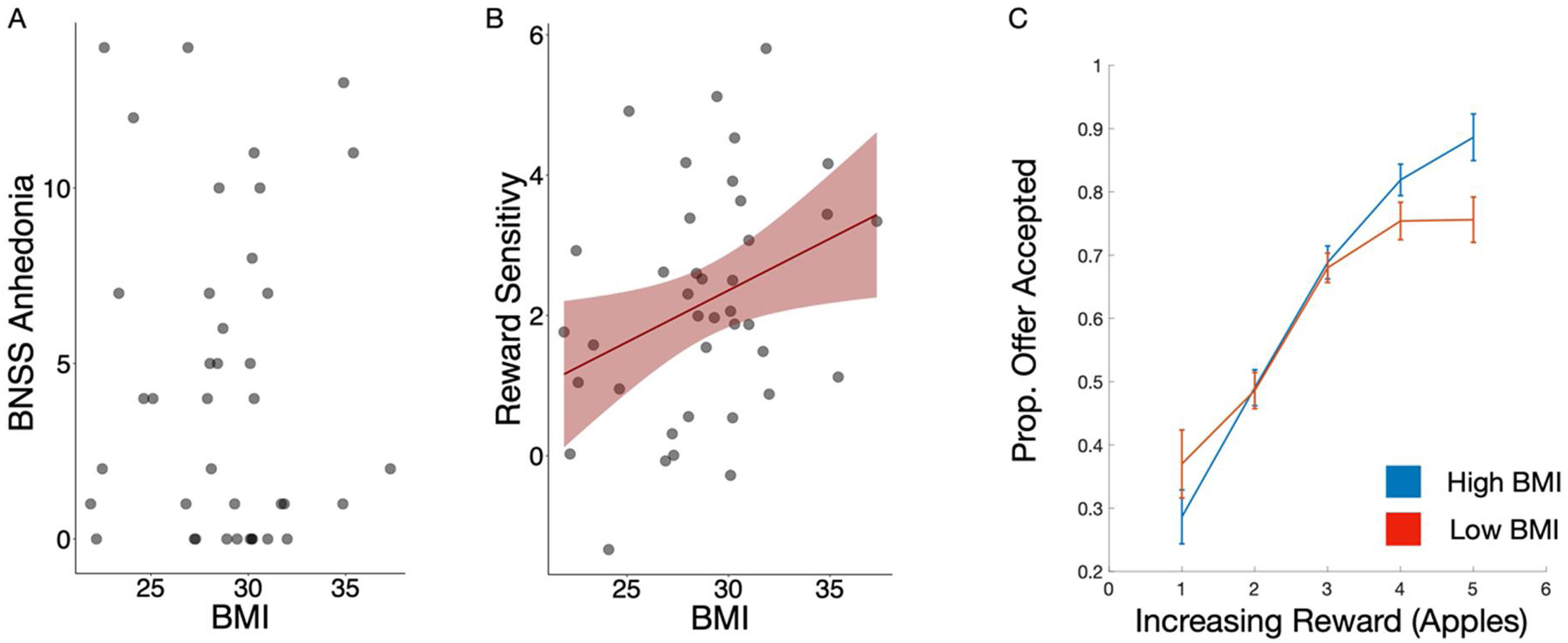
Linear regression found no significant association between anhedonia and BMI (r2=0.001, p=0.84, Fig. 1A). Behavioural analyses confirmed main effects of both reward ([F(1,4848)=65.35, p<0.001]), and effort on choice [F(1,4848)=55.19, p<0.001]. Specifically, greater reward increased offer acceptance whilst greater effort reduced acceptance.

Fig. 1.

Associations between anhedonia, BMI and reward sensitivity. (A) There was no significant association between the anhedonia sub-scale of the BNSS (BNSS_Anh) and BMI. (B) BMI (z-scored) was associated with a significant increase in reward sensitivity. (C) Behaviourally the effect of BMI on reward sensitivity was explained by an increase in offers accepted in those patients with higher BMI at the highest levels of reward (here the patient group is split down the median BMI).

Although BMI had no main effect on choice in this task, there was a significant interaction between reward sensitivity and BMI ([F(1,4848)=3.85, p=0.047], Fig. 1B). Specifically, people with higher BMI accepted more offers as reward levels increased (Fig. 1C). In other words, they were more sensitive to accepting high rewards. Anhedonia, however, was not associated with main effects on choice or reward sensitivity (respectively, ([F(1,4848)=3.28, p=0.07] and [F(1,4848)=0.7, p=0.38]).

This study, therefore, failed to find convincing evidence for associations between BMI, BNSS-measured anhedonia and reward sensitivity. Whilst we demonstrated a significant association between reward sensitivity and BMI, this association was not linked to negative symptoms. Nonetheless, this work is the first demonstrating an association between reward sensitivity and BMI in chronic schizophrenia, extending previous findings amongst those with new onset psychosis.5

Several limitations may explain this study's failure to identify an association between weight and negative symptoms. First, this is a relatively small sample. Second, it lacks a representative control group. Thirdly, clinician-rated measures have various limitations within psychiatric assessment. These include (a) influence of patients’ cognitive impairments on reporting accuracy, (b) susceptibility to clinician-introduced biases (including social desirability and halo effects), and (c) limited precision – they require clinicians to represent numerous patient experiences from various contexts with a single-value.10

These limitations have prompted movement towards objective symptom measures, including the computer-based reward sensitivity assessment deployed here. Objective assessments (e.g., digital phenotyping) might profitably be considered in future projects exploring negative symptoms and their association with BMI.10 Further work exploring the hypothesis that reduced negative symptoms contribute to weight gain in schizophrenia by encouraging eating as an accessible form of reward is needed. Such projects might consider longitudinal study designs to investigate associations between negative symptoms and BMI, employing objective symptom measures.

Acknowledgements

MH is supported in part by the Wellcome Trust (Grant Code 206330/Z/17/Z) and in part by the NIHR Oxford Health Biomedical Research Centre. F-E is supported by the 2022 MRC/NIHR CARP award (MR/W029987/1) and the NIHR Cambridge Biomedical Research Centre (BRC-1215-20014).

References
[1]
S. Galderisi, P. Gorwood, M. de Hert, S. del Prato, S. Leucht, A. Pietro Maggioni.
Identification and management of cardiometabolic risk in subjects with schizophrenia spectrum disorders: a Delphi expert consensus study.
Eur Psychiatry, 64 (2021), pp. 1-8
[2]
H. Ziauddeen, C. Garcia-Rizo, M. Bernardo, et al.
Association of birth weight and the development of antipsychotic induced adiposity in individuals with treatment resistant schizophrenia.
Eur Neuropsychopharmacol, 26 (2016), pp. 972-978
[3]
H.K. Luckhoff, S. Plessis, F. Scheffler, et al.
Neuroimaging Fronto-limbic white matter fractional anisotropy and body mass index in first-episode schizophrenia spectrum disorder patients compared to healthy controls.
Psychiatry Res Neuroimaging, 305 (2020), pp. 111173
[4]
G. Mezquida, G. Savulich, C. Garcia-rizo, et al.
Inverse association between negative symptoms and body mass index in chronic schizophrenia.
Schizophr Res, 192 (2018), pp. 69-74
[5]
M. Nielsen, E. Rostrup, S. Wulff, B. Glenthoj, B. Ebdrup.
Striatal reward activity and antipsychotic-associated weight change in patients with schizophrenia undergoing initial treatment.
JAMA Psychiatry, 73 (2016), pp. 121-128
[6]
Y. Saleh, I. Jarratt-Barnham, E. Fernandez-Egea, M. Husain.
Mechanisms underlying motivational dysfunction in schizophrenia.
Front Behav Neurosci, 15 (2021),
[7]
M. Husain, J.P. Roiser.
Neuroscience of apathy and anhedonia: a transdiagnostic approach.
Nat Rev Neurosci, 19 (2018), pp. 470-484
[8]
Y. Saleh, I. Jarratt-Barnham, P. Petitet, E. Fernandez-Egea, S.G. Manohar, M. Husain.
Negative symptoms and cognitive impairment are associated with distinct motivational deficits in treatment resistant schizophrenia.
[9]
B. Kirkpatrick, G.P. Strauss, L. Nguyen, et al.
The brief negative symptom scale: psychometric properties.
Schizophr Bull, 37 (2011), pp. 300-305
[10]
B.F.-E.E. Kirkpatrick.
Assessment and the concept of negative symptoms.
Spanish J Psychiatry Ment Health, (2023),
Copyright © 2024. Sociedad Española de Psiquiatría y Salud Mental (SEPSM)
Download PDF
Article options
Tools