

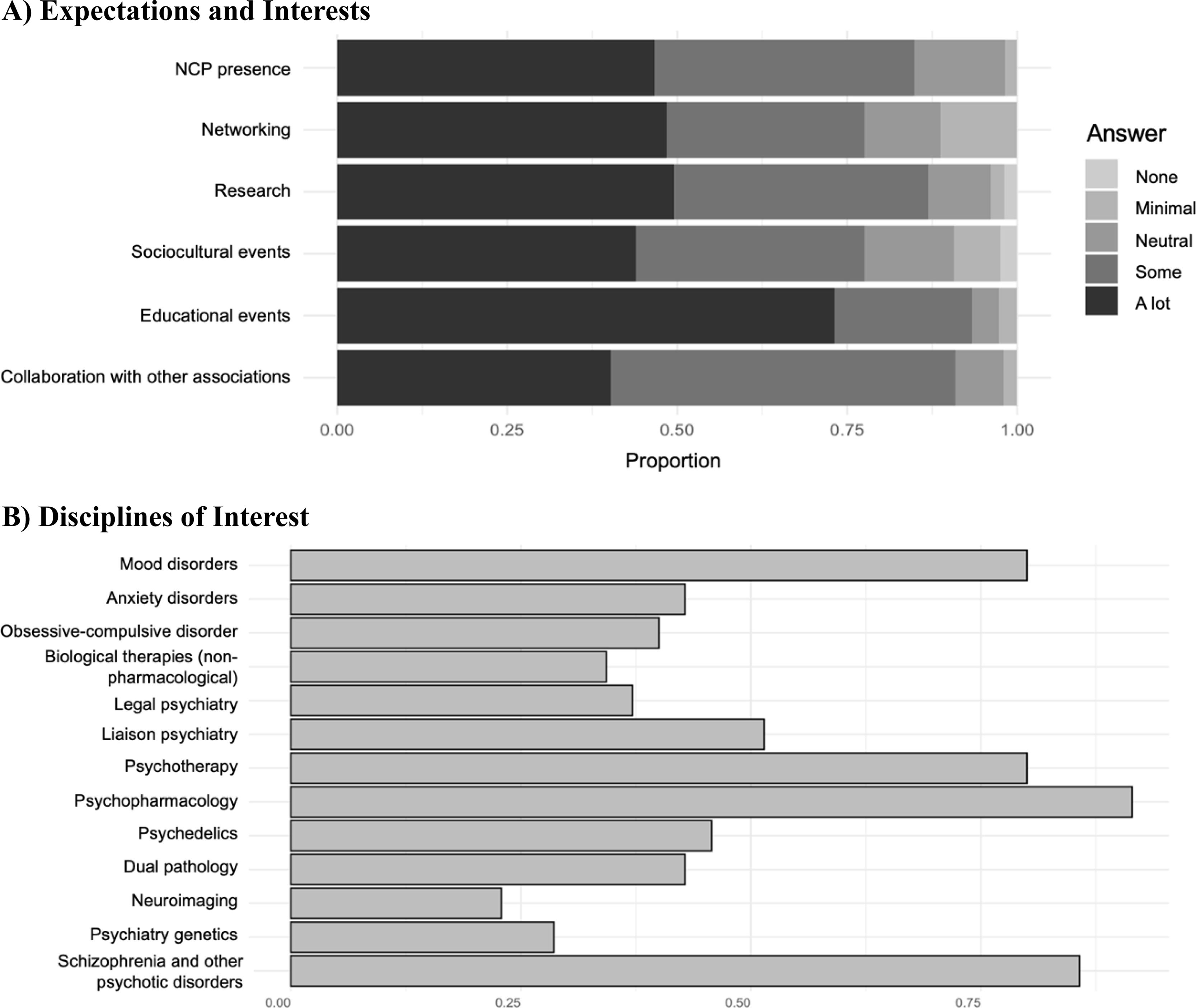
Currently, in the Spanish Society of Psychiatry and Mental Health (SEPSM), there are 545 members under the age of 35. In 2023, the SEPSM established the Young Psychiatrists Section to address the concerns of this group. The Section was presented during the XXVI National Congress of Psychiatry in Salamanca and is coordinated by Dr Justo Pinzón-Espinosa and Dr Gonzalo Svcalazar de Pablo. On November 24, 2023, within the scientific program of the Congress, the first meeting on activities and opportunities for the members of the section where development and training objectives were discussed, was held. In addition, the results of a an exploratory, scoping, voluntary, directed online survey, with mixed Likert-scale questions, multiple choice, and an open-ended question sent to young psychiatrists in the Society were discussed. The survey was replied by 47 young psychiatrists of the SEPSM. Based on this, the expectations and interests for the section were discussed, which we will briefly present in this letter (Fig. 1A).

One of the most notable findings of our survey is the great interest of our Section's members in research. 86% of the respondents expressed a desire to participate in research activities, either through opportunities for internships abroad or by promoting research projects in their centers or with collaborators from other institutions. In response to this interest, as coordinators of the Young Psychiatrists Section of the Spanish Society of Psychiatry and Mental Health, we would like to facilitate young psychiatrists with internships abroad to provide them with valuable exposure to different mental health systems and research opportunities. Additionally, we are committed to promoting independent research among young psychiatrists, recognizing their crucial role in advancing our discipline.1,2 We believe it is important for independent research to be promoted among and by younger psychiatrists3; indeed, recent work carried out within European organizations and entirely driven by “novice” psychiatrists has resulted in high-level publications.4 One of the first projects the our Section aims dertake is a study of the job market landscape and satisfaction of psychiatrists who have completed their training in recent years.
Another objective of the Section is to serve as a liaison between this group and the rest of the scientific society by promoting collaborative projects, seeking to establish formal collaborations and strengthen ties with analogous sections of other societies. At the European level, young psychiatrists from the “European College of Neuropsychopharmacology” (ECNP), the “European Psychiatric Association” (EPA), and the Royal College of Psychiatrists are entities with valuable experience and trajectory in the development of this group. Likewise, at the international level, ties with the “American Psychiatric Association” (APA) and the “World Psychiatric Association” (WPA) will enhance the international projection of our Section and Society. This initiative reflects the growth and European and global horizon of SEPSM,5 promoting the exchange of knowledge and experiences to drive the professional and scientific development of our young members. Additionally, we seek to collaborate with the “Early Career Psychiatrists Committee” (ECPC)6 of the EPA, whose objective is to promote research activities among young psychiatrists and contribute to their professional development by organizing courses, educational events, and collaborating in publications.7 Likewise, the growing Early Career Psychiatrist Section of the WPA offers unique opportunities for the integration and support of psychiatrists at the beginning of their careers internationally, further strengthening the position of psychiatry as a valuable, dynamic, and hopeful field for the future. Joining forces with determination and starting early in the professional career makes psychiatry valuable and hopeful for its future.8
Finally, another point of interest highlighted in the recent survey was independent training activities, which garnered the interest of 74% of the participants. In this regard, young psychiatrists expressed interest in psychopharmacology and psychotherapy (Fig. 1B), two areas of vital importance in the field. In this sense, it is the ambition of this Section to promote and boost quality training activities, such as meetings with experts or update sessions, both within the SESPM congresses and outside of them.
In summary, the SEPSM is dedicated to supporting and promoting the professional development of young psychiatrists in Spain. We are excited about the opportunities that this new Section offers and look forward to collaborating closely to achieve our common goals. We look forward to seeing you in San Sebastián at the XXVII National Congress of Psychiatry where our Section has organized a workshop on systematic reviews to promote research skills among young psychiatrists, which may lead to new and exciting collaborations.
Conflict of interestGSP has received honoraria from Janssen Cilag, Lundbeck, Angelini and Menarini. CA has received honoraria from Janssen Cilag and Neuraxpharm. JP-E has received CME-speaker fees and other non financial support from Angelini, Casen Recordati, Lundbeck, Neuraxpharm and Otsuka, Esteve, Janssen, and Otsuka, all unrelated to the current work.