



El objetivo de este estudio fue investigar la capacidad de predicción de la respuesta terapéutica mediante parámetros derivados de PET con [68Ga]Ga-PSMA, así como la eficacia de los criterios de evaluación de la respuesta en PSMA PET/TC (RECIP) y de la respuesta del PSA para predecir la supervivencia tras la terapia con [177Lu]Lu-PSMA.
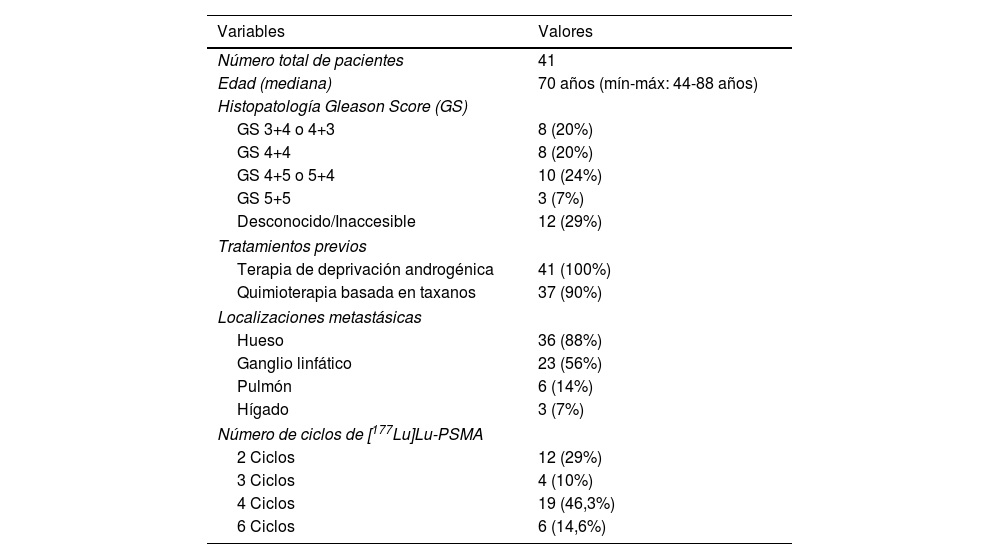
MétodosSe incluyeron retrospectivamente en el estudio pacientes que habían recibido al menos dos ciclos de tratamiento con [177Lu]Lu-PSMA. Todas las lesiones visibles en las imágenes PET fueron segmentadas y se extrajeron los parámetros basados en PSMA-PET. La respuesta al tratamiento se evaluó según los criterios RECIP y del antígeno prostático específico (PSA). Se realizaron análisis de característica operativa del receptor (ROC) para valorar el poder discriminatorio de los distintos parámetros en la predicción de la respuesta. La correlación entre la supervivencia global (SG) y la respuesta evaluada mediante RECIP y PSA se analizó mediante análisis de supervivencia de Kaplan-Meier.
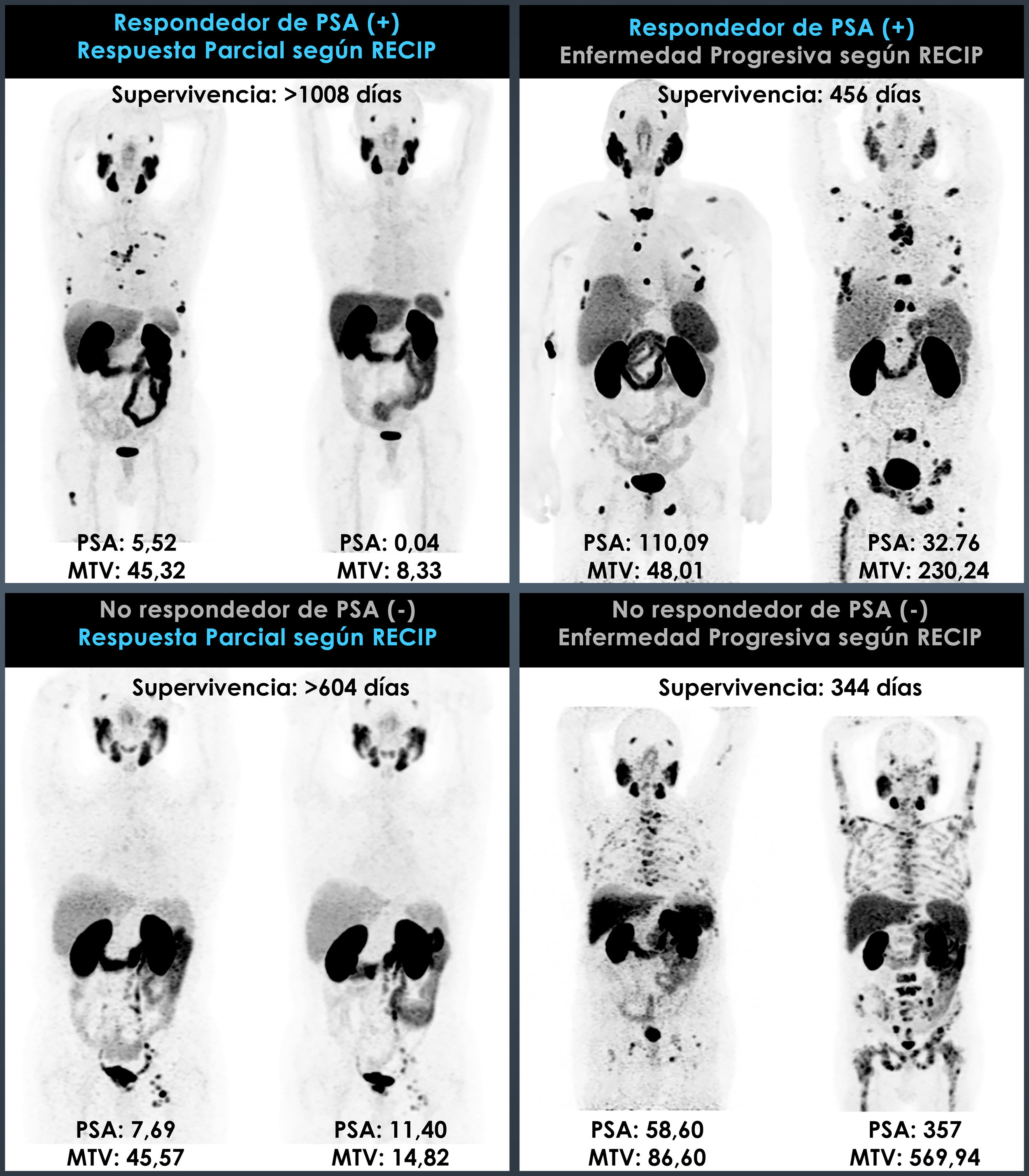
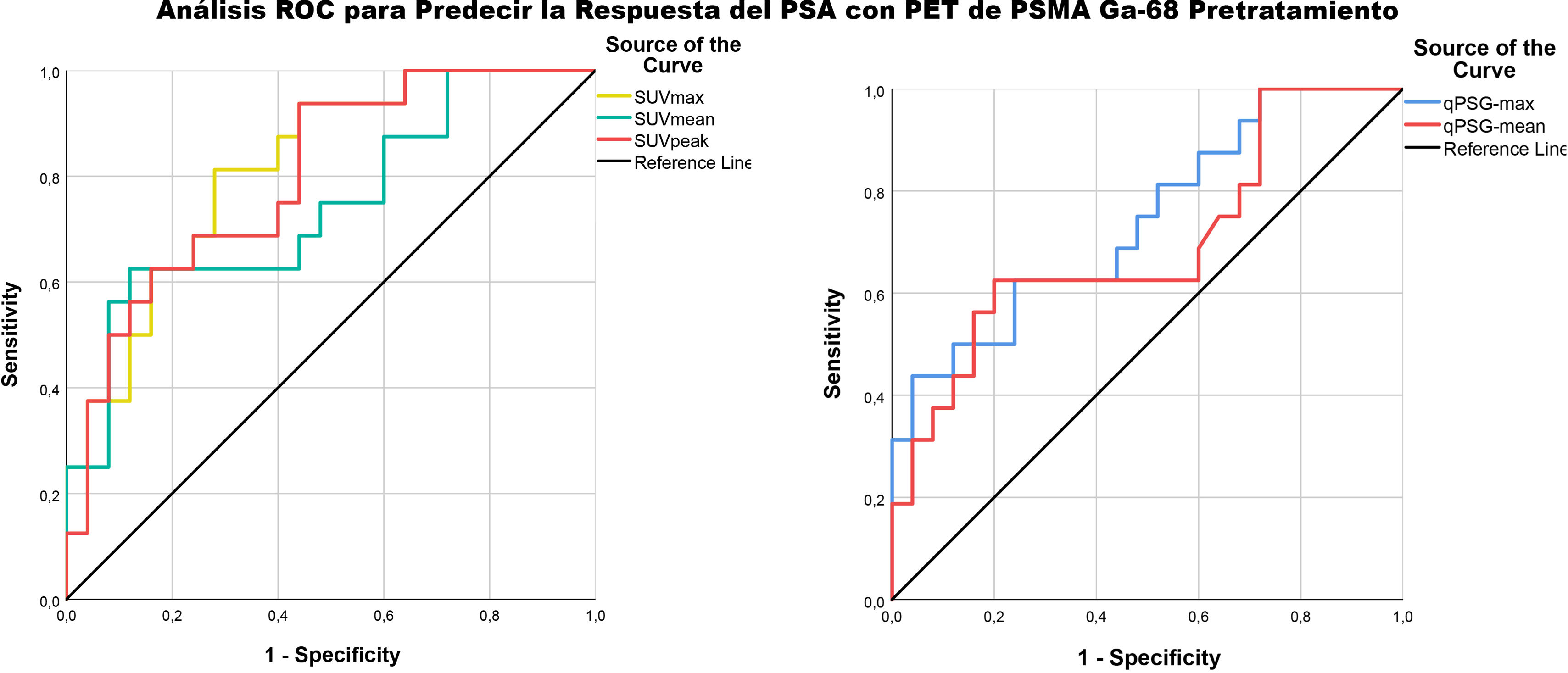
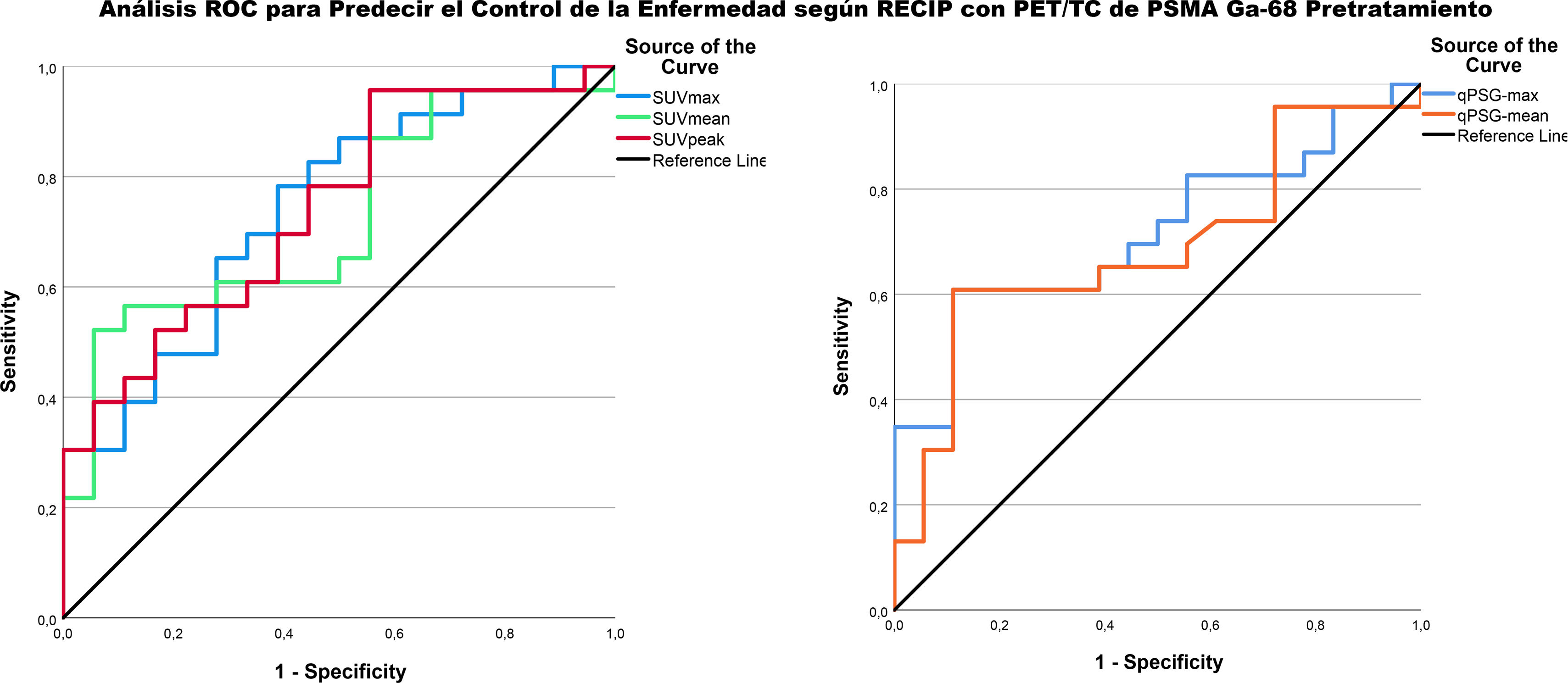
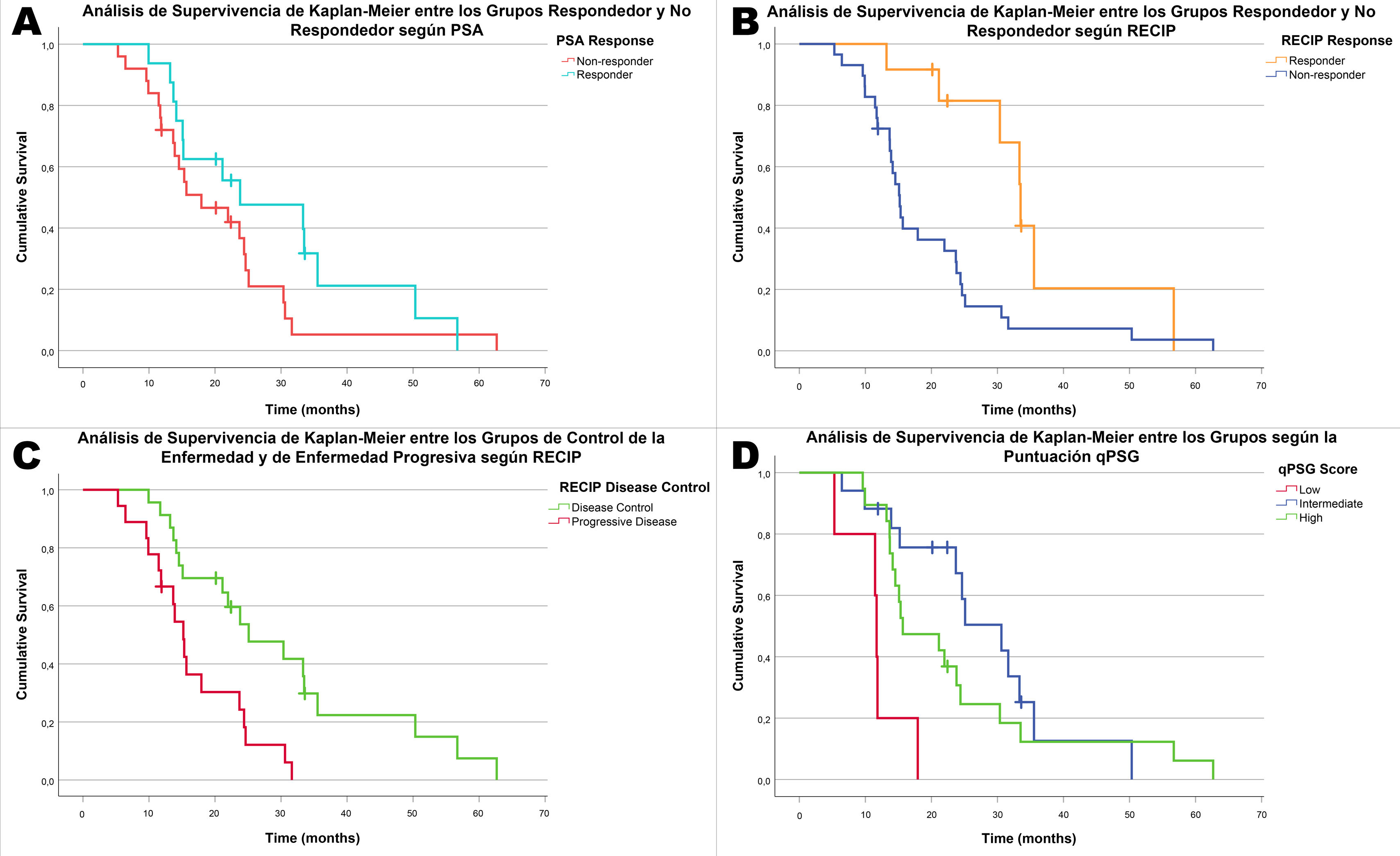
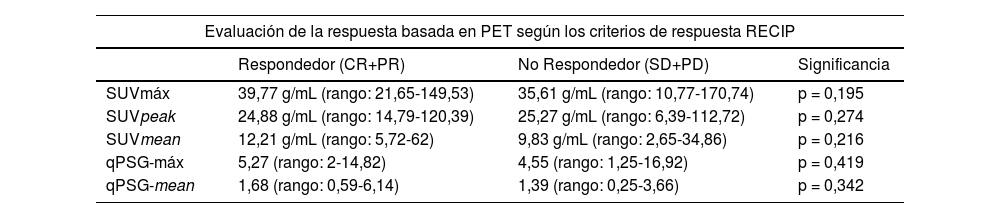
ResultadosEn total se incluyeron 41 pacientes. Los valores de SUVmáx, SUVpeak, SUVmean, qPSG-máx y qPSG-mean fueron factores significativos para predecir la respuesta en base al PSA. Sin embargo, para predecir la respuesta RECIP (CR+PR), los valores del área bajo la curva (AUC) para los parámetros de valor de captación estandarizado (SUV) no fueron significativamente superiores a 0,5. En la predicción del control de enfermedad según RECIP (CR+PR+SD), los valores AUC para SUVmáx, SUVpeak y SUVmean fueron 0,742 (p = 0,002), 0,742 (p = 0,002) y 0,722 (p = 0,006), respectivamente. En los grupos de respondedores y no respondedores según RECIP, la mediana de supervivencia fue de 33,5 y 15,2 meses (p = 0,005), respectivamente. En los pacientes con control de enfermedad frente a enfermedad progresiva según RECIP, la mediana de supervivencia fue de 25,1 y 15,2 meses (p = 0,002). En cambio, la diferencia de supervivencia entre los grupos de respondedores y no respondedores según PSA no alcanzó significación estadística (p = 0,127).
ConclusiónLa imagen molecular mediante PET con antígeno prostático específico de membrana (PSMA) constituye una herramienta útil para seleccionar a los pacientes con mayor probabilidad de beneficiarse del tratamiento con [177Lu]Lu-PSMA. Además, se demostró que los criterios RECIP tienen un rendimiento significativamente mejor que la evaluación basada en el PSA para predecir la SG.
In this study we aimed to investigate prediction of response with [68Ga]Ga-PSMA PET-derived parameters and the effectiveness of RECIP criteria and PSA response in predicting survival after [177Lu]Lu-PSMA therapy.
MethodsPatients who received at least 2 cycles of [177Lu]Lu-PSMA therapy were retrospectively included in the study. All lesions in the PET images were segmented and PSMA PET-based parameters were extracted. The treatment response was evaluated according to RECIP and PSA criteria. ROC analyses were performed to assess their discriminatory power in predicting response. Correlation of overall survival with RECIP and PSA-based response was evaluated using Kaplan-Meier survival analysis.
ResultsA total of 41 patients were included in the study. SUVmáx, SUVpeak, SUVmean, qPSG-max and qPSG-mean values were significant factors in predicting PSA response. However, in predicting RECIP response (CR+PR), the AUC values for the SUV parameters were not significantly higher than 0.5. In predicting RECIP disease control (CR+PR+SD), the AUC values for SUVmáx, SUVpeak, and SUVmean were 0.742(p=0.002), 0.742(p=0.002), and 0.722(p=0.006). In the RECIP-responder and non-responder groups, the median survival was 33.5 and 15.2 months (p=0.005). In patients with RECIP-disease control and progressive disease, the median survival was 25.1 and 15.2 months (p=0.002). However, the survival difference between PSA-responder and non-responders groups did not reach significance (p=0.127).
ConclusionPSMA PET imaging is a useful method to select patients who will most likely to benefit from [177Lu]Lu-PSMA treatment. Also, it has been shown that RECIP has significantly performed better than PSA-based response evaluation in terms of predicting overall survival.
Artículo
Si tiene problemas de acceso puede contactar con la Secretaría Técnica de la SEMNIM en el correo electrónico secretaria.tecnica@semnim.es o en el teléfono: + 34 619 594 780

