






Determinar en nuestra práctica clínica habitual el valor de la PET/TC con [18F]FDG como factor pronóstico en pacientes diagnosticados de linfoma folicular (LF).
Material y métodosEstudio retrospectivo de pacientes con LF valorados con PET/TC en nuestro centro desde el 01/06/2008 hasta el 01/06/2020. Se analizó la relación de parámetros cuantitativos (VMT, GTL, ΔSUVmáx) y criterios cualitativos (clasificación de Lugano), con la supervivencia libre de progresión (SLP) y la supervivencia global (SG).
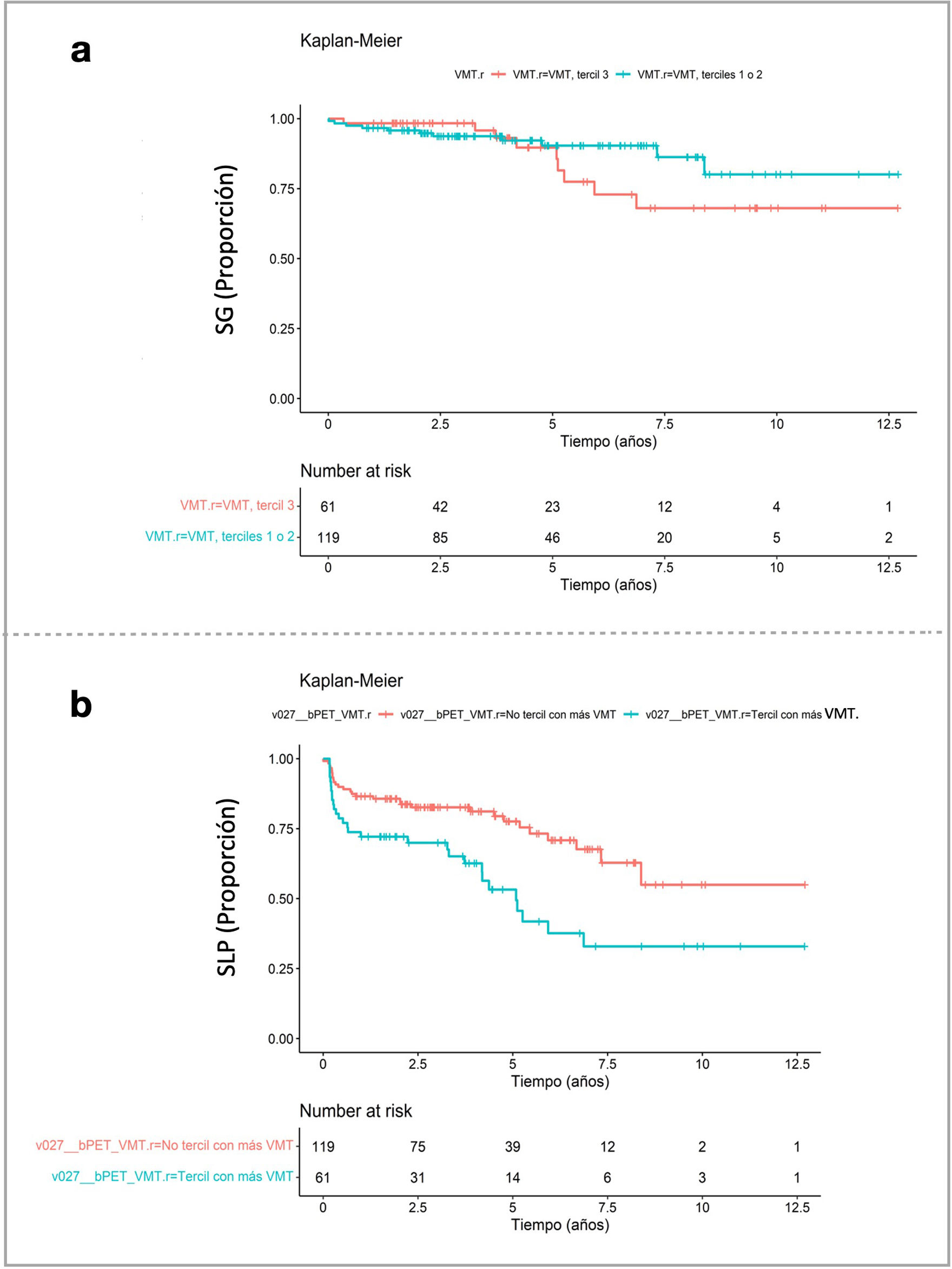
ResultadosDe los pacientes con PET/TC de estadificación disponible, la SG a los cinco años fue 90,4% para los de menor VMT, y 89,7% para aquellos de mayor VMT (p=0,3). La SLP fue 77,6% para los de menor VMT, y 53,2% para aquellos de mayor VMT (p=0,001). La GTL ofreció resultados estadísticamente similares.
Un ΔSUVmáx ≥ 66% se asoció a una mayor SG y SLP a los cinco años, tanto en la iPET como en la fPET.
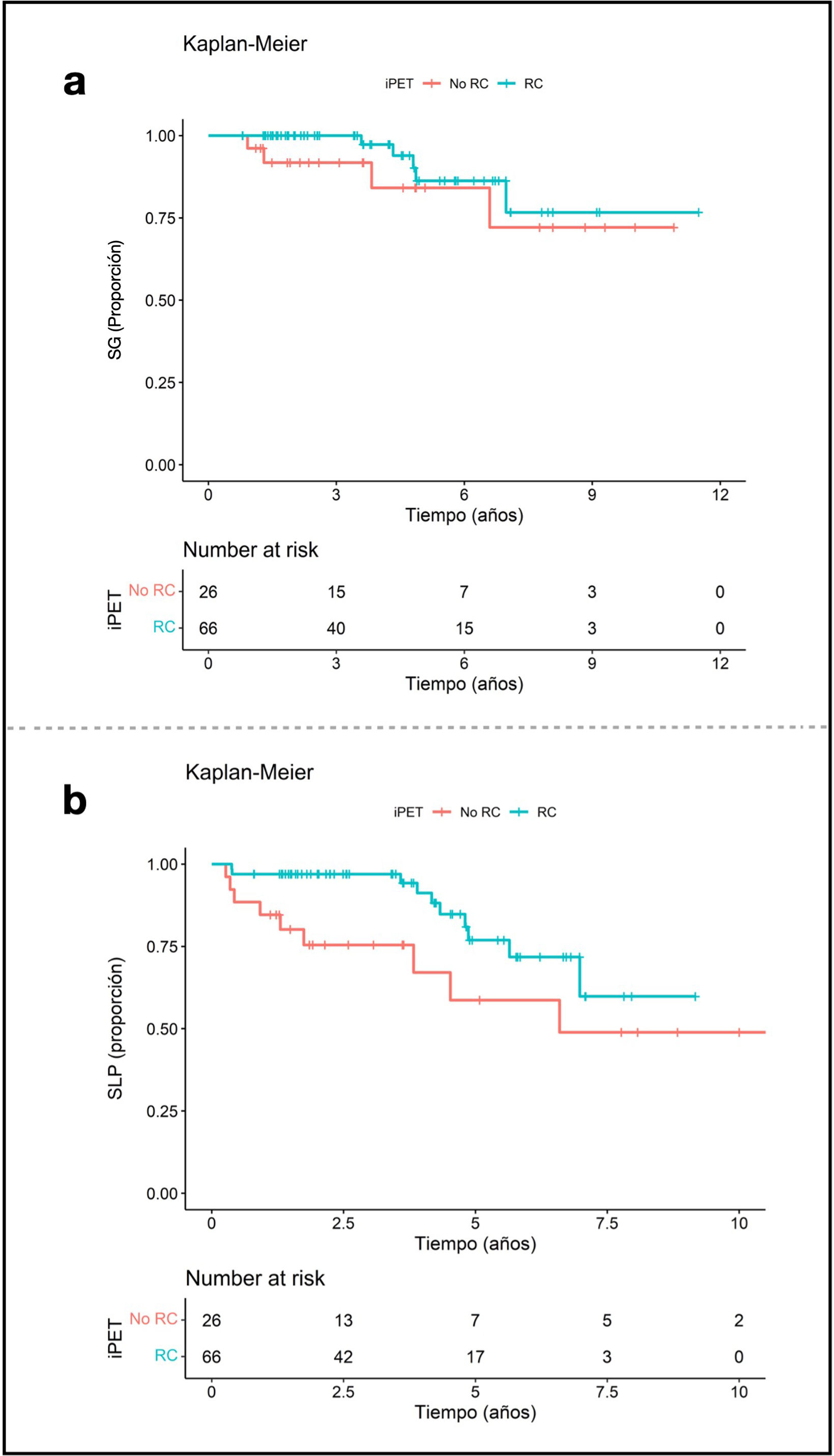
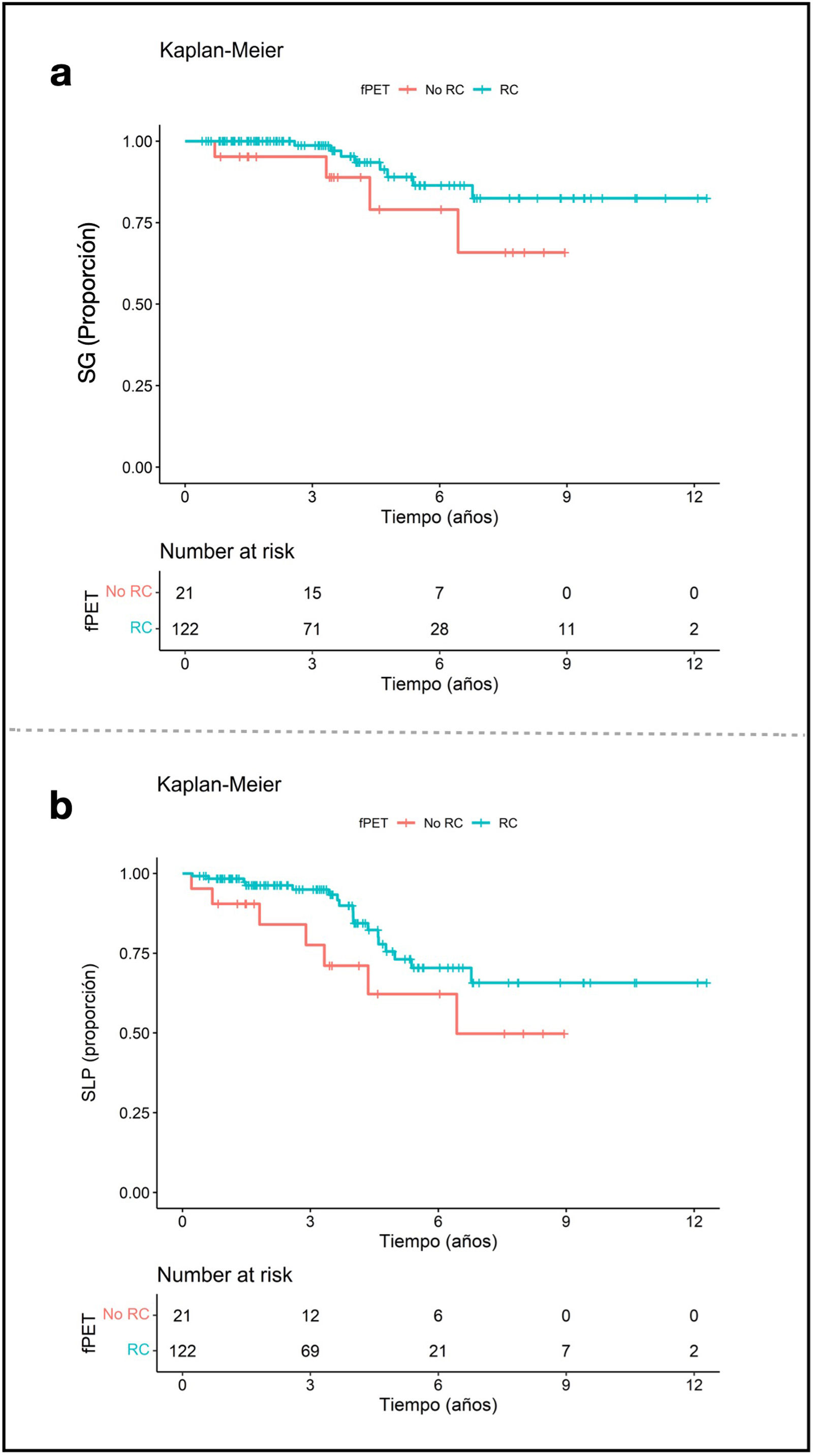
La SG a los cinco años para los pacientes con respuesta metabólica completa fue 86,3% en la iPET y 89,0% en la fPET, frente a un 84,1% y un 79,0%, respectivamente, en aquellos positivos en iPET (p=0,3) y fPET (p=0,1). La SLP a los cinco años para los pacientes con respuesta metabólica completa fue 76,9% en la iPET y 73,1% en la fPET, frente a un 58,7% y 62,2%, respectivamente, en aquellos positivos en iPET (p=0,04) y fPET (p=0,09).
ConclusionesLa PET/TC tiene valor como factor pronóstico en los pacientes con LF, tanto en la estadificación (proporciona parámetros con valor pronóstico propio como el VMT y la GTL), como durante el tratamiento y al final del mismo (se relaciona con la supervivencia del paciente).
To determine the prognostic value of [18F]FDG PET/CT in follicular lymphoma (FL) patients in our routine clinical practice.
Material and methodsRetrospective study of FL patients assessed with PET/CT in our centre from 01/06/2008 to 01/06/2020. This study aimed to investigate the prognostic value of quantitative parameters (MTV, TLG, ΔSUV max) and qualitative criteria (Lugano classification), and its relationships with progression-free survival (PFS) and overall survival (OS).
ResultsAmong patients with available staging PET/CT, the 5-year OS was 90.4% for those with lower MTV and 89.7% for those with higher MTV (p=0.3). The PFS was 77.6% for those with lower MTV and 53.2% for those with higher MTV (p=0.001). TLG yielded statistically similar results.
A ΔSUV max ≥ 66% was associated with higher OS and PFS at 5 years, at both interim and final PET/CT studies (iPET and fPET). The 5-year OS for patients with complete metabolic response was 86.3% in iPET and 89.0% in fPET, compared to 84.1% and 79.0%, respectively, for those positive in iPET (p=0.3) and fPET (p=0.1). The 5-year PFS for patients with complete metabolic response was 76.9% in iPET and 73.1% in fPET, compared to 58.7% and 62.2%, respectively, for those positive in iPET (p=0.04) and fPET (p=0.09).
ConclusionsPET/CT is valuable as a prognostic factor in FL, both during staging (providing parameters with independent prognostic value such as MTV and TLG) and during and after treatment (as it correlates with survival).
Artículo
Si tiene problemas de acceso puede contactar con la Secretaría Técnica de la SEMNIM en el correo electrónico secretaria.tecnica@semnim.es o en el teléfono: + 34 619 594 780

