






Analizar el valor pronóstico del propéptido natriurético cerebral N-terminal (NT-proBNP) y otros biomarcadores de inflamación en pacientes con tumores neuroendocrinos (TNE) tratados con [177Lu]Lu-DOTA-TATE (Lutathera®). Evaluar el valor pronóstico de las características tumorales.
Pacientes y métodosCohorte prospectiva de pacientes con TNE avanzados y metastásicos tratados con [177Lu]Lu-DOTA-TATE. Previamente a la administración, se realizó una determinación analítica de NT-proBNP, hemoglobina, hematocrito, proteína C reactiva (PCR), leucocitos, linfocitos, neutrófilos, ratio neutrófilos/linfocitos (NLR) y ratio plaquetas/linfocitos (PLR). Se calcularon la supervivencia global (SG) y la supervivencia libre de progresión (SLP) con el método de Kaplan-Meier y se compararon las curvas con la prueba log-rank. Las variables predictoras de SG y SLP se determinaron con un modelo de regresión univariante de Cox.
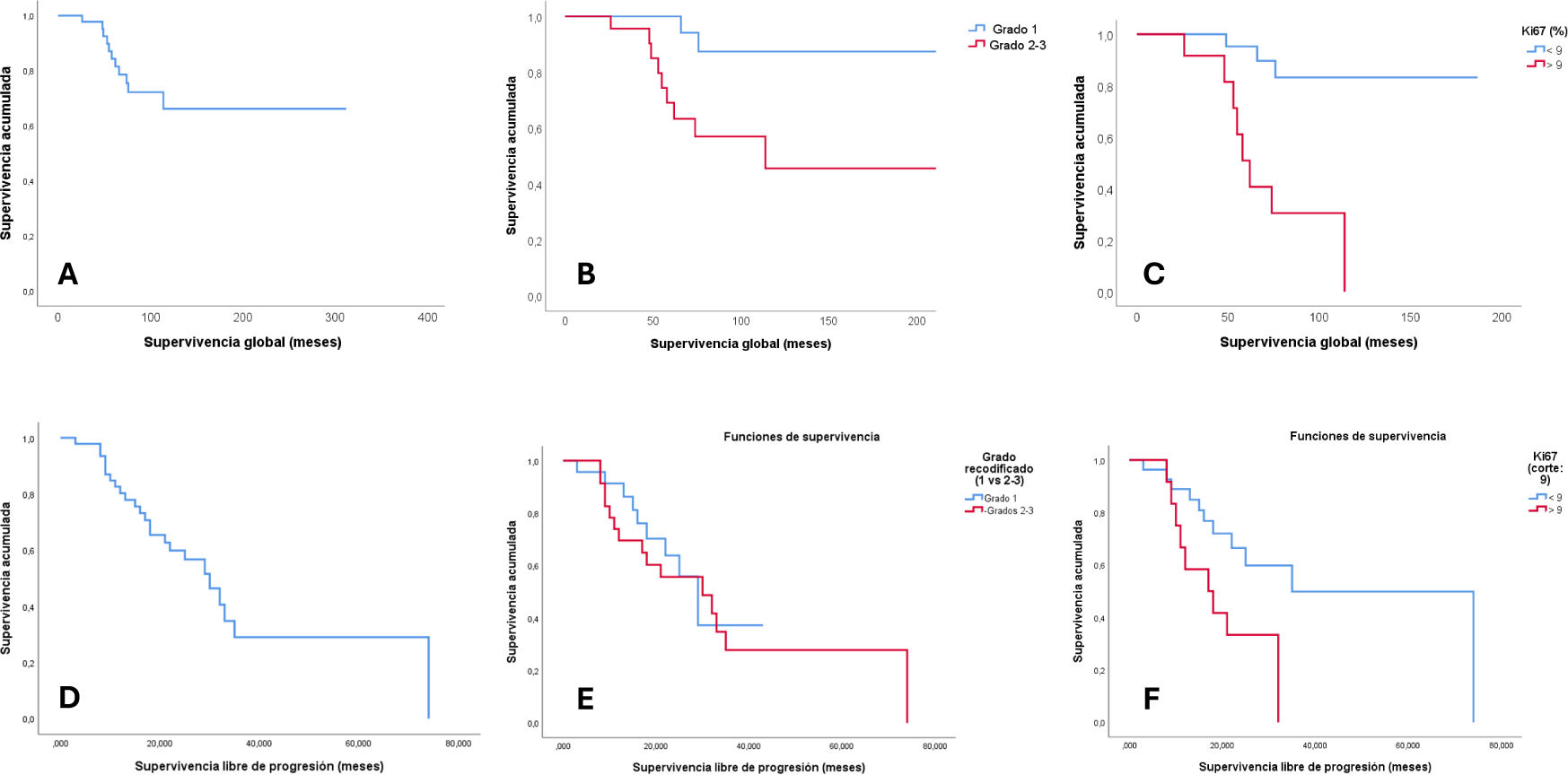
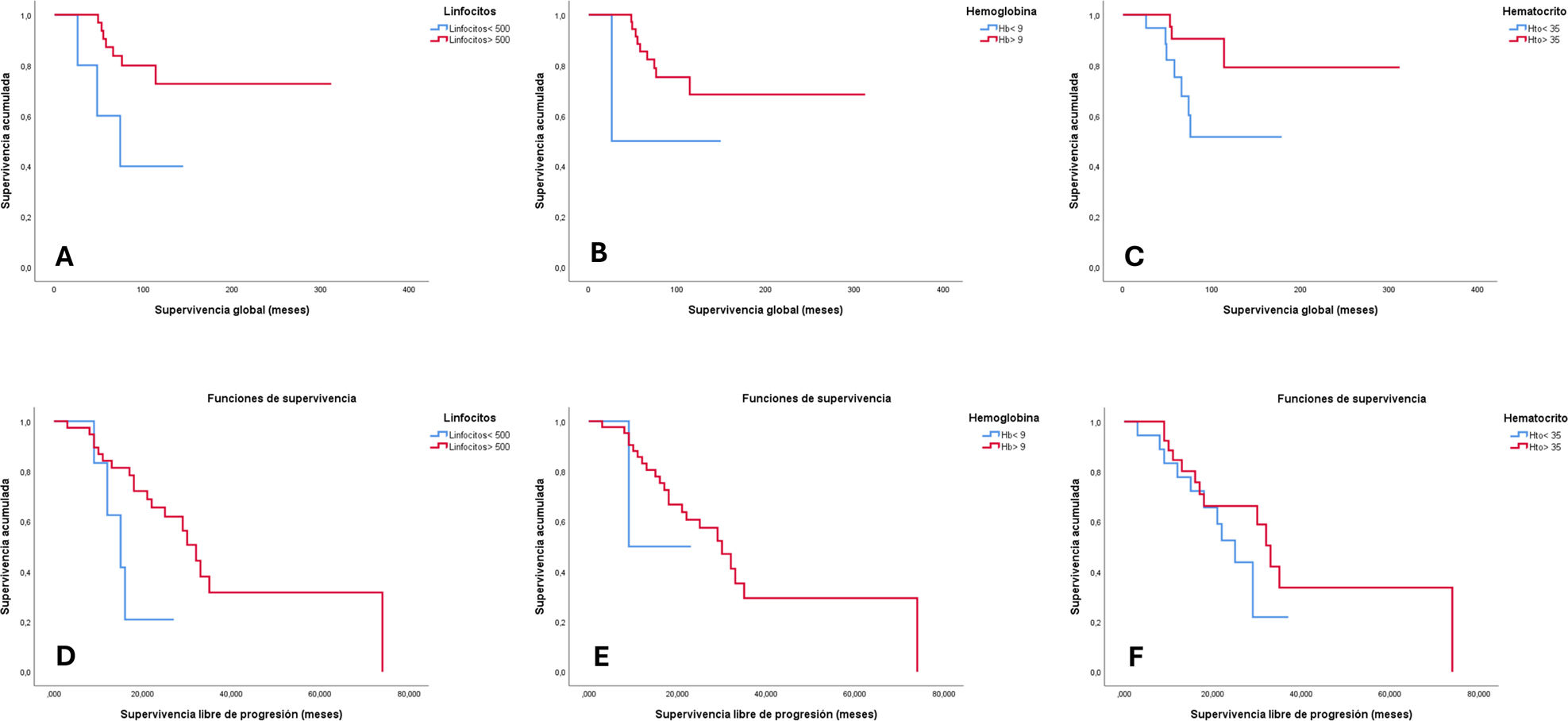
ResultadosCuarenta y ocho pacientes de TNE tratados con [177Lu]Lu-DOTA-TATE. La mediana de SG fue de 96meses, y la de SLP, de 29meses. Los factores asociados con menor SG fueron: los valores de NT-proBNP >300pg/ml (HR: 10,5; p=0,005) en el subgrupo de pacientes con grados2-3, además de los índices inflamatorios NLR >2 (HR: 3,87; p=0,049) y PLR >300 (HR: 11,88; p=0,01) y el mayor grado tumoral (HR: 6,45; p=0,011). Los valores de PLR >300 (HR: 5,506; p=0,003) también se asociaron a menor SLP. En cambio, niveles mayores de linfocitos (HR: 0,21; p=0,002), hemoglobina (HR: 0,65; p=0,041) y hematocrito (HR: 0,862; p=0,031) se asociaron con mayor SG, sin cambios significativos de SLP.
ConclusionesEn los pacientes con TNE tratados con [177Lu]Lu-DOTA-TATE, la determinación de NT-proBNP y otros biomarcadores de inflamación pueden tener utilidad como predictores de supervivencia, teniendo estos valor pronóstico.
To analyze the prognostic value of N-terminal prohormone of brain natriuretic peptide (NT-proBNP) and other biomarkers of inflammation in patients with neuroendocrine tumors (NETs) treated with [177Lu]Lu-DOTA-TATE (Lutathera®). The prognostic value of histological characteristics of the tumor was also analyzed.
Patients and methodsProspective study of a cohort of patients with advanced and metastatic NETs treated with [177Lu]Lu-DOTA-TATE. Before the administration of doses, NT-proBNP, hemoglobin, hematocrit, C-reactive protein, leukocytes, lymphocytes, neutrophils, neutrophil/lymphocyte ratio (NLR) and platelet/lymphocyte ratio (PLR) have been determined. Overall survival (OS) and progression free survival (PFS) were calculated, using the Kaplan-Meier method, and curves were compared with a log-rank test. To determine the predictor variables of OS, a Cox regression model was fitted.
Results48 NET patients treated with [177Lu]Lu-DOTA-TATE. Median OS was 96months and PFS was 29months. Factors associated with lower OS were: NTproBNP values>300pg/mL (HR: 10.5; P=.005) in the subgroup of patients with grades2-3, in addition to inflammatory indices NLR>2 (HR: 3.87; P=.049) and PLR>300 (HR: 11.88; P=.01) and higher tumor grade (HR: 6.45; P=.011). PLR>300 (HR: 5.506; P=.003) was also associated with lower PFS. In contrast, higher levels of lymphocytes (HR: 0.21; P=.002), hemoglobin (HR: 0.65; P=.041) and hematocrit (HR: 0.862; P=.031) were associated with higher OS, without significant changes in PFS.
ConclusionIn patients with NETs treated with [177Lu]Lu-DOTA-TATE, the determination of natriuretic factors (NT-ProBNP) and other inflammatory biomarkers may be useful as predictors of survival and prognostic factors.
Artículo
Si tiene problemas de acceso puede contactar con la Secretaría Técnica de la SEMNIM en el correo electrónico secretaria.tecnica@semnim.es o en el teléfono: + 34 619 594 780

