




Evaluar la utilización de las semillas radiactivas de yodo-125 (SRI-125) en la cirugía de mama o axila, en pacientes con cáncer de mama tratadas con quimioterapia neoadyuvante (QtNeo).
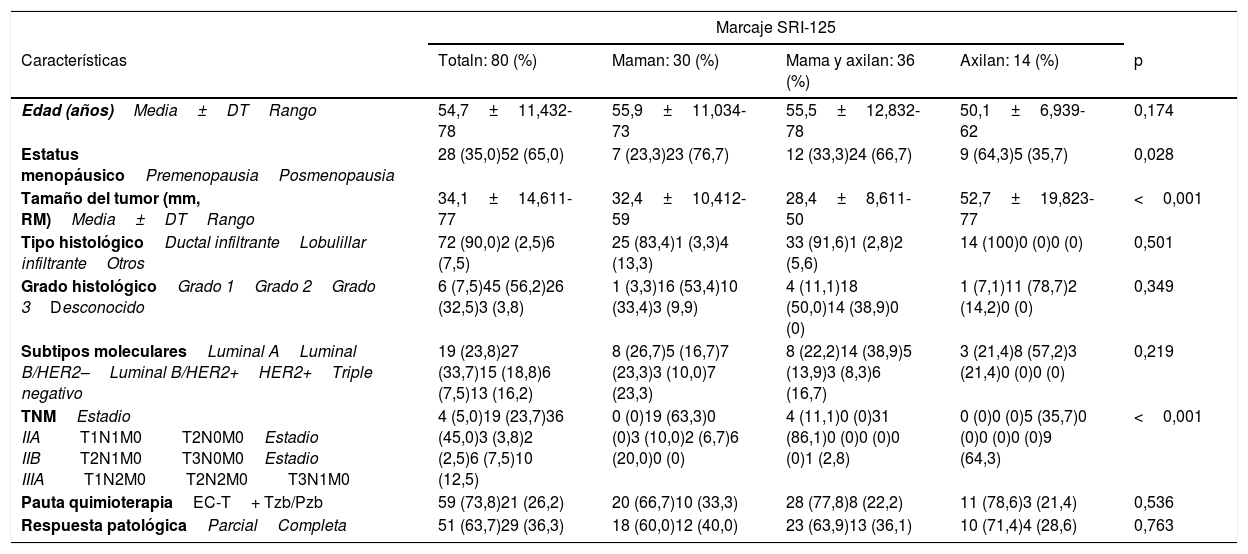
Material y métodosEstudio prospectivo, entre enero del 2016 y junio del 2020; 80 mujeres T1-3, N0-2, M0: 30 marcaje SRI-125 del tumor en mama, 36 tanto del tumor como del ganglio axilar positivo biopsiado, y 14 solo de axila. Edad: 54,7±11,4 años. Tamaño tumoral: 34,1±14,6mm. Tipo histológico: ductal infiltrante 90,0%. Subtipos moleculares: luminal-A 23,8%; luminal-B/HER2- 33,7%; luminal-B/HER2+ 18,8%; HER2+ 7,5%; triple negativo 16,2%.
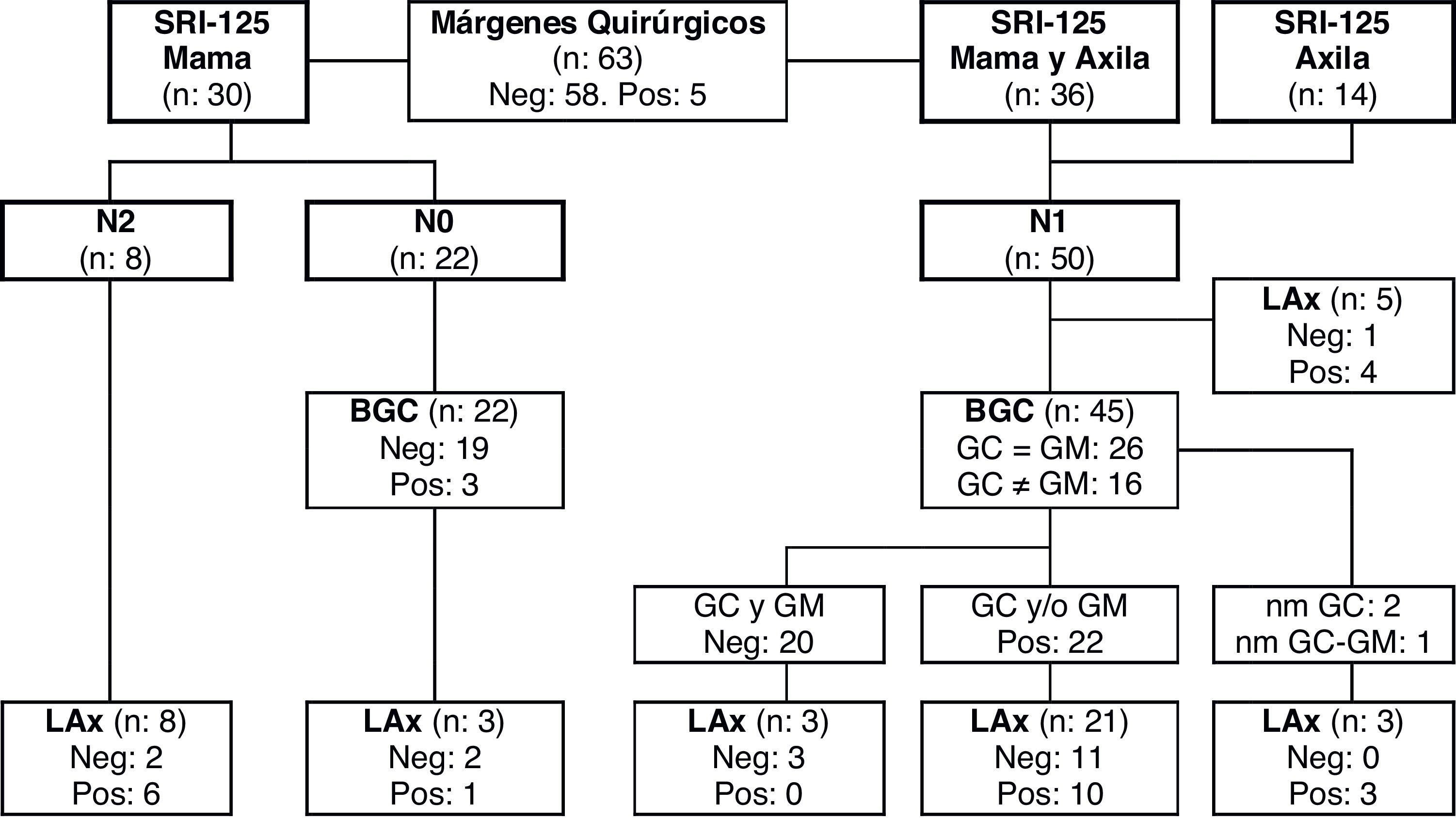
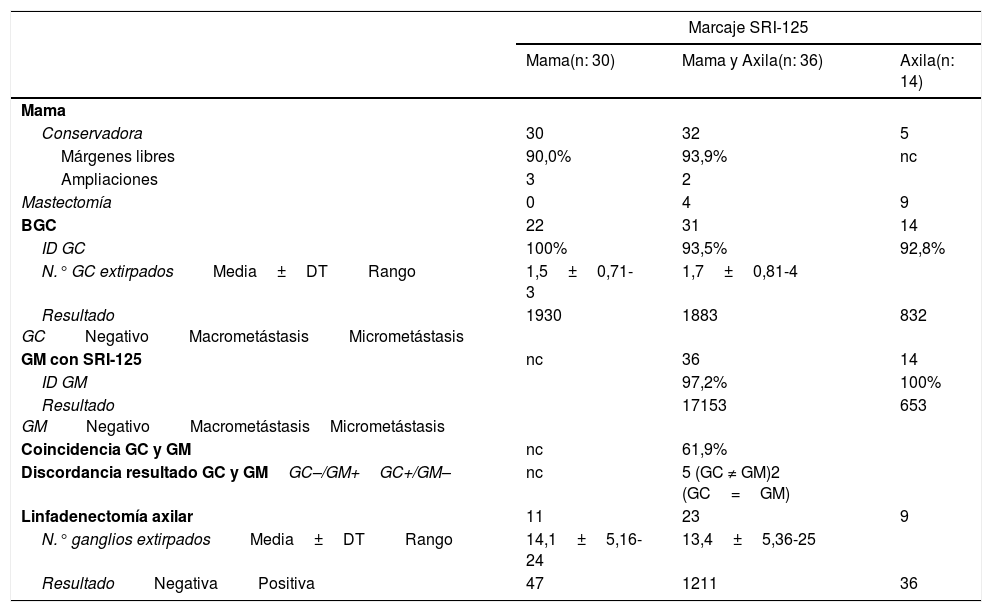
ResultadosDe las 66 pacientes con marcaje SRI-125 del tumor (51 pre-QtNeo, 15 post-QtNeo), el 92,1% presentaba márgenes quirúrgicos libres, con un volumen de las piezas de 126,7±111,2 cm3. De las 5 reintervenciones, en 3 la ampliación fue positiva (una mastectomía).
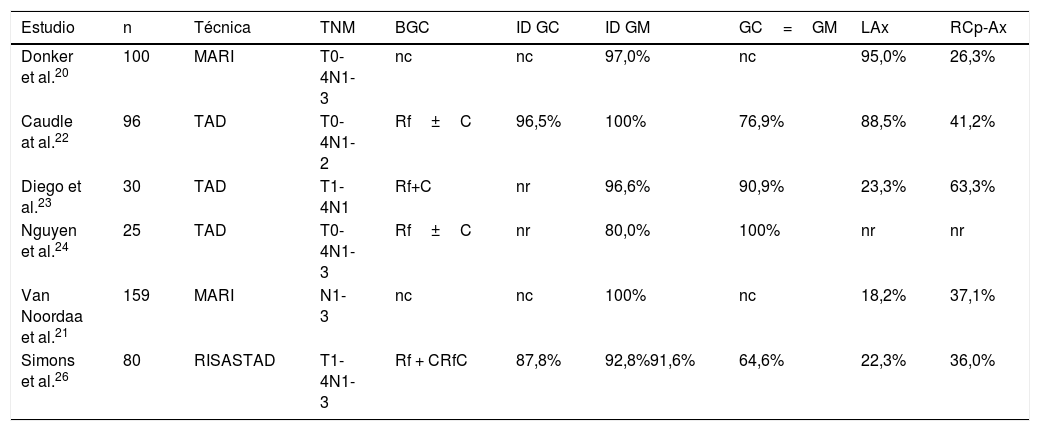
De las 50 pacientes N1 con marcaje SRI-125 (GM), 44 pre-QtNeo y 6 post-QtNeo, se identificó el GM en el 97,2%: negativo en 23, positivo en 26. En 45 se realizó biopsia selectiva del ganglio centinela y se identificó en el 93,3%: negativo en 26, positivo en 16. En un caso la SRI-125 no se colocó correctamente y tampoco se localizó GC por no migración.
En el 61,9% de las pacientes el GM se encontraba entre el/los GC identificados en la cirugía. En 5 pacientes, con GC y GM no coincidentes, el resultado anatomopatológico del GC fue negativo y el GM positivo. En 53,8% de las pacientes se realizó linfadenectomía axilar.
ConclusiónLas SRI-125 permiten realizar cirugía conservadora de la mama y mejorar la detección de enfermedad residual axilar, en pacientes tratadas con QtNeo.
To evaluate the use of radioactive iodine-125 seed (RIS) in breast and/or axillary surgery, in patients with breast cancer treated with neoadjuvant chemotherapy (NAC).
Material and methodsProspective study between January 2016 and June 2020. 80 women T1-3,N0-2,M0: 30 RIS marking the breast tumor, 36 both the tumor and the biopsied positive axillary node, and 14 only the axilla. Age: 54.7±11.4 years. Tumor size: 34.1±14.6mm. Histological type: invasive ductal carcinoma 90.0%. Molecular subtypes: luminal-A 23.8%, luminal-B/HER2- 33.7%, luminal-B/HER2+ 18.8%, HER2+ 7.5%, basal-like 16,2%.
ResultsOf the 66 patients with RIS marking of the tumor (51 pre-NAC, 15 post-NAC), 92.1% had tumor-free surgical margins, with a specimen volume of 126.7±111.2 cm3. Of the 5 second local excisions, in 3 the resection margin was involved (1 mastectomy).
Of the 50 patients N1 with RIS marking (MLN), 44 pre-NAC and 6 post-NAC, MLN was identified in 97.2%: negative 23, positive 26. In 45/50 patients, sentinel node biopsy (SNB) was performed and it was identified in 93.3%: negative 26, positive 16. In 1 case RIS was not placed correctly and SNB was not identified due to non-migration.
In 61.9% of the patients, MLN was among the SNB identified in the surgery. In 5 patients with mismatched SNB and MLN, the pathological result of the SNB was negative and the MLN was positive. Axillary lymph node dissection was performed in 53.8% of the patients.
ConclusionRIS allow to perform breast-conserving surgery and improve detection of residual axillary disease in patients treated with NAC.
Artículo
Si tiene problemas de acceso puede contactar con la Secretaría Técnica de la SEMNIM en el correo electrónico secretaria.tecnica@semnim.es o en el teléfono: + 34 619 594 780

