


The human papillomavirus (HPV) is a DNA virus of the papovavirus family with a high rate of prevalence worldwide that demonstrates exclusive tropism due to the stratified epithelium of skin and mucous membranes. HPV infection offers a wide variety of clinical manifestations including asymptomatic and latent infections, benign lesions such as condylomata acuminata, dysplasias, and malignant lesions such as invasive carcinoma of the cervix. The development of condyloma acuminatum is one of the possible benign clinical manifestations of HPV infection, known since ancient times by the Latin name of Crista Galli. The usual clinical expression of condyloma is a cauliflower-shaped, soft, moist, flesh-coloured protuberance on the genital mucosa. Currently, more than 150 HPV viral genotypes have been identified through molecular biology procedures, about 40 of them potentially pathogens of the human genital mucosa, which are classified as high or low risk depending on their oncogenic potential. Genotypes 6,11,16 and 18 represent more than 95% of the condylomata acuminata in clinical practice.1 In Spain, the prevalence with respect to the global rate is very low, with an upward trend in recent decades related to immigrant populations originating from countries with a high prevalence, especially Latin America.2 Following the introduction of quadrivalent HPV vaccination programmes (2007), a significant reduction in the incidence of condylomata acuminata has been observed.1 The common route of transmission of HPV is sexual contact, and HPV infection is the most common sexually transmitted infection in the world.
The development of condylomata acuminata in a minor makes it necessary to carry out a medicolegal assessment of the case, since it may constitute the clinical expression of sexual violence. In this direction, articles 355 and 544 of the Criminal Procedure Law of the Spanish legal system obligate the clinician and medical caregiver to inform the authorities of any diagnosis of condyloma acuminatum in a minor.
The sexual route of transmission is not the sole route of transmission of HPV which determines the medicolegal controversy. There is sizeable scientific literature that accredits the transmission of HPV in minors through vertical mother–child transmission (transplacental, intrapartum, in caesarean section or breast-feeding); periconceptional transmission by the partner; and domestic transmission through intimate contact of a non-sexual nature by the main caregiver. In countries with a high prevalence, the possible transmission of HPV by fomites is under discussion.2
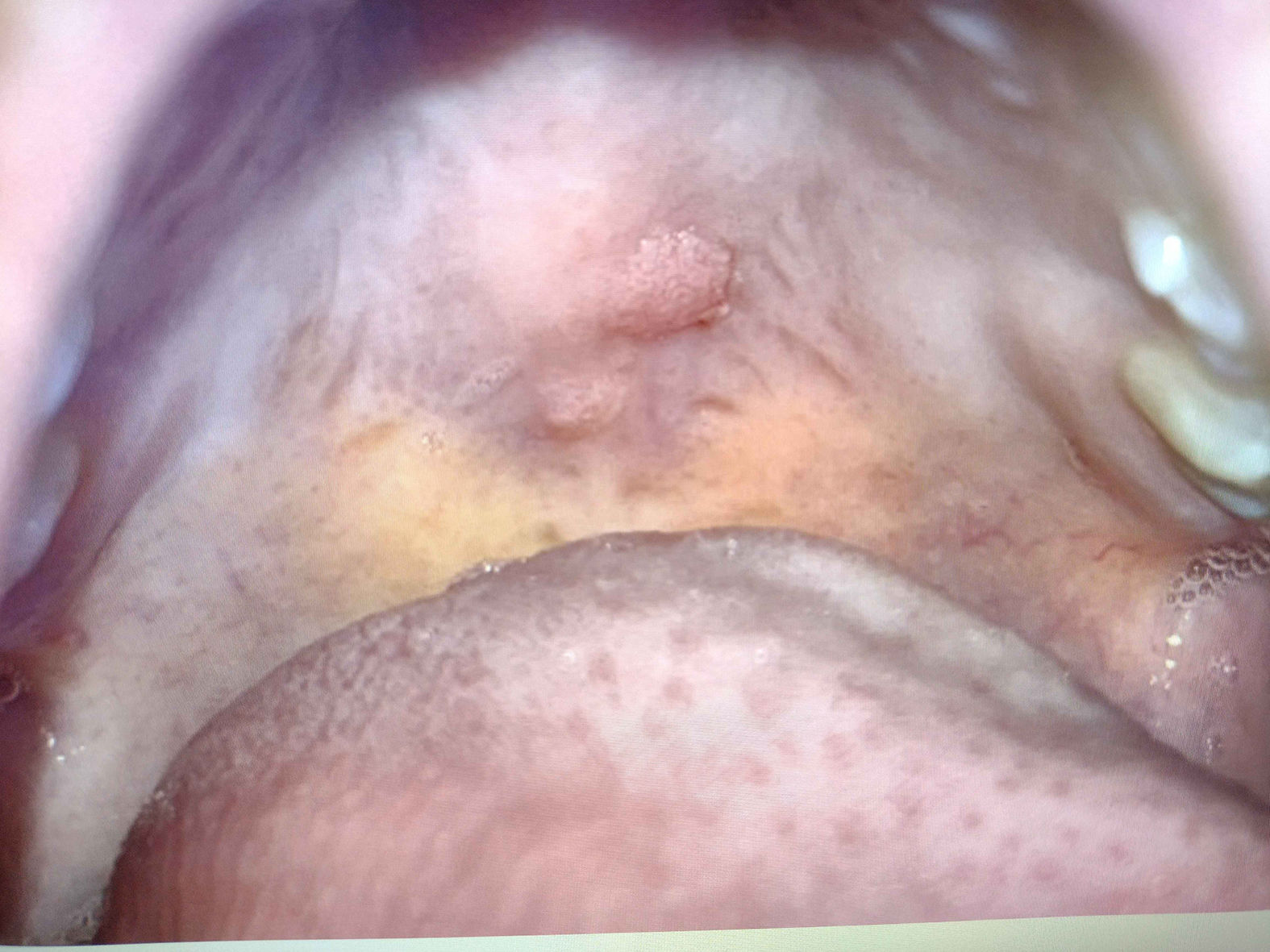
Case reportA 7-year-old girl in the process of being treated in the Dermatology Unit of the University Hospital of Navarre (HUN) for a clinical picture of nail lichen and vulvar scleroatrophic lichen was referred from her health centre due to the accidental finding, in the palatine raphe, of a whitish cupuliform papillomatous lesion, associated with another more flattened papule (Fig. 1). A visual clinical diagnosis of oral condyloma versus oral thrush, verruca vulgaris, or spongy white nevus was reached. The child was referred to the Maxillofacial Surgery Unit at the HUN, where the lesion was biopsied and removed by means of an elliptical incision on the subperiosteal plane and closure by secondary intention with no post-surgical incidents. The anatomical and pathological study showed no cytological features suggestive of viral infection in the squamous epithelium. The PCR molecular study confirmed the diagnosis of human papillomavirus with an indeterminate genotype. After the diagnostic confirmation, the minor was included in the HUN's internal protocol for cases of suspected sexual abuse and the case was reported to the Duty Court.

Urgent intervention was activated by the community social services (SSs), which produced an intense emotional reaction in the family unit. Both parents were immigrants in Spain and originally from a country with a high prevalence of HPV. Both parents denied having any suspicion of sexual violence in the minor. The family cohabitation unit was made up of both parents, the minor as an only child, the grandmother and a maternal uncle. The girl had regular contact with the whole nuclear family of a paternal uncle. The parents reported that the girl had never left the protective environment of the family and school. The school informed the SSs that the minor presented normal behavioural parameters during school activities and in the relationship with her peers. Primary Care ran a family history that showed that the mother had been operated on years ago for genital condylomata acuminata, without a post-surgical molecular study being run, so the maternal viral genotype of HPV was unknown. The father reported not having suffered from any known HPV infection.
The investigating court opened urgent proceedings, and the minor was assessed by the Forensic Clinical Unit and the Forensic Psychology Unit of the Navarre Institute of Legal Medicine and Forensic Sciences (INML and CF in their Spanish acronyms). The assessment showed normality in all physical, psychological, school and family parameters, highlighting the existence of a degree of maturity corresponding to age and the absence of any suspicious report of possible episodes of sexual behaviour. In the face of a final ruling by the INML and CF on the absence of indications of any psychological harm to the girl, attributable to sexual violence, the case was closed by the Justice Dept. The SSs did not observe any parameters regarding the need for intervention or follow-up on the family unit in their intervention.
DiscussionThe clinician has the professional and legal obligation to report any case of HPV infection in a minor to the legal authorities. In our setting, it is common to have a specific protocol for suspected sexual abuse in clinical units, as is the case of the HUN. The clinical management of the case obligates the physician in charge to act with skill and prudence in communicating the legal situation to the parents or guardians of the affected minor, taking into account the individual epidemiological history.
The route of transmission of HPV in a minor gives rise to uncertainty for the clinician and the forensic physician, since sexual transmission is not the exclusive route of transmission. The clinical expression of mother-to-child HPV infection by vertical transmission usually has a long latency period, with the development of condylomata that frequently occur in children or even in adolescence.3 The series published in the scientific literature shows considerable variability in the proportion of HPV infections in minors, attributable to sexual assault, which indicates the need for further research on the subject.4 In condylomata located in the anogenital region, the most frequent route of transmission is considered to be the sexual route.5 In condylomata located in the oral region, the most frequent route of transmission is considered to be maternal-filial; however, in some cases, it is advisable to suspect sexual contagion.6,7 In countries with a high prevalence of HPV, the incidence of anogenital condylomata acuminata in minors without evidence of previous sexual contact is increasing,8 so that in children born in Spain to parents from countries with a high prevalence of HPV, the non-sexual route of transmission could be considered frequent.
The knowledge of the clinical history of anogenital condyloma acuminatum in parents is limited and affected by multiple factors, and it is not possible to clarify this in all cases. It is common for the record of the mother having suffered from an HPV infection to be absent in the clinical history and it should be taken into account that subclinical and unknown HPV infections in the mother may be the main risk of vertical transmission of HPV to the minor.9 The physician practicing in primary care can play an essential role in the clinical approach, providing fundamental data from the family history in the process of referral to specialised care, which can monitor the risk of secondary victimisation of the minor.
We have not found any studies that confirm the aetiology of HPV infection by comparing the HPV genotype between the alleged perpetrator and the alleged victim of sexual violence. It should be noted that up to 20–30 % of cases have co-infection with multiple types of HPV.1 There are, however, studies that have detected consistency between the HPV genotype of infected mothers and that of newborns.10 The determination of the HPV genotype has not been protocolised in the therapy of adult patients, since this information does not alter the clinical treatment of condyloma acuminata, which means that this is not normally available for the medicolegal assessment of the case. There are studies in which HPV DNA has been isolated from breast milk and colostrum, however, no agreement was found between the type of HPV and cervical or oral maternal samples.10
In the absence of clinical criteria that make it possible to establish the route of transmission of HPV with any certainty, the essential medicolegal assessment is the determination of the existence of psychological harm attributable to sexual violence in the minor by the forensic psychology departments of the INML and CF. The most frequent clinical characteristics described in minors who have suffered sexual violence include emotional and behavioural changes. The questioning directed at the minor must be carried out exclusively by specialised psychologists in a friendly, safe environment and the rest of the professionals involved in the case must refrain from questioning the minor on the issue, in order to avoid the stigma of secondary victimisation and interference in the subsequent assessment by the forensic psychology department.
In the case we present, the association of condyloma with the intercurrent development of other dermatological diseases (lichen nails and genital scleroatrophic lichen) stood out in the clinical presentation; this issue suggests that the clinical expression of HPV in the child may have a shared immunological, pathogenic basis with the aforementioned skin diseases. Likewise, the absence in the anatomical and pathological study of cytological features of viral infection in the squamous epithelium should be noted. Both factors could be clinical indicators of a non-sexual route of HPV transmission; observations that need to be confirmed by other studies.
The medicolegal problem of the development of condylomata acuminata in a minor may present considerable difficulties in their assessment by the institutes of forensic medicine and forensic sciences and, in some cases, the final opinion may not be conclusive.
Please cite this article as: Chérrez Bermejo C, Ilundáin Cabedo M, Cabero López G, Ibarrola Hermoso de Mendoza I, Amatriain Pileño R, Muñiz Lorenzo M, Condiloma acuminado oral en una menor de 7 años. Controversias médico-legales en su vía de transmisión. Revista Española de Medicina Legal. 2025. https://doi.org/10.1016/j.reml.2024.09.003.
