


Low mannose-binding lectin (MBL) concentrations in serum are due mainly to the presence of three punctual mutations in the coding region of the MBL2 gene. SLE patients, who are homozygous for MBL allele variants, have a significantly greater risk of developing infections. With the purpose of examining the association of MBL locus haplotypes with disease activity and past history of infection in SLE, we studied a group of patients treated in the Rheumatology Outpatient Clinic of the UANL University Hospital.
ObjectiveDetermine the prevalence of MBL2 locus haplotypes and the causal associations between MBL2 locus haplotypes and SLE determining the Hardy–Weinberg law for specific genotypes in both groups of study.
Materials and methodsAn observational, cross-sectional, retrospective study was performed. Hardy–Weinberg equilibrium for genotypic frequencies was proven with the X2 test. The risk of lupus associated with MBL2 genotypes as a genetic factor and the strength of the association of the genotypes with the frequency of clinical characteristics was estimated by calculation of odds ratio with a 95% confidence interval. Statistical significance was taken as a value of P<.05.
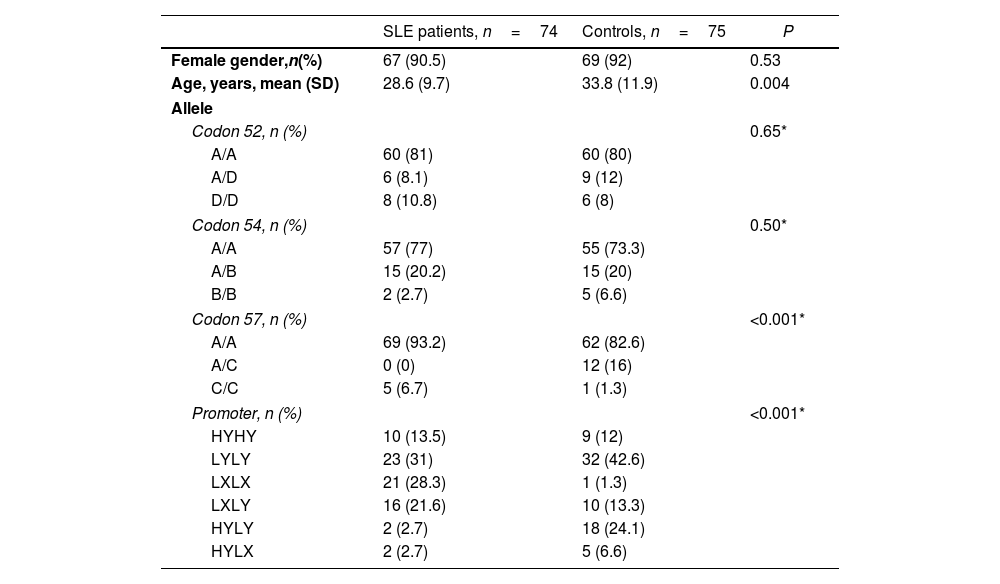
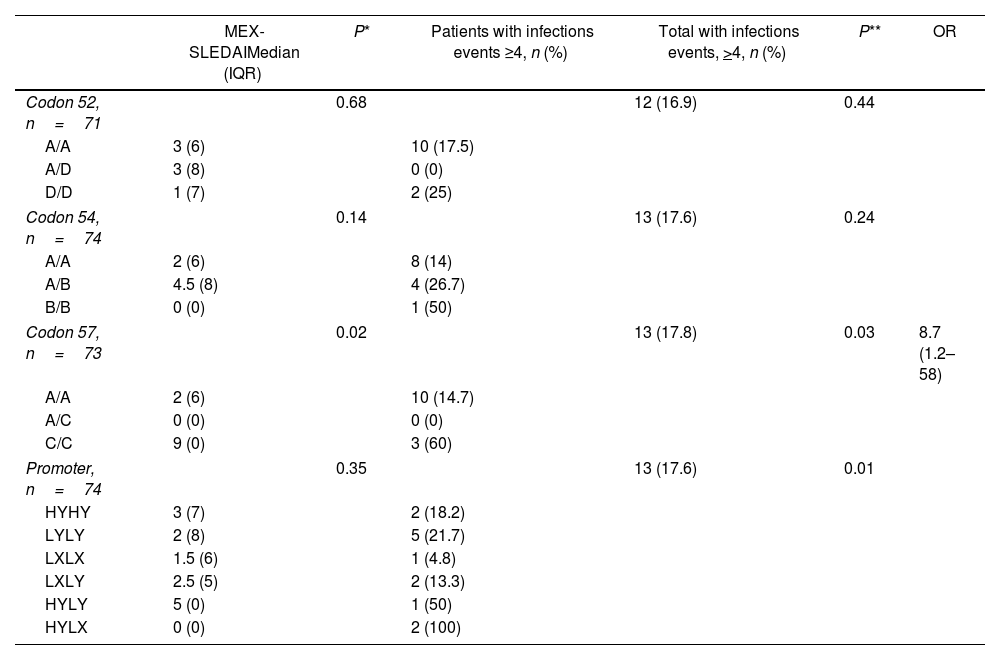
ResultsThe findings suggest potential genetic associations between allelic systems and the risk of SLE. A relationship was found regarding the MEX-SLEDAI index, as well as the number of infections among patients with differences in structural gene polymorphisms and promoter gene polymorphisms.
ConclusionsThere are significant differences in the polymorphisms of the promoter region regarding the risk for developing SLE.
Las bajas concentraciones de lectina de unión a manosa (MBL) en suero se deben principalmente a la presencia de tres mutaciones puntuales en la región codificante del gen MBL2. Los pacientes con lupus eritematoso sistémico (LES), que son homocigotos para las variantes del alelo MBL, tienen un riesgo significativamente mayor de desarrollar infecciones. Con el propósito de examinar la asociación de los haplotipos del locus MBL con la actividad de la enfermedad y los antecedentes de infección en el LES, estudiamos a un grupo de pacientes atendidos en la Consulta Externa de Reumatología del Hospital Universitario de la Universidad Autónoma de Nuevo León (UANL).
ObjetivoDeterminar la prevalencia de los haplotipos del locus MBL2 y las asociaciones causales entre los haplotipos del locus MBL2 y el LES, determinando la ley de Hardy-Weinberg para genotipos específicos en ambos grupos de estudio.
Materiales y métodosSe realizó un estudio observacional, transversal y retrospectivo. El equilibrio de Hardy-Weinberg para las frecuencias genotípicas se comprobó con la prueba de X2. El riesgo de LES asociado a los alelos de MBL2 como factor genético y la fuerza de la asociación de los genotipos con la frecuencia de las características clínicas se estimó mediante el cálculo de la odds ratio, con un intervalo de confianza del 95%. Se consideró significación estadística un valor de p<0,05.
ResultadosLos hallazgos sugieren potenciales asociaciones genéticas entre los sistemas alélicos y el riesgo de LES. Se encontró relación respecto al índice MEX-SLEDAI, así como al número de infecciones entre los pacientes con diferencias en los polimorfismos del gen estructural y del gen promotor.
ConclusionesExisten diferencias significativas en los polimorfismos de la región promotora respecto al riesgo de desarrollar LES.

