

metricas
covid
Revista Colombiana de Psiquiatría Screening Accuracy of Reduced Scales PHQ and GAD in Young People Living in Depri...
Información de la revista
Compartir
Descargar PDF
Más opciones de artículo
Original Article
Disponible online el 29 de octubre de 2025
Screening Accuracy of Reduced Scales PHQ and GAD in Young People Living in Deprived Urban Areas in Bogotá, Buenos Aires and Lima
Exactitud de tamizaje de las escalas reducidas PHQ y GAD en jóvenes residentes en zonas urbanas desfavorecidas de Bogotá, Buenos Aires y Lima
David Niño-Torresa, Carlos Gomez-Restrepoa,b,c,
Autor para correspondencia
cgomez@javeriana.edu.co

Corresponding author.
, Francisco Diez-Cansecog, Luis Ignacio Bruscod, Diliniya Stanislaus Sureshkumarf, Viviana Rodríguez-Romeroa, Ana L. Vilela-Estradag, Fernando Luis Carbonettid, José Miguel Uribe-Restrepoc, Mauricio Toyamag, Natividad Olivard, Catherine Fungf, Stefan Priebee
a Department of Clinical Epidemiology and Biostatistics, Pontificia Universidad Javeriana, Bogotá, Colombia
b Hospital Universitario San Ignacio, Bogotá, Colombia
c Department of Psychiatry and Mental Health, Pontificia Universidad Javeriana, Bogotá, Colombia
d Department of Psychiatry and Mental, School of Medicine, University of Buenos Aires, Buenos Aires, Argentina
e Centre for Psychosocial Medicine, University of Hamburg, Hamburg, Germany
f Unit for Social and Community Psychiatry, Wolfson Institute of Population Health, Queen Mary University of London, London, United Kingdom
g CRONICAS Center of Excellence in Chronic Diseases, Universidad Peruana Cayetano Heredia, Lima, Peru
Información del artículo
Resumen
Texto completo
Bibliografía
Descargar PDF
Estadísticas
Figuras (2)
Tablas (2)
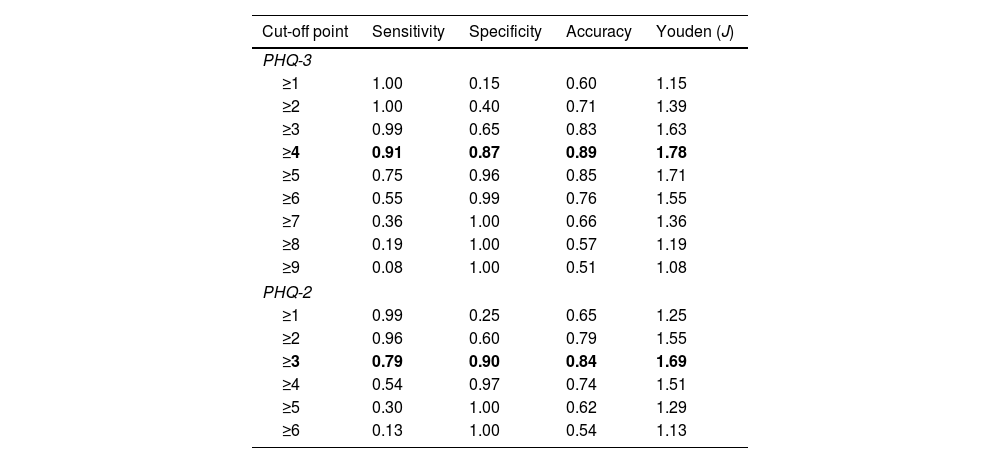
Table 1. Sensitivity, specificity, accuracy and Youden's J for PHQ-3 and PHQ-2 scores in relation to a PHQ-8 cut-off score of ≥10.
Tablas
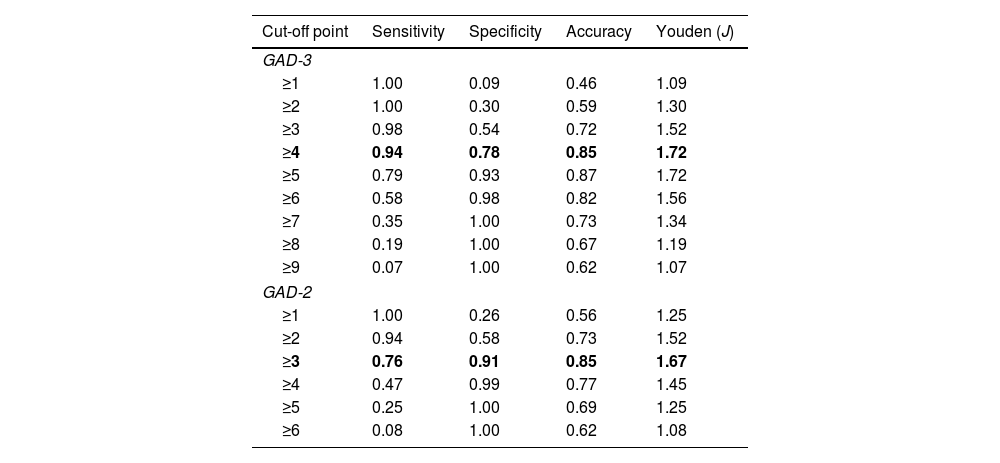
Table 2. Sensitivity, specificity, accuracy and Youden's J for GAD-3 and GAD-2 scores in relation to a GAD-7 cut-off score of ≥10.
Tablas
Mostrar másMostrar menos
Abstract
Objective

To evaluate the sensitivity and specificity of the PHQ-3, PHQ-2, GAD-3, and GAD-2 in young people from deprived urban areas in Bogotá, Buenos Aires, and Lima for early depression and anxiety detection.

Methods

Adolescents (15–16 years) and young adults (20–24 years) from low-income neighborhoods in these cities were recruited. Sensitivity, specificity, and accuracy were assessed at different cut-off points. A ROC curve analysis was performed, obtaining the AUC with 95% CI using PHQ-8 and GAD-7 (cut-off ≥10) as references. The Youden index identified optimal cut-off points.

Results

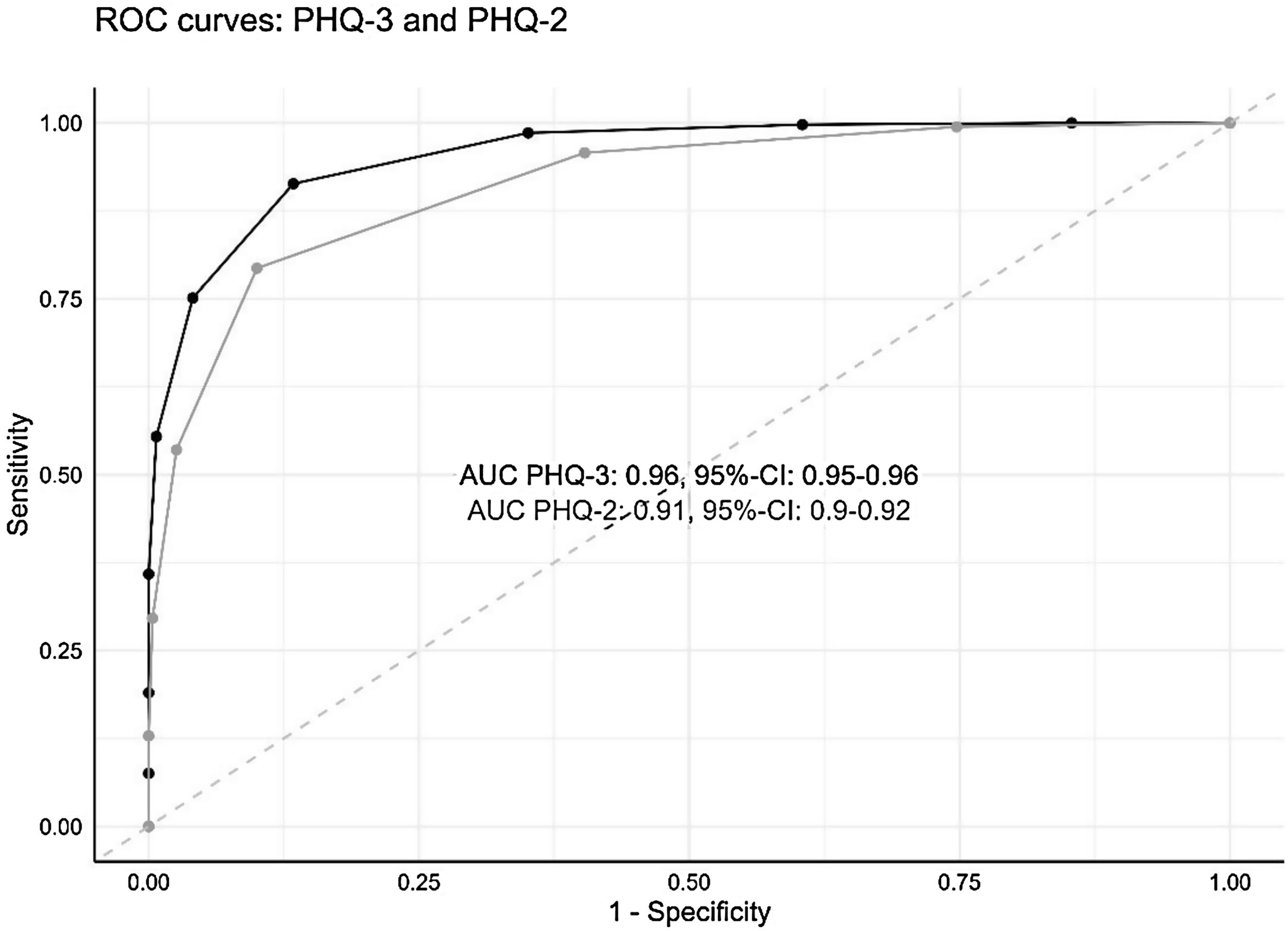
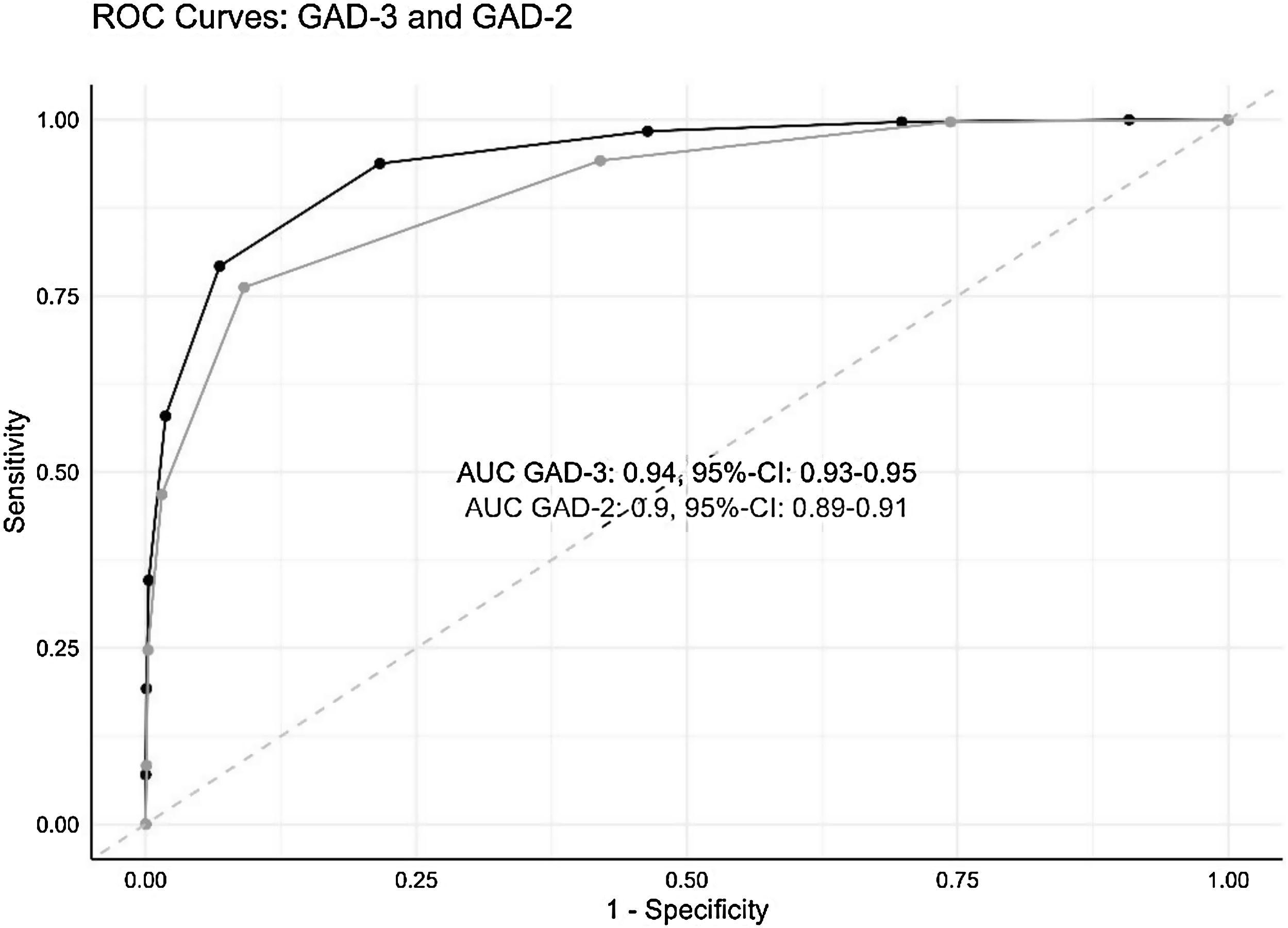
Two thousand four hundred two individuals completed PHQ-8 and GAD-7; 45.0% were adolescents, 55.0% young adults. Depression symptoms were present in 53.0% and anxiety in 40.9%. AUC values were 0.96 (PHQ-3) and 0.91 (PHQ-2). Optimal cut-offs: PHQ-3 ≥4 (sensitivity 91%, specificity 87%), PHQ-2 ≥3 (sensitivity 79%, specificity 90%), GAD-3 ≥4 (sensitivity 94%, specificity 78%), and GAD-2 ≥3 (sensitivity 76%, specificity 91%).

Conclusions

PHQ-3 and GAD-3 scales demonstrate acceptable discriminative ability for screening depression and anxiety in young people living in deprived urban areas of the studied cities. Then, their three-item format allows for symptom screening with a shorter response time.

Keywords:
Depression
Anxiety
Sensitivity
Specificity
Young
Resumen
Objetivo

Evaluar la sensibilidad y especificidad de PHQ-3, PHQ-2, GAD-3 y GAD-2 en jóvenes de áreas urbanas desfavorecidas de Bogotá, Buenos Aires y Lima para la detección temprana de depresión y ansiedad.

Métodos

Se seleccionaron adolescentes (15-16 años) y adultos jóvenes (20-24 años) de barrios de bajos ingresos en estas ciudades. Se evaluó la sensibilidad, la especificidad y la exactitud en diferentes puntos de corte. Se llevó a cabo un análisis de curva ROC, obteniendo el AUC con IC del 95% utilizando el PHQ-8 y el GAD-7 (punto de corte10) como referencias. El índice de Youden identificó los puntos de corte óptimos.

Resultados

Un total de 2.402 individuos completaron el PHQ-8 y el GAD-7; el 45,0% eran adolescentes y el 55,0% adultos jóvenes. Los síntomas de depresión estuvieron presentes en el 53,0% y los de ansiedad en el 40,9%. Los valores del AUC fueron 0,96 (PHQ-3) y 0,91 (PHQ-2). Puntos de corte óptimos: PHQ-34 (sensibilidad 91%, especificidad 87%), PHQ-23 (sensibilidad 79%, especificidad 90%), GAD-34 (sensibilidad 94%, especificidad 78%) y GAD-23 (sensibilidad 76%, especificidad 91%).

Conclusiones

Las escalas PHQ-3 y GAD-3 muestran una capacidad discriminativa aceptable para el tamizaje de depresión y ansiedad en jóvenes que viven en áreas urbanas desfavorecidas de las ciudades estudiadas. Además, su formato de 3 ítems permite un tamizaje de síntomas con un menor tiempo de respuesta.


Palabras clave:
Depresión
Ansiedad
Sensibilidad
Especificidad
Jóvenes

Artículo

Opciones para acceder a los textos completos de la publicación Revista Colombiana de Psiquiatría
Suscriptor
Suscriptor de la revista

Si ya tiene sus datos de acceso, clique aquí.

Si olvidó su clave de acceso puede recuperarla clicando aquí y seleccionando la opción "He olvidado mi contraseña".
Comprar
Comprar acceso al artículo

Comprando el artículo el PDF del mismo podrá ser descargado

Comprar ahora
Contactar
Teléfono para suscripciones e incidencias
De lunes a viernes de 9h a 18h (GMT+1) excepto los meses de julio y agosto que será de 9 a 15h
Llamadas desde España
932 415 960
Llamadas desde fuera de España
+34 932 415 960
E-mail
Opciones de artículo
Herramientas