

metricas

Revista Colombiana de Psiquiatría

Sugerencias
Revista Colombiana de Psiquiatría Psychological and social effects on long term quarantined college students: Prev...
Información de la revista
Vol. 54. Núm. 1.
Páginas 13-24 (Enero - Marzo 2025)
Visitas
329
Vol. 54. Núm. 1.
Páginas 13-24 (Enero - Marzo 2025)
Original article
Acceso a texto completo

Psychological and social effects on long term quarantined college students: Prevalence, correlated factors and coping skills

Efectos psicológicos y sociales en estudiantes universitarios bajo cuarentena prolongada: prevalencia, factores asociados y mecanismos de afrontamiento
Visitas
329
Héctor Badellinoa,
Autor para correspondencia
hectorbade@hotmail.com

Corresponding author.
, María Emilia Gobboa, Eduardo Torresb, María Emilia Aschieric, Martín Biottia, Valentina Alvareza, Camila Gigantea, Mabel Cachiarellia
a Faculty of Psychology, UCES University, San Francisco (Córdoba), Argentina
b CIECS (CONICET y UNC) y FCE-Universidad Nacional de Córdoba, Córdoba, Argentina
c School of Languages, Universidad Nacional de Córdoba, Córdoba, Argentina
Este artículo ha recibido
Información del artículo
Resumen
Texto completo
Bibliografía
Descargar PDF
Estadísticas
Figuras (1)
fig0005
Tablas (4)
Table 1. Demographic characteristics of the study population.
Tablas
Table 2. Association between socio-demographic variables and concerns for moderate/severe anxiety during quarantine by COVID-19 in Argentine university students.
Tablas
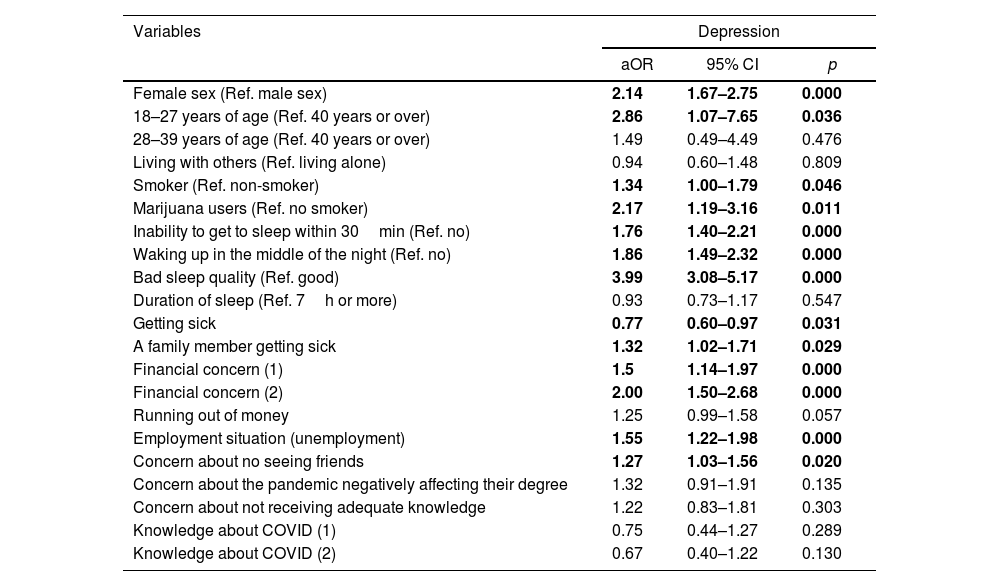
Table 3. Association between socio-demographic variables and concerns for moderate/severe depression during quarantine by COVID-19 in Argentine university students.
Tablas
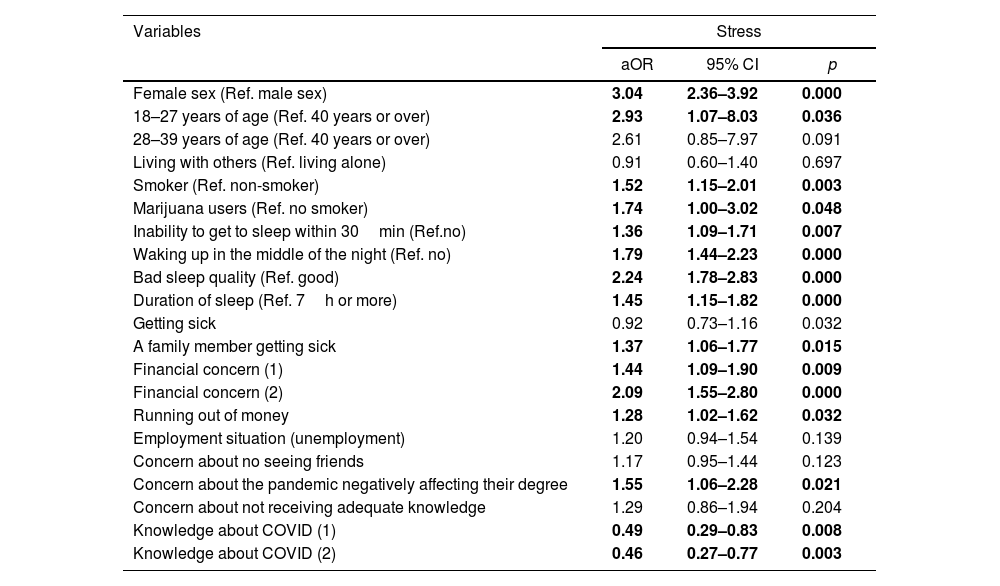
Table 4. Association between socio-demographic variables and concerns for significant stress during quarantine by COVID-19 in Argentine university students.
Tablas
Mostrar másMostrar menos
Abstract
Objectives

To determine the prevalence of anxiety, depression and stress on Argentinian university students, their risk factors, concerns and coping skills.

Method

A cross-sectional study was conducted in college students from Argentina, using a survey spread on social networks.

Results

Of 1711 surveyed students, 40.67% experienced moderate/severe anxiety, 58.03% experienced moderate/severe depression, 48.01% experienced stress and 68.8% reported insomnia. Females (aOR: 2.14; 95% CI: 1.67–2.75), young people (aOR: 2.86; 95%CI: 1.07–7.65), smokers (aOR: 1.34; 95% CI: 1.005–1.79), users of marijuana (aOR: 2.17; 95% CI: 1.19–3.96) and participants with poor sleep quality (aOR: 3.99; 95% CI: 3.08–5.17) were more affected. Economic concerns (aOR: 2.95; 95% CI: 1.50–2.68), unemployment (aOR: 1.55; 95% CI: 1.02–1.56) and concern about not seeing friends (aOR: 1.27; 95% CI: 1.03–1.56) were associated with increased risk of having the conditions mentioned above.

Conclusions

The psychological impact caused by the long-term confinement is greater on Argentinian university students than on the general population.

Keywords:
Anxiety
Depression
Stress
Sleep disorders
College students
Resumen
Objetivos

Determinar la prevalencia de ansiedad, depresión y estrés en estudiantes universitarios argentinos, los factores de riesgo, sus preocupaciones y métodos de afrontamiento utilizados.

Método

Se efectuó un estudio transversal en estudiantes universitarios argentinos, utilizando una encuesta diseminada por redes sociales.

Resultados

De los 1.711 estudiantes encuestados, 40,67% experimentaron ansiedad moderada/severa, 58,03% depresión moderada/severa; 48,01% estrés significativo y 68,8% reportaron insomnio. Las mujeres (razón de probabilidad ajustada [aOR]: 2,14; intervalo de confianza [IC] 95%: 1,67-2,75), la gente más joven (aOR: 2,86; IC 95%: 1,07-7,65), los fumadores (aOR: 1,34; IC 95%: 1,005-1,79), consumidores de marihuana (aOR: 2,17; IC 95%: 1,19-3,96) y los participantes con mala calidad de sueño (aOR: 3,99; IC 95%: 3,08-5,17) estuvieron más afectados. Las preocupaciones económicas (aOR: 2,95; IC 95%: 1,50-2,68), el desempleo (aOR: 1,55; IC 95%: 1,02-1,56) y la preocupación por no ver a sus amigos (aOR: 1,27; IC 95%: 1,03-1,56) estuvieron asociados con mayor riesgo de padecer las condiciones arriba mencionadas.

Conclusiones

El impacto psicológico causado por un confinamiento más prolongado es mayor en estudiantes universitarios argentinos que en la población general.


Palabras clave:
Ansiedad
Depresión
Estrés
Trastornos del sueño
Estudiantes universitarios
Texto completo
Introduction

The disease caused by SARS-CoV-2, which originated in China in December 2019, was declared a pandemic by the World Health Organization (WHO) on March 11, 2020.1 COVID-19 rapidly and uncontrollably spread around the world, causing great, unprecedented impact on physical and mental health, and on social and economic spheres.2–4 In order to reduce the rate of contagion and the dissemination of the disease, the Government of the Argentine Republic enforced a mandatory quarantined on March 20, 2020,5 which continues to December 2020 and then some activities started to open, with severe limitations.

At the time this study began, 11,353 confirmed cases and 445 deaths had been reported in Argentina,6 and 5,103,006 confirmed cases and 333,401 deaths had been reported worldwide.7 In addition to the enormous number of confirmed cases and deaths attributable to COVID-19, mental health indicators (anxiety, depression, stress, post-traumatic stress, etc.) were strongly affected by the rapid progression of the disease and by the measures taken to reduce the rate of contagion. Such measures, such as isolation and social distancing, had demonstrated a strong impact on the mental health of the population in previous epidemics,8,9 and could also be verified during the current pandemic.2,4,10–12

Most studies conducted so far show that women, the young and some social groups such as students and health personnel show a greater impact on mental health conditions as a result of the enforced isolation measures.3,13–20 Measures of movement restriction, confinement, social distancing and school activities closure at all levels also had a strong impact on young Argentinians.21

In young people, interpersonal relationships showed changes affecting fun time, and with them, the need to share with others again. Consequently, thousands of clandestine parties have taken place in many cities, either due to a lack of recognition among the public of the implications of contagion, or due to the urgent need to overcome confinement and to be able to experience physical contact with family and friends.15,22

University life constitutes a stage of high stress that is strongly associated to mental diseases. Most of the studies conducted to date on university students have shown a high level of stress, depression and anxiety associated with isolation.17,22–32 The prevalence differed by gender, epidemic stage, region, education stage and assessment tool. The prevalence of psychological stress in the student population during the COVID-19 epidemic may be higher compared to the global prevalence.33 By the contrary, a meta-analysis study showed lower prevalence of depression in university students compared with general population.31

However, the psychological impact brought about by these measures has not yet been evaluated on university students in Argentina. Using data from a large cross-sectional study carried out on the Argentinian population, the present study aims to know the prevalence of anxiety, depression, stress and sleep disorders and to know the risk factors and the level of concerns that may contribute to psychological distress in university students, as well as the coping strategies they use to overcome this difficult stage.

MethodsStudy design and study population

From May 23, 2020 to June 12, 2020, we conducted a cross-sectional survey to determine the psychological impact (anxiety, depression and self-perceived stress) of the COVID-19 pandemic on Argentinian university student population using an anonymous, voluntary online questionnaire. The online survey was made with a digital tool (Google Forms) and was spread on social networks (Facebook, Twitter, Instagram) and by email. Inclusion criteria were as follows: (a) being over 18 years of age, (b) living in Argentina and (c) being student of any Argentinian university. Exclusion criteria were as follows: (a) having a previous mental disorder and (b) having dyslexia.

First, participants were asked to provide their demographic and social information: age, sex, civil status (single, married, with a partner, divorced, etc.) place of study (private or public university or institute), city of residence, way of living (living alone, living with family members, living with friends or living with a partner), compliance with quarantine conditions (no/yes) and alcohol, cigarette and marijuana consumption.

The level of knowledge on COVID-19 (how it acts, symptoms, modes of transmission and prevention, and participants’ attitude towards the appearance of symptoms) using a Likert scale, in which 0 means no knowledge and 10 means maximum knowledge was evaluated. Such knowledge was graduated as scarce (0–4), moderate (5–7) and high (8–10).

Questions about the financial and employment situation and participants’ concerns were added. To assess the current employment situation, we grouped the possible responses into a binary response: employed or unemployed. Regarding concern about the financial situation, we asked: “How concerned have you been about your own or your family financial situation in the last month? A Likert scale from 1 to 10 (0=no concern and 10=maximum concern) was used, and the level of concern was ranked as mild (0–4), moderate (5–7) or maximum (8–10).

We also studied various aspects of concern using a Likert scale from 1 to 4, in which 1 means “not concerned”, 2 means “a little concerned”, 3 means “concerned” and 4 means “very much concerned”. The following concerns were considered: “Getting sick”, “a family member getting sick”, “running out of money to pay my expenses, rent and taxes”, “not seeing my friends”, “the pandemic having a negative effect on my degree” and “not achieving ideal learning”. Answers were grouped in two options (No stands for “I am not concerned” and “I am little concerned”; Yes stands for “I am concerned” and “I am very much concerned”). Then, participants were asked to complete questionnaires measuring psychological distress and sleep quality.

Tools to measure the impact on mental health and sleep quality

The following tools were used to measure the impact on mental health (anxiety, depression and self-perceived stress) and sleep quality:

GAD-7 (Generalized Anxiety Disorder-7 items scale)

Each question is given a value from 0 to 3. Possible answers were as follows: not at all sure (0), several days (1), over half the days (2) and nearly every day (3). The total test score can range from 0 to 21. The cut-off point was 10 (with a sensitivity of 86.8% and specificity of 93.4%) and anxiety was classified as follows: Minimum (0–4), Mild (5–9), Moderate (10–14) and Severe (15–21).24 Respondents who reported moderate or severe anxiety were considered.

PHQ-9 (Patients Health Questionnaire 9-items)

This is an instrument to assess the presence and severity of depression symptoms. It consists of 9 questions, each rated from 0 to 3. Possible answers were not at all sure (0), several days (1), over half the days (2) and nearly every day (3). The PHQ-9 scores are as follows: None (0–4), Mild (5–9), Moderate (10–14) and Severe (15–27). Only respondents who reported moderate or severe depression (10–27 points) were considered, since a cutoff score of 10 or greater has an 88% of sensibility and an 88% of specificity. A binary classification of depression symptoms was used (yes/no).

PSS-10 (Perceived Stress Scale)

This is an instrument to measure the level of perceived stress. It consists of 10 questions, each rated from 0 to 4. Possible answers were as follows: never (0), almost never (1), sometimes (2), fairly often (3) and very often (4). The cut-off point was 20, from which the level of perceived stress was considered to be high.33

PSQI (Pittsburgh Sleep Quality Index)

This is a self-report questionnaire used to measure sleep quality and sleep disturbances during the past month. In this case, following Liu et al. only the following 4 items (out of 9 items) of the index were selected to measure sleep quality: (a) How would you rate your sleep quality overall? (0. Very good; 1. Fairly good; 2. Fairly bad and 3. Very bad); (b) How often have you had trouble sleeping because you cannot get to sleep within 30min? (0. Not during the past month; 1. Less than once a week; 2. Once or twice a week; 3. Three or more times a week); (c) How often have you had trouble sleeping because you wake up in the middle of the night or early morning? (0. Not during the past month; 1. Less than once a week; 2. Once or twice a week; 3. Three or more times a week)l (d) How many hours of actual sleep do you get at night? (less than 5h per night; 6–7h per night; more than 7h per night). The use of some items has been seen in other studies since it has been proved that the use of isolated components for measuring subjective sleep quality highly correlates with the global PSQI score.34 Responses with the two highest values in the scale and the response “less than 7h” for the last question were considered significant.

Coping strategies

This section consisted of questions related to the ways in which students cope with stress during the pandemic. The options were as follows: I communicate daily with family and friends with my phone, via WhatsApp, etc. – I use social networks (Instagram, WhatsApp, Facebook, etc.) to stay connected and informed. – I have online psychotherapy sessions. – I do online activities such as cooking courses, language classes, yoga, sports, meditation, etc. – I get a lot of information on TV and radio. – I stopped watching the news on TV and newspapers. – I watch movies or series on TV. – I read, paint or play music. – I set up a daily routine of physical activity.

Data analysis

Data were analyzed in two stages. The first step consisted in the creation of contingency tables with the descriptive analysis of the data among the independent variables versus the dependent variables (anxiety, depression and stress) in order to know the relationship between these variables (t-test). Next, multivariate logistic regression analysis was performed in each model separately to test the adjusted odds ratio (aOR), in order to assess associated factors (gender, age, living with others, smoker, marijuana use, sleep quality, financial and study concerns and knowledge about COVID) related to depression, anxiety and stress. All predictors were entered into the model simultaneously. Other confounding factors were excluded of the analysis. The following statistics were calculated for estimation: coefficient estimates, 95% confidence intervals (CI) for the regression coefficient, standard errors of the regression coefficient, odds ratio, z-values, and their corresponding p-values. P-value<0.05 was considered to be significant. The software used was SPSS 19.0 (IBM SPSS Statistics, New York, United States).

Ethical approval

A consent form was signed by all participants before they completed the survey. The study was approved by the Ethics Committee of Hospital Regional José Iturraspe of the city of San Francisco in Córdoba, Argentina.

ResultsPrevalence and demographic characteristics

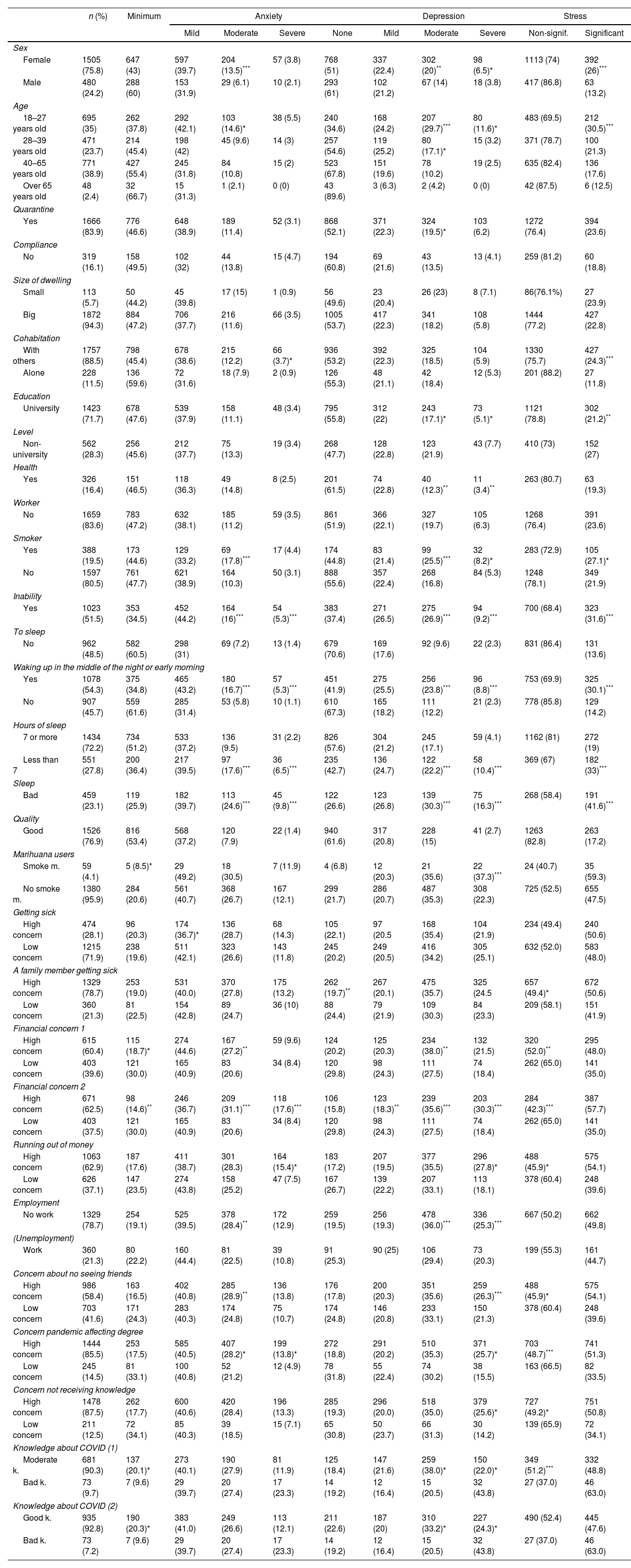
A total of 1711 students from private/public universities in Argentina participated in this study. 75.2% (1287) were women and the average age was 21.16 years (DS 4.13). 90% (1571) were single, 86.5% (1481) lived with family, 6.8% (116) lived alone, and 6.7% (116) lived with partners or friends. 20.6% (352) studied in non-university institutes, 62.4% (1068) studied in public universities and 17% (291) attended private universities. 77.2% (1343) complied with the isolation decreed by the government, whereas 22.8% (368) reported non-compliance with such isolation for some reason. Table 1 shows the demographic characteristics of the study population.

Table 1.

Demographic characteristics of the study population.

  n (%)  Minimum  AnxietyDepressionStress
      Mild  Moderate  Severe  None  Mild  Moderate  Severe  Non-signif.  Significant 
Sex
Female  1505 (75.8)  647 (43)  597 (39.7)  204 (13.5)***  57 (3.8)  768 (51)  337 (22.4)  302 (20)**  98 (6.5)*  1113 (74)  392 (26)*** 
Male  480 (24.2)  288 (60)  153 (31.9)  29 (6.1)  10 (2.1)  293 (61)  102 (21.2)  67 (14)  18 (3.8)  417 (86.8)  63 (13.2) 
Age
18–27 years old  695 (35)  262 (37.8)  292 (42.1)  103 (14.6)*  38 (5.5)  240 (34.6)  168 (24.2)  207 (29.7)***  80 (11.6)*  483 (69.5)  212 (30.5)*** 
28–39 years old  471 (23.7)  214 (45.4)  198 (42)  45 (9.6)  14 (3)  257 (54.6)  119 (25.2)  80 (17.1)*  15 (3.2)  371 (78.7)  100 (21.3) 
40–65 years old  771 (38.9)  427 (55.4)  245 (31.8)  84 (10.8)  15 (2)  523 (67.8)  151 (19.6)  78 (10.2)  19 (2.5)  635 (82.4)  136 (17.6) 
Over 65 years old  48 (2.4)  32 (66.7)  15 (31.3)  1 (2.1)  0 (0)  43 (89.6)  3 (6.3)  2 (4.2)  0 (0)  42 (87.5)  6 (12.5) 
Quarantine
Yes  1666 (83.9)  776 (46.6)  648 (38.9)  189 (11.4)  52 (3.1)  868 (52.1)  371 (22.3)  324 (19.5)*  103 (6.2)  1272 (76.4)  394 (23.6) 
Compliance
No  319 (16.1)  158 (49.5)  102 (32)  44 (13.8)  15 (4.7)  194 (60.8)  69 (21.6)  43 (13.5)  13 (4.1)  259 (81.2)  60 (18.8) 
Size of dwelling
Small  113 (5.7)  50 (44.2)  45 (39.8)  17 (15)  1 (0.9)  56 (49.6)  23 (20.4)  26 (23)  8 (7.1)  86(76.1%)  27 (23.9) 
Big  1872 (94.3)  884 (47.2)  706 (37.7)  216 (11.6)  66 (3.5)  1005 (53.7)  417 (22.3)  341 (18.2)  108 (5.8)  1444 (77.2)  427 (22.8) 
Cohabitation
With others  1757 (88.5)  798 (45.4)  678 (38.6)  215 (12.2)  66 (3.7)*  936 (53.2)  392 (22.3)  325 (18.5)  104 (5.9)  1330 (75.7)  427 (24.3)*** 
Alone  228 (11.5)  136 (59.6)  72 (31.6)  18 (7.9)  2 (0.9)  126 (55.3)  48 (21.1)  42 (18.4)  12 (5.3)  201 (88.2)  27 (11.8) 
Education
University  1423 (71.7)  678 (47.6)  539 (37.9)  158 (11.1)  48 (3.4)  795 (55.8)  312 (22)  243 (17.1)*  73 (5.1)*  1121 (78.8)  302 (21.2)** 
Level
Non-university  562 (28.3)  256 (45.6)  212 (37.7)  75 (13.3)  19 (3.4)  268 (47.7)  128 (22.8)  123 (21.9)  43 (7.7)  410 (73)  152 (27) 
Health
Yes  326 (16.4)  151 (46.5)  118 (36.3)  49 (14.8)  8 (2.5)  201 (61.5)  74 (22.8)  40 (12.3)**  11 (3.4)**  263 (80.7)  63 (19.3) 
Worker
No  1659 (83.6)  783 (47.2)  632 (38.1)  185 (11.2)  59 (3.5)  861 (51.9)  366 (22.1)  327 (19.7)  105 (6.3)  1268 (76.4)  391 (23.6) 
Smoker
Yes  388 (19.5)  173 (44.6)  129 (33.2)  69 (17.8)***  17 (4.4)  174 (44.8)  83 (21.4)  99 (25.5)***  32 (8.2)*  283 (72.9)  105 (27.1)* 
No  1597 (80.5)  761 (47.7)  621 (38.9)  164 (10.3)  50 (3.1)  888 (55.6)  357 (22.4)  268 (16.8)  84 (5.3)  1248 (78.1)  349 (21.9) 
Inability
Yes  1023 (51.5)  353 (34.5)  452 (44.2)  164 (16)***  54 (5.3)***  383 (37.4)  271 (26.5)  275 (26.9)***  94 (9.2)***  700 (68.4)  323 (31.6)*** 
To sleep
No  962 (48.5)  582 (60.5)  298 (31)  69 (7.2)  13 (1.4)  679 (70.6)  169 (17.6)  92 (9.6)  22 (2.3)  831 (86.4)  131 (13.6) 
Waking up in the middle of the night or early morning
Yes  1078 (54.3)  375 (34.8)  465 (43.2)  180 (16.7)***  57 (5.3)***  451 (41.9)  275 (25.5)  256 (23.8)***  96 (8.8)***  753 (69.9)  325 (30.1)*** 
No  907 (45.7)  559 (61.6)  285 (31.4)  53 (5.8)  10 (1.1)  610 (67.3)  165 (18.2)  111 (12.2)  21 (2.3)  778 (85.8)  129 (14.2) 
Hours of sleep
7 or more  1434 (72.2)  734 (51.2)  533 (37.2)  136 (9.5)  31 (2.2)  826 (57.6)  304 (21.2)  245 (17.1)  59 (4.1)  1162 (81)  272 (19) 
Less than 7  551 (27.8)  200 (36.4)  217 (39.5)  97 (17.6)***  36 (6.5)***  235 (42.7)  136 (24.7)  122 (22.2)***  58 (10.4)***  369 (67)  182 (33)*** 
Sleep
Bad  459 (23.1)  119 (25.9)  182 (39.7)  113 (24.6)***  45 (9.8)***  122 (26.6)  123 (26.8)  139 (30.3)***  75 (16.3)***  268 (58.4)  191 (41.6)*** 
Quality
Good  1526 (76.9)  816 (53.4)  568 (37.2)  120 (7.9)  22 (1.4)  940 (61.6)  317 (20.8)  228 (15)  41 (2.7)  1263 (82.8)  263 (17.2) 
Marihuana users
Smoke m.  59 (4.1)  5 (8.5)*  29 (49.2)  18 (30.5)  7 (11.9)  4 (6.8)  12 (20.3)  21 (35.6)  22 (37.3)***  24 (40.7)  35 (59.3) 
No smoke m.  1380 (95.9)  284 (20.6)  561 (40.7)  368 (26.7)  167 (12.1)  299 (21.7)  286 (20.7)  487 (35.3)  308 (22.3)  725 (52.5)  655 (47.5) 
Getting sick
High concern  474 (28.1)  96 (20.3)  174 (36.7)*  136 (28.7)  68 (14.3)  105 (22.1)  97 (20.5  168 (35.4)  104 (21.9)  234 (49.4)  240 (50.6) 
Low concern  1215 (71.9)  238 (19.6)  511 (42.1)  323 (26.6)  143 (11.8)  245 (20.2)  249 (20.5)  416 (34.2)  305 (25.1)  632 (52.0)  583 (48.0) 
A family member getting sick
High concern  1329 (78.7)  253 (19.0)  531 (40.0)  370 (27.8)  175 (13.2)  262 (19.7)**  267 (20.1)  475 (35.7)  325 (24.5  657 (49.4)*  672 (50.6) 
Low concern  360 (21.3)  81 (22.5)  154 (42.8)  89 (24.7)  36 (10)  88 (24.4)  79 (21.9)  109 (30.3)  84 (23.3)  209 (58.1)  151 (41.9) 
Financial concern 1
High concern  615 (60.4)  115 (18.7)*  274 (44.6)  167 (27.2)**  59 (9.6)  124 (20.2)  125 (20.3)  234 (38.0)**  132 (21.5)  320 (52.0)**  295 (48.0) 
Low concern  403 (39.6)  121 (30.0)  165 (40.9)  83 (20.6)  34 (8.4)  120 (29.8)  98 (24.3)  111 (27.5)  74 (18.4)  262 (65.0)  141 (35.0) 
Financial concern 2
High concern  671 (62.5)  98 (14.6)**  246 (36.7)  209 (31.1)***  118 (17.6)***  106 (15.8)  123 (18.3)**  239 (35.6)***  203 (30.3)***  284 (42.3)***  387 (57.7) 
Low concern  403 (37.5)  121 (30.0)  165 (40.9)  83 (20.6)  34 (8.4)  120 (29.8)  98 (24.3)  111 (27.5)  74 (18.4)  262 (65.0)  141 (35.0) 
Running out of money
High concern  1063 (62.9)  187 (17.6)  411 (38.7)  301 (28.3)  164 (15.4)*  183 (17.2)  207 (19.5)  377 (35.5)  296 (27.8)*  488 (45.9)*  575 (54.1) 
Low concern  626 (37.1)  147 (23.5)  274 (43.8)  158 (25.2)  47 (7.5)  167 (26.7)  139 (22.2)  207 (33.1)  113 (18.1)  378 (60.4)  248 (39.6) 
Employment
No work  1329 (78.7)  254 (19.1)  525 (39.5)  378 (28.4)**  172 (12.9)  259 (19.5)  256 (19.3)  478 (36.0)***  336 (25.3)***  667 (50.2)  662 (49.8) 
(Unemployment)
Work  360 (21.3)  80 (22.2)  160 (44.4)  81 (22.5)  39 (10.8)  91 (25.3)  90 (25)  106 (29.4)  73 (20.3)  199 (55.3)  161 (44.7) 
Concern about no seeing friends
High concern  986 (58.4)  163 (16.5)  402 (40.8)  285 (28.9)**  136 (13.8)  176 (17.8)  200 (20.3)  351 (35.6)  259 (26.3)***  488 (45.9)*  575 (54.1) 
Low concern  703 (41.6)  171 (24.3)  283 (40.3)  174 (24.8)  75 (10.7)  174 (24.8)  146 (20.8)  233 (33.1)  150 (21.3)  378 (60.4)  248 (39.6) 
Concern pandemic affecting degree
High concern  1444 (85.5)  253 (17.5)  585 (40.5)  407 (28.2)*  199 (13.8)*  272 (18.8)  291 (20.2)  510 (35.3)  371 (25.7)*  703 (48.7)***  741 (51.3) 
Low concern  245 (14.5)  81 (33.1)  100 (40.8)  52 (21.2)  12 (4.9)  78 (31.8)  55 (22.4)  74 (30.2)  38 (15.5)  163 (66.5)  82 (33.5) 
Concern not receiving knowledge
High concern  1478 (87.5)  262 (17.7)  600 (40.6)  420 (28.4)  196 (13.3)  285 (19.3)  296 (20.0)  518 (35.0)  379 (25.6)*  727 (49.2)*  751 (50.8) 
Low concern  211 (12.5)  72 (34.1)  85 (40.3)  39 (18.5)  15 (7.1)  65 (30.8)  50 (23.7)  66 (31.3)  30 (14.2)  139 (65.9)  72 (34.1) 
Knowledge about COVID (1)
Moderate k.  681 (90.3)  137 (20.1)*  273 (40.1)  190 (27.9)  81 (11.9)  125 (18.4)  147 (21.6)  259 (38.0)*  150 (22.0)*  349 (51.2)***  332 (48.8) 
Bad k.  73 (9.7)  7 (9.6)  29 (39.7)  20 (27.4)  17 (23.3)  14 (19.2)  12 (16.4)  15 (20.5)  32 (43.8)  27 (37.0)  46 (63.0) 
Knowledge about COVID (2)
Good k.  935 (92.8)  190 (20.3)*  383 (41.0)  249 (26.6)  113 (12.1)  211 (22.6)  187 (20)  310 (33.2)*  227 (24.3)*  490 (52.4)  445 (47.6) 
Bad k.  73 (7.2)  7 (9.6)  29 (39.7)  20 (27.4)  17 (23.3)  14 (19.2)  12 (16.4)  15 (20.5)  32 (43.8)  27 (37.0)  46 (63.0) 

n: 1711.

*

P0.05.

**

P0.01.

***

P0.001.

With respect to sleep quality, 1126 respondents (65.8%) reported inability to sleep in the first thirty minutes, 913 respondents (53.4%) reported waking up easily at night or very early, 1177 (68.8%) reported sleeping less than 7h, and 604 respondents (35.3%) evaluated their sleep quality as poor.

Factors related to anxiety

80.71% (1381) of the respondents showed some degree of anxiety, of which 40.03% (685) had mild anxiety, 28.34% (485) had moderate anxiety and 12.33% (211) had severe anxiety. For statistical analysis, only respondents with moderate and severe anxiety were considered (696 respondents: 40.67%). The average anxiety score was 8.67 (DS: 4.62).

There was a significant increase in moderate (22.26% vs 4.55%; p: 0.000) and severe (10.69% vs 1.63%; p: 0.000) anxiety in women compared to men.

A significant prevalence of moderate/severe anxiety was demonstrated in students who were unable to fall asleep within 30min, woke up at night or very early in the morning, slept less than 7h and had poor sleep quality.

The other factors studied such as age, living with others or living alone, cigarette consumption, compliance with quarantine and residence size showed no statistically significant differences.

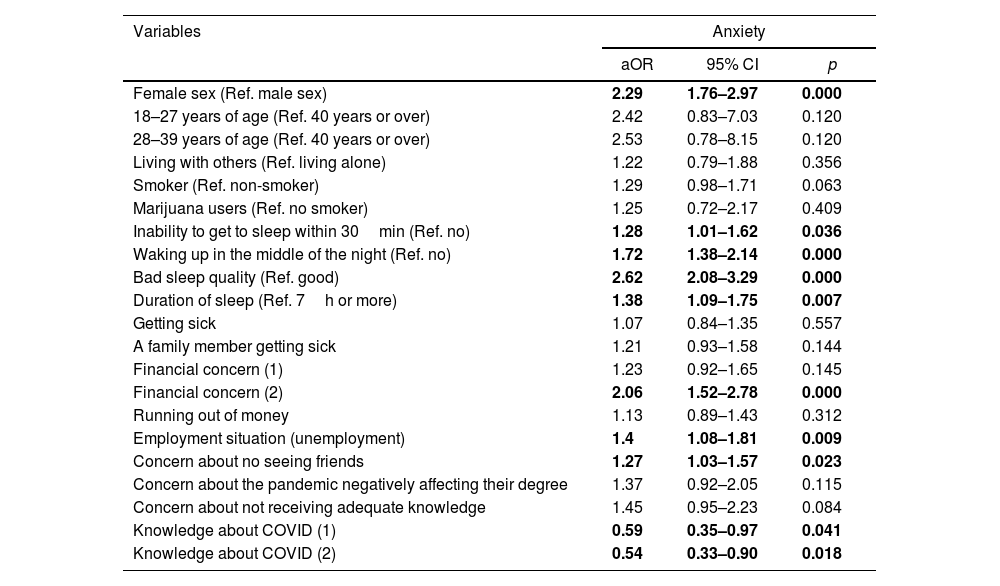
Then, associated factors for moderate/severe anxiety were analyzed (Table 2). Females were significantly associated with anxiety (aOR: 2.29; 95% CI: 1.76–2.97), as participants with inability to fall asleep within 30min, who woke up in the middle of the night or very early in the morning, who slept less that 7h and participants with poor sleep quality. The rest of the factors studied showed no association with anxiety.

Table 2.

Association between socio-demographic variables and concerns for moderate/severe anxiety during quarantine by COVID-19 in Argentine university students.

Variables  Anxiety
  aOR  95% CI  p 
Female sex (Ref. male sex)  2.29  1.76–2.97  0.000 
18–27 years of age (Ref. 40 years or over)  2.42  0.83–7.03  0.120 
28–39 years of age (Ref. 40 years or over)  2.53  0.78–8.15  0.120 
Living with others (Ref. living alone)  1.22  0.79–1.88  0.356 
Smoker (Ref. non-smoker)  1.29  0.98–1.71  0.063 
Marijuana users (Ref. no smoker)  1.25  0.72–2.17  0.409 
Inability to get to sleep within 30min (Ref. no)  1.28  1.01–1.62  0.036 
Waking up in the middle of the night (Ref. no)  1.72  1.38–2.14  0.000 
Bad sleep quality (Ref. good)  2.62  2.08–3.29  0.000 
Duration of sleep (Ref. 7h or more)  1.38  1.09–1.75  0.007 
Getting sick  1.07  0.84–1.35  0.557 
A family member getting sick  1.21  0.93–1.58  0.144 
Financial concern (1)  1.23  0.92–1.65  0.145 
Financial concern (2)  2.06  1.52–2.78  0.000 
Running out of money  1.13  0.89–1.43  0.312 
Employment situation (unemployment)  1.4  1.08–1.81  0.009 
Concern about no seeing friends  1.27  1.03–1.57  0.023 
Concern about the pandemic negatively affecting their degree  1.37  0.92–2.05  0.115 
Concern about not receiving adequate knowledge  1.45  0.95–2.23  0.084 
Knowledge about COVID (1)  0.59  0.35–0.97  0.041 
Knowledge about COVID (2)  0.54  0.33–0.90  0.018 

n: 1711.

Subsequently, the concerns that were significantly associated with moderate/severe anxiety were analyzed. When asked about economic concerns there was significant association in respondents who expressed a lot of concern about their economic situation or were unemployed. In terms of social concerns, not being able to see friends was a significant risk factor. The following were not significant relationship with anxiety: concern about the financial situation, concern about getting infected, concern about a family member getting infected, running out of money, concern about the pandemic negatively affecting the degree, concern about not getting an adequate learning, cigarette or marijuana consumption.

Having moderate and a lot of knowledge of COVID-19 was inversely associated to anxiety.

Factors related to depression

The prevalence of depression was 78.25% (1339 respondents), of which 346 respondents (20.22%) had mild depression, 584 (34.13%) had moderate depression and 409 respondents (23.90%) had severe depression. The 993 respondents (58.03%) experiencing moderate/severe depression were analyzed. The average depression score was 10.48 (DS: 5.69).

Women were significantly more affected than men by moderate and severe depression. A significant increase in severe depression was found in students aged 18–27 in comparison to older students. There was a significantly higher prevalence of severe depression in smokers than in non-smokers and the same was found in participants who used marijuana.

A significant relationship was found between sleep disorders and moderate/severe depression. A high prevalence of depression was found in participants who were unable to fall asleep within 30min, who woke up the middle of the night and participants who evaluated their sleep quality as poor. There was no significant relationship between depression and the number of hours’ students slept. Respondents who did not comply with the mandatory quarantine were more prone to moderate and severe depression.

The following factors had association with moderate/severe depression (Table 3): being female, being between 18 and 27 years old, smoking, using marijuana, being unable to fall asleep within 30min, wakening up in the middle of the night and having poor sleep quality. There was no significant relationship between depression and living with others nor with the number of hours of sleep.

Table 3.

Association between socio-demographic variables and concerns for moderate/severe depression during quarantine by COVID-19 in Argentine university students.

Variables  Depression
  aOR  95% CI  p 
Female sex (Ref. male sex)  2.14  1.67–2.75  0.000 
18–27 years of age (Ref. 40 years or over)  2.86  1.07–7.65  0.036 
28–39 years of age (Ref. 40 years or over)  1.49  0.49–4.49  0.476 
Living with others (Ref. living alone)  0.94  0.60–1.48  0.809 
Smoker (Ref. non-smoker)  1.34  1.00–1.79  0.046 
Marijuana users (Ref. no smoker)  2.17  1.19–3.16  0.011 
Inability to get to sleep within 30min (Ref. no)  1.76  1.40–2.21  0.000 
Waking up in the middle of the night (Ref. no)  1.86  1.49–2.32  0.000 
Bad sleep quality (Ref. good)  3.99  3.08–5.17  0.000 
Duration of sleep (Ref. 7h or more)  0.93  0.73–1.17  0.547 
Getting sick  0.77  0.60–0.97  0.031 
A family member getting sick  1.32  1.02–1.71  0.029 
Financial concern (1)  1.5  1.14–1.97  0.000 
Financial concern (2)  2.00  1.50–2.68  0.000 
Running out of money  1.25  0.99–1.58  0.057 
Employment situation (unemployment)  1.55  1.22–1.98  0.000 
Concern about no seeing friends  1.27  1.03–1.56  0.020 
Concern about the pandemic negatively affecting their degree  1.32  0.91–1.91  0.135 
Concern about not receiving adequate knowledge  1.22  0.83–1.81  0.303 
Knowledge about COVID (1)  0.75  0.44–1.27  0.289 
Knowledge about COVID (2)  0.67  0.40–1.22  0.130 

n: 1711.

In terms of concerns associated with moderate/severe depression, economic concerns were very significant. A meaningful impact was found in participants who reported moderate and a lot of concern about their financial situation and in participants who were unemployed. Concern about a family member getting infected or not seeing friends were also associated factors for depression, contrary to concern about getting sick, not getting adequate learning or having moderate or a lot of knowledge on the disease.

Factors related to stress

48.10% (823) of the students surveyed reported significant stress. It was found that females experienced a higher level of stress than men. Smokers, being unable to fall asleep within 30min, wakening up in the middle of the night, sleeping less than 7h and having poor sleep quality were other factors related to a high level of stress.

The following were the significant factors associated to stress (Table 4): being female (aOR: 3.04; 95%CI: 2.36–3.92), young students between 18 and 27 years old, smoking, using marijuana, being unable to fall asleep within 30min, wakening up in the middle of the night, having poor sleep quality.

Table 4.

Association between socio-demographic variables and concerns for significant stress during quarantine by COVID-19 in Argentine university students.

Variables  Stress
  aOR  95% CI  p 
Female sex (Ref. male sex)  3.04  2.36–3.92  0.000 
18–27 years of age (Ref. 40 years or over)  2.93  1.07–8.03  0.036 
28–39 years of age (Ref. 40 years or over)  2.61  0.85–7.97  0.091 
Living with others (Ref. living alone)  0.91  0.60–1.40  0.697 
Smoker (Ref. non-smoker)  1.52  1.15–2.01  0.003 
Marijuana users (Ref. no smoker)  1.74  1.00–3.02  0.048 
Inability to get to sleep within 30min (Ref.no)  1.36  1.09–1.71  0.007 
Waking up in the middle of the night (Ref. no)  1.79  1.44–2.23  0.000 
Bad sleep quality (Ref. good)  2.24  1.78–2.83  0.000 
Duration of sleep (Ref. 7h or more)  1.45  1.15–1.82  0.000 
Getting sick  0.92  0.73–1.16  0.032 
A family member getting sick  1.37  1.06–1.77  0.015 
Financial concern (1)  1.44  1.09–1.90  0.009 
Financial concern (2)  2.09  1.55–2.80  0.000 
Running out of money  1.28  1.02–1.62  0.032 
Employment situation (unemployment)  1.20  0.94–1.54  0.139 
Concern about no seeing friends  1.17  0.95–1.44  0.123 
Concern about the pandemic negatively affecting their degree  1.55  1.06–2.28  0.021 
Concern about not receiving adequate knowledge  1.29  0.86–1.94  0.204 
Knowledge about COVID (1)  0.49  0.29–0.83  0.008 
Knowledge about COVID (2)  0.46  0.27–0.77  0.003 

n: 1711.

Moderate and a lot of concern about the financial situation and concern about running out of money, were significantly associated to stress. Concern about a family member getting sick and the pandemic negatively affecting the degree were also associated factors for stress among students.

Students having moderate or a lot of knowledge of COVID-19 were less associated with stress than students having scarce knowledge on the disease.

Coping skills

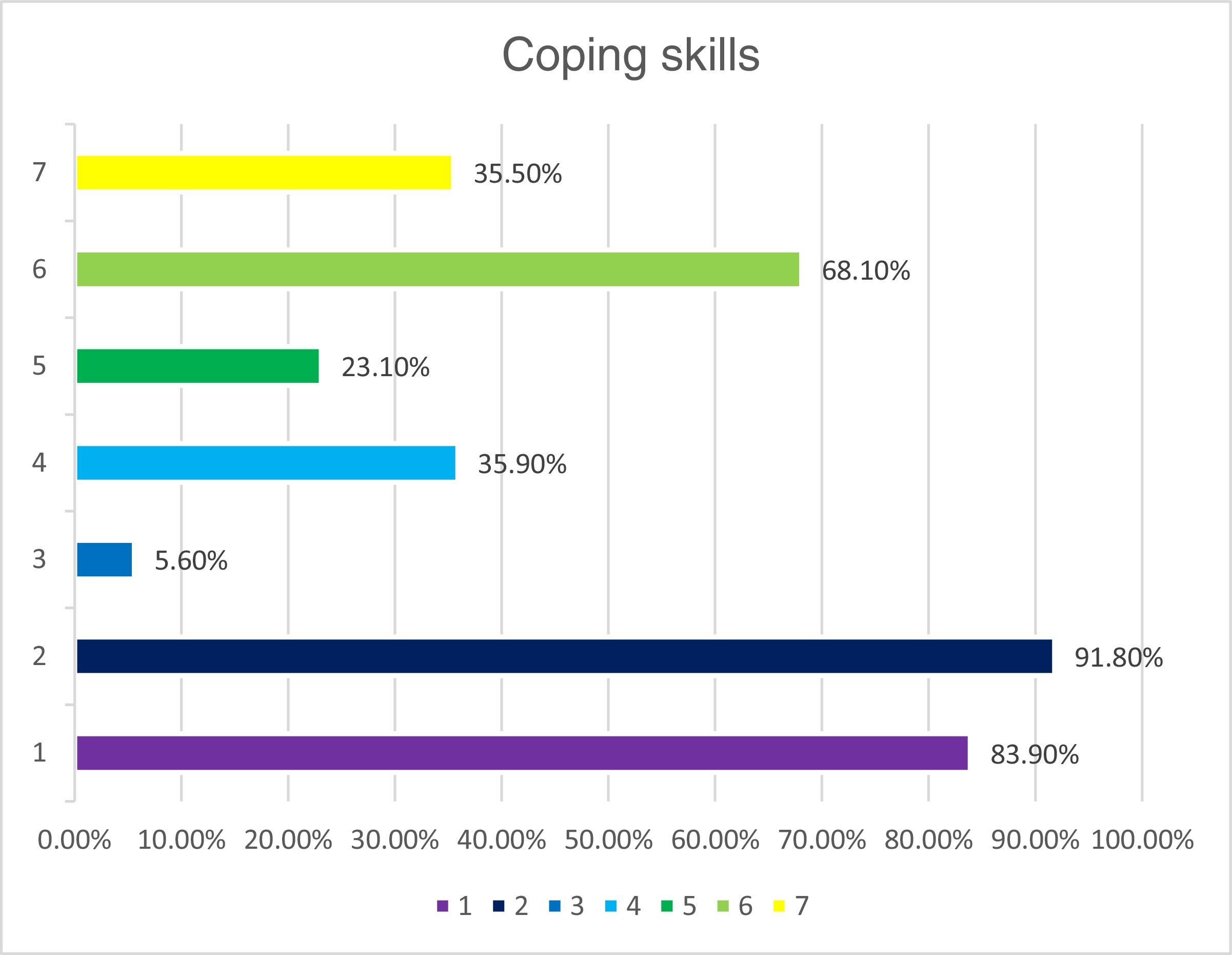
As for the coping mechanisms put in place to cope with the quarantine, those in which electronic media were used – communicating by phone or chatting with family and friends (83%), using social networks (91.8%), watching movies, series and TV (68%) and doing online cooking courses, yoga, meditation, etc. (35.9%) – far exceed those in which no electronic media were used – reading, painting, playing musical instruments (30%) or having a daily routine of physical activity (23.1%). Only 5.6% of respondents reported having online psychotherapy sessions (Fig. 1).

Fig. 1.

Coping mechanisms in Argentine university students. n:1711. (1-I) Communicate with my family and friends every day by phone or social networks. (2-I) Use social networks to keep me updated/informed. (3-I) Have online sessions of psychological support. (4-I) Do online activities (cooking classes, languages, sports, yoga, etc.). (5-I) Set up I daily routine of physical activity. (6-I) Watch movies or series on TV. (7-I) Read, paint or play music.

Discussion

This cross-sectional study was carried out among university students and began two months after the Argentine Government enforced mandatory social isolation throughout the country. A high level of psychological distress was evident, with a prevalence of moderate/severe anxiety of 40.67%, moderate/severe depression of 58.03% and significant stress of 48.10%.

The levels of prevalence of anxiety, depression and stress found in university students in our country far exceed those reported in China,24,25,37 USA,29 France,38 and are much higher than those found in the global study conducted by the WHO in 24 universities in 9 countries.23 In the largest population study on students carried out,39 which included the participations of over 700,000 respondents, the values of anxiety (11%), depression (21.1%) and stress (34.9%) were significantly lower, despite the use of a significantly lower cutoff point for anxiety and depression (cutoff point: 7). In most recent meta-analysis with 146,330 records, prevalence of depression was 32%, anxiety 28% and stress 31%.36 The high prevalence of psychological distress compared to other countries was already evident in the general Argentine population at the beginning of the pandemic.21 Thus, we believe that at that time increased stress could be associated with social and economic factors (repeated economic crises, high level of inflation, insecurity, a lot of unemployment) previous to the pandemic. The prolonged quarantine (the Argentine government has maintained the conditions of social isolation for more than 9 moths) has generated an enormous economic and social impact (increased unemployment, closure of sources of employment and universities, restrictions on mobility), which doubled the already high values of the beginning of the quarantine.40

Both prevalence and mean scores of anxiety, depression and stress in university students were higher than those of the general Argentine population,21,40 showing that students constitute a significant risk group to suffer such disorders and in a more severe manner.

The related factors identified in this study are consistent with those reported in the literature during previous quarantines. Female students showed higher scores and prevalence than males in all the disorders studied, which confirms results obtained by other researchers,37,38,42 although some of them found that the role of gender for depression and anxiety is not universal and depends on cross-cultural differences.43 Pelucio et al. showed in Brasil that the participants presented moderate anxiety levels, with no significant differences between genders, and mild levels of depressive symptoms with significant differences between genders.35

The consumption of cigarette and especially marijuana was significantly associated with depression and stress. The link between smoking and anxiety/depression has been evidenced in several publications,44 although it is not possible to establish a clear causal relationship or to know which of the two factors precedes the other. The use of marijuana has been linked to previous cigarette consumption, especially in young men, and worsening psychosis such as schizophrenia.45 Data regarding anxiety and depression are contradictory, although prolonged consumption by adolescents has been linked with anxiety, depression, psychosis, and suicidal ideation.46,47

A strong association was observed between insomnia, sleep duration and poor sleep quality with all levels of psychological distress studied, which has been evidenced in previous studies conducted on general population.3,14,21,40 However, there is scarce information of such association in relation to young students. Undoubtedly, sleep disorders and sleep quality can be considered part of the psychological distress brought about by social isolation conditions in young Argentine students.

Economic concerns, unemployment, and fear of running out of money are the most important factors associated with psychological distress among students, which was also evident in a general population study.40 Argentina's economic conditions prior to the pandemic, which significantly worsened during the pandemic (the pre-quarantine unemployment rate rose from 10.4% to 13.1% at the time the study began and annual inflation was of 48.4%),41 may at least partially explain the remarkable prevalence of the disorders studied. On the other hand, the enormous influence of the economic factors in psychological distress was clearly demonstrated.48,49

Perception of low social support was significantly associated with increased risk for anxiety and depressive symptoms.18,43 Our findings are consistent with previous publications that show that perception of low social support (a family member getting sick or not seeing friends) is also a factor that highlights the great importance young people place on social support from family and peers (83.9% reported that they communicate by phone or social networks daily with family or friends as coping skills in the face of isolation). Therefore, psychosocial support from family and friends may be important to maintain individual's psychological wellbeing during the COVID-19 pandemic.50,51

As in the general population, concern about getting sick with COVID-19 was not associated with mental distress in young people.40 This can lead to provocative behaviour and rejection of isolation and self-care measures (22.8% of participants reported non-compliance with isolation measures for some reason). Similarly, the concern about the degree being affected and not getting adequate knowledge were not related factors.

Students reported that having moderate and a lot of knowledge on COVID-19 generated less anxiety and stress than those without, which was also demonstrated by other researchers.29,38 Public health agencies should generate in the most vulnerable population coping mechanisms through adequate information not only of the disease but of the psychological means to overcome the prolonged conditions of isolation.

As for the coping mechanisms for dealing with quarantine, the preponderance of audiovisual media and the Internet as a regular part of coping skills and distraction became evident. Only 5.6% of respondents reported having online psychotherapy sessions, which in the context of a huge number of people affected by isolation it shows the poor access of young people to health mechanisms. This worsens current and future conditions. Telepsychiatry and telepsychology should be encouraged to alleviate the current serious situation and prevent future mental damage.

There are several limitations to the present study. Firstly, we have used social networks as a recruitment method with voluntary participation, which may generate important potential biases, since it is not possible to know the psychological state of the non-surveyed. Despite the fact that our exclusion criteria include people with previous mental disorder, it's impossible to secure that this requirement was assured. Google Forms was programed to accept a single answer by participants, avoiding more than one answer. Because the pandemic imposes certain operational conditions, such as social isolation, it is impossible to know the psychological impact of those university students who voluntarily decided not to participate in the study, despite the wide dissemination of the study.

Secondly, the cross-sectional nature of the study does not allow an interpretation for causality. It is not possible to know the real effect of isolation and the measures imposed on the population of university students, since we do not know the pre-pandemic condition of the same students. On the other hand, all variables are self-reported, which contributes to increased potential biases. Nonetheless, these particularities have been observed in most of the surveys that have been carried out to determine psychological impact on different populations. Generalizing the results may be hindered by the lack of random sampling and representation of the student population being limited to specific regions in our country. Considering strengths and limitations of this study, future research ought to examine mental health using a longitudinal design from the cross-cultural perspective.

Finally, coping skills were not measured using validated tools; instead, activities that allowed students to cope with this very special moment were described.

In conclusion, although it is not possible to generalize conclusions, it is possible to hypothesize – given the high number of participants – that the extended quarantine causes, in a country with a history of repeated economic crises, a very high emotional impact on university students. The link between social and economic concerns and the risk of mental health impact is high and it is a red flag that public health authorities must take very much into account in order to take urgent action to mitigate this impact that may prolong in time.

Funding

This research did not receive any specific grant from funding agencies in the public, commercial, or not-for-profit sectors.

Conflict of interests

The authors have no conflicts of interest to declare.

Acknowledgements

The authors would like to thank all the participants in our study.

References
[2]
C. Ettman, S. Abdalla, G. Cohen, L. Sampson, P. Vivier, S. Galea.
Prevalence of depression symptoms in US adults before and during the COVID-19 pandemic.
JAMA Network Open, 3 (2020), pp. 2019686
[3]
Y. Huang, N. Zhao.
Generalized anxiety disorder depressive symptoms and sleep quality during COVID-19 outbreak in China: a web-based cross-sectional survey.
Psychiatry Res, 288 (2020), pp. 112954
[4]
A.L. Pedrosa, L. Bitencourt, A.C.F. Fróes, M.L.B. Cazumbá, R.G.B. Campos, S.B.C.S. de Brito, et al.
Emotional, behavioral, and psychological impact of the COVID-19 pandemic.
Front Psychol, 11 (2020), pp. 566212
[5]
Gobierno de la República Argentina. Declaration of mandatory quarantine. https://www.argentina.gob.ar/noticias/el-gobierno-nacional-decreto-el-aislamiento-social-preventivo-y-obligatorio [accessed 22.10.20].
[6]
Gobierno de la República Argentina. Nuevo Coronavirus COVID-19. Informes diarios. https://www.argentina.gob.ar/coronavirus/informes-diarios/reportes/mayo2020 [accessed 22.10.20].
[8]
A. Lee, J. Wong, G. Mc Alonan, V. Cheung, C. Cheung, P. Sham, et al.
Stress and psychological distress among SARS survivors 1 year after the outbreak.
Can J Psychiatry, 52 (2007), pp. 233-240
[9]
G. Rubin, S. Wessely.
The psychological effects of quarantining a city.
BMJ, 368 (2020), pp. 1-2
[10]
J. Alvarez Duarte Bonini Campos, B. Gonzalez Martins, L. Arrais Campos, J. Marô, R. Saadiq, R. Ruano.
Early psychological impact of the COVID-19 pandemic in Brazil: a national survey.
J Clin Med, 9 (2020), pp. 2976
[11]
L. Canet-Juric, M.L. Andrés, M. del Valle, H. Lopez-Morales, F. Poo, J.I. Galli, et al.
A longitudinal study on the emotional impact cause by the COVID-19 pandemic quarantine on general population.
[12]
M. Daly, A. Suttin, E. Robinson.
Depression reported by US adults in 2017–2018 and March and April 2020.
J Affect Disord, 278 (2020), pp. 131-135
[13]
S. Özdin, S. Özdin.
Levels and predictors of anxiety, depression and health anxiety during COVID-19 pandemic in Turkish society: the importance of gender.
Int J Soc Psychiatry, 66 (2020), pp. 504511
[14]
S. Pappa, V. Ntella, T. Giannakas, V. Giannakoulis, E. Papoutsi, P. Katsaounou.
Prevalence of depression, anxiety, and insomnia among healthcare workers during the COVID-19 pandemic: a systematic review and meta-analysis.
Brain Behav Immun, 81 (2020), pp. 901
[15]
V. Clemente-Suárez, M. Martínez-González, J. Benitez-Agudelo, E. Navarro-Jiménez, A. Beltran-Velasco, P. Ruisoto, et al.
The impact of the COVID-19 pandemic on mental disorders. A critical review.
Int J Environ Res Public Health, 18 (2021), pp. 10041
[16]
M. Gawrych.
Mental health of medical workers during Covid-19 pandemic – literature review.
Psychiatr Pol, 56 (2022), pp. 289-296
[17]
S. Liyanage, K. Saqib, A.F. Khan, T. Thobani, W. Tang, C. Chiarot, et al.
Prevalence of anxiety in university students during the COVID-19 pandemic: a systematic review.
Int J Environ Res Public Health, 19 (2022), pp. 62
[18]
M. Pierce, H. Hope, T. Ford, S. Hatch, M. Hotopf, A. John, et al.
Mental health before and during the COVID-19 pandemic: a longitudinal probability sample survey of the UK population.
Lancet Psychiatry, 7 (2020), pp. 883-892
[19]
J. Qiu, B. Shen, M. Zhao, Z. Wang, B. Xie, Y. Xu.
A nationwide survey of psychological distress among Chinese people in the COVID-19 epidemic: implications and policy recommendations.
General Psychiatry, 33 (2020 6), pp. 100213
[20]
N. Racine, R. Eirich, J. Cooke, J. Zhu, P. Pador, N. Dunnewold, et al.
When the Bough Breaks: a systematic review and meta-analysis of mental health symptoms in mothers of young children during the COVID-19 pandemic.
Infant Ment Health J, 43 (2022), pp. 36-54
[21]
H. Badellino, M.E. Gobbo, E. Torres, M.E. Aschieri.
Early indicators and risk factors associated with mental health problems during COVID-19 quarantine: is there a relationship with the number of confirmed cases and deaths?.
Int J Soc Psychiatry, (2020), pp. 1-9
[22]
N. Holm.
No time to fun: the politics of partying during a pandemic.
Cult Stud, 35 (2021), pp. 452-461
[23]
E. Karyotaki, P. Cuijpers, Y. Albor, J. Alonso, R.P. Auerbach, J. Bantjes, et al.
Sources of stress and their associations with mental disorders among college students: results of the World Health Organization World Mental Health Surveys International College Student Initiative.
Front Psychol, 11 (2020), pp. 1759
[24]
W. Cao, Z. Fang, G. Hou, M. Han, X. Xu, J. Dong, et al.
The psychological impact of the COVID-19 epidemic on college students in China.
Psychiatry Res, 287 (2020), pp. 112934
[25]
X. Chi, B. Becker, Q. Yu, P. Willeit, C. Jiao, L. Huang, et al.
Prevalence and psychosocial correlates of mental health outcomes among Chinese college students during the Coronavirus Disease (COVID-19) pandemic.
Front Psychiatry, 11 (2020), pp. 803
[26]
Y. Li, Y. Wang, J. Jiang, U. Valdimarsdóttir, K. Fall, F. Song.
Psychological distress among health professional students during the COVID-19 outbreak.
Psychol Med, (2020), pp. 1-3
[27]
H.Y. Li, H. Cao, D. Leung, Y.W. Mak.
The psychological impacts of a COVID-19 outbreak on college students in China: a longitudinal study.
Int J Environ Res Public Health, 17 (2020), pp. 3933
[28]
W. Tang, T. Hu, C. Jin, G. Wang, C. Xie, S. Chen, et al.
Prevalence and correlates of PTSD and depressive symptoms one month after the outbreak of the COVID-19 epidemic in a sample of home quarantined Chinese university students.
J Affect Disord, 274 (2020), pp. 1-7
[29]
X. Wang, S. Hegde, C. Son, B. Keller, A. Smith, F. Sasangohar.
Investigating mental health of US college students during the COVID-19 pandemic: cross-sectional survey study.
J Med Internet Res, 22 (2020), pp. e22817
[30]
J. Arsandaux, I. Montagni, M. Macalli, et al.
Mental health condition of college students compared to non-students during COVID-19 lockdown: the CONFINS study.
BMJ Open, 11 (2021), pp. e053231
[31]
A.H. Ebrahim, A. Dhahi, M.A. Husain, H. Jahrami.
The psychological well-being of university students amidst COVID-19 pandemic: scoping review, systematic review and meta-analysis.
Sultan Qaboos Univ Med J, 22 (2020), pp. 179-197
[32]
K. Kroenke, R. Spitzer, J. Williams, P. Manahan, B. Löwe.
Anxiety disorders in primary care: prevalence, impairment, comorbidity, and detection.
Ann Intern Med, 146 (2007), pp. 317-325
[33]
J. Pedroso-Pupo, M. Pedroso-Pupo, A. Campo-Arias.
Internal consistency and dimensionality of the perceived stress scale (PSS-10 and PSS-14) in a sample of female university students in Bogotá, Colombia.
Aquichan, 9 (2009), pp. 271-280
[34]
J. Carpenter, M. Andrykoswski.
Psychometric evaluation of the Pittsburgh Sleep Quality Index.
J Psychosom Res, 45 (1998), pp. 5-13
[35]
L. Pelucio, P. Simoes, M. Nascimento Dourado, L. Quagliato, A. Nardi.
Depression and anxiety among online learning students during the COVID-19 pandemic: a cross-sectional survey in Rio de Janeiro, Brazil.
BMC Psychol, 10 (2022), pp. 192
[36]
Y. Bo Ji, Y. Liu, J. Zhang, Q. Liu, Y. Ge, Y. Xie, et al.
[37]
Z. Wang, H.L. Yang, Y.Q. Yang, D. Liu, Z.H. Li, X.R. Zhang, et al.
Prevalence of anxiety and depression symptom, and the demands for psychological knowledge and interventions in college students during COVID-19 epidemic: a large cross-sectional study.
J Affect Disord, 275 (2020), pp. 188-193
[38]
M. Wathelet, S. Duhem, G. Vaiva, T. Baubet, E. Habran, E. Veerapa, et al.
Factors associated with mental health disorders among university students in France confined during the COVID-19 pandemic.
JAMA Netw Open, 3 (2020), pp. e2025591
[39]
Z. Ma, Y. Zhao, D. Li, T. Chen, Z. Wang, Z. Zhang, et al.
Mental health problems and correlates among 746 217 college students during the coronavirus disease 2019 outbreak in China.
Epidemiol Psychiatric Sci, 29–181 (2020), pp. 1-10
[40]
H. Badellino, M.E. Gobbo, E. Torres, M. Biotti, V. Alvarez, C. Gigante, et al.
‘It's the economy, stupid’: lessons of a longitudinal study of depression in Argentina.
Int J Soc Psychiatry, (2021),
[41]
INDEC – Instituto Nacional de Estadísticas y Censo. Mercado de trabajo. Tasas e indicadores socioeconómicos. Segundo trimestre de 2020. 2020. https://www.indec.gob.ar/uploads/informeprensa/mercado_trabajo_eph_2trim20929E519161.pdf [accessed 5.3.22].
[42]
J. Dratva, A. Zysset, N. Schlatter, A. von Wy, M. Huber, T. Volken.
Swiss University students’ risk perception and general anxiety during the COVID-19 pandemic.
Int J Environ Res Public Health, 17 (2020), pp. 7433
[43]
D. Ochnik, A. Rogowska, C. Ku'snierz, M. Jakubiak, A. Schütz, M. Held, et al.
A comparison of depression and anxiety among university students in nine countries during the COVID-19 Pandemic.
J Clin Med, 10 (2021), pp. 2882
[44]
M. Fluharty, A. Taylor, M. Grabski, M. Munafó.
The association of cigarette smoking with depression and anxiety: a systematic review.
Nicotine Tobacco Res, 19 (2017), pp. 3-13
[45]
C. Martin, A. Ksinan, F.G. Moeller, D. Dick, Spit for Science Working Group.
Sex-specific risk profiles for substance use among college students.
[46]
S.H. Gage, M. Hickman, J. Heron, M.R. Munafó, G. Lewis, J. Macleod, et al.
Associations of cannabis and cigarette use with depression and anxiety at age 18: findings from the Avon Longitudinal Study of Parents and Children.
PLOS ONE, 10 (2020), pp. e0122896
[47]
I. Urits, K. Gress, K. Charipova, N. Li, A.A. Berger, E.M. Cornett, et al.
Cannabis use and its association with psychological disorders.
Psychopharmacol Bull, 50 (2020), pp. 56-67
[48]
S.J. Goldman-Mellor, K.B. Saxton, R. Catalano.
Economic contraction and mental health: a review of the evidence, 1990–2009.
Int J Ment Health, 39 (2010), pp. 6-31
[49]
N. Hertz-Palmor, T. Moore, D. Gothelf, G. DiDoménico, L. Dekel, D. Greenberg, et al.
Association among income loss, financial strain and depressive symptoms during COVID-19: evidence from two longitudinal studies.
[50]
V. Saladino, D. Algeri, V. Auriemma.
The psychological and social impact of Covid-19: new perspectives of well-being.
Front Psychol, 11 (2020), pp. 577684
[51]
J. Shigemura, R. Ursano, J. Morganstein, M. Kurosawa, D. Benedek.
Public responses to the novel 2019 coronavirus (2019-nCoV) in Japan: mental health consequences and target populations.
Psychiatry Clin Neurosci, (2020),
Copyright © 2023. Asociación Colombiana de Psiquiatría
Descargar PDF