


Globalization and the introduction of exotic pets have led to the identification of new species that produce tinea in humans. Here, we report the clinical case of a 22-year-old female, who presented with a lesion on her hand that was compatible with dermatophytosis. Molecular biology methods identified the cultured fungus as Trichophyton erinacei.
La globalización y la introducción de animales exóticos han contribuido a que se identifiquen nuevas especies productoras de tiñas en el humano. Se presenta un caso clínico de la paciente femenina de 22 años con una lesión en mano compatible con dermatofitosis, que desarrolla por cultivo un hongo identificado por métodos de biología molecular como Trichophyton erinacei.
Tinea is an infection or superficial lesion on the skin and nails caused by various fungi collectively known as dermatophytes. Dermatophytes constitute a group of fungi characterized by hyaline, septate hyphae, which have the ability to degrade keratinized tissue. Depending on whether its main reservoir is humans, animals or the soil, dermatophytes can be classified as anthropophilic, zoophilic and geophilic. To date, only seven genera that affect humans have been recognized, with Trichophyton rubrum being the most distributed species3. Currently, globalization and human interaction with exotic or wild pets promote the emergence of new pathogens or cross-species transmission, challenging the identification of the microorganism that causes the pathology and making it compulsory to complement traditional identification techniques with molecular methods2.
The case of a 22-year old immunocompetent female patient is presented. She attended the laboratory in October 2022 presenting with scaly lesions of two weeks’ duration on the palm and interdigital region of her left hand, which were compatible with tinea manuum. In the check-up questionnaire completed by patients before sample collection, the patient mentioned that she had been in contact with an African hedgehog.
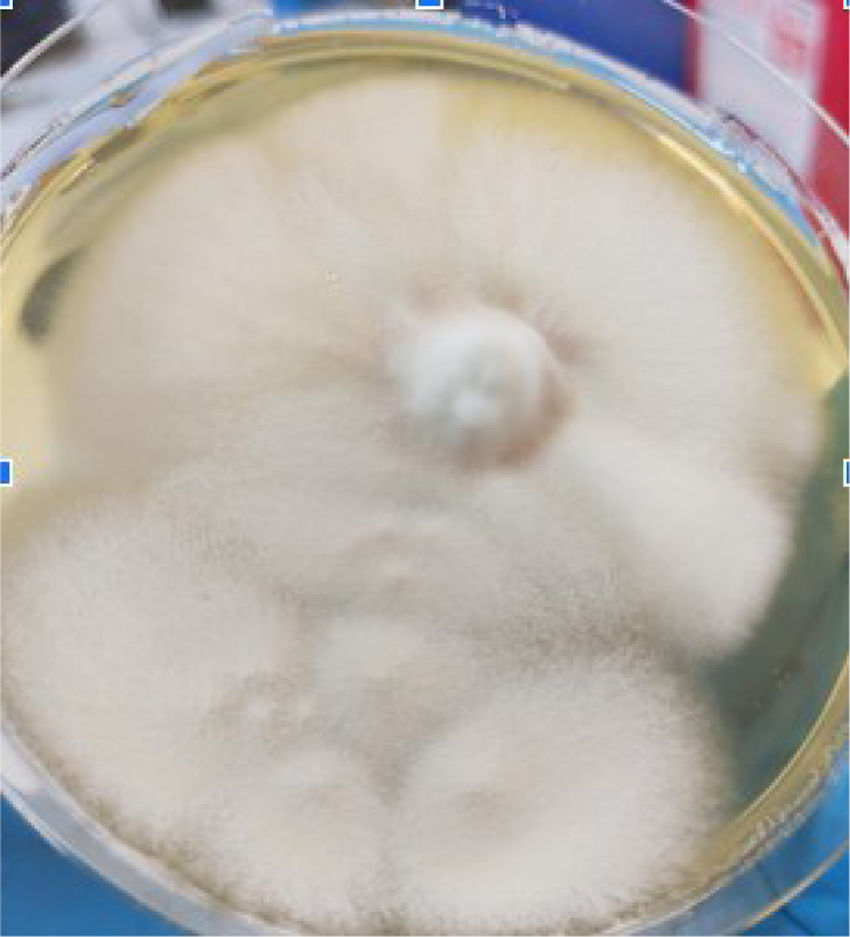
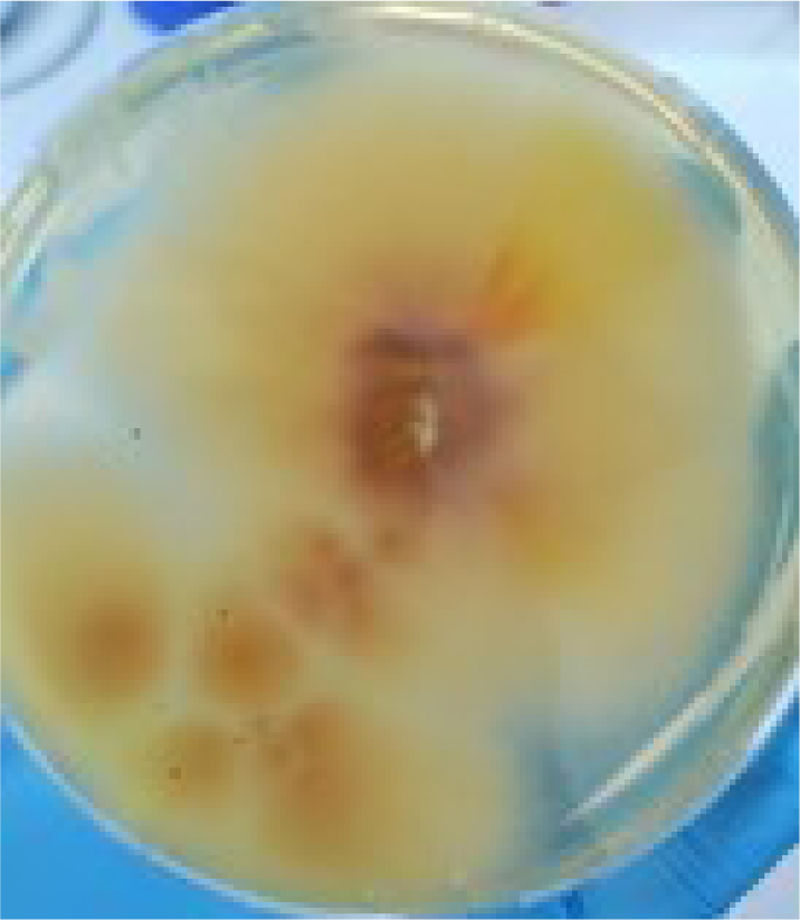
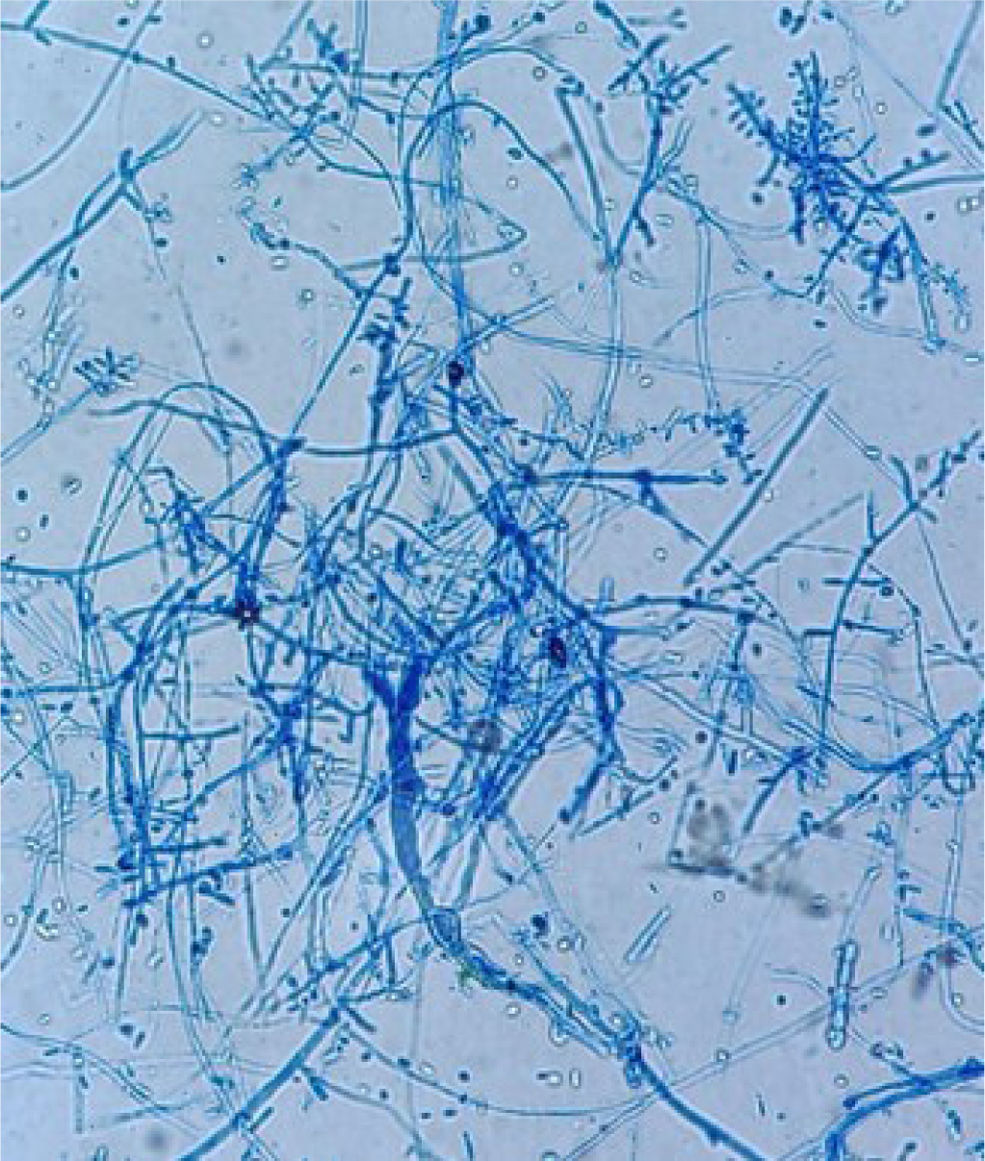
A sample was collected by scraping the edge of the lesions for mycological culture. The 40% potassium hydroxide (KOH) wet mount showed hyaline septate hyphae compatible with dermatophytes. The sample was cultured in potato dextrose agar (Britania S.A), Lactrimel agar and Sabouraud agar with the addition of Actidione media (bioMérieux Argentina S.A). After 13 days, growth of a white mycelium was observed with a powdery texture on the obverse side (Fig. 1) and bright-yellow-color on the reverse side (Fig. 2) compatible with Microsporum canis colonies was obtained on the three media. During the microscopic analysis, numerous elongated microconidia along the hyphae (Fig. 3) were found, characteristic of the Trichophyton spp. genus.


According to the morphological criteria and diagnostic keys provided in Larone's medical mycological guide4, this microorganism can be classified as a dermatophyte. Since there was a discordance between the macroscopic observation and the micromorphology, and taking into consideration the epidemiologic history, it was decided to send the sample to the reference center, the Mycology Department of the Argentine National Institute of Infectious Diseases and National Administration of Laboratories and Health Institutes “Dr. C. G. Malbrán” (INEI- ANLIS “Dr. C. G. Malbrán”) to enable the final identification of the species.
The identification, based on rDNA morphology and partial sequencing (ITS1-5.8-ITS2), confirmed the species as Trichophyton erinacei.
Trichophyton erinacei belongs to the T. benhamiae series (Clade A-2), along with T. benhamiae, T. concentricum, and T. verrucosum6. These species, as well as others with high prevalence, such as T. mentagrophytes and T. interdigitale (Clade A-1), are morphologically similar and can only be reliably distinguished through multilocus molecular data. Therefore, the use of molecular methods is essential to achieve accurate species-level identification within this group.
T. erinacei is a zoophilic fungi and hedgehogs are the main reservoir in nature. Dermatophytosis is the most common mycosis amongst these animals, in which T. erinacei is practically the only isolated species5. The signs produced by this dermatophyte in hedgehogs is usually mild and low-inflammatory1, thus it can be unobvious and, even, in a large number of cases it is asymptomatic, which increases the risk of transmission to humans handling these animals. In humans, the infection mainly causes inflammatory lesions in the skin in contact with the infected animal, most frequently present in hands and body (tinea manuum and tinea corporis). First symptoms, such as itchiness, redness and inflammation, can be mild and nonspecific, hence it is essential to discard other pathologies such as eczemas, which are most frequently treated with corticosteroids; however, their immunosuppressant effect is counterproductive in mycotic lesions7.
The aim of this report was to highlight the importance of obtaining the epidemiologic history, given that, as mentioned before, it is not easy to identify T. erinacei in routine laboratory tests and the diagnosis can be missed if contact of the patient with a hedgehog is not taken into account. Consequently, the check-up questionnaire that patients are required to complete before sample collection becomes vitally relevant since it guides the choice of the study methodology to definitely determine the etiologic agent of the mycosis.
Although cases of tinea caused by T. erinacei in humans have not been previously reported in Argentina to date, this fungus has been isolated from clinical specimens, establishing it as an emerging pathogen of clinical significance.
The importance of reaching the species level is highlighted, due to the fact that it allows to establish an epidemiological link and, therefore, the source of infection, enabling the implementation of the necessary preventive and control measures, which in this case include, limiting contact with the animal and administering specific treatment.
FundingThe procedures mentioned in the manuscript have been funded by the Laboratorio Centro Rossi; no external funding has been received from the affiliated site.
Conflicts of interestNone declared.

