




After the implementation of the European Space for Higher Education, the contents of the Radiology and Physical Medicine Area that were taught in the Medicine Degree have also been incorporated into the new degrees of Dentistry, Nursing, Physiotherapy, Podiatry, and, to a lesser extent, Pharmacy, Occupational Therapy, Logopedia, and Biomedical Engineering As a whole, the basic concepts of radiology and radiological protection are taught in Murcia in 5 different degrees with a total of 52.5 ECTS credits, participating in the training of 1219 students each academic year. This incorporation in the new degrees has tripled the number of subjects in which undergraduate teaching is taught, and doubled both the number of ECTS credits and the number of undergraduate students to whom it directs its training work. Thus, given the possible creation of new university degrees in the near future (Diagnostic Imaging and Radiotherapy Technicians), it would be necessary to involve a greater number of accredited professionals, from different specialties, and to optimize teaching resources (bibliography, material teacher, clinical cases, etc.,) for its usefulness in the different subjects that share similar contents.
Tras la implantación del Espacio Europeo de Formación Superior los contenidos del Área de Radiología y Medicina Física que se impartían tradicionalmente en la Licenciatura de Medicina se han incorporado también a los nuevos grados de Odontología, Enfermería, Fisioterapia, Podología y, en menor medida, Farmacia, Terapia Ocupacional, Logopedia, e Ingeniería Biomédica. En su conjunto, los conceptos básicos de radiología y protección radiológica se imparten en Murcia en 5 grados diferentes con un total de 52,5 créditos ECTS, participando en la formación de 1219 alumnos cada curso académico. Esta incorporación en los nuevos grados ha triplicado el número de asignaturas en las que se imparte docencia pregrado, y duplicado tanto el número de créditos ECTS como el número de alumnos de pregrado a los que dirige su labor de formación. Así, ante la posible creación de nuevos grados universitarios en un futuro próximo (Imagen para el Diagnóstico y Técnico en Radioterapia) sería necesaria la implicación de un mayor número de profesionales acreditados, de diferentes especialidades, y que optimicen los recursos docentes (bibliografía, material docente, casos clínicos, etc.,) para su utilidad en las diferentes asignaturas que comparten contenidos similares.
For decades in Spain, radiology and medical physics was taught exclusively to undergraduate students on the old Spanish Licenciatura in Medicine and Surgery.1 The implementation of the Bologna criteria established the European Higher Education Area and led to the introduction of new undergraduate degrees, during which process radiology and medical physics was incorporated into a variety of undergraduate degrees, such as dentistry, nursing, physiotherapy, podiatry and, to a lesser extent, pharmacy, occupational therapy, speech therapy and biomedical engineering. As a result, the university teaching load in this discipline has increased dramatically and numerous professionals have joined the clinical consultant in teaching the basic concepts of medical diagnostic radiology (including dentists, podiatrists, nurses, physicists, chemists, engineers, mathematicians and biologists).2
Radiology and medical physics lecturers have little bargaining power at each university in isolation for two main reasons: on the one hand, the small number of tenured or permanent senior lecturers at each university; and, on the other hand, the large number of clinical instructors who teach, but play no part in university management. To this end, the Association of University Lecturers in Radiology and Medical Physics (APURF, Spanish acronym) has worked for the last 37 years to promote the discipline and publish their updates and innovations in university radiology teaching, which they have used to ensure basic and specific competencies in radiology are met.2–6
However, this will remain a challenge in the coming years. Following in the footsteps of many of its European neighbours, Spain may soon offer the courses Advanced Technician in Diagnostic Imaging and Nuclear Medicine and Advanced Technician in Radiotherapy as university degrees rather than vocational training. The teaching staff for these new degrees should include medical specialists who would belong to our discipline, just as we already have medical specialist teaching staff who teach diagnostic radiology, nuclear medicine and radiation oncology. However, in our experience, clinical specialists face significant difficulties when trying to access a career in teaching (occupying a clinical role, accreditation for teaching). The persistence of these issues can be interpreted as an inability or lack of interest on the part of public institutions to resolve them.
This paper presents the teaching practices in radiology and medical physics at the University of Murcia as an example. The discipline is currently responsible for the three modules traditionally taught as part of the degree in medicine (Physics in Medicine, General Radiology and Medical Physics, and Specialised Radiology), as well as the final dissertations in these subjects. In a normal academic year this equates to training 677 students who receive 13.5 ECTS credits of theoretical and practical content. Following the implementation of the European Higher Education Area criteria and the introduction of the new degrees, radiology and medical physics has been incorporated into degrees in dentistry, nursing, physiotherapy and pharmacy. This has significantly increased the number of modules taught, the teaching load for lecturers in these modules and the number of undergraduate students who receive specialised radiology training adapted to their specific training competencies and needs.
The Radiology and Medical Physics Subject Area is now responsible for three radiology modules in the degree in dentistry, which are worth 12 ECTS credits in total. Around 93 students receive this training annually. In nursing, the subject area is responsible for one module. It is a 6 ECTS-credit module but is taught across three different campuses, in three different faculties located in three different cities across the autonomous community of the Region of Murcia (Murcia, Cartagena and Lorca), with the travel this entails. Teaching the same module in three different locations on a practical level equates to three independent modules of 6 ECTS credits each, totalling 18 ECTS credits taught to 371 students each academic year. In addition, in the degree in physiotherapy, the subject area is responsible for one 6 ECTS-credit module with 81 students per year. Finally, one module in the degree in pharmacy is taught together with the Physics Department, which equates to another 3 ECTS credits taught to 78 students annually. Overall, the basic concepts in radiology and radiation protection are taught in Murcia across five different degrees, totalling 52.5 ECTS credits, and in which 1219 students are trained each academic year (Table 1).
Radiology in different university degrees.
| Degree | Module | Year | Course type | Credits ECTS | Work hours/student | Number of students |
|---|---|---|---|---|---|---|
| Medicine | Physics in Medicine | 1 | Core | 4.5 | 112.5 | 190 |
| Medicine | General Radiology and Medical Physics | 2 | Core | 4.5 | 112.5 | 195 |
| Medicine | Specialised Radiology | 3 | Core | 4.5 | 112.5 | 197 |
| Dentistry | Radiation Protection | 2 | Core | 3 | 75 | 41 |
| Dentistry | Radiology and Physics in Medicine | 2 | Core | 3 | 75 | 42 |
| Dentistry | Dental Diagnostic Radiology Management | 3 | Optional | 6 | 150 | 22 |
| Nursing | Radiological Biophysics and Medical Physics | 1 | Basic | 6 | 150 | 371 |
| Physiotherapy | Applied Biophysics | 1 | Basic | 6 | 150 | 81 |
| Podiatrya | Diagnostic Radiology and Radiation Protection | 3–4 | Core | 6 | 150 | 65 |
| Biomedical Engineeringa | Biomedical Radiology/Radiotherapy and Radiation Protection | 2 | Core | 4.5–6 | 75 | 75 |
| Pharmacy | Physics | 1 | Core | 6 | 150 | 80 |
| Speech Therapy | No specific name | 1 | --- | ---- | ---- | 70- |
| Occupational Therapy | No specific name | 1–3 | ---- | --- | ----- | 50 |
One ECTS credit is equivalent to a study load of 25 h, with a 60/40 split between theory and practice, and requiring 50% attendance.
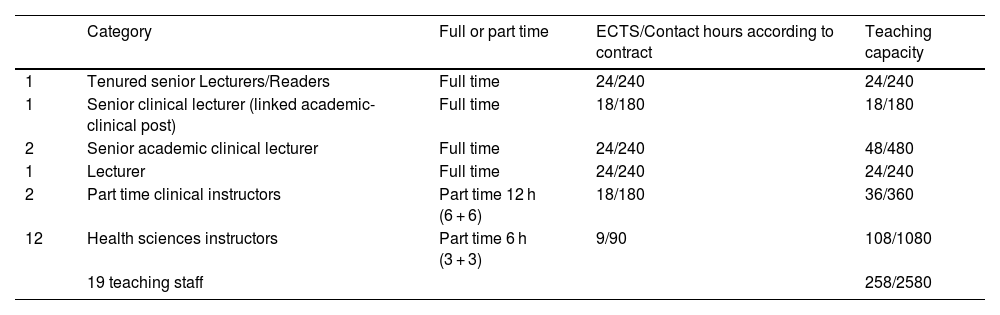
To cover this teaching load, Radiology and Medical Physics employs 19 lecturers on various types of public sector and university-specific contracts (Table 2). Radiology and Medical Physics is a multidisciplinary area with professionals from various undergraduate courses: two physicists, one doctor, one chemist, one dentist, one doctor specialised in diagnostic radiology and 12 clinical instructors (10 specialists in diagnostic radiology and two in nuclear medicine). We also employ 12 clinical guest lecturers (11 specialists in diagnostic radiology) who work across a variety of clinical departments and provide support with practicals throughout the course.
Type of teacher in Radiology and Medical Physics.
| Category | Full or part time | ECTS/Contact hours according to contract | Teaching capacity | |
|---|---|---|---|---|
| 1 | Tenured senior Lecturers/Readers | Full time | 24/240 | 24/240 |
| 1 | Senior clinical lecturer (linked academic-clinical post) | Full time | 18/180 | 18/180 |
| 2 | Senior academic clinical lecturer | Full time | 24/240 | 48/480 |
| 1 | Lecturer | Full time | 24/240 | 24/240 |
| 2 | Part time clinical instructors | Part time 12 h (6 + 6) | 18/180 | 36/360 |
| 12 | Health sciences instructors | Part time 6 h (3 + 3) | 9/90 | 108/1080 |
| 19 teaching staff | 258/2580 |
Although this equates to a ratio of 64.16 students per lecturer, the lecturer/student ratio is not used as a parameter to assess the teaching load or teaching capacity at the university. In Spanish universities, the teaching capacity for each lecturer is calculated on the basis of class time or ECTS credits that they must teach according to their employment contract (one ECTS credit is equivalent to 10 h of in-person theory or practical classes, including seminars and tutorials) (Table 2). According to that calculation, our area has a surplus, i.e., we could still take on more teaching as we could teach a greater number of theoretical/practical classes.
The composition of our teaching staff has changed significantly over the last few years. Three full-time teaching posts, previously occupied by doctors specialising in diagnostic radiology (two professors and one lecturer), became vacant for various reasons (retirement and resignation) and have now been filled by professionals from other degrees. Teaching on the degree in medicine or other degree courses has not been disrupted by this change, above all because we have been able to rely on clinical instructors, who have been key in teaching practical skills to students. However, this situation may become a problem in the near future because none of the 22 clinical specialists on the teaching staff (12 clinical instructors and 10 guest lecturers) meet the strict ANECAi accreditation requirements, making it impossible for them to pursue a career in university teaching.6 Additionally, young clinical specialists with an interest in teaching are not allowed to continue to practise medicine in their specialty, so they generally end up leaving teaching.6 This situation is not specific to radiology and medical physics, but is common to all other clinical subjects in medical schools.6
The teaching of radiology and medical physics in other degree coursesUndergraduate degree in dentistryThere is currently no radiology specialty in dentistry. After Spain’s incorporation into the European Higher Education Area, universities developed the new degree programmes autonomously, which has led to the fragmentation of traditional subjects. As a result, in Spanish universities many of these subjects have acquired different names, different teaching loads (ECTS credits) and are taught at different times throughout the degrees. In dentistry, radiology usually occupies 3–6 ECTS credits and covers radiation protection, how radiological images are obtained, and a significant focus on interpreting diagnostic images. Nuclear medicine and radiation oncology are taught less frequently. Universities such as Granada, Seville, Salamanca, Valencia, Zaragoza, the Basque Country, Santiago de Compostela and the Balearic Islands are some noteworthy examples of this situation.
In the University of Murcia the degree covers three different modules: Radiation Protection, Radiology and Physics in Medicine, Dental Diagnostic Radiology Facilities Management.
Radiation protectionStudents have access to a virtual classroom and various web pages which provide all the relevant theory, as well as information about the practical elements of the module. Table 1 provides the module details.
There is a course book which sets out the contents of the module,7 as well as three additional books published and endorsed by the Nuclear Safety Council8–10 which provide information about dental radiology in Spain. In addition to the written material, training is given in radiological techniques and features, the interpretation of radiological images, medical applications of diagnostic radiology and occupational radiation protection. The theoretical content of the module is the same as that of physics in medicine (interaction of radiation with matter, radiation units, X-ray equipment, radiobiology, personal and operational radiation protection). The practical aspect, meanwhile, is the most important and specialty-specific part of the module. It provides students with the competencies and skills necessary to perform manual, automatic and digital radiological image processing techniques, as well as design a dental diagnostic radiology room and ensure that it complies with radiological protection requirements.7
Radiology and physics in medicineThis module is divided into two distinct areas. The first looks at basic physics concepts that are relevant to the area of radiology and medical physics and that are similar to the concepts taught as part of the physics in medicine module in the degree in medicine.7,11 The second part of the module focuses on dental intraoral and extraoral diagnostic radiology, as well as imaging techniques relevant to dentistry (CT, MRI and ultrasound).12 The module also includes the relevant material for students to gain an understanding of the basic concepts of dental diagnostic radiology: the imaging features of dental cavities, periodontal disease, third molar pathology, cephalometric study, dental implant assessment, developmental abnormalities, dental age assessment and tumours of the maxilla and mandible.12
The latest version of the syllabus for dentistry at the University of Murcia (2021) has merged these two modules into a single module called Radiology, Physics in Medicine and Radiation Protection. It is still taught in the second year and has the same contents as described above.
Dental diagnostic radiology facilities managementThis module is taught by two lecturers at the University of Murcia who are accredited by the Nuclear Safety Council to give this type of course. The module is taught in parallel with a Nuclear Safety Council-accredited course helping students to gain the official accreditation necessary to operate dental diagnostic radiology equipment.
Undergraduate degree in nursingThere is currently no radiology specialty (diagnostic radiology, nuclear medicine, radiotherapy) for nursing in Spain. The creation of the degree in nursing has made it possible to introduce radiology material into some nursing schools in Spanish universities, although these are still in the minority. When the degree does include a radiology element, modules tend to consist of between 3 and 4.5 ECTS credits taught at various points between the second and the fourth year. They cover radiation protection, applications and uses of diagnostic imaging techniques and procedures. Examples of universities where radiology has been incorporated into the new degrees are: Salamanca, Avila, Complutense de Madrid, Basque Country, Zaragoza and Santiago de Compostela. It should be noted that these modules are often not taught by specialists in medical diagnostic radiology.
At the University of Murcia, the module comprises two distinct parts. The first consists of a basic introduction to radiation protection and physics in medicine which makes use of the web pages indicated for the radiation protection module, supported by the corresponding texts and bibliography.7,12 The second part is longer and covers imaging techniques and tests, and is similar in content to that of other general radiology modules in medicine, but adapted to the specific needs of nursing students.12–14 The module covers the characteristics of different diagnostic modalities (CT, MRI, ultrasound, conventional radiology) and the different diagnostic imaging techniques (digestive, renal, musculoskeletal, thoracic, breast, central nervous system, as well as image-guided vascular and interventional techniques).
Undergraduate degree in physiotherapyThere is currently no specialty in radiology in physiotherapy. The creation of the degree in physiotherapy and an interest in imaging techniques have enabled radiology to be introduced in some schools. The module is normally called Radiology for Physiotherapists or Diagnostic Imaging for Physiotherapists. Modules usually carry between 3 and 4.5 ECTS credits and are taught between the second and fourth year of studies. They cover the applications and use of diagnostic imaging techniques and procedures of interest to the physiotherapy profession. Universities which offer these modules include: Granada, Almeria, Salamanca, Valladolid, Complutense de Madrid, Cadiz or Antonio de Nebrija.
At the University of Murcia, Applied Biophysics is a compulsory module (Table 1). The module also comprises two distinct parts. The first consists of a basic introduction to radiation protection and physics in medicine and makes use of the web pages indicated for the radiation protection module, which follows the same bibliography7,10,13,14 as the physics in medicine module in the degree in medicine and/or physics in medicine and radiology in dentistry. The second part covers the techniques and tests used in physiotherapy, specifically the aspects of diagnostic radiology and medical physics that are of special interest to physiotherapy. However, Radiology and Medical Physics is not responsible for the interpretation of radiological imaging and diagnostic radiology modules as these are already incorporated into other medical and surgical modules on the degree, taught by lecturers from different disciplines.
Undergraduate degree in pharmacyThe pharmacy degree at the University of Murcia includes a physics module as a core subject. We run the module together with the Physics Department. Our discipline is responsible for teaching the basic concepts shared by the relevant modules in medicine and dentistry and following the same bibliography,7,11 with slight modifications to optimise the use of resources. We have not found other examples where Radiology and Medical Physics lecturers teach on pharmacy degrees at other Spanish universities, so it would seem our case has come about because of good staff relationships and the fact that some content is shared with the Physics Department.
Some Spanish universities include radiology content in their podiatry, biomedical engineering, occupational therapy and speech therapy degrees (Table 1). Universities that include radiology content, specifically radiation protection and diagnostic imaging, in their podiatry degrees include: Complutense de Madrid, Seville, Miguel Hernández de Elche, Leon, Castilla La Mancha, Valencia, Extremadura, Catholic University of Valencia and Malaga. Several universities include biomedical radiology or radiological image processing as a significant element of their biomedical engineering degree syllabuses, such as the Carlos III University of Madrid and the University of Valladolid. Finally, although radiology material does appear in the degree in occupational therapy, we have not found any subject-specific modules assigned to radiology and medical physics.
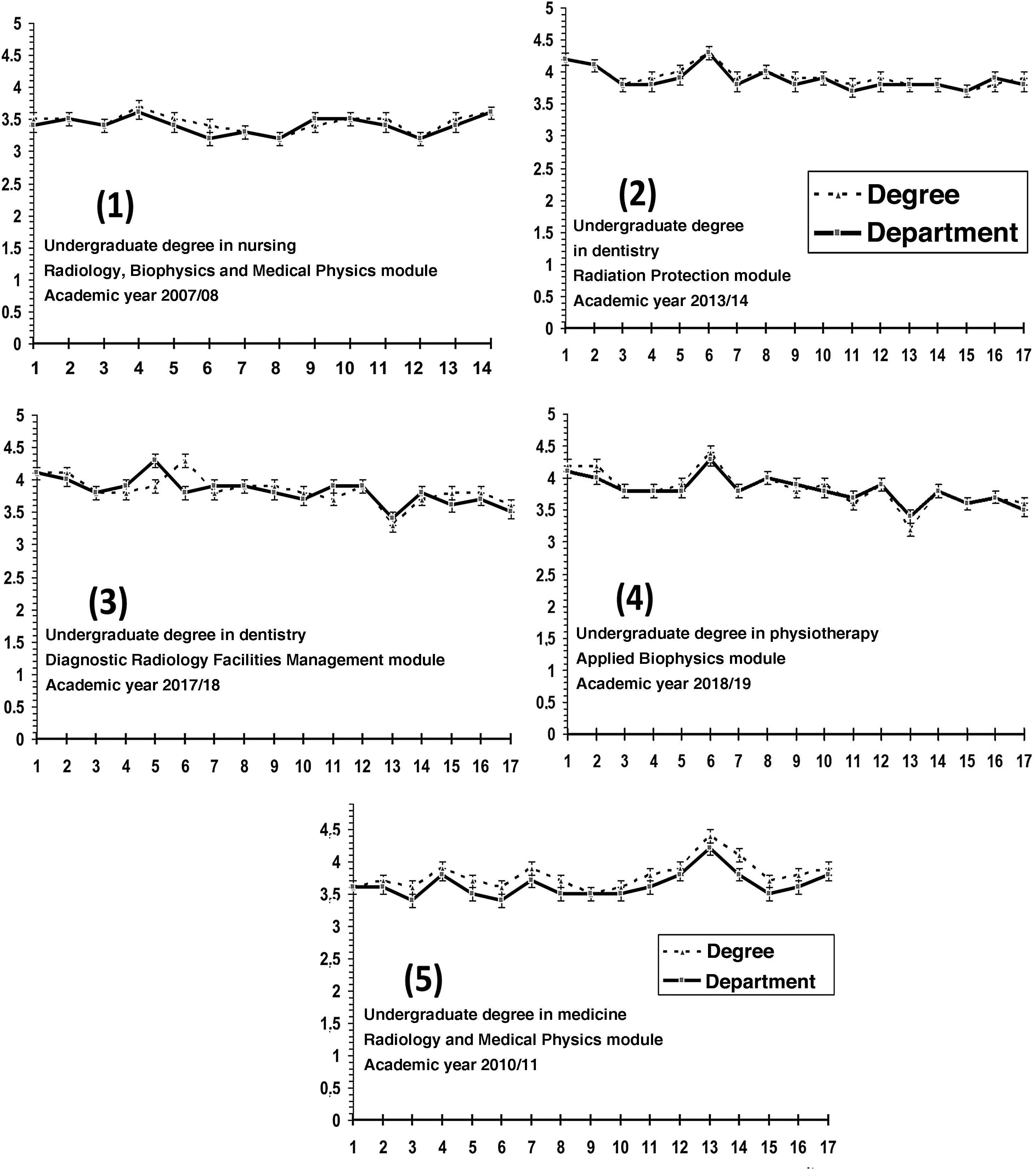
Student satisfaction across degrees with radiology contentAll modules are subject to independent teaching quality control and reports produced by the university Vice-Chancellor’s Office Quality Assurance Units, who use biannual surveys to collect information on how satisfied students are with teaching by the module's lecturers (department) and how they compare with the other modules in that degree (dentistry, nursing and medicine, respectively). Surveys are anonymous and voluntary, and are collected from enrolled students by specialised staff. They apply a Likert scale and require a minimum number of responses for the results to be considered valid. Data analysis is carried out independently by each university’s Quality Assurance Unit. Internal consistency is assured through the use of Cronbach's alpha coefficient (split-half reliability) and a high Guttman coefficient (0.98). Table 3 shows the results of the surveys on student satisfaction with university staff teaching and with the degree course contents. We have selected different academic years to show the results for each module and how they compare with the module traditionally taught by Radiology and Medical Physics staff in the undergraduate degree in medicine. These modules have been taught every year since 2000, and we have identified no significant differences in satisfaction levels across modules in the same degree over time. Fig. 1 shows student satisfaction levels with university teaching in specific modules (department) and how they compare with overall teaching satisfaction levels for the same degree, according to the Likert scale. In multidisciplinary areas such as ours, the results speak to student satisfaction with the lecturer, the discipline, the department and the university as a whole, but the results say nothing about the lecturer’s previous training as a physicist, chemist, doctor or dentist.
Results of the students’ teacher satisfaction surveys: 1. Degree in Nursing, module Biophysics, Radiology and Nuclear Medicine, 2007/08. 2. Degree in Medicine, module General Radiology and Medical Physics, 2010/11. 3. Degree in Dentistry, module Radiology Protection, 2013/14. 4. Degree in Dentistry, module Dental Facilities Management, 2017/18. 5. Degree in Physiotherapy, module Applied Biophysics, 2018/19 (University of Murcia Quality Support Unit).
| Nª0 | Statements | Nursing 2007/08 Biophysics and radiology (n = 74/130) | Medicine 2010/11 Radiology (n = 57/110) | Dentistry 2013/14 Radiation protection (n = 14/31) | Dentistry 2018/19 Management (n = 12/29) | Physiotherapy 2018/19 Biophysics A (n = 17/85) |
|---|---|---|---|---|---|---|
| 1. | The lecturer follows the module syllabus and activities (as set out in the teaching guidelines) | 3.4 ± 0.1 | 3.6 ± 0.1 | 4.2 ± 0.1 | 4.1 ± 0.1 | 4.1 ± 0.1 |
| 2. | The lecturer applies the assessment criteria as set out in the teaching guidelines | 3.5 ± 0.1 | 3.6 ± 0.1 | 4.1 ± 0.1 | 4.0 ± 0.1 | 4.0 ± 0.1 |
| 3. | Theoretical and practical activities are well coordinated | 3.4 ± 0.1 | 3.4 ± 0.1 | 3.8 ± 0.2 | 3.8 ± 0.2 | 3.8 ± 0.2 |
| 4. | The lecturer employs activities that support learning (knowledge and skills) | 3.6 ± 0.1 | 3.8 ± 0.1 | 3.8 ± 0.2 | 3.9 ± 0.2 | 3.8 ± 0.2 |
| 5. | The lecturer’s explanations help me to understand the content of the course | 3.4 ± 0.1 | 3.5 ± 0.1 | 3.9 ± 0.1 | 4.3 ± 0.1 | 4.3 ± 0.1 |
| 6. | The lecturer knows the material | 3.2 ± 0.1 | 3.4 ± 0.1 | 4.3 ± 0.1 | 3.8 ± 0.1 | 3.8 ± 0.1 |
| 7. | The lecturer encourages student participation in class | 3.3 ± 0.01 | 3.7 ± 0.1 | 3.8 ± 0.1 | 3.9 ± 0.2 | 4.0 ± 0.2 |
| 8. | The lecturer clarifies doubts and guides us appropriately when undertaking tasks | 3.2 ± 0.1 | 3.5 ± 0.1 | 4.0 ± 0.1 | 3.9 ± 0.2 | 3.9 ± 0.2 |
| 9. | The didactic resources used (whiteboard, audiovisual media, materials on the internal network, etc.) are useful and appropriate for classes and self-directed study | 3.5 ± 0.1 | 3.5 ± 0.1 | 3.8 ± 0.2 | 3.8 ± 0.2 | 3.8 ± 0.2 |
| 10. | I am satisfied with the support received from the lecturer in tutor sessions (both in person and online) | 3.5 ± 0.1 | 3.5 ± 0.1 | 3.9 ± 0.2 | 3.7 ± 0.2 | 3.8 ± 0.2 |
| 11 | The lecturer has stoked my interest in the module content and skills | 3.4 ± 0.1 | 3.6 ± 0.1 | 3.7 ± 0.2 | 3.9 ± 0.2 | 3.7 ± 0.2 |
| 12. | Provide an overall score for the lecturer in their work, considering all previous factors | 3.2 ± 0.1 | 3.8 ± 0.1 | 3.8 ± 0.1 | 3.9 ± 0.1 | 3.9 ± 0.1 |
| 13. | The teaching guide is useful when preparing for the module | 3.4 ± 0.1 | 4.2 ± 0.1 | 3.8 ± 0.4 | 3.4 ± 0.1 | 3.4 ± 0.1 |
| 14. | The module doesn’t repeat the content of other modules | 3.6 ± 0.1 | 3.8 ± 0.1 | 3.8 ± 0.2 | 3.8 ± 0.1 | 3.8 ± 0.1 |
| 15. | Class activities are planned appropriately (date, duration, etc.) | 3.5 ± 0.1 | 3.7 ± 0.2 | 3.6 ± 0.1 | 3.6 ± 0.1 | |
| 16. | The lecturer’s bibliography facilitates module preparation (understandable, up to date, complete) | 3.6 ± 0.1 | 3.9 ± 0.1 | 3.7 ± 0.1 | 3.7 ± 0.1 | |
| 17. | The assessments in place seem appropriate to assess student learning and knowledge acquired | 3.8 ± 0.1 | 3.8 ± 0.2 | 3.5 ± 0.1 | 3.5 ± 0.1 |
Questions 15–17 were included after 2008.
The results are shown as a standard error ± of the mean.
(n = number of student responses/number of students registered on the course).

Results of the student teaching satisfaction surveys based on the Likert scale 1–5 (department) in comparison with their satisfaction with the degree as a whole. 1. Degree in Nursing, module Biophysics, Radiology and Nuclear Medicine, 2007/08. 2. Degree in Dentistry, module Radiation Protection, 2010/11.3 3. Degree in Dentistry, module Dental Facilities Management, 2017/18. 4. Degree in Physiotherapy, module Applied Biophysics, 2018/19. 5. Degree in Medicine, module General Radiology and Medical Physics, 2010/11. (University of Murcia Quality Assurance Unit). The items in Table 2 are positioned along the x-axis and the numerical value is expressed as standard error ± of the mean.
The results obtained show the student satisfaction levels across the different degrees in which Radiology and Medical Physics staff teach undergraduate courses. Satisfaction levels are similar to those expressed by undergraduate students in medicine, where this undergraduate material has traditionally been taught. This confirms that radiology materials have been successfully adapted to the specific competencies and training needs in each of the university degrees where they are taught, and that students in different disciplines welcome the contents.
ConclusionsThe introduction of radiology and medical physics content in the new degrees has significantly increased the number of credits to be taught and has broadened the scope of teaching in different areas. To cover this, the discipline needs to bring more accredited professionals on board, possibly from different specialties, and it would also benefit from optimising teaching resources (bibliography, teaching material, clinical case studies, etc.) to be used across different modules that share similar content.
Author contributions- 1
Research coordinators: M. Alcaraz Baños.
- 2
Development of study concept: M. Alcaraz Baños.
- 3
Study design: M. Alcaraz Baños.
- 4
Data collection: M. Alcaraz Baños, A. Olivares Rueda, J.L. Navarro.
- 5
Data analysis and interpretation: J.A. Garcia Gamuz, M. Alcaraz Baños, JD Berná Mestre.
- 6
Statistical analysis:
- 7
Literature search: J.D. Berná Mestre.
- 8
Writing of article: M. Alcaraz Baños.
- 9
Critical review of the manuscript with intellectually relevant contributions: M. Alcaraz Baños, A. Olivares Rueda, JL Navarro Fernández.
- 10
Approval of the final version: M. Alcaraz Baños, A. Olivares Rueda, J.L. Navarro, J.A. Garcia Gamuz, J.A. Garcia Gamuz.
The authors declare that they have no conflicts of interest.
FundingThis investigation received no specific funding from public, commercial or not-for-profit sectors.


