


Herlyn-Werner-Wunderlich (HWW) syndrome, more commonly known as obstructed hemivagina and ipsilateral renal anomaly (OHVIRA), is a rare condition characterised by Müllerian and mesonephric duct anomalies. Clinical presentation of the syndrome is non-specific, with symptoms including chronic pelvic pain and menstrual dysfunction, meaning it can be easily confused with other entities that require different therapeutic treatments. Radiologists should be familiar with this condition in order to ensure adequate diagnosis and treatment, which improves the quality of life of affected patients.1,2
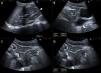
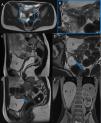
Case presentationWe present the case of a 10-year-old prepubertal girl, under paediatric care due to the prenatal diagnosis of solitary left kidney. A postnatal ultrasound revealed a tubular structure with anechoic fluid in the pelvis, with a narrowing towards the right urethra. The initial differential diagnosis included atypical mesonephric remnant, urachal remnant, ectopic kidney or atrophic right kidney. The ultrasound was repeated later (Fig. 1), which revealed a bicornuate bicollis uterus with fluid collection near the vagina. The magnetic resonance image (MRI) confirmed uterus didelphys with obstructed right hemivagina and patent left hemivagina (Fig. 2). A vaginoscopy was performed to confirm that the left hemivagina was patent and the patient is currently on a waiting list for definitive vaginoplasty.

Abdominopelvic ultrasound images. (A) Solitary left kidney, compensatory growth (arrowheads, showing edges). (B) Paravesical fluid collection measuring 48 × 18 mm with fine internal echoes (arrow). (C and D) Uterine malformation with apparent bicornuate bicollis uterus with both uterine bodies in anteflexion (1. right: 27 mm/2. left: 24 mm), each turned to one side, with collection of fluid adjacent to right uterus (arrow). Both endometria are central.

MRI of pelvis. (A) Axial T2-weighted sequences and (B) enlargement of (A) centred on region of interest. Uterus didelphys with right vaginal septum with prepubertal morphology. The uterine bodies (1 right/2 left) are in anteflexion, each turned to the side. (C) Sagittal oblique T2-weighted sequence and (D) Coronal oblique T2-weighted sequence centred on the cervix of the right uterus. Right cervix (1, arrow) with opening in the dilated right hemivagina and with hyperintense content (fluid) inside (*), corresponding to the cystic image described in previous ultrasounds. No apparent contact with the perineum. (E) Sagittal oblique T2-weighted sequence centred on left hemivagina. Left cervix (2) which continues into a collapsed elongated structure (arrowhead) that reaches the perineum, consistent with left hemivagina, which appears to be patent. (F) Contrast-enhanced T1-weighted VIBE sequence in parenchymal phase revealing solitary left kidney, compensatory growth.
B: spleen, H: liver, O: right ovary, R: rectum, RI: left kidney, V: bladder.
This case highlights the importance of pre- and postnatal ultrasound assessment when renal agenesis is detected, to investigate potential associated genitourinary abnormalities. OHVIRA syndrome is characterised by the triad of double uterus or uterus didelphys, unilateral cervicovaginal obstruction and ipsilateral renal abnormalities, such as renal agenesis (most frequently), but also duplicate kidneys, dysplastic kidneys, rectovesical band or crossed fused renal ectopia.1,3
Imaging tests are fundamental to the diagnosis of this syndrome and MRI is the gold standard for assessing uterine morphology, pelvic structures and possible associated renal abnormalities. Characteristic findings in MRI include the presence of a double uterus, and less frequently, a bicornuate bicollis uterus (a single uterus with two uterine horns and two cervixes), unilateral cervicovaginal obstruction with obstructed hemivagina and ipsilateral renal abnormalities, as we describe above and as our patient presented. Suspected diagnosis is usually established during ultrasounds in the neonatal period, as the uterus is still stimulated by the mother’s hormones emphasising the myometrium and endometrium, usually difficult to assess in prepubertal children. Differential diagnosis should consider other Müllerian duct abnormalities, such as isolated unilateral renal agenesis and unilateral cervical atresia. Furthermore, when the uterovaginal obstruction results in significant dilatation, image-based differential diagnosis may include benign adnexal masses, such as a cystadenoma or an endometrioma, or malignant ones.2,4,5
It is important to highlight that early diagnosis of OHVIRA syndrome, such as the case of this prepubertal patient, is crucial to avoiding serious complications during adulthood. Often patients with this condition remain undiagnosed until after the onset of menarche, when they start to experience symptoms such as cyclic abdominal pain, dysmenorrhoea and haematocolpos due to the hemivagina obstruction. However, early diagnosis means surgical interventions can be performed in time to prevent long-term complications, such as recurrent pelvic infections, endometriosis, infertility and obstetric complications during pregnancy.1,2,5
Finally, first-line treatment generally involves single-stage vaginoplasty with transvaginal resection of the obstructed septum followed by anastomosis of the vaginal mucosa. In some cases, a hemihysterectomy may be necessary. In addition to surgery, menstrual suppression with combined oral contraceptives may be recommended to prevent greater accumulation of fluid in the hemivagina prior to surgical intervention.5
CRediT authorship contribution statement- 1
Research coordinators: EPP.
- 2
Development of study concept: EEP.
- 3
Study design: EEP, AAM, PBT.
- 4
Data and image collection: EEP, AAM.
- 5
Literature search: EEP.
- 6
Writing of article: EEP, PBT, AAM.
- 7
Critical review of the manuscript with intellectually relevant contributions: EEP, PBT, AAM.
- 8
Approval of the final version: EEP, PBT, AAM.
Informed consent was obtained from the patient and guardians.
FundingThis article has not received financial support from public sector agencies, the business sector or any non-profit organisations.


