



The aim was to examine reasons for retraction and rates of article retraction in the field of smoking.
Material and methodsWe conducted an observational study and searched the largest database of articles that have been retracted.
ResultsWe found 83 papers that were retracted from 1988 to 2024. According to the type of document (documents typologies), the majority were original articles (74 papers). The 83 documents have been retracted in 65 different journals. The retracted papers’ citation counts were examined by searching Web of Science (WoS) and Scopus, and we have observed that a quarter (26.5%) of the 68 articles available in the WoS database had increased their citations, despite the fact that they were retracted works. The reasons for retraction were unreliable, inconsistent, erroneous, or missing data or an incorrect conclusion; duplication of previously published articles; duplication of images into the articles or in previous articles; conflicts of interest; the ethical/plagiarism policy and authorship issues concerns; fake peer reviews; data falsification/data error; articles retracted at the authors’ request; and unknown causes of retraction and journal publisher's error.
ConclusionsUnreliable, inconsistent, inaccurate, or missing data; an incorrect conclusion; or duplication/already published articles; duplication of images; and conflicts of interest are the main causes of retractions. Retracted articles have been increasing in number over the years, and additionally, the amount of time that passes between an article's publication and retraction is getting shorter. We verify that retracted articles indeed continue to gain citations after the retraction, some even more than before.
El objetivo fue examinar las razones de la retractación y las tasas de retractación de artículos en el campo del tabaquismo.
Material y métodosRealizamos un estudio observacional, y buscamos en la base de datos más grande de artículos que han sido retractados.
ResultadosEncontramos 83 artículos que fueron retractados de 1988 a 2024. Según el tipo de documento (tipologías de documentos), la mayoría fueron artículos originales (74 artículos). Los 83 documentos han sido retractados en 65 revistas diferentes. Se examinaron los recuentos de citas de los artículos retractados mediante búsquedas en Web of Science (WoS™) y Scopus®, y observamos que una cuarta parte (26,5%) de los 68 artículos disponibles en la base de datos de WoS™ había aumentado sus citas, a pesar de que eran trabajos retractados. Las razones de la retractación fueron datos poco fiables, inconsistentes, erróneos o faltantes o una conclusión incorrecta; duplicación de artículos publicados previamente; duplicación de imágenes en los artículos o en artículos anteriores; conflictos de intereses; preocupaciones sobre la política ética/antiplagio y los problemas de autoría; revisiones por pares falsas; falsificación/error de datos; artículos retractados a petición de los autores, y causas desconocidas de retractación y error del editor de la revista.
ConclusionesDatos poco fiables, inconsistentes, inexactos o faltantes; una conclusión incorrecta; o artículos duplicados/ya publicados; duplicación de imágenes, y conflictos de intereses son las principales causas de retractaciones. El número de artículos retractados ha aumentado con los años y, además, el tiempo que transcurre entre la publicación de un artículo y su retractación es cada vez menor. Verificamos que los artículos retractados siguen ganando citas después de la retractación, algunos incluso más que antes.

Original research is the foundation of scientific evidence that drives clinical standards and practice. Articles that have been peer-reviewed and published in reputable journals are presumed to be reliable. Therefore, when this is not the case, retractions are important to preserve the integrity of the scientific literature. An international initiative called the Committee on Publication Ethics (COPE) advises editors and publishers on all facets of publication ethics, with a focus on how to deal with instances of research and publication misconduct.1 Attempts to formally remove published papers or posted preprints that contain mistakes, fraud, or other types of misconduct are known as “manuscript retractions”. Retractions have increased in both number and prominence over the past two decades.2,3 In August of 2010 was founded the Retraction Watch database (http://retractiondatabase.org/), developed by two science writers, Ivan Oransky and Adam Marcus, been acquired by Crossref in 2023, a not-for-profit organisation that provides infrastructure for research communications. This is a site dedicated to reporting on scientific retractions and related issues, to bring to light how many scientific papers are withdrawn yearly and why. It is a searchable database that compiles and tracks retractions of scientific publications. It is a resource for identifying research that has been deemed unreliable due to issues like fraud, plagiarism, or errors and is important for maintaining the integrity of scientific knowledge.
To date, no systematic studies on retractions in smoking topics exist. The aim of this study was to examine reasons for retraction and rates of article retraction in the field of smoking.
Material and methodsData sources and inclusion criteriaIn this observational study, a search of the largest database of retracted articles, the Retraction Watch database (http://retractiondatabase.org/) was performed to quantify the number of retracted publications in smoking. A search strategy was performed on September 25, 2024, in the title field. The final strategy in the title field with the terms that provided some result in the previous studies was the following: smok* OR tobacco OR nicotine OR electr* cigar* OR e-cig* OR vaping* OR IQOS. Truncation was used to group all the variables of the same root.
Phases of the methodology. Data extractionWe searched for all articles about the terms of interest in the subject database. Retracted entries totalled 143, but when combining the strategy with the Boolean term OR, the final result was 119, since some works included one or more terms in the title. So, the final results (119 articles) were then screened by two authors for all articles relating to smoking in the title field. Discrepancies were resolved by a third author. It was found that the documentary typologies of the retracted works are normally research articles, but there are also some commentaries/editorials, clinical studies, preprints, articles in press, and letters. Of the 119 total records, 28 records that were not relevant because they belonged to other disciplines such as botany, engineering, etc., have been eliminated. Thus, there are finally 91 works. Of these, 8 were repeated because they are retracted and corrected or expressions of concern, leaving us with 83 different unique records (Fig. 1). We obtained the manuscripts from the Web of Science (WoS), Scopus and PubMed databases and included them in a relational database in Microsoft Access.

Two authors independently have extracted data. The results were screened by two authors for all articles relating to the smoking field, and any disagreement was resolved by a third author.
Regarding the phases of the methodology, these has been:
- •
We have downloaded the titles from the retraction database to verify their relevance or not.
- •
Information on the reasons for the retraction of the articles was recorded from the retraction database, including the publication date and the retraction date.
- •
From the selected works, through the DOI, we have downloaded the records in the Web of Science (WoS) database, assigned an identifier and then related it to the reasons why it has been retracted that appear in the retraction database.
- •
On the other hand, we have downloaded the PDF from the DOI, both for the articles and the retraction causes.
For each retracted manuscript, the following data were extracted: article type, number of authors, year of publication, abstract and DOI, year of retraction, thematic category and the journal's quartile, country of origin, open access or paywall-protected retraction notice, reasons for retraction, and number of citations on WoS and Scopus.
A checklist of the Strengthening the Reporting of Observational Studies in Epidemiology (STROBE) recommendations4 for the reporting of observational studies has been completed and is provided in supplementary file 1 (SF1). The study does not require ethics committee approval or informed consent because it was not based on patient data.
StatisticsDescriptive statistics have been used to summarise and describe the characteristics of the data set using measures such as means as a measure of central tendency and percentage.
ResultsGeneral characteristicFig. 2 shows the trend over time for retracted articles by year. The 83 papers were retracted from 1988 to 2024. 2021 was the year with the highest number of retracted articles. According to the type of document (documents typologies), there are 74 original articles, 4 letters, 1 review and 4 meeting abstracts. The 83 documents have been retracted in 65 different journals. Table 1 shows the journals with more than one retracted article (Table 1). Table 2 and Fig. 3 show the collaboration index by year. Table 3 shows the distribution of authors by work. Ninety-four per percent of the works were written in collaboration, meaning they were signed by two or more authors, and only five works were signed by a single author. Works signed by two, three, and four authors range from 10 to 15% of the total. At the other extreme, there is one work signed by 33 different authors.

Journals with more than 1 retracted article.
| Journal | ISSN | Editorial | Total retracted articles | Subject area | Quartile JCR 2024 | Position | Edition JCR |
|---|---|---|---|---|---|---|---|
| PLoS One | 1932-6203 | Public Library Science | 8 | Multidisciplinary Sciences | Q2 | 44/135 | SCIE |
| Psychological Reports | 0033-2941 | Sage Publications Inc | 3 | Psychology, Multidisciplinary | Q2 | 103/221 | SSCI |
| American Journal of Respiratory Cell and Molecular Biology | 1044-1549 | Amer Thoracic Soc | 2 | Biochemistry & Molecular BiologyCell BiologyRespiratory System | Q1Q2Q1 | 66/31957/20415/108 | SCIE |
| Archivos de Bronconeumologia | 0300-2896 | Elsevier Espana SLU | 2 | Respiratory System | Q1 | 6/108 | SCIE |
| BMC Public Health | 1471-2458 | BMC | 2 | Public, Environmental & Occupational Health | Q1 | 73/419 | SCIE |
| Cochrane Database of Systematic Reviews | 1469-493X | Wiley | 2 | Medicine, General & Internal | Q1 | 15/332 | SCIE |
| Journal of Crohn's and Colitis | 1873-9946 | Oxford Univ Press | 2 | Gastroenterology & Hepatology | Q1 | 12/147 | SCIE |
| Journal of Healthcare Engineering | 2040-2295 | Hindawi Ltd | 2 | Health Care Sciences & Services | Q2 (2021) | 33/109 | SCIE |
| Lung Cancer | 0169-5002 | Elsevier Ireland Ltd | 2 | OncologyRespiratory System | Q2Q1 | 85/32619/108 | SCIE |
| Tobacco Control | 0964-4563 | BMJ Publishing Group | 2 | Public, Environmental & Occupational HealthSubstance Abuse | Q1N/A | 34/419N/A | SCIE |
| Tumor Biology | 1010-4283 | Sage Publications Ltd | 2 | Oncology | Q2 (2016) | 81/2017 | SCIE |
Collaboration index by years.
| Year | Signed | Documents | Collaboration index |
|---|---|---|---|
| 1988 | 6 | 2 | 3 |
| 1989 | 2 | 1 | 2 |
| 1990 | 2 | 1 | 2 |
| 1991 | 4 | 2 | 2 |
| 1994 | 4 | 1 | 4 |
| 1995 | 1 | 1 | 1 |
| 1998 | 5 | 1 | 5 |
| 2004 | 4 | 2 | 2 |
| 2005 | 11 | 1 | 11 |
| 2006 | 10 | 2 | 5 |
| 2007 | 20 | 2 | 10 |
| 2008 | 9 | 2 | 4.5 |
| 2009 | 10 | 1 | 10 |
| 2010 | 25 | 4 | 6.3 |
| 2011 | 20 | 4 | 5 |
| 2012 | 9 | 2 | 4.5 |
| 2013 | 26 | 4 | 6.5 |
| 2014 | 19 | 2 | 9.5 |
| 2015 | 53 | 7 | 7.6 |
| 2016 | 5 | 1 | 5 |
| 2017 | 62 | 4 | 15.5 |
| 2018 | 8 | 2 | 4 |
| 2019 | 33 | 7 | 4.7 |
| 2020 | 48 | 7 | 6.9 |
| 2021 | 48 | 8 | 6 |
| 2022 | 54 | 7 | 7.7 |
| 2023 | 26 | 3 | 8.7 |
| 2024 | 15 | 2 | 7.5 |

The retracted papers have been searched in WoS and Scopus to see the citations they have received. There are 68 papers (82%) that have been retracted in WoS journals. The two most cited articles received 88 citations (published in 1988 and 2007), and the third most cited received 86 citations (published in 2011). Table 4 shows the number of citations for each article, both in WoS and Scopus. Citations of the different articles were downloaded in WoS in October 2024 and March 2025, while citations were downloaded in Scopus only in March 2025. In March 2025, five months later, the citation data was updated, and it was observed that a quarter (26.5%) of the 68 articles available in the WoS database had increased their citations, despite the fact that they were retracted works. Regarding the citation results from the Scopus database, there are 74 works (89.2%) of the total. We do not have Scopus citation data for October 2024.
Number of citations in Web of Science and Scopus and thematic field of the included articles.
| Journal | DOI | Year of publication | Citation WoS October 24 | WoS citation differences between October 2024 and March 2025 | Citation WoS March 2025 | WoS citation average | Citation Scopus March 2025 | Scopus citation average | Thematic field |
|---|---|---|---|---|---|---|---|---|---|
| Journal of Ambient Intelligence and Humanized Computing | 10.1007/s12652-020-01796-4 | 2021 | 3 | 0 | 3 | 0.6 | 6 | 1.2 | Epidemiology |
| Environmental Science and Pollution Research | 10.1007/s11356-021-12949-z | 2021 | 7 | 0 | 7 | 1.4 | 7 | 1.4 | Lung & heart toxicity |
| Journal of Immigrant and Minority Health | 10.1007/s10903-012-9660-0 | 2013 | 20 | 1 | 21 | 1.6 | 24 | 1.8 | Metabolic syndrome |
| Journal of Healthcare Engineering | 10.1155/2022/6984403 | 2022 | 1 | 0 | 1 | 0.3 | 1 | 0.3 | Pulmonary tuberculosis |
| Gastroenterology Research | 10.14740/gr1490 | 2022 | 1 | 0 | 1 | 0.3 | Electronic cigarettes | ||
| Journal of Public Health-Heidelberg | 10.1007/s10389-020-01256-5 | 2021 | 1 | 0 | 1 | 0.2 | 0 | 0.0 | Smoking cessation |
| Journal of Crohn's and Colitis | 10.1016/S1873-9946(10)00006-1 | 2010 | Digestive | ||||||
| World Journal of Oncology | 10.14740/wjon1438 | 2022 | 6 | 1 | 7 | 1.8 | 10 | 2.5 | Cancer |
| American Journal of Respiratory Cell and Molecular Biology | 10.1165/rcmb.2013-0545OC | 2015 | 13 | 0 | 13 | 1.2 | 13 | 1.2 | Emphysema |
| Nicotine & Tobacco Research | 10.1093/ntr/ntad107 | 2023 | 1 | 3 | 4 | 1.3 | 1 | 0.3 | Epidemiology |
| Blood Cells Molecules and Diseases | 10.1016/j.bcmd.2013.12.001 | 2014 | 12 | 0 | 12 | 1.0 | 12 | 1.0 | Metabolism |
| Journal of Crohn's and Colitis | 10.1016/j.crohns.2011.06.003 | 2011 | 4 | 0 | 4 | 0.3 | 3 | 0.2 | Digestive |
| International Conference on Bioinformatics and Biomedical Engineering | 10.1109/icbbe.2011.5781306 | 2011 | 2 | 0.1 | Cardiovascular | ||||
| Archivos de Bronconeumologia | 10.1016/j.arbres.2021.05.003 | 2021 | 1 | 0 | 1 | 0.2 | 1 | 0.2 | COVID-19 |
| Annals of the American Thoracic Society | 10.1513/AnnalsATS.201507-407OC | 2015 | 13 | 0 | 13 | 1.2 | 13 | 1.2 | Asthma |
| Psychological Reports | 10.2466/pr0.1995.77.3f.1243 | 1995 | 1 | 0 | 1 | 0.0 | 2 | 0.1 | Media information |
| Journal of Cellular Biochemistry | 10.1002/jcb.29148 | 2019 | 10 | 0 | 10 | 1.4 | 10 | 1.4 | Cancer |
| American Journal of Physiology-Endocrinology and Metabolism | 10.1152/ajpendo.90829.2008 | 2009 | 15 | 0 | 15 | 0.9 | 18 | 1.1 | Obesity |
| Indian Journal of Community Medicine | 10.4103/0970-0218.173494 | 2016 | Pulmonary | ||||||
| Journal of Herbmed Pharmacology | 10.15171/jhp.2019.47 | 2019 | 3 | 0.4 | Neurology | ||||
| Medicina Oral, Patologia Oral y Cirugia Bucal | 10.4317/medoral.22439 | 2018 | Bones | ||||||
| PLoS One | 10.1371/journal.pone.0106140 | 2014 | 39 | 1 | 40 | 3.3 | 45 | 3.8 | Gynecology |
| JAMA Internal Medicine | 10.1001/jamainternmed.2023.7846 | 2024 | 5 | 2 | 7 | 3.5 | 7 | 3.5 | electronic cigarettes |
| Anticancer Research | Anticancer Research, 32: 1639–1648 | 2012 | 5 | 0 | 5 | 0.4 | 5 | 0.4 | Cancer |
| Journal of the American Heart Association | 10.1161/JAHA.119.012317 | 2019 | 46 | 3 | 49 | 7.0 | 48 | 6.9 | Electronic cigarettes |
| American Journal of Respiratory and Critical Care Medicine | 10.1164/ajrccm.158.1.9801028 | 1998 | 61 | 0 | 61 | 2.2 | 58 | 2.1 | Asthma |
| Addictive Behaviors | 10.1016/j.addbeh.2019.02.022 | 2019 | 13 | 2 | 15 | 2.1 | 15 | 2.1 | Epidemiology |
| Proceedings of the National Academy of Sciences of the United States of America | 10.1073/pnas.91.24.11743 | 1994 | 28 | 0 | 28 | 0.9 | 29 | 0.9 | Nicotine receptor |
| Tobacco Control | 10.1136/tobaccocontrol-2019-055521 | 2020 | 8 | 1.3 | Heat not burn | ||||
| Oncogene | 10.1038/onc.2012.39 | 2013 | 63 | 2 | 65 | 5.0 | 65 | 5.0 | Cancer |
| PLoS One | 10.1371/journal.pone.0230895 | 2020 | 21 | 3 | 24 | 4.0 | 26 | 4.3 | Digestive |
| Tobacco Control | 10.1136/tobaccocontrol-2018-054879 | 2019 | 9 | 0 | 9 | 1.3 | 12 | 1.7 | Prevalence |
| American Journal of Physiology. Lung Cellular and Molecular Physiology | 10.1152/ajplung.00230.2019 | 2020 | 4 | 0.7 | Electronic cigarettes | ||||
| Journal of Inflammation Research | 10.2147/JIR.S19523 | 2011 | 12 | 0 | 12 | 0.8 | 12 | 0.8 | COPD |
| BMC Public Health | 10.1186/s12889-018-5602-7 | 2018 | 3 | 0 | 3 | 0.4 | 4 | 0.5 | Management |
| PLoS One | 10.1371/journal.pone.0180475 | 2017 | 5 | 0 | 5 | 0.6 | 5 | 0.6 | Digestive |
| BMJ Open | 10.1136/bmjopen-2020-045396 | 2021 | 3 | 0 | 3 | 0.6 | 2 | 0.4 | Diabetes |
| Psychological Reports | 10.2466/pr0.1989.65.1.177 | 1989 | 3 | 0 | 3 | 0.1 | 5 | 0.1 | Media information |
| Tumor Biology | 10.1007/s13277-012-0340-4 | 2012 | 10 | 0 | 10 | 0.7 | 9 | 0.6 | Cancer |
| Circulation | 10.1161/CIRCULATIONAHA.114.012089 | 2015 | 2 | 0 | 2 | 0.2 | 1 | 0.1 | electronic cigarettes |
| Bioscience Reports | 10.1042/BSR20193896 | 2020 | COPD | ||||||
| PLoS One | 10.1371/journal.pone.0019652 | 2011 | 85 | 1 | 86 | 5.7 | 106 | 7.1 | Inflammation |
| PLoS One | 10.1371/journal.pone.0134181 | 2015 | 7 | 0 | 7 | 0.6 | 5 | 0.5 | Gynecology |
| Cureus Journal of Medical Science | 10.7759/cureus.38516 | 2023 | 0 | 0 | 0 | 0.0 | ORL | ||
| Journal of Healthcare Engineering | 10.1155/2022/6480749 | 2022 | 1 | 2 | 3 | 0.8 | 3 | 0.8 | Metabolism |
| Molecular Therapy Nucleic Acids | 10.1016/j.omtn.2020.12.001 | 2021 | 54 | 10.8 | Cancer | ||||
| American Journal of Respiratory Cell and Molecular Biology | 10.1165/rcmb.2006-0214OC | 2007 | 204 | 10.7 | Cancer | ||||
| Social Science & Medicine | 10.1016/j.socscimed.2020.113448 | 2020 | 18 | 2 | 20 | 3.3 | 20 | 3.3 | Prevalence |
| Journal of Biological Chemistry | 10.1074/jbc.M703701200 | 2007 | 86 | 2 | 88 | 4.6 | 99 | 5.2 | Metabolism |
| Lung Cancer | 10.1016/j.lungcan.2016.05.011 | 2015 | 14 | 0 | 14 | 1.3 | 16 | 1.5 | Cancer |
| Drug and Alcohol Dependence | 10.1016/j.drugalcdep.2024.112428 | 2024 | 0 | 1 | 1 | 0.5 | 1 | 0.5 | Nicotine pouch |
| Personality and Individual Differences | 10.1016/0191-8869(88)90125-0 | 1988 | 88 | 0 | 88 | 2.3 | 98 | 2.6 | Epidemiology |
| Psychological Reports | 10.2466/PR0.67.7.1024-1026 | 1990 | 3 | 0 | 3 | 0.1 | 8 | 0.2 | Cancer |
| Integrative Physiological and Behavioral Science | 10.1007/BF02691067 | 1991 | 41 | 1.2 | Epidemiology | ||||
| BMC Public Health | 10.1186/s12889-022-14341-z | 2022 | 5 | 0 | 5 | 1.3 | 5 | 1.3 | Electronic cigarettes |
| Journal of Child Psychology and Psychiatry | 10.1111/j.1469-7610.2006.01647.x | 2006 | 12 | 0 | 12 | 0.6 | 12 | 0.6 | Attention deficit |
| Toxicology Mechanisms and Methods | 10.1080/15376520490434692 | 2004 | 24 | 0 | 24 | 1.1 | 29 | 1.3 | Toxicity |
| Journal of Maternal-Fetal & Neonatal Medicine | 10.1080/14767050801924829 | 2008 | 4 | 0 | 4 | 0.2 | 3 | 0.2 | Gynecology |
| Cochrane Database of Systematic Reviews | 10.1002/14651858.CD008033.pub2 | 2010 | 63 | 0 | 63 | 3.9 | 68 | 4.3 | Smoking cessation |
| PLoS One | 10.1371/journal.pone.0055695 | 2013 | 31 | 0 | 31 | 2.4 | 35 | 2.7 | COPD |
| PLoS One | 10.1371/journal.pone.0134591 | 2015 | 19 | 0 | 19 | 1.7 | 19 | 1.7 | Obesity |
| Oncotargets and Therapy | 10.2147/OTT.S226580 | 2019 | 9 | 0 | 9 | 1.3 | 8 | 1.1 | Urology |
| Antioxidants & Redox Signaling | 10.1089/ars.2009.2874 | 2010 | 33 | 0 | 33 | 2.1 | 38 | 2.4 | Pulmonary & cardiovascular diseases |
| Journal of Clinical Oncology | 10.1200/JCO.2005.03.172 | 2005 | 11 | 0 | 11 | 0.5 | 11 | 0.5 | Cancer |
| Biomedicine & Pharmacotherapy | 10.1016/j.biopha.2016.12.032 | 2017 | 36 | 0 | 36 | 4.0 | 43 | 4.8 | COPD |
| Respiratory Research | 10.1186/s12931-020-01426-9 | 2020 | 16 | 4 | 20 | 3.3 | 19 | 3.2 | COPD & cancer |
| Archivos de Bronconeumologia | 10.1016/j.arbres.2020.12.027 | 2021 | 1 | 0 | 1 | 0.2 | 2 | 0.4 | COVID-19 |
| Gut | 10.1136/gut.2009.209056e | 2010 | 0 | 0 | 0 | 0.0 | Nephrology | ||
| Ginekologia Polska | Ginekologia Polska, 59(9): 528–533 | 1988 | 2 | 0.1 | Gynecology | ||||
| Journal of Diabetes and its Complications | 10.1016/j.jdiacomp.2015.10.005 | 2015 | 12 | 0 | 12 | 1.1 | 14 | 1.3 | Diabetes |
| Cochrane Database of Systematic Reviews | Cochrane database of systematic reviews (Online), 1: CD003041 | 2004 | 220 | 10.0 | Cardiovascular | ||||
| Medrxiv | 10.1101/2020.05.05.20092015 | 2020 | COVID-19 | ||||||
| Thyroid | 10.1089/thy.2021.0675 | 2022 | 16 | 2 | 18 | 4.5 | 18 | 4.5 | Cancer |
| Functional & Integrative Genomics | 10.1007/s10142-023-01002-6 | 2023 | 1 | 0 | 1 | 0.3 | 0 | 0.0 | Cancer |
| Psychopharmacology | 10.1007/s00213-019-05261-9 | 2019 | 3 | 0 | 3 | 0.4 | 3 | 0.4 | Neurology |
| Preventive Medicine | 10.1016/j.ypmed.2005.11.019 | 2006 | 43 | 0 | 43 | 2.2 | 45 | 2.3 | Epidemiology |
| Tumor Biology | 10.1007/s13277-012-0562-5 | 2013 | 9 | 0 | 9 | 0.7 | 8 | 0.6 | Cancer |
| Archives of Public Health | 10.1186/s13690-022-00998-w | 2022 | 62 | 13 | 75 | 18.8 | 75 | 18.8 | Electronic cigarettes |
| PLoS One | 10.1371/journal.pone.0251888 | 2021 | 6 | 1 | 7 | 1.4 | 4 | 0.8 | Cardiovascular |
| British Journal of Addiction | British Journal of Addiction, 86(8): 957–966 | 1991 | 4 | 0 | 4 | 0.1 | 5 | 0.1 | Management |
| Cancer Prevention Research | 10.1158/1940-6207.CAPR-17-0198 | 2017 | 49 | 0 | 49 | 5.4 | 49 | 5.4 | Cancer |
| Lung Cancer | 10.1016/j.lungcan.2016.11.013 | 2017 | 75 | 0 | 75 | 8.3 | 75 | 8.3 | Cancer |
| Chest | 10.1378/chest.134.4_MeetingAbstracts.p158001 | 2008 | Cancer |
Table 4 shows the number of citations in WoS and Scopus and the thematic field of the included articles, and Fig. 4 shows the total number of papers by thematic topic. Fig. 5 shows the distribution of documents downloaded from WoS and Scopus by quartile of the journal where it was published.
Reasons for retraction

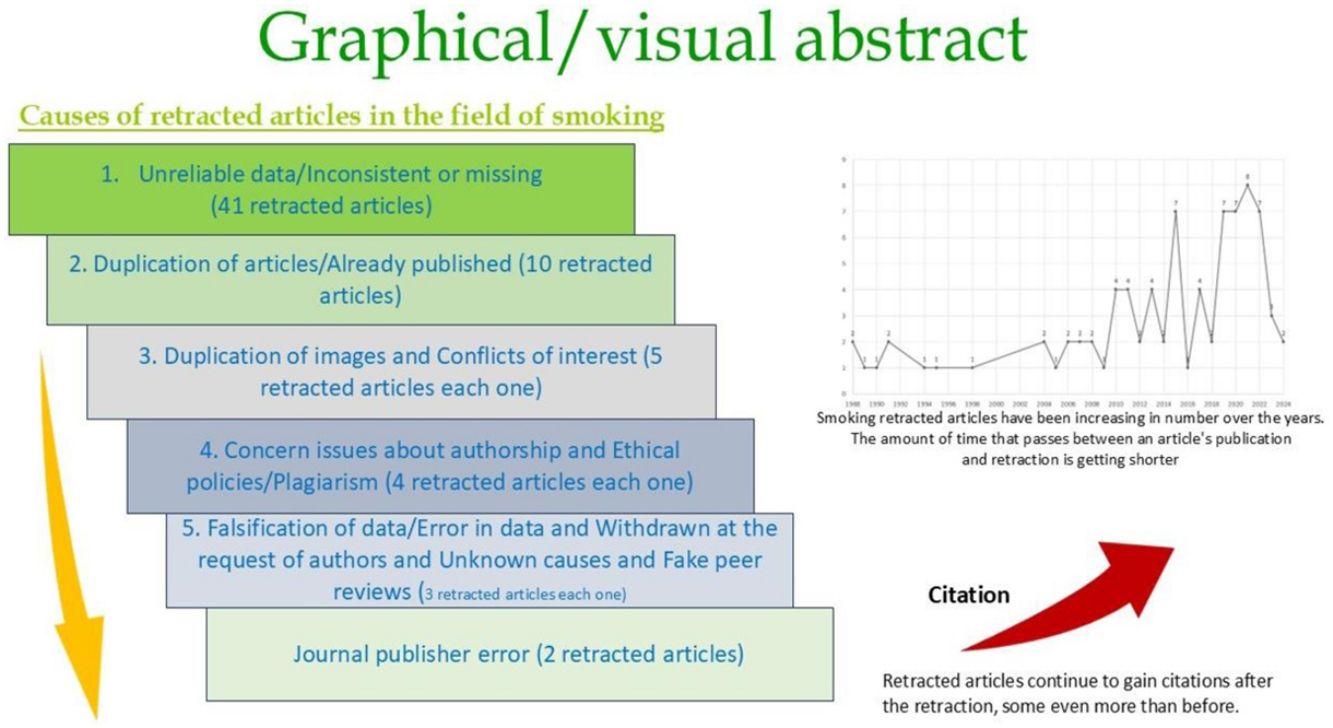
Fig. 6 shows the reason for retraction. The most common reason for retraction in the articles analysed, with 41 articles, was unreliable, inconsistent, erroneous, or missing data, or an incorrect conclusion. Duplication of previously published articles was the second group of retracted articles, with 10 articles, and duplication of images into the articles or in previous articles and conflicts of interest was the third cause of retraction, with 5 documents in each group. The ethical/plagiarism policy and authorship issuesconcerns were the cause of retraction in 4 articles in each group. The following groups have 3 articles each: fake peer reviews, data falsification/data error, articles retracted at the authors’ request, and unknown causes of retraction. Finally, the journal publisher's error included 2 articles.
Disparity between the year of retraction and the year of publication
Fig. 7 shows the number of retracted articles in the five-year period 1988–1992, with a median gap of 24.67 years between the year of retraction and the year of publication. It can be seen how the median gap between the year of retraction and the year of publication has decreased every four years, reaching 0.85 years between 2021 and 2024.
Discussion
Only 83 articles were retracted in this thorough analysis of the literature on smoking over the previous 36 years, with the majority of these retractions being due to unreliable, inconsistent, erroneous, or missing data or an incorrect conclusion. Duplication/already published of previously published articles was the second group of retracted articles, and the third one was duplication of images and conflicts of interest. What we found in our work is no different from what other authors have found in other fields of science. Rong et al.,5 in an article in which they analysed retracted articles in the field of cardiothoracic and vascular anaesthesia, found that the three most frequent causes of retraction were scientific misconduct by the author, duplication, and errors within the manuscript, with the majority of articles being original. Yan et al.,6 in the field of orthopaedic literature, found that the most frequent causes of retraction were fraudulent data, plagiarism, and duplicate publication. Again, the majority of articles retracted were originals. In a study of retracted articles on neurosurgical publications by Wang et al.,7 it was found that the most common reason for retraction was because of a duplicated publication, followed closely by plagiarism, presenting fraudulent data, errors/mistakes, author misattribution, and compromised peer review. Moylan et al.8 have examined all BioMed Central retraction notices published in 2000–2015, and they found that the majority of retractions were due to some form of misconduct, that is, compromised peer review, plagiarism and data falsification/fabrication. In the early years of the SARS-CoV-2 epidemic, a large number of articles were published in an effort to gain a deeper understanding of the disease and quickly address its causes. This was a time of numerous retractions. Gaudino et al.,9 in a study that has described trends and characteristics of retracted articles in the biomedical literature from 1971 to August 2020, found that scientific misconduct was the most common reason for retraction (the most common reasons for misconduct were duplication, plagiarism, and fabrication of data). Shi et al.10 have compared author characteristics and reasons for retractions of COVID-19 and non-COVID-19 research articles between February 1, 2020, and May 5, 2022. They found the following causes of retraction: lack of adherence to journal policies or ethics violations, duplication of data, images, tests, or articles, errors, falsification or fabrication of data, images, or results, plagiarism of data, images, text, or articles, and other non-misconduct-related concerns or unspecified concerns. From another point of view, Khan et al.11 found 189 retracted articles in the COVID-19 field, and they analysed retracted articles to look at the Altmetric Attention Scores (AAS) garnered over a period of time in order to highlight the role of social media and other platforms in advertising retracted articles and its effect on the spread of misinformation. Authors conclude that retracted articles receive significant online attention, so journals and their Twitter accounts ought to put more effort into discrediting all of their retracted articles. Focus on preprint articles; journals should reevaluate preprints in their entirety because of the significant risk they pose for spreading misleading information.
Misconduct is the primary reason for retracting scientific articles, accounting for a significant portion of retractions. Common types of misconduct include plagiarism, data manipulation (falsification and fabrication), and manipulation of the peer review process. Li et al.12 found that having a large number of researchers may mitigate scientific errors and omissions and result in better reporting of studies, which may therefore avoid future retraction of such papers. As for the characteristics of retracted articles, they found that the majority were authored by male investigators as the senior or corresponding authors, but this finding may be explained by sex differences in risk-taking behaviours, including a greater tendency for men for intellectual risk-taking and because there are more men leading research groups and authoring studies than women in biomedical research. They also found that most of the retracted articles had no source of funding or conflict of interest available. Indeed, the desire to produce “significant” results may be stronger among researchers who had close relationships with industry, conducted research using their own funds or had personal investments in the results, among others.13 So, it is essential that sources of funding and conflicts of interest should be clearly documented in published articles. Another factor to be taken into account is the language, as there is also a higher rate of plagiarism when first authors do not have English as their first language, suggesting a difficulty in using original wording. Another factor for misconduct is that a single-person author has less tendency to commit misconduct, and probably there is less group pressure to meet targets.14 The majority of retracted articles, which are especially troublesome for high-impact journals, came from nations with established research traditions (such as the US, Germany, and Japan). However, plagiarism and duplicate publication are more common in nations with less established research traditions, and they are frequently linked to lower-impact journals. The number of retractions for fraud or suspected fraud and error was found to be highly correlated with the journal impact factor; the mean impact factor was significantly higher for articles retracted for fraud, suspected fraud, or error than for plagiarism or duplicate publication15 Retraction due to misconduct is probably the effect of increasing pressure on authors to publish.14 Probably scientific merits should not be evaluated in order of quantity but of quality.16
In our search for retracted articles on smoking, we found three retracted articles for unknown reasons. One of them is a rebuttal letter from us (doi: 10.1016/j.arbres.2020.12.027) in which we responded to authors commenting on some aspects of a previous original article of ours. We, of course, did not retract that letter, and we know that neither did the publisher nor the journal, since we made the inquiry. We do not understand why, because in that rebuttal letter, thanks to the authors’ comments, we were able to make the previous article more profitable.
In our work, we have found that retracted articles have been increasing in number over the years. Koo et al.17 analysed retracted articles published between 2003 and 2022 and found the same as us: a consistent increase between 2003 and 2019; however, after reaching the peak in 2019, the trend reversed, with the number of retracted articles falling by 2022. This decline after 2019 probably might be attributed to the time delay required for retractions to occur, considering that retractions may take several years. Grieneisen et al.,18 Yan et al.,6 Fang et al.,15 and Wang et al.7 found the same, but in previous decades. According to Van Noorden,19 over the last ten years, the retraction rate (the percentage of papers published in a given year that are later retracted) has more than tripled. Points out that a record 10,000 papers were retracted in 2023, suggesting a rise in the publication of faulty or fraudulent research. This phenomenon is probably linked to the increase in the number of published papers and scientific journals but also to the improvement in methodologies to detect fraud or misconduct, such as software to detect plagiarism, mandatory registry of clinical trials, required declaration of conflict of interest and so on. Grieneisen et al.18 clarify that some debate on rising retraction rates focuses on whether more cases are occurring’ or simply more cases are being caught due to improved tools such as plagiarism-detecting software and the Deja Vu database. Technological advances enable cut-and-paste plagiarism and, in masse, multiple article submissions. Another contributor is the recent emergence of articles retracted while ‘in press’, for example, those available to the research community on the publisher's website but retracted prior to volume, issue, and page assignment.
Another impactful aspect, connected to the previous paragraph, is the time required from the publication of an article until it is retracted. As we have seen in our work (Fig. 7), this timeframe is becoming increasingly shorter. In a previous article Dal-Ré et al.20 found, in a study about retracted genetics articles, that the median time to retraction was 3.2 years, and they found that time for retraction depended on the causes of retraction: median time to retraction was shorter (1.3 years) in the case of plagiarism than for fabrication/falsification (4.8 years, p<0.001). In another article21 found in the biomedical field that the median duration between the first publication date of the articles and the date of retraction was 10.33 (0.73–144.06) months. Gaudino et al.9 found the same differences according to the type of retraction; they found that the median time from publication to retraction was 1.8 (0.6–4.7) years: 2.4 years for retractions owing to scientific misconduct and 1.1 years for other reasons, such as errors in the manuscript and issues with the journal or publisher. But these authors, as in our work, found that over the study period, the median time from publication to retraction significantly decreased (start of study period, 0.83 years, vs. end of study period, 0.14 years; p<.001). Di Traglia et al.,22 in a study that performed a systematic review of all retracted literature in ear, nose, and throat, found a median time from publication to retraction of 1 year, and years till retraction were shorter in more recent publications, suggesting that journals are more expeditious in processing retractions.
One aspect we have been able to verify is that retracted articles indeed continue to gain citations after the retraction, some even more than before. Indeed, Di Traglia et al.22 found in their work that the number of citations following retraction was higher relative to the average citation counts prior to retraction, but not statistically significant. They also have explored potential barriers to post-retraction citation and found that paywalls, the presence of a retraction notice, and the cause of retraction made no difference. A study by Candal-Pedreira et al.23 used two time periods to examine the relationship between retraction and citations received by papers that were retracted because of misconduct: during a post-retraction period equivalent to the time the article had been in print before retraction and during the total post-retraction period. They found an increase in post-retraction citations when compared with citations received pre-retraction. However, there were some exceptions: articles published in first-quartile journals saw a decrease in citations immediately following retraction (p<0.05), which was followed by an increase after some time, and articles that had received a large number of citations prior to retraction saw a significant decrease in post-retraction citations (p<0.05). The findings show that there is no long-term correlation between retraction and citations because retracted articles are still cited, avoiding retraction. So, to prevent this lack of effect on citations after retraction, more effective mechanisms to avoid citing retracted papers should be established by the scientific journals, but we believe that the only possible mechanism to avoid citations after retraction is that, depending on the article that is retracted, it should be removed from the journal.
Our study has certain limitations. We used the Retraction Watch database, the most comprehensive database for retractions, and did not manually search retracted articles in the literature. Other databases might have contained more articles that were not found by searching them. Additionally, this may not be generally applicable to other fields and specialities because we only included those who were retracted in the smoking field. Retractions resulting from scientific misconduct have been categorised by us based on prior research, though these may not have been consistent across all studies. Another limitation was the lack of a control group, which thus did not allow for the comparison of the observed trends in retracted articles to those in non-retracted articles. According to our data and prior research, there may be a lag of one to three years in retractions, and we are unable to include studies that will be the focus of future research and subsequent retraction. We also have to acknowledge a limited capacity to classify publications as misconduct or not if not clearly detailed in the retraction note.
ConclusionsIn this comprehensive review of the literature on smoking over the past 36 years, only 83 articles were retracted. Unreliable, inconsistent, inaccurate, or missing data, or an incorrect conclusion, are the main causes of retractions, according to our research. Duplication/already published of previously published articles was the second group of retracted articles, and the third one was duplication of images and conflicts of interest. Retracted articles have been increasing in number over the years, and additionally, the amount of time that passes between an article's publication and retraction is getting shorter. We verify that retracted articles indeed continue to gain citations after the retraction, some even more than before.
Declaration of generative AI and AI-assisted technologies in the writing processNone of the materials have been produced partially or totally with the aid of any artificial intelligence software or tool.
FundingThis paper was not funded.
Authors’ contributionsJIG-O: conception and design of the study, writing the core content of the study, analysis and interpretation of data, drafting the article and revising it critically for important intellectual content. AA-A and RA-B have proposed the search strategy for the articles in the different selected databases, they have obtained the different selected articles and they have discarded the repeated ones and carried out the first screening of them. DL-P: statistical analysis and interpretation of data, preparation and critical review of the manuscript. CAJ-R, CR-C: screened the articles and critical review of the manuscript.
All authors approved the current version of the manuscript.
Conflicts of interestJIG-O has received honoraria for lecturing, scientific advice, participation in clinical studies or writing for publications for the following (alphabetical order): Aflofarm, Adamed, Boehringer, Esteve, Neuroxpharm and Pfizer. CAJ-R has received honoraria for presentations, participation in clinical studies and consultancy from: Aflofarm, Adamed, Bial, GSK, Menarini, Neuroxpharm and Pfizer. DL-P has received honoraria for lecturing, scientific advice, conferences attendance, participation in clinical studies and educational activities in general for the following (alphabetical order): Astra Zeneca, Aerogen, Chiesi, GSK, Menarini, Oximesa, Philips, Resmed, Sapio, Vivisol and Zambón. The rest of the authors have no conflict of interest.
The following are the supplementary data to this article: