
A 28-year-old woman, primigravida, at 23 weeks of gestation, was referred to pulmonology for consultation in the context of polyglobulia on clinical laboratory testing. She reported previous incomplete evaluations in her country of birth, where a presumed diagnosis of pulmonary mass was not further studied. She was a never-smoker and had no personal or family medical history or history of bleeding. She presented with SatO2 88–90% that did not improve after supplementary oxygen, her main symptom being dyspnea on exertion.
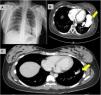
Physical examination was significant for the presence of clubbing and normal vesicular breath sounds. A chest X-ray was performed, revealing an opacity in the left lower lobe (Fig. 1A). No heart valve disease or contractility alterations were seen on echocardiogram. Pulmonary arteriovenous malformation (PAVM) was the principal differential diagnosis, and a shunt was identified after administration of 100% O2 according to protocols, with a calculated shunt fraction of 50%. This was a complex case with a high risk of morbidity and mortality for both the mother and the fetus, so management with the involvement of several hospital departments was discussed by a multidisciplinary committee.

Chest X-ray showing an opacity in the left lower lobe. (B) Computed tomography angiography before endovascular embolization. The arrow indicates a large arteriovenous malformation in the left lower lobe. (C) Computed tomography angiography following endovascular embolization with an 18mm Amplatzer. The arrow indicates post-embolization changes in the left lower lobe.
The initial strategy was to perform an elective cesarean section when fetal maturity had been achieved, but at week 35 the patient showed clear deterioration with dyspnea on minimal effort and SaO2 near 80% despite supplemental oxygen. The patient was hospitalized and a cesarean was performed.
Computed tomography angiography of the thoracic aorta was subsequently performed, in which a left pulmonary arteriovenous shunt was visualized with the presence of a thrombus in its interior (Fig. 1B). The interventional radiology department conducted an embolization of the main trunk of the anterior basal arteries feeding the arteriovenous fistula, using an 18mm Amplatzer via femoral access. Subsequently, two smaller branches were catheterized with 5 and 6mm Amplatzers. The procedure was completed without complications. Radiological monitoring was performed with chest CT after 6 months, showing post-embolization changes in the arteriovenous shunt of the left lower lobe, with no additional alterations (Fig. 1C). The patient currently remains in follow-up with visits to the pulmonology department and shows marked clinical improvement with SatO2 98%.
PAVMs are anomalous communications in the pulmonary circuit. They are unilateral and more prevalent in women and in the lower lobes.1 About 40% of cases are symptomatic, with dyspnea being the predominant symptom (15–56%), followed by hemoptysis (7–30%).2 PAVMs should be suspected in patients who present unidentified dyspnea or hypoxemia, the presence of pulmonary nodules, or a diagnosis of hereditary hemorrhagic telangiectasia. The increase in physiological demand, during pregnancy, due to increased blood volume and cardiac output, places additional stress on the pulmonary vasculature. Hormonal changes during pregnancy also contribute to vascular dilation and increased blood flow. These physiological alterations can lead to the enlargement or rupture of existing arteriovenous malformations, increasing the risk of complications such as ruptures, hemothorax, and hypovolemic shock.3,4 Close monitoring and management of pregnant women with PAVMs is essential to minimize risks to both the mother and the fetus.4,5
This case describes the presentation of a PAVM in a primigravida patient, its multidisciplinary management, and diagnostic approach.
Declaration of generative AI in scientific writingNo artificial intelligence was used in the development and writing of this article.
Informed consentThe patient's informed consent to publish her case was obtained.
FundingThis research did not receive any specific grant from funding agencies in the public, commercial, or not-for-profit sectors.
Authors’ contributionsAll authors have contributed to the preparation, writing and review of the article.
Conflict of interestNone.