



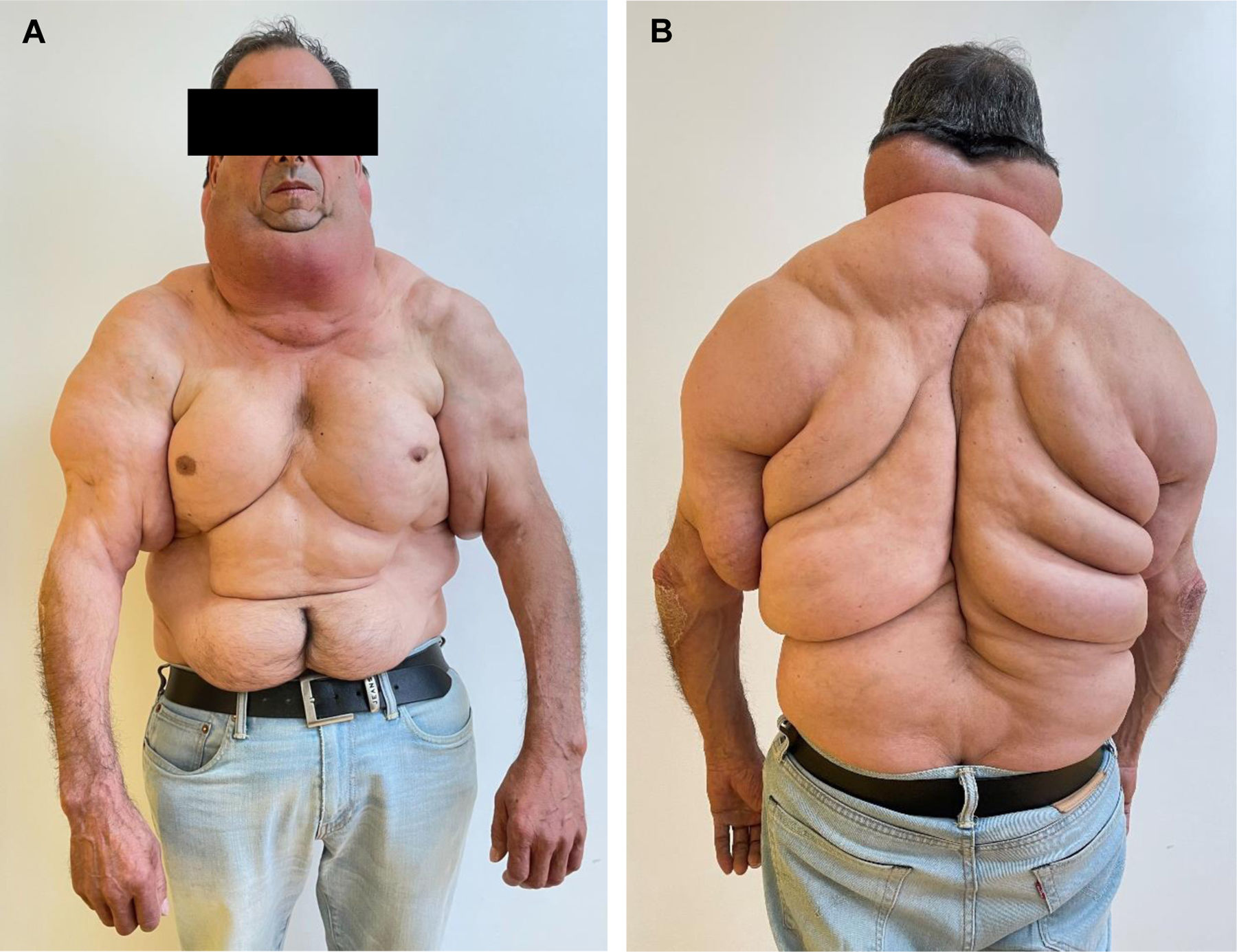
A 56-year-old male patient presented with a neck mass progressing over a period of 10 years. Similar masses appeared bilaterally around the shoulder, trunk and upper arms, causing restricted neck movement and symptoms of dysphagia and dyspnea.
The patient had medical history of hyperuricemia, alcohol abuse and chronic liver disease. He also had been smoking 25 cigarettes per day for 32 years. His medication and family history were unremarkable.
The physical examination revealed a body mass index (BMI) of 26.5kg/m2 (weight 73kg; height 1.66m), collateral venous circulation across the upper chest, soft palate thickening and symmetrical soft masses around the neck and upper arms.
Laboratory tests revealed elevated liver marker values: aspartate aminotransferase (AST 122U/L, reference: <35U/L), alanine aminotransferase (ALT 83U/L, reference: <45U/L), gamma-glutamyl transpeptidase (GGT 210U/L, reference: <55U/L) and total bilirubin (2mg/dL, reference: 0.2–1.2mg/dL).
The patient was referred for a computed tomography (CT) scan of the neck and chest which showed bilateral excessive fat deposition of the neck and partial occlusion of the oropharynx and nasopharynx due to thickening of the soft palate.
Based upon the symptoms, physical examination and auxiliary investigation, the patient was diagnosed with Madelung's disease (Fig. 1).

Extensive lipectomy was offered to the patient, which he agreed. This procedure required prior abstinence from alcohol, which was monitored by measuring the GGT level.
Madelung's disease (MD) is a rare lipid metabolic disorder characterized by multiple, symmetrical accumulation of fat tissue in the maxillofacial region, neck, shoulder, trunk, limbs, and other regions, with progressive enlargement and slow tumor growth.1,2 Although it is usually asymptomatic, patients may present with peripheral neuropathy, limited movement, dysphagia, and dyspnea from laryngeal and mediastinal involvement.1,3
MD is more common in middle-aged men, especially those from the Mediterranean region.4 The etiology remains unclear but most of the patients share similar habits such as alcohol abuse and history of smoking.1 Madelung's disease can be categorized into two types: Type 1 characterized by fat deposition predominantly on the neck and shoulders (known as Madelung's or horse collar), and Type 2, with a more diffuse distribution and fat accumulation on the abdomen and thighs, which can lead to a misdiagnosis with typical obesity.1,5
The diagnosis is based on clinical features and imaging studies.3 There are numerous differential diagnosis that must be considered including thyroid and salivary gland diseases, Cushing disease, neck cysts, soft-tissue sarcoma, among others.6
MD's management is difficult. Lipectomy and liposuction are considered the most effective treatment methods, but recurrence commonly occurs. Abstinence from alcohol cannot reverse the disease but it can slow the enlargement of adipose masses and reportedly decreases the recurrence rate after treatment.1,4
The progression of MD has a serious impact on patient quality of life and is associated with various comorbidities. Clinicians must increase awareness of MD to avoid misdiagnosis.
Authors’ contributionCP: conception of the work, draft of the manuscript, data acquisition, literature review.
MJ: literature review, critical review of the paper.
JG: literature review, data acquisition, critical review of the paper.
Protection of humansThe authors declare that the procedures were followed according to the regulations established by the Clinical Research and Ethics Committee and to the Helsinki Declaration of the World Medical Association updated in 2013.
Data confidentialityThe authors declare having followed the protocols in use at their working center regarding patients’ data publication.
Patient consentObtained.
Funding sourcesThis research received no specific grant from any funding agency in the public, commercial, or not-for-profit sectors.
Conflict of interestThe authors state no conflict of interest.

