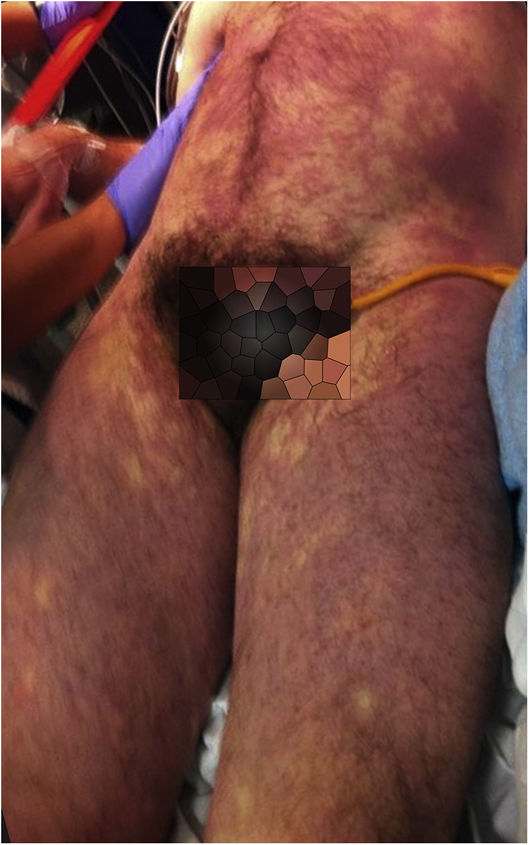


A 47-year-old man presented to the emergency department with a 1-h of epigastric pain. He had a history of acute pancreatitis and he was an active smoker. Physical examination revealed a livedo reticularis (Fig. 1) between chest and knees. Computed tomography showed an irregularity of renal and mesenteric arteries, an occlusion of the splenic artery and a pancreatic pseudocyst. He was initially treated with corticoids and gamma globulin with a suspected diagnosis of antiphospholipid syndrome. 4-Days later he started abdominal pain and a new computed tomography showed necrosis of the gastric wall with penetration of the spleen into the stomach (Fig. 2). A sleeve gastrectomy with splenectomy was performed. Histologic examination revealed ischemic necrosis and cholesterol clefts with occlusion of the lumen of the stomach and spleen blood vessels. 1-Year later, he had no recurrence. Cholesterol crystal embolism can involve any organ of the gastrointestinal tract, presenting with common gastrointestinal symptoms. The risk of cholesterol crystal formation is directly related to risk factors for atherosclerosis, such as smoking. The skin is commonly involved, presenting as livedo reticularis. It is therefore considered the “great masquerader,” requiring a high level of suspicion because the condition is associated with increased morbidity and mortality.
Citescore 2024
0,7
SJR
SJR es una prestigiosa métrica basada en la idea de que todas las citaciones no son iguales. SJR usa un algoritmo similar al page rank de Google; es una medida cuantitativa y cualitativa al impacto de una publicación.
Ver másSJR 2024
0,140
SNIP
SNIP permite comparar el impacto de revistas de diferentes campos temáticos, corrigiendo las diferencias en la probabilidad de ser citado que existe entre revistas de distintas materias.
Ver másSNIP 2024
0,282
Porcentaje de aceptación
La tasa de aceptación de las revistas se calcula dividiendo el número total de artículos aceptados (inicialmente y después de la revisión estándar) por el número total de envíos (aceptados y rechazados).
Ver másPorcentaje de aceptación
63 %
Ver más métricas