





Approximately 25– of patients undergoing bariatric surgery (BS) experience weight regain or suboptimal weight loss. Glucagon-like peptide-1 receptor agonists (GLP-1 RAs) have emerged as a therapeutic option in these cases.
AimTo evaluate the effectiveness of GLP-1 RAs in managing weight regain and suboptimal weight response after BS in a real-world setting.
Materials and methodsRetrospective study of BS patients treated with GLP-1 RAs due to weight regain or suboptimal weight response.
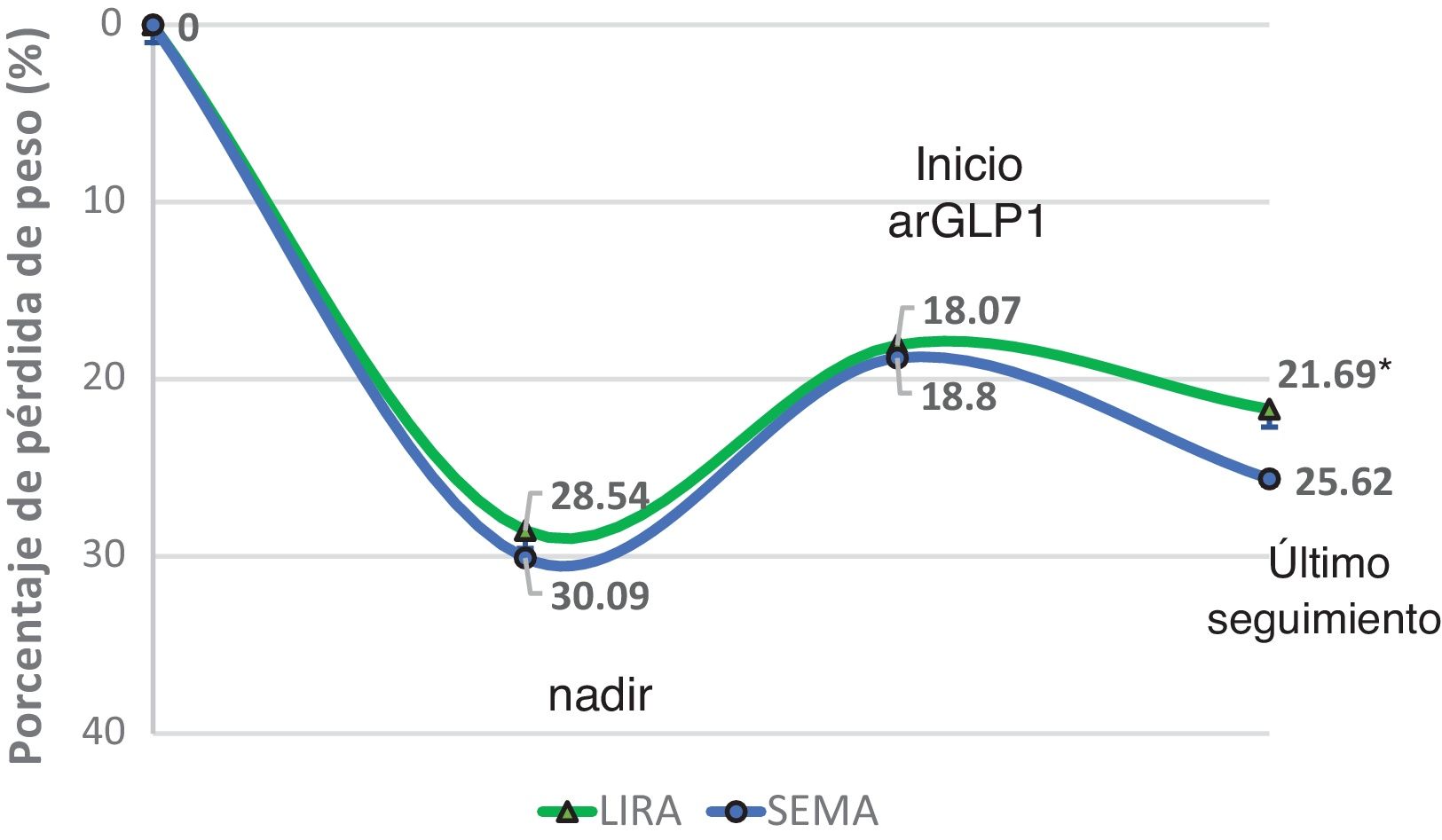
ResultsA total of 953 patients underwent BS between 2015 and 2020; 122 initiated treatment with GLP-1 RAs. The cohort was composed 78% women, with a mean age of 50.4 ± 10.6 years and a baseline BMI of 44.7 ± 6.3 kg/m2. At the start of treatment, 41.9 ± 20.5 months post-BS, the mean weight loss was 18.6 ± 10%; 52% had lost <20% of their initial weight and 82% had regained >20% of the weight lost. 35% received liraglutide (LIRA) (1.8 ± 0.5 mg/day) and 65% semaglutide (SEMA) (1.0 ± 0.8 mg/week), with a mean treatment duration of 19.3 ± 17.3 months. Maximum weight loss was 4.7 ± 4.8% with LIRA vs. 8.3 ± 5.9% with SEMA (p = 0.01). Total weight loss (BS + GLP-1 RA) was 21.6 ± 9.2% with LIRA vs. 25.6 ± 10.5% with SEMA. The proportion of patients with a suboptimal weight response after BS + pharmacotherapy (<20%) significantly decreased (from 52% to 31%).
ConclusionsSEMA led to greater weight reduction than LIRA, positioning it as a more effective option for managing post-BS weight regain.
Aproximadamente el de los pacientes sometidos a cirugía bariátrica (CB) experimentan recuperación de peso o una pérdida subóptima. Los análogos del receptor de GLP-1 (arGLP1) han surgido como una opción terapéutica en estos casos.
ObjetivoEvaluar la eficacia de los arGLP1 en la recuperación de peso y pérdida de peso subóptima tras la CB en vida real.
Materiales y métodosEstudio retrospectivo en pacientes con CB tratados con arGLP1 debido a recuperación de peso o pérdida insuficiente.
ResultadosUn total de 953 pacientes fueron intervenidos de CB entre los años 122 iniciaron tratamiento con arGLP1. La cohorte incluyó 78% mujeres, con una edad media de 50,4 ± 10,6 años e IMC inicial de 44,7 ± 6,3 kg/m2. Al inicio del tratamiento, 41,9 ± 20,5 meses post-CB, la pérdida de peso fue 18,6 ± 10%, 52% mostró pérdida <20% del peso inicial y 82% recuperaron >20% del peso perdido.
El 35% recibió liraglutida (LIRA) (1,8 ± 0,5 mg/día) y el 65% semaglutida (SEMA) (1,0 ± 0,8 mg/semana), con una duración media de 19,3 ± 17,3 meses. La máxima pérdida de peso fue 4,7 ± 4,8% con LIRA vs. 8,3 ± 5,9% con SEMA (p = 0,01). La pérdida total (CB + arGLP1) fue 21,6 ± 9,2% con LIRA vs. 25,6 ± 10,5% con SEMA. La proporción de pérdida insuficiente (<20%) disminuyó significativamente (52% a 31%).
ConclusionesSEMA mostró una mayor reducción de peso que LIRA, posicionándose como una opción más efectiva en la recuperación de peso post-CB.

