



metricas
covid
Medicina Clínica (English Edition) Therapeutic approach to non-functioning pituitary adenomas
Journal Information
Vol. 156. Issue 6.
Pages 284-289 (March 2021)
Vol. 156. Issue 6.
Pages 284-289 (March 2021)
Review
Therapeutic approach to non-functioning pituitary adenomas
Enfoque terapéutico de los adenomas hipofisarios no funcionantes
Carlos Pérez-Lópeza,
Corresponding author
cperezhulp@yahoo.es

Corresponding author.
, Cristina Álvarez-Escoláb, Alberto Isla Guerreroa
a Servicio de Neurocirugía, Hospital Universitario La Paz, Madrid, Spain
b Servicio de Endocrinología, Hospital Universitario La Paz, Madrid, Spain
Article information
Abstract
Full Text
Bibliography
Download PDF
Statistics
Figures (2)
Tables (3)
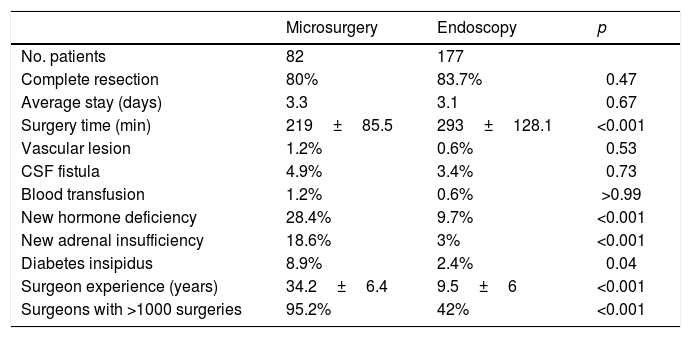
Table 1. Comparative data of microsurgery and endoscopy in a 2019 series where only the most experienced surgeons in both techniques were included.31
Tables
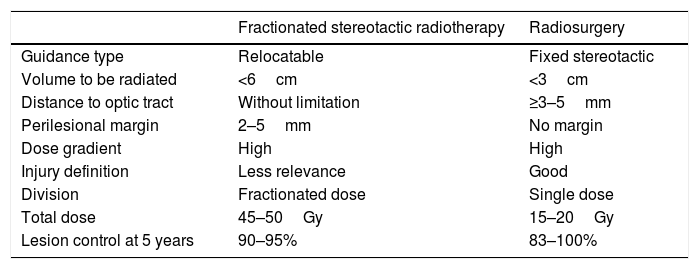
Table 2. Radiotherapy modalities most used in the treatment of non-functioning pituitary adenomas.
Tables
Table 3. Summary of the five largest series of NFPA patients who received radiosurgery.
Tables
Show moreShow less
Abstract

The treatment of non-functioning pituitary adenomas raises two questions: when should they be treated and what role does each available treatment play. We review the usefulness of the different treatments and propose a therapeutic scheme based on the existing literature.

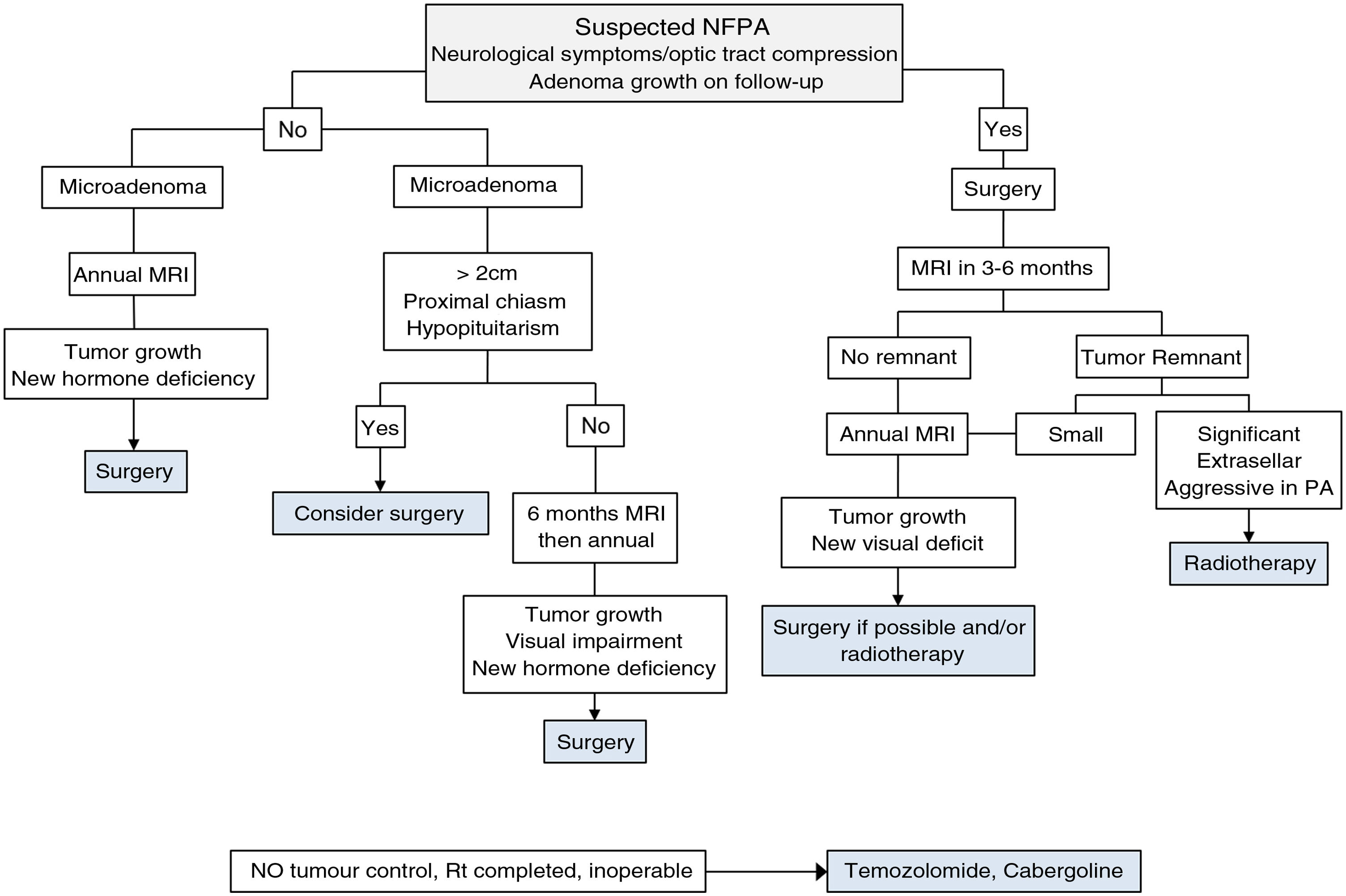
Active treatment of pituitary adenomas should be performed when they produce symptoms, have contact with the optic tract, or have grown on imaging tests. The treatment is surgical, using radiotherapy for cases with significant non-removable postsurgical tumour remnants and for those in which histopathology studies show aggressive features. Medical treatment is reserved for situations in which surgical and radiotherapy treatments have been exhausted.

The most advisable surgical treatment is endoscopic, although experienced neurosurgeons achieve results with microsurgery that are only slightly inferior.

Keywords:
Pituitary adenoma
Non-functioning
Temozolomide
Radiotherapy
Surgery
Endoscopy
Resumen

El tratamiento de los adenomas hipofisarios no funcionantes establece dos interrogantes: cuándo se deben tratar y qué papel desempeña cada tratamiento disponible. Revisamos la utilidad de los diferentes tratamientos y proponemos un esquema terapéutico basado en la literatura existente.

Se debe realizar tratamiento activo de los adenomas hipofisarios que producen síntomas, contactan con la vía óptica o muestran crecimiento en pruebas de imagen. El tratamiento será quirúrgico, reservándose la radioterapia fundamentalmente para casos de resto tumoral postquirúrgico significativo no extirpable y para casos de anatomías patológicas agresivas. El tratamiento médico se reserva para situaciones en que se ha agotado el tratamiento quirúrgico y radioterápico.

El tratamiento quirúrgico más aconsejable es el endoscópico, aunque en manos expertas la microcirugía obtiene resultados sólo ligeramente inferiores.


Palabras clave:
Adenoma hipofisario
No funcionante
Temozolomida
Radioterapia
Cirugía
Endoscopia

Article

These are the options to access the full texts of the publication Medicina Clínica (English Edition)
Subscriber
Subscriber

If you already have your login data, please click here .

If you have forgotten your password you can you can recover it by clicking here and selecting the option “I have forgotten my password”
Subscribe
Subscribe to

Medicina Clínica (English Edition)

Purchase
Purchase article

Purchasing article the PDF version will be downloaded

Purchase now
Contact
Phone for subscriptions and reporting of errors
From Monday to Friday from 9 a.m. to 6 p.m. (GMT + 1) except for the months of July and August which will be from 9 a.m. to 3 p.m.
Calls from Spain
932 415 960
Calls from outside Spain
+34 932 415 960
E-mail
Article options
Tools