




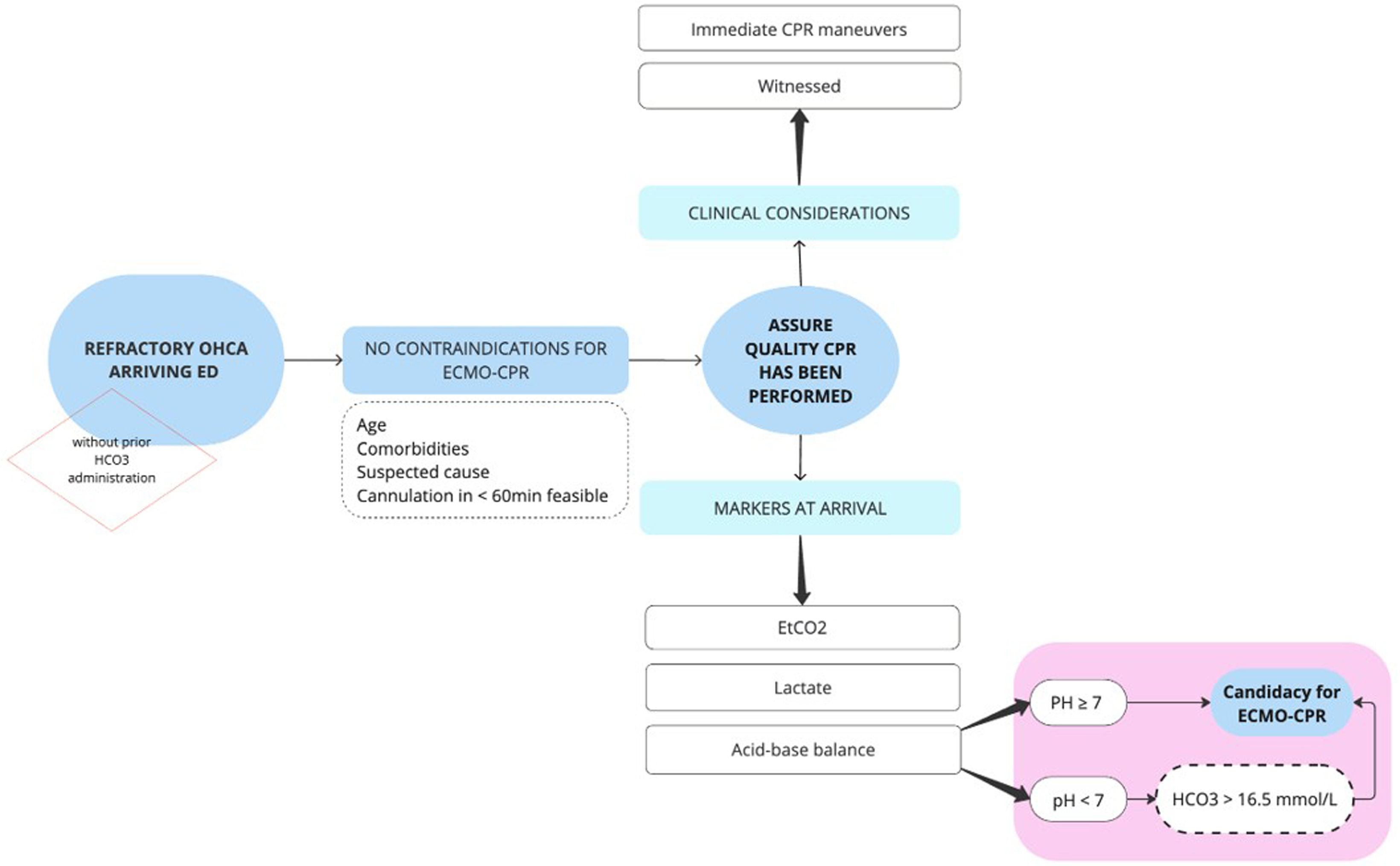


Mortality after an out-of-hospital cardiac arrest (OHCA) remains excessively high. The use of extracorporeal cardiopulmonary resuscitation at admission may improve survival, but selecting candidates for this therapy is challenging. Finding the best predictive biomarkers of severe hypoxic-ischemic brain injury (HIBI) on arrival might aid in the multimodal decision making. Our aim was to analyse the predictive value of the acid–base balance components in this scenario.
MethodsThis was a prospective observational study of OHCA patients that achieved return of spontaneous circulation without administration of HCO3 during resuscitation, admitted to an ICCU of a tertiary care centre. Point-of-care arterial biomarkers on arrival, including pH, pCO2 and HCO3 were analysed. The primary objective was severe HIBI.
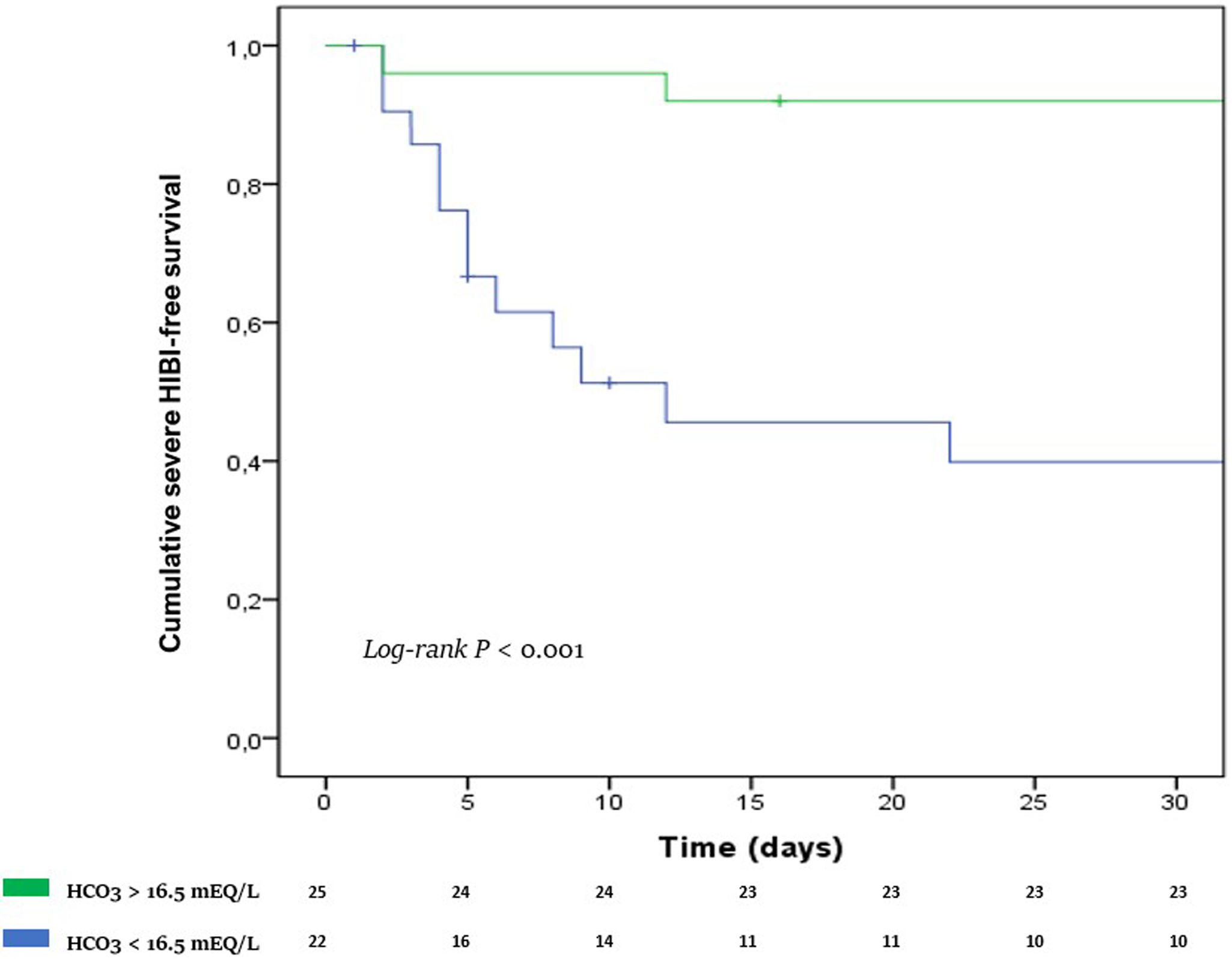
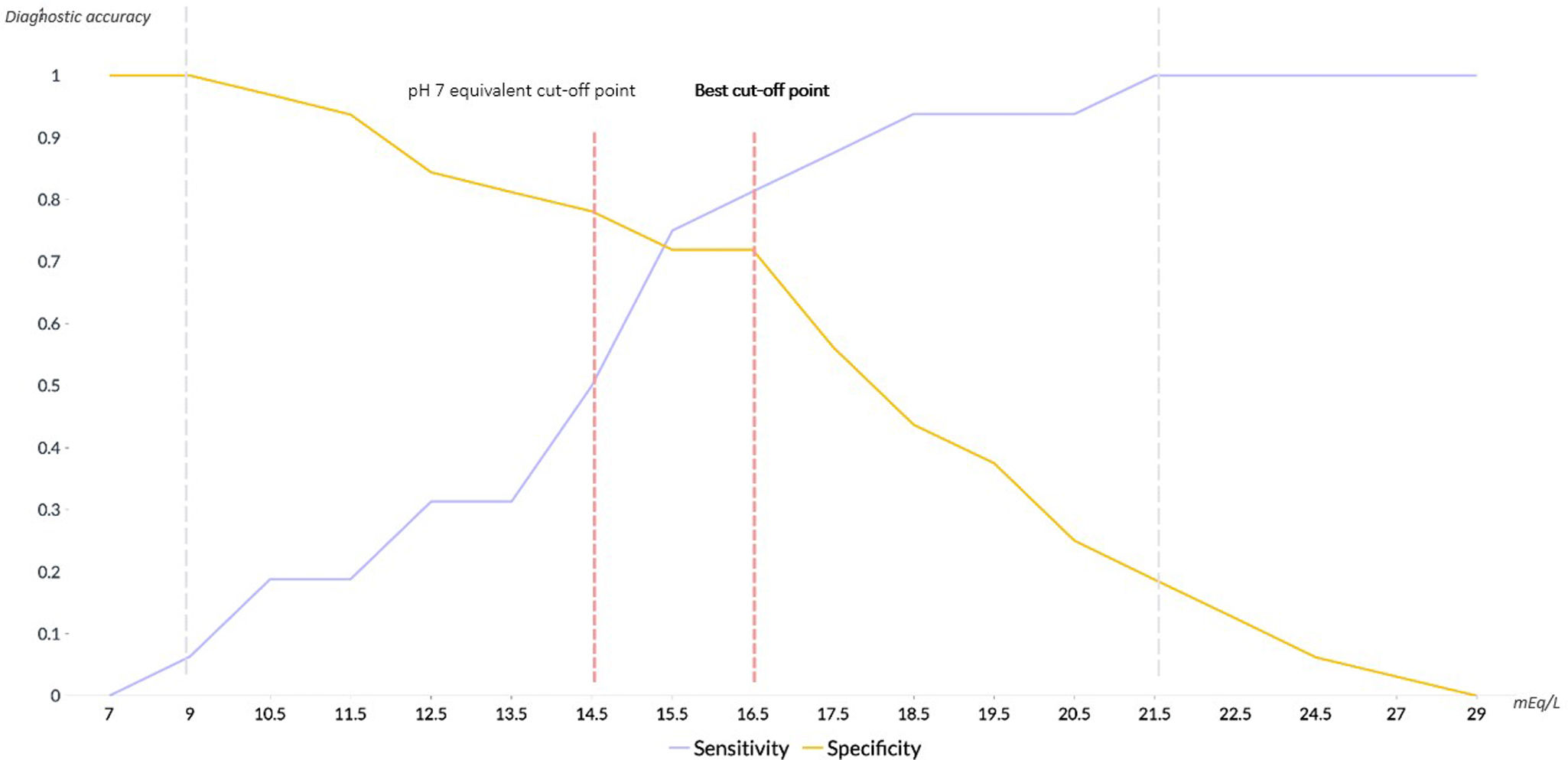
ResultsFrom 2019 to 2021, 50 OHCA patients were included, of which 17 (34%) suffered severe HIBI. Initial pH (6.99±0.20 vs. 7.14±0.15, P=0.007) and HCO3 values (14.13±3.24mEq/L vs. 17.97±4.28mEq/L, P=0.003) were significantly lower in severe HIBI patients, while no difference was observed regarding pCO2 (52.44±14.41mmHg vs. 51.38±13.38mmHg, P=0.801). HCO3 showed higher accuracy to predict severe HIBI than pH (AUC of 0.764 vs. 0.727), with a value of 16.5mmol/L as the best cut-off point.
ConclusionsFirst HCO3 levels on admission of OHCA patients who achieved ROSC significantly predicted severe HIBI, unlike pCO2, and showed even better accuracy than pH.
La mortalidad tras una parada cardíaca extrahospitalaria (PCEH) es excesivamente elevada. La resucitación mediante membrana extracorpórea al ingreso podría mejorar la supervivencia, sin embargo, la selección de candidatos para esta terapia supone un reto. Encontrar biomarcadores a la llegada con mayor capacidad predictiva de encefalopatía hipóxico-isquémica (EHI) podría ayudar en la toma de decisiones. Nuestro objetivo es analizar el valor de los componentes del equilibrio acido-base en este escenario.
MétodosEstudio prospectivo observacional de pacientes con PCEH en los que se consiguió el retorno a la circulación espontánea (RCE) sin administración de HCO3 durante la resucitación, ingresados en una Unidad de Cuidados Cardiacos Agudos de un hospital terciario. Se analizaron mediante gasometría arterial “point-of-care” a la llegada biomarcadores incluyendo pH, pCO2 y HCO3. El objetivo primario fue la EHI.
ResultadosEntre 2019 y 2021, 50 pacientes con PCEH fueron incluidos, de los cuales 17 (34%) sufrieron EHI grave. Los valores de pH (6.99±0.20 vs. 7.14±0.15, P=0.007) y HCO3 (14.13±3.24mEq/L vs. 17.97±4.28mEq/L, P=0.003) iniciales, fueron significativamente menores en los pacientes con EHI grave, mientras que no se observaron diferencias en cuanto a la pCO2 (52.44±14.41mmHg vs. 51.38±13.38mmHg, P=0.801). El HCO3 presentó una mayor exactitud para predecir la EHI grave respecto al pH (AUC 0.764 vs. 0.727), siendo el valor de 16.5 mmol/L el mejor punto de corte.
ConclusionesLos niveles de HCO3 al ingreso de pacientes con PCEH que consiguieron el RCE, fueron predictores de EHI grave, al contrario que los niveles de pCO2, y tuvieron mayor capacidad predictora que los de pH.

