



La insuficiencia cardíaca (IC) es una enfermedad frecuente con elevada morbimortalidad. Asocia comorbilidades como la insuficiencia renal que agravan su pronóstico.
ObjetivosAnalizar si la función renal influye en la efectividad de los inhibidores del cotransportador de sodio-glucosa tipo 2 (iSGLT2) para reducir reingresos y mortalidad en los ancianos pluripatológicos con IC aguda.
Material y métodosEstudio retrospectivo de 913 pacientes pluripatológicos con IC aguda procedentes del registro PROFUND-IC. Se clasificaron según el filtrado glomerular (FG) en 3 grupos: ≤percentil (P) 25 (FG≤30,41ml/min/1,73m2; N=229), P25-75 (FG: 30,41-65,14ml/min/1,73m2; N=456) y ≥P75 (FG≥65,14ml/min/1,73m2; N=228). Las variables cualitativas se analizaron mediante el test de Chi-cuadrado o Fisher; las cuantitativas con ANOVA o Kruskal-Wallis según normalidad. Se utilizaron curvas de Kaplan-Meier para analizar supervivencia y reingresos según tratamiento con iSGLT2.
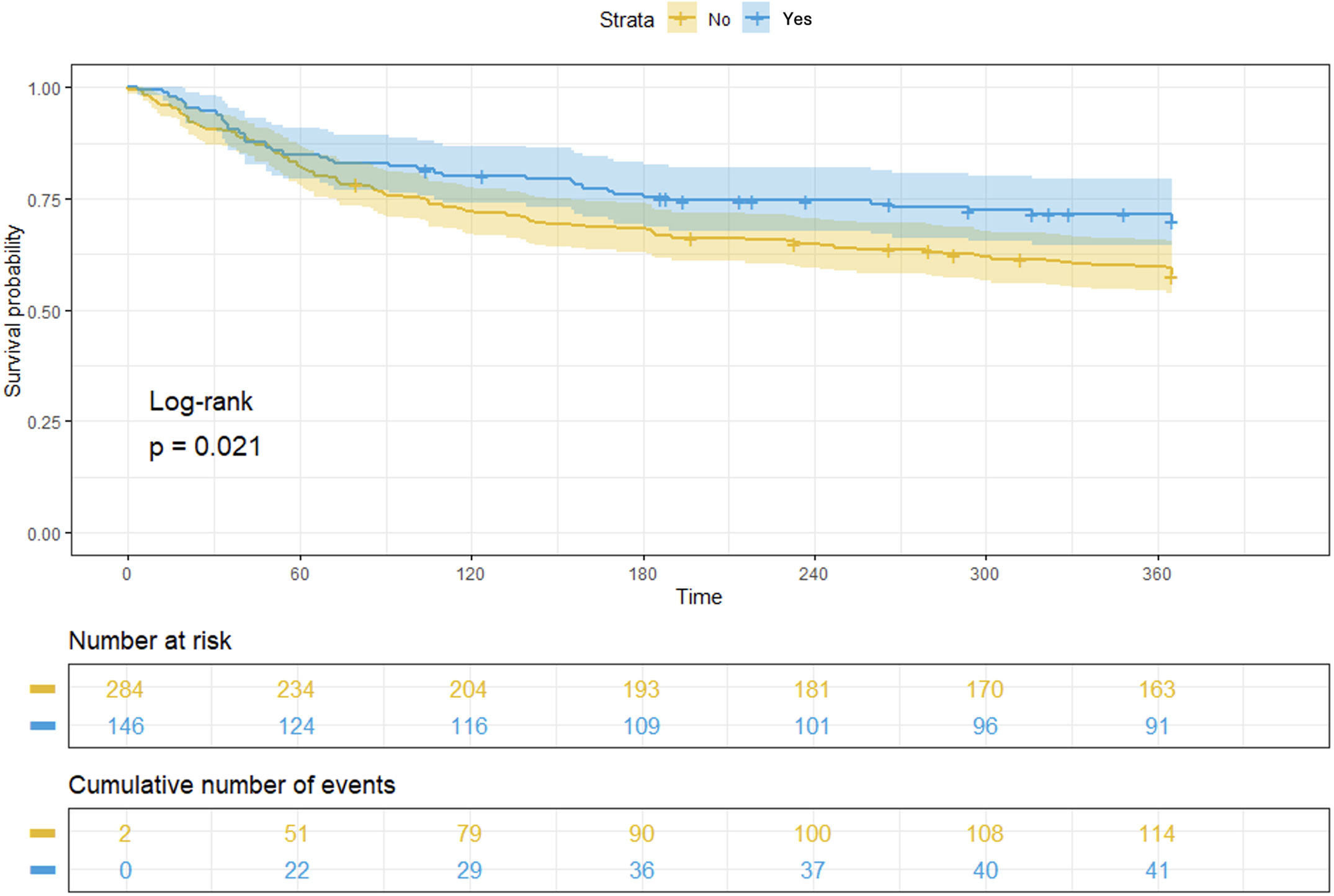
ResultadosSe incluyeron 913 pacientes, con FG medio de 49ml/min/1,73m2 y creatinina media de 1,4mg/dl. El 58,2% eran mujeres, con edad media de 84 años, y fracción de eyección del ventrículo izquierdo del 51,45%. Los pacientes con menor FG eran más mayores (p<0,001), tenían más diabetes mellitus (p<0,001) y peor clase funcional (p=0,038). No hubo diferencias significativas en mortalidad o reingresos según FG. La administración de iSGLT2 se asoció a menor reingreso en todos los grupos si bien la reducción de la mortalidad (p=0,0068) y reingreso (p=0,021) es estadísticamente significativa únicamente en los pacientes con FG entre 30,41 y 65,14ml/min/1,73m2.
ConclusionesEl tratamiento con iSGLT2 se asoció a una reducción estadísticamente significativa de reingresos y mortalidad en los ancianos pluripatológicos con IC aguda y FG entre 30,41-65,14ml/min/1,73m2.
Heart failure is a prevalent disease causing high morbidity and mortality. It is associated with comorbidities like renal impairment that worsen its prognosis.
AimsTo analyse whether renal function influences the effectiveness of SGLT2 inhibitors in reducing readmissions or mortality in elderly pluripathological patients with acute heart failure (AHF).
Materials and methodsRetrospective study of 913 pluripathological patients with AHF from the PROFUND-IC registry. The sample was divided into three groups by glomerular filtration rate (GFR): ≤25th percentile (GFR≤30.41ml/min/1.73m2; N=229), 25th-75th percentile (GFR: 30.41-65.14; N=456), and ≥75th percentile (GFR≥65.14; N=228). Group differences were analyzed using chi-square test for qualitative variables and ANOVA for quantitative ones, with Fisher and Kruskal-Wallis tests applied when indicated. Kaplan-Meier curves evaluated survival and readmissions according to treatment with iSGLT2.
ResultsNine hundred thirteen patients were included, with mean GFR of 49ml/min/1.73m2 and mean creatinine of 1.4mg/dl. The 58.2% were women, with a mean age of 84 years, and mean left ventricular ejection fraction of 51.45%. Patients with lower GFR were older (p<.001), had more diabetes mellitus (p<.001), and worse functional class (p=.038). Mortality and readmission rates did not differ across GFR categories. SGLT2 inhibitors use was associated with reduced readmissions in all groups, although significant differences in mortality (p=.0068) and readmissions (p=.021) were only observed in patients with GFR between 30.41 and 65.14ml/min/1.73m2.
ConclusionSGLT2 inhibitors significantly reduced readmissions and mortality in elderly pluripathological patients with AHF and GFR between 30.41 and 65.14ml/min/1.73m2.