


metricas
covid
Medicina Clínica (English Edition) Autonomic syncope
Journal Information
Vol. 165. Issue 3.
(September 2025)
Review
Autonomic syncope
Síncope autonómico
Jaume Francisco-Pascuala,b,c,d,
Corresponding author
jaume.francisco@vallhebron.cat

Corresponding author.
, Jose Manuel Medina Maguiñaa, Nuria Rivas-Gándaraa,b,d,e
a Unitat d’Arritmies, Servei de Cardiologia, Hospital Universitari Vall d’Hebron, Barcelona, Spain
b Vall d’Hebron Institut de Recerca (VHIR), Vall d’Hebron Barcelona Hospital Campus, Barcelona, Spain
c Departament de Biologia Cel·lular de Fisiologia i d’Immunologia, Universitat Autònoma de Barcelona, Barcelona, Barcelona, Spain
d CIBER de Enfermedades Cardiovasculares (CIBERCV), Instituto de Salud Carlos III, Madrid, Spain
e Departament de Medicina, Universitat Autònoma de Barcelona, Barcelona, Spain
Article information
Abstract
Full Text
Bibliography
Download PDF
Statistics
Figures (4)
Show moreShow less
Tables (2)
Table 1. High-risk criteria and characteristics suggestive of autonomic syncope.
Tables
Table 2. Key clinical trials of pharmacological and pacemaker treatments for autonomic syncope.
Tables
Show moreShow less
Abstract

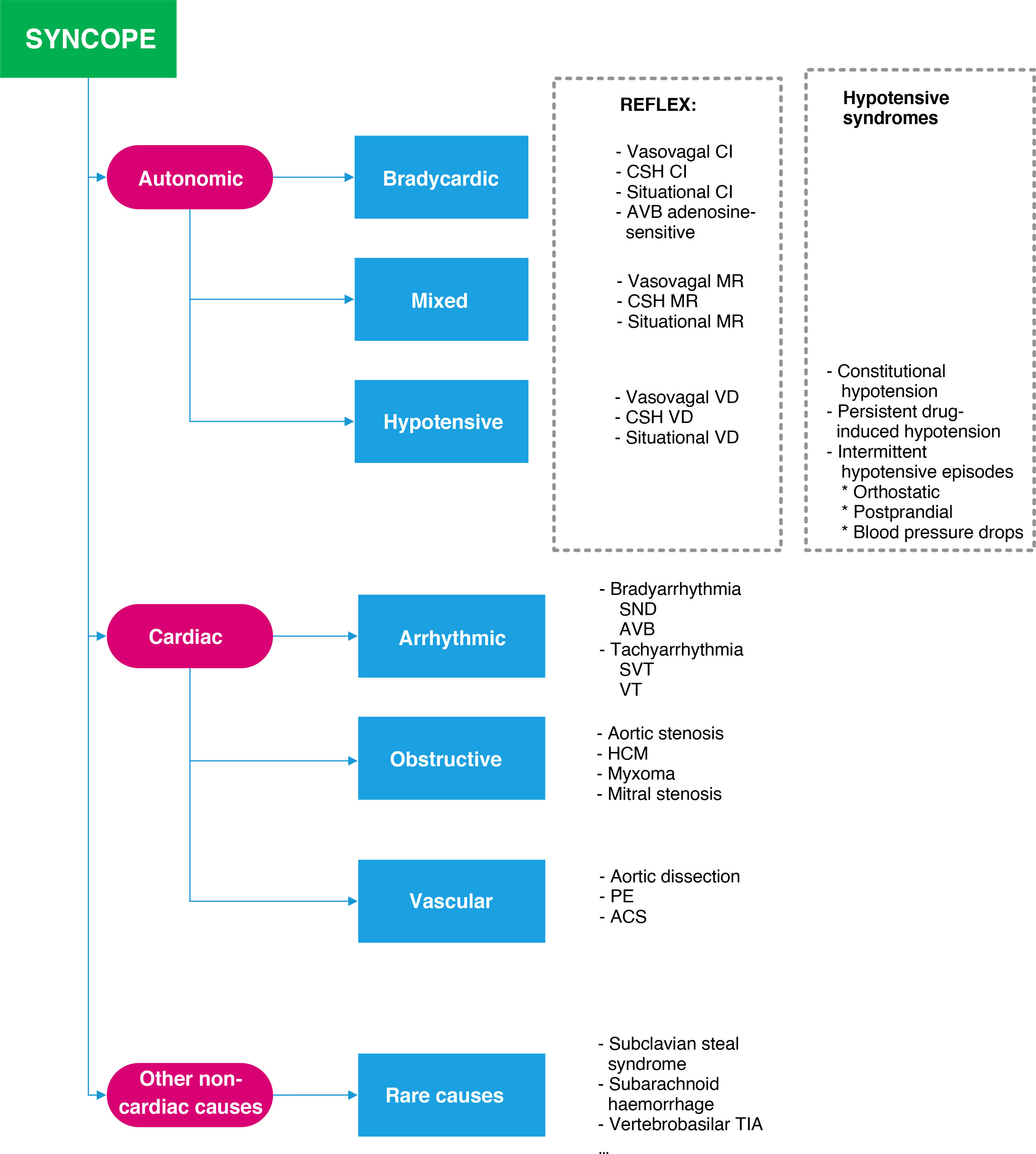
The term "autonomic syncope" has recently been introduced in the literature to encompass non-cardiac causes of syncope in which the autonomic nervous system plays a key role in its pathophysiology. The phenotypic classification into bradycardic, hypotensive, and mixed types has enabled a more precise approach to diagnosis and treatment.

This narrative review will present the latest updates with a practical focus, emphasizing the importance of diagnostic tools such as ambulatory blood pressure monitoring and the tilt table test. Additionally, advances in personalized treatments will be discussed, ranging from lifestyle modifications to the use of medications and devices such as closed-loop stimulation pacemakers. Ongoing research continues to improve diagnostic accuracy and therapeutic effectiveness, ultimately enhancing the quality of life for patients with autonomic syncope.

Keywords:
Syncope
Reflex syncope
Orthostatic hypotension
Vasovagal syncope
Resumen

El término "síncope autonómico" ha sido introducido recientemente en la literatura para englobar aquellas causas de síncope no cardíaco en las que el sistema nervioso autonómico desempeña un papel clave en su fisiopatología. La clasificación fenotípica en bradicárdico, hipotensor y mixto ha permitido un enfoque más preciso en el diagnóstico y tratamiento.

Esta revisión narrativa abordará las últimas novedades con un enfoque práctico, destacando la importancia de herramientas diagnósticas como la monitorización ambulatoria de presión arterial y la prueba de mesa basculante. Además, se revisarán los avances en tratamientos personalizados, desde modificaciones en el estilo de vida hasta el uso de fármacos y dispositivos como el marcapasos con estimulación en bucle cerrado. La investigación en curso sigue mejorando la precisión diagnóstica y la efectividad terapéutica, permitiendo una mejor calidad de vida para los pacientes con síncope autonómico.


Palabras clave:
Síncope
Síncope reflejo
Hipotensión ortostática
Síncope vasovagal

Article

These are the options to access the full texts of the publication Medicina Clínica (English Edition)
Subscriber
Subscriber

If you already have your login data, please click here .

If you have forgotten your password you can you can recover it by clicking here and selecting the option “I have forgotten my password”
Subscribe
Subscribe to

Medicina Clínica (English Edition)

Purchase
Purchase article

Purchasing article the PDF version will be downloaded

Purchase now
Contact
Phone for subscriptions and reporting of errors
From Monday to Friday from 9 a.m. to 6 p.m. (GMT + 1) except for the months of July and August which will be from 9 a.m. to 3 p.m.
Calls from Spain
932 415 960
Calls from outside Spain
+34 932 415 960
E-mail
Article options
Tools