


metricas
covid
Medicina Clínica (English Edition) Adult Pompe disease: Analysis of 13 patients
Journal Information
Clinical report
Adult Pompe disease: Analysis of 13 patients
Enfermedad de Pompe del adulto: análisis de 13 pacientes
Paloma Martín-Jiméneza, Laura Bermejo-Guerreroa,b, Ana Hernandez-Vothc, Ana Arteche-Lópezb,d, Aurelio Hernández-Laine, María Rabasaf, Cristina Domínguez-Gonzáleza,b,g,
Corresponding author
cdgonzalez@salud.madrid.org

Corresponding author.
a Unidad de Enfermedades Neuromusculares, Servicio de Neurología, Hospital Universitario 12 de Octubre, Madrid, Spain
b Grupo de Investigación de Enfermedades metabólicas, mitocondriales y neuromusculares, Instituto de Investigación imas12, Hospital 12 de Octubre, Madrid, Spain
c Servicio de Neumología, Hospital Universitario 12 de Octubre, Madrid, Spain
d Servicio de Genética, Hospital Universitario 12 de Octubre, Madrid, Spain
e Servicio de Anatomía Patológica, Sección de Neuropatología, Hospital Universitario 12 de Octubre, Madrid, Spain
f Servicio de Neurología, Hospital de Fuenlabrada, Fuenlabrada, Madrid, Spain
g Centro de Investigación Biomédica en Red de Enfermedades Raras (CIBERER), Madrid, Spain
Article information
Abstract
Full Text
Bibliography
Download PDF
Statistics
Figures (3)
Show moreShow less
Tables (1)
Table 1. Patient characteristics.
Tables
Additional material (1)
Abstract
Introduction

Pompe Disease (PD) is a lysosomal disorder caused by a deficiency of the enzyme acid alpha-glucosidase (GAA), primarily manifesting as a progressive myopathy with early respiratory involvement. Since 2006, enzyme replacement therapy (ERT) has been available.

Materials and methods

We describe 13 patients with partial GAA deficiency, followed at Hospital 12 de Octubre, 8 of whom were receiving treatment.

Results

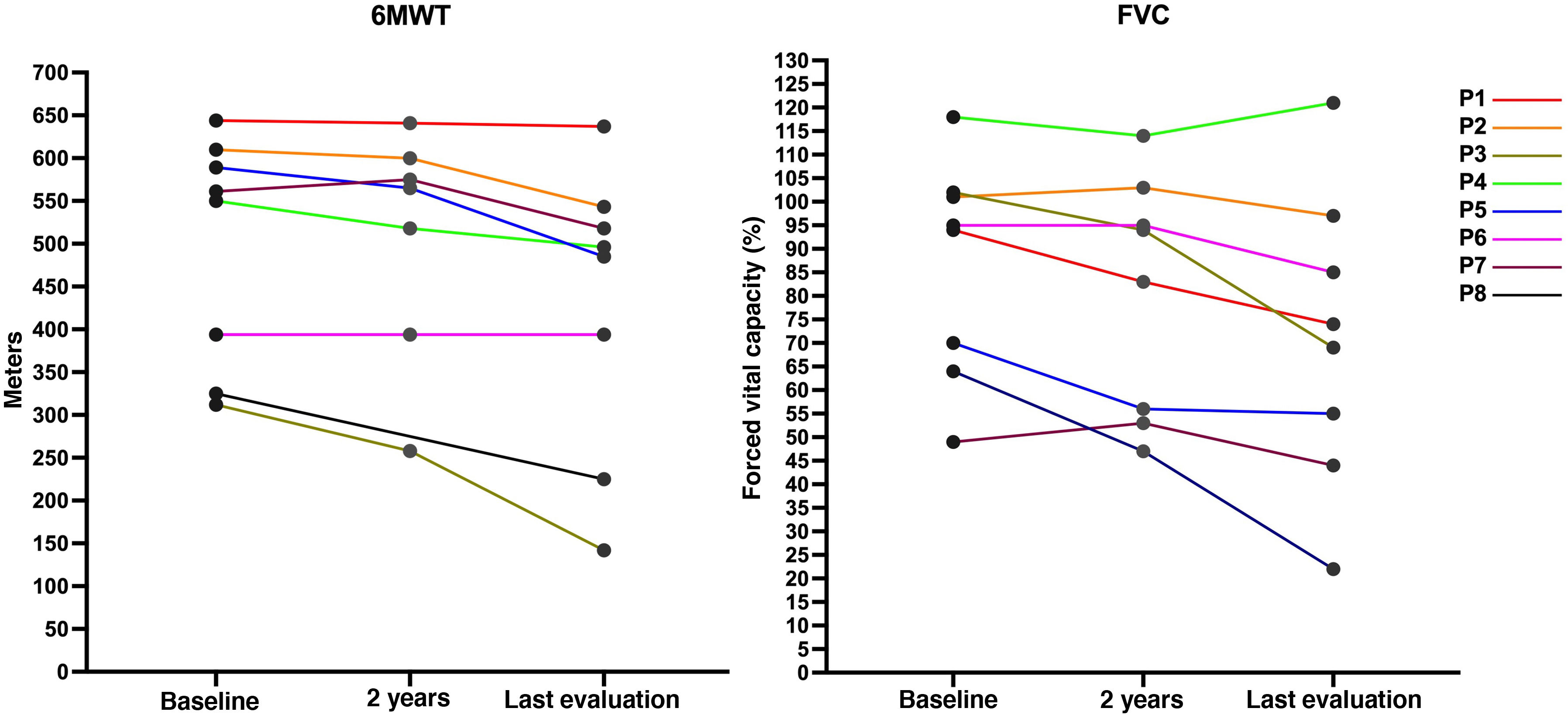
8 patients exhibit symptoms, all with late onset. They display axial and proximal weakness predominantly in the lower limbs but maintain autonomous gait. Five patients require non-invasive mechanical ventilation due to respiratory insufficiency. All symptomatic patients receive ERT, and in 7/8 (87.5%), there is a decline in motor and pulmonary function after an average of 8.25 years of treatment (baseline and post-treatment FVC and 6MWT mean 86.6% vs 70.8% and 498 vs 430 m, respectively).

Conclusion

Not all patients with partial GAA deficiency experience symptoms of PD, and symptomatic patients, despite ERT with recombinant alpha-glucosidase, mostly experience a gradual decline in motor and respiratory function.

Keywords:
Late onset Pompe disease
Enzyme replacement therapy
Acid alfa-glucosidase
Treatment
GAA gen
Resumen
Introducción

La enfermedad de Pompe (EP) es una enfermedad lisosómica debida a un déficit de la enzima alfa-glucosidasa ácida (GAA), que se manifiesta fundamentalmente como una miopatía progresiva con afectación respiratoria temprana. Desde el año 2006 existe un tratamiento de reemplazo enzimático (TRE).

Material y métodos

Se describen 13 pacientes con déficit parcial de GAA en seguimiento en el Hospital 12 de Octubre, 8 de ellos en tratamiento.

Resultados

Ocho de los pacientes tienen síntomas, todos ellos de inicio tardío. Presentan debilidad axial y proximal de predominio en extremidades inferiores, pero conservan la marcha autónoma. Cinco pacientes requieren ventilación mecánica no invasiva por insuficiencia respiratoria. Todos los pacientes con síntomas reciben TRE y en 7/8 (87,5%) existe un empeoramiento de la función motora y pulmonar tras una media de 8,25 años de tratamiento (FVC y 6MWT, media basal y post tratamiento 86.6% vs 70.8% y 498 vs 430 metros respectivamente).

Conclusión

No todos los pacientes con déficit parcial de GAA experimentan síntomas de EP y los sintomáticos, a pesar la TRE, experimentan en su mayoría un deterioro motor y respiratorio gradual.


Palabras clave:
Enfermedad de Pompe de inicio tardío
Terapia enzimática sustitutiva
Alfa glucosidasa ácida
Tratamiento
Gen GAA

Article

These are the options to access the full texts of the publication Medicina Clínica (English Edition)
Subscriber
Subscriber

If you already have your login data, please click here .

If you have forgotten your password you can you can recover it by clicking here and selecting the option “I have forgotten my password”
Subscribe
Subscribe to

Medicina Clínica (English Edition)

Purchase
Purchase article

Purchasing article the PDF version will be downloaded

Purchase now
Contact
Phone for subscriptions and reporting of errors
From Monday to Friday from 9 a.m. to 6 p.m. (GMT + 1) except for the months of July and August which will be from 9 a.m. to 3 p.m.
Calls from Spain
932 415 960
Calls from outside Spain
+34 932 415 960
E-mail
Article options
Tools
Supplemental materials