













Digital education, including digitally supported education, is loaded with biases. Most participants are blinded by the abundance of digital devices and misled by the hardware and software providers who try to convince and force education systems to keep track of untraceable developments. However, recent studies have revealed that the productivity of the participants and the sustainability of their digital artifacts generate a huge but silent waste, both in terms of human and machine resources. This contradiction generates a paradox in which the illusion of digital prosperity does not allow us to clearly see the ineffectiveness of digital processes and artifacts and the losses piling up. Our research revealed that the methodology of Lean Thinking allows us to find the root causes of the problems and the revolutionary changes which must be applied to eliminate the waste generated by the participants in the digital era. It was also found that the adaptation of the lean philosophy, proven effective in production, services, and administration, can be a solution in resolving the paradox of digital education, which leads us to Lean Digital Education (LDE). Within this framework – instead of the widely accepted tool-centered ideas – we offer a human-centered, long-term thinking philosophy focusing on respect for participants, on their development, tasks, and problems, while at the same time eliminating and reducing waste. The present paper details the strength of this innovative approach which is based on (1) a solid theoretical background (2) a reliable measuring system for calculating the waste of digital activities and artifacts, (3) approaches proven to be effective and efficient in end-user data management, and (4) examples of the learning-teaching materials which support the philosophy adapted.
The present paper investigates how both digital and digitally supported education can become derailed under the cover of the abundance of digital tools, including both hardware and software. It is widely accepted that these digital tools must be acquired and introduced in schools as soon as possible to keep track of digital developments. However, it is found that the mere presence of digital tools does not serve the development of computational thinking skills of either teachers or students, or in general terms, end-users for whom these devices are developed. It is also revealed that tool-centered approaches and methods focusing on the teaching of tools are ineffective; consequently, end-user activities and the digital artifacts created in these processes are erroneous and generate huge losses both in terms of human and machine resources.
It is also found that uncovering these problems is as important as offering alternative solutions. Our research revealed that industry has faced similar problems during and after world-wide economic crises, and one of the solutions proven effective and efficient is Lean Thinking (LT), which originated in the philosophy of the Toyota Production System (TPS). Our research group concluded that in magnitude, similar revolutionary changes are needed in digital education, instead of an approach which patches the gaps. This leads us to Lean Digital Education, by adapting the philosophy and some of the methods and tools of TPS and LT.
The structure of the paper is the following. The Background section sheds light on the problems of digital education from this novel viewpoint. Following the introduction and background, the paper provides the missing concepts which lead to the paradox of the illusion of digital prosperity (Section 3). Section 4 introduces and details Lean Digital Edition (LDE) and argues that without innovation and revolutionary ideas, digital education with a tool-centered background is not able to prepare students for the challenges of the digital era. The hypotheses presented in Section 5 focus on the adaptation of LT in digital education, the waste generated in end-user computing, and the comparison of the effectiveness of push and pull production [education] systems. The Results section details the process of the adaptation of LT in digital education, argues for its necessity, and provides the outlines of an approach incorporated into LDE, focusing on end-users and professionals in an end-user role. At present, this approach includes three methods – Sprego (Spreadsheet Lego), the Error Recognition Model (ERM), Webtable→Datatable Conversion (WDC) – and a measuring system – Entropy of Digital Text (EDT) – which allows both teachers and researchers to validate novel methods and to provide data on calculating the waste generated by end-users and by their digital artifacts. Finally, we provide a section on the future work closely related to our revolutionary ideas, the possible acceptance/non-acceptance and implementation of it in schools, the conclusions drawn from the progress of the development and the results of this innovation. The Appendix provides examples from a series of course books from Grade 4 to 11 to demonstrate how tool-centered methods can violate theories such as Cognitive load, Thinking, fast and slow, Subject integration, and how students, their background knowledge, age, characteristics, and interests are ignored.
BackgroundEnd-user paradox and digital artifactsThe black sheep of digital education, data management, and computer science is the end-user (Nagy & Csernoch, 2023; Panko, 2013a; Raković, 2019). A huge industry is built around them, but they still must fulfill their assigned roles in the digital era. In short, their abilities to handle digital data effectively and efficiently (Denning, 2013; Lodi & Martini, 2021; Wing, 2006) and to carry out value-added activities in their problem-solving processes (Smalley, 2018) should be improved, and guidance should be offered to support their development process. Stakeholders within the education sector, such as students, teachers, school administrators, education policymakers, and parents, are essential in the current context, as students represent the future workforce, and the other stakeholders provide crucial assistance and support. Students need to be proficient in working productively in the digital realm, with a focus on minimizing waste in digital activities and processes that rely on a strong foundation in computer science (Denning, 2013; Lodi & Martini, 2021; Wing, 2006).
Earlier studies implied (Ben-Ari, 1999; Ben-Ari & Yeshno, 2006; Carroll, 1987; Carroll & Rosson, 1986; Csernoch, 2009, 2010; Horror stories, n.d.; McGill & Klobas, 2005; Panko, 2013a, 2013b; Thorne & Ball, 2006), and recent studies – based on objective measuring systems – have revealed that the proportion of value-added (VA) and requested non-value-added (RNVA) activities in end-user computing could be much higher (Csernoch et al., 2015, 2021, 2023, 2024a; 2024d; McGill & Klobas, 2005; Nagy & Csernoch, 2023; Rattenbury et al., 2017; Sarkar et al., 2020; Stuermer et al., 2016) since non-value-added (NVA) (Liker, 2004; Rother, 2010; Womack & Jones, 2003) activities swallow up huge human and machine resources. Recent analyses have also revealed that the end-user paradox is present, stating that the less trained end-users are, the more errors they make, and the more resources are required to modify their artifacts (documents) (Csernoch et al., 2023, 2024a, 2024d). It is also remarkable that this phenomenon is almost unnoticed and, as such, creates silent (hidden) waste (Csernoch et al., 2023, 2024a, 2024d; Nagy & Csernoch, 2023). However, spreadsheet risk management in spreadsheeting can reveal and calculate losses (Horror Stories, n.d.; McGill & Klobas, 2005; Panko, 2013; Rattenbury et al., 2017; Sarkar et al., 2020; Thorne & Ball, 2006) and Csernoch et al. (2023, 2024a, 2024d) clearly identified wastes (NVA) by positioning natural language digital text management in ‘the ten basic conditions of sustainable digital artifacts’.
Based on these preliminary analyses, our research group found indications that digital education operates similarly to push production systems, which focus on tools and might explain end-users’ behavior, activities, and overconfidence (Csernoch et al., 2023, 2024b; Liker, 2004; Rother, 2010; Womack & Jones, 2003). Approaches based on minimal guidance (Kirschner et al., 2006; Sweller et al., 2007), teachers’ belief in a fixed nature of computer science (Chen et al., 2014), the misleading nature of novel tools arriving from education (Baranyi & Gilányi, 2013; Baranyi et al., 2015; 2024; Wolfram, 2015; 2020), and the misinterpretation of end-users in society and industry strongly support end-users’ underdevelopment (Ben-Ari, 1999; Ben-Ari & Yeshno, 2006; Carroll, 1987; Carroll & Rosson, 1986; Csernoch, 2009, 2010; Csernoch et al., 2015, 2021; 2023, 2024a, 2024d; Horror Stories, n.d.; McGill & Klobas, 2005; Nagy & Csernoch, 2023; Panko, 2013a, 2013b; Rattenbury et al., 2017;Sarkar et al., 2020; Stuermer et al., 2016; Thorne & Ball, 2006). Our ambitious objective is to identify compelling evidence derived from the gathered data and outcomes in order to draw attention to the issue and provide effective solutions and guidance to address this paradox.
Currently, computer science has overtaken mathematics with “the dubious honor of being the least popular subject in the curriculum. Future teachers pass through the elementary schools learning to detest mathematics [computer science]. They return to the elementary school to teach a new generation to detest it.” (Polya, 1956). The problem is more complicated since future teachers not only detest computer science but also mistake it for digital devices (including both hardware and software) and are consequently overconfident. This approach leads to the greatest problem of TPS: No one has more trouble than the man who claims to have no trouble (Ohno, cited in Smalley, 2018).
Lean thinking in digital education?The theoretical background of our proposal was established on the results of our predecessors in computer education theories (CET) (Malmi et al., 2019; 2022) but needed further clarification and a more solid background to cover the end-user paradox (Csernoch et al., 2023). Consequently, previously published concepts and ideas were expanded by theories and findings that have proven effective and efficient in industry which focus on the human being, namely lean production (LP) and lean thinking (LT) (Womack & Jones, 2003). LT originated in the Toyota Production System (TPS) (Krafcik, 1988; Liker, 2004; Ohno, 1988; Rother, 2010; Womack et al., 1990) (Fig. 1). It was found that TPS can be extended to countries beyond Japan, and to production beyond the automobile industry (Krafcik, 1988; Womack et al., 1990), construction and housing, transport, the food supply system, manufacturing, personal services and consumption (services for short) (Womack, 2005; Womack & Jones, 2003), and administration (Balzer et al., 2015; Dimitrova, 2021; Klein et al., 2023; Toma, 2024). “The Toyota production system is a method to thoroughly eliminate waste and enhance productivity. In production, “waste” refers to all elements of production that only increase cost without adding value.” (Ohno, 1988).

The question arises: if lean (LP and LT) is proven effective and efficient in various industries and services, why can digital education and production, which generate so much waste, not be transformed based on the same theoretical background.
Related but missing conceptsThe following definitions were required to clarify the problem we are faced with and to set up a scientifically solid, objective measuring system to calculate waste that is generated by negligent and/or erroneous end-user data management processes. The approach and its accompanying concepts are fundamental for revealing
- •
the nature of end-user digital behavior and activities,
- •
the information content of their digital products (documents), and
- •
the information content that education should put on the communication channels to build up reliable computer science (CS) knowledge in long-term memory (Denning, 2013; Kirschner et al., 2006; Lodi & Martini, 2021; Papert, 1980; Sweller et al., 2007, 2011; Wing, 2006).
Our goal is to develop a robust content knowledge base that can stimulate fast thinking based on schemata while also providing room for deliberate, slow thinking when schemata are not accessible (Kahneman, 2011; Kirschner et al., 2006; Rother, 2010; Sweller et al., 2007, 2011), along with solutions which support error-detection and elimination.
Digital prosperityThe concept of digital prosperity aligns with Industry 4.0 (Nagy et al., 2018), assuming the abundance of digital tools – including both hardware and software. However, the widespread adoption of these tools may create an illusion of progress in digitization, as expressed in the work of Prensky, who categorized humans based on their age and access to digital tools (Prensky, 2001a, 2001b) but criticized and contradicted by Kirschner & Bruyckere (2017). Rather than solving problems, a tool-centered approach – as argued in industry by Ohno (1988) and in education by Wolfram (2020) and Baranyi and his coworkers (Baranyi & Gilányi, 2013; Baranyi et al., 2015; 2024) – can be misleading, and indeed, they are (Wolfram, 2020). This phenomenon is evident in digital education and today's digital world, where the misconception persists that acquiring newer devices and software is sufficient. Beyond the overwhelming presence of digital tools, the concept of problem-based learning (PBL) is widely accepted without considering how short- and long-term memory works (Panko, 2013), when students are exposed to an enormous amount of data available on the internet and in the form of software helps, tutorials, blogs, ANI-generated results (Artificial Narrow Intelligence (Hatamleh & Tilesch, 2020)), and advice in languages [terminology] which they do not understand due to their lack of background knowledge. “The process of discovery is in conflict with our current knowledge of human cognitive architecture which assumes that working memory is severely limited in capacity when dealing with novel information sourced from the external environment but largely unlimited when dealing with familiar, organized information sourced from long-term memory.” (Sweller et al., 2007)
Fig. 2 presents the very first word processing task in the Grade 4 Digital Culture course book (Lénárd et al., 2023 p. 22). The task in the present form is “in conflict with our knowledge of human cognitive architecture” (Sweller et al., 2007). In about 20 mins, a word processor cannot just be found by chance on a school computer; a ten-year-old cannot discover a huge word processor, a science project cannot be designed based on these requirements, a blind ten-year-old cannot discuss this project with another blind ten-year-old, and a word processor is a program, which cannot be opened but run on a computer (Lénárd et al., 2023).

The very first word processing task in the Grade 4 Digital Culture course book, (Lénárd et al., 2023) translated by ChatGPT and DeepL.11 ChatGPT Task. Find the word processor on the school computer, open it, and freely explore its features! If you get stuck, ask your teacher for help! Think about how you could use the application to write a homework assignment on an environmental studies topic in an attractive and accurate way. Discuss your ideas with your classmates! DeepL Task. Find the word processor on your school computer, open it up, and explore its possibilities. If you get stuck, ask your teacher for help. Think about how you could use the app to write an essay on a topic related to environmental studies that is both attractive and correct. Share your ideas with your peers!
The second ambitious task for the same Grade 4 students is presented in Fig. 3 (Lénárd et al., 2023 p. 23).

The second word processing task in the Grade 4 Digital Culture course book (Lénárd et al., 2023), translated by ChatGPT and DeepL.22 ChatGPT Task. Work in small groups! Try out all the tools you learned about in this lesson! Brainstorm, and on one of your group members' computers, create a (short) document with text, images, and notes about the most recent environmental studies material! DeepL Task. Work in small groups! Try out all the tools you have learned in this lesson. Make a (short) document with text, pictures and notes on one of your computers for the latest environmental lesson.
As the examples in Figs. 2 and 3 show, software packages, educational programs, and course books often focus on presenting and teaching associated tools, letting students discover these pieces of software with the assumption that students can build up knowledge inventories independently. However, the brain does not function like a warehouse; restrictions on cognitive load (Kahneman, 2011; Kirschner et al., 2006; Panko, 2013; Sweller et al., 2007, 2011) and the reliance on tool-centered approaches create the illusion of digital prosperity. This phenomenon also triggers overconfidence (Csernoch et al., 2015, 2021, 2024b; Dunning, 2011; Gibbs, 2013; Gibbs et al., 2017; Kruger & Dunning, 1999; Kun et al., 2023; Máté & Darabos, 2017; Raković et al., 2019; Stuermer et al., 2016) and informational cascades in group decisions (Kahneman et al., 2022).
Furthermore, cascades in group decisions, where teachers are primarily involved, are associated with “folk pedagogy” (Bruner, 1990; Lister, 2008). Teachers who find their methods overwhelming without scientific proof form a strong alliance. Following this phenomenon, only a few papers that directly apply theoretical constructs (TC) to inform educational practice can be found. As Malmi et al. reported “We did not find a single case in which someone other than the original researchers had used the TC as a data collection and analysis framework, and we found only few cases in which the TC was used in discussion of results or in building new pedagogical solutions. This is somewhat concerning, because there is presumably some valuable work being done, yet its potential for re-use is not being realized.” (Malmi et al., 2019).
We can conclude that informatics, computer science teachers and authors of course books tend to ignore or are unaware of the results of computing education research (CER) (Malmi et al., 2019). This leads to problem-solving processes and digital products that generate waste that should be reduced or eliminated, if not so, revealed and handled.
Illusion of digital prosperityThe illusion of digital prosperity impacts both digital education and productivity. Despite the abundance of digital tools in education, the efficiency of transferring Computer Science (CS) knowledge still needs to be improved. End-users’ work and personal life productivity is affected. Our research aims to uncover the root causes of this contradiction, where we primarily focus on end-users (including IT professionals in an end-user role), their activities and digital products, artifacts.
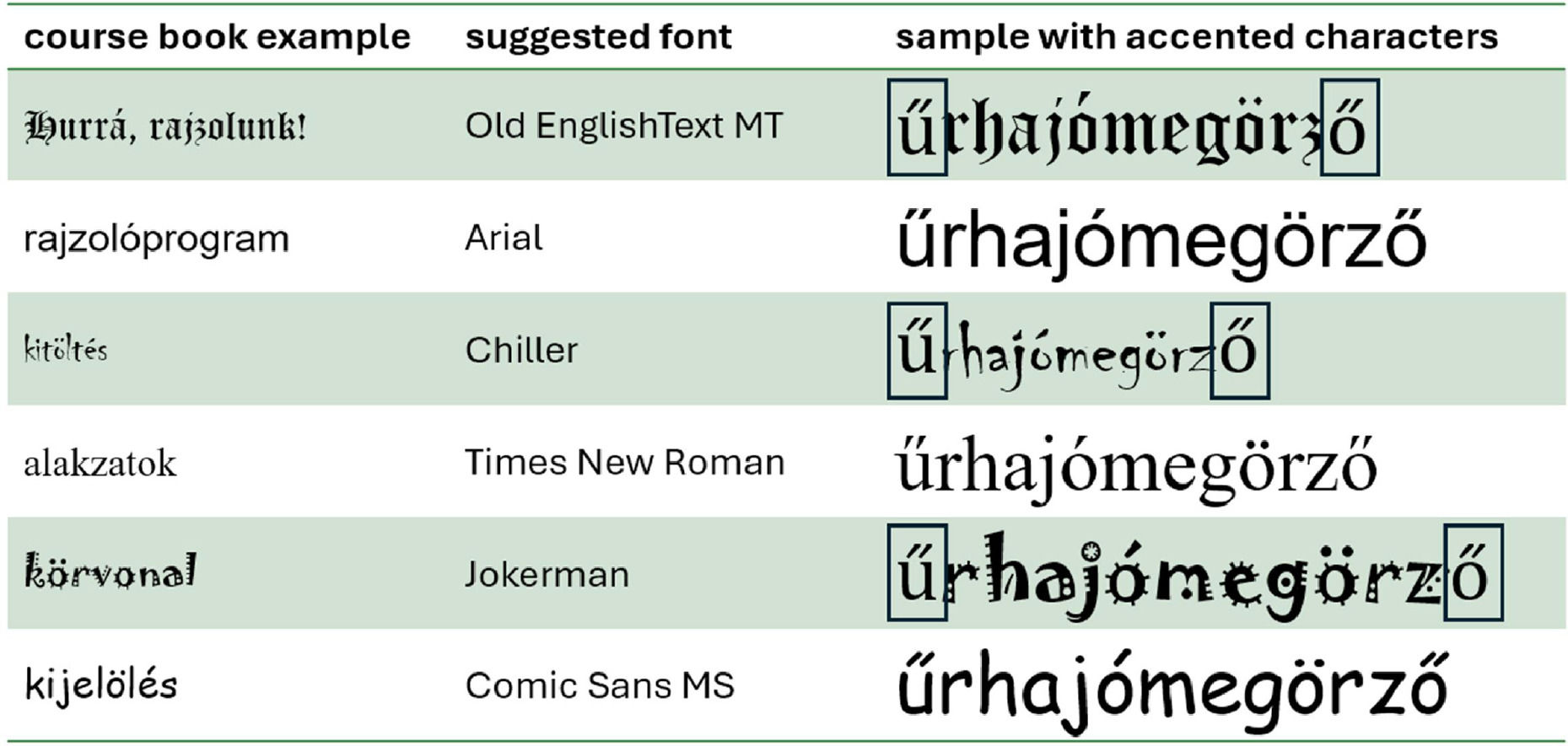
One example of the illusion of digital prosperity is presented in Figs. 4 and 5. The Grade 3 Digital Culture course book states, “You can find lots of fonts on your computer that you can use not only in graphics programs.” (Lénárd et al., 2022 p. 34). This includes the fact that there is a high number of different fonts that can be used to your liking (digital prosperity). However, when applying fonts to a text, first, typographic rules (Jury, 2004, 2006; Virágvölgyi, 2004) must be considered, which express an equilibrium between the content and the aimed audience and do not allow an unlimited combination of fonts (illusion of digital prosperity). On the other hand, there are languages where the characters of the language rule out many fonts since most fonts do not contain the special characters of the language (illusion of digital prosperity) (Fig. 5).

Example of a combination of various fonts without real content, where typographic rules cannot be applied (Lénárd et al., 2022). The focus is on the tools rather than providing a real task to solve. The example suggests that it is enough for students to know how to click a button, and there is no need to know why they selected that button.

The fonts presented in Fig. 4 are applied to a word that has two accented characters (űrhajómegörző, in English: protector of a spaceship). The results show that three course-book-suggested fonts cannot be used in this unique language (green records).
Natural text management is one of the most frequent digital activities (handling word processed texts, presentations, web pages). As such, it can be used to introduce concepts connected to the illusion of digital prosperity. The definition of properly edited digital text has been around for years (Csernoch, 2009, 2010; Csernoch et al., 2015; 2017; Nagy & Csernoch, 2023), but along with other CER results, it has yet to reach education and has remained isolated (Malmi et al., 2019). The definition has two constraints, which are connected to the printed (quantitative requirements) and the editable (qualitative requirements) format of the document. This definition in LT can be considered as a standard, a guideline to follow and a source for further improvement (Csernoch et al., 2024a; Krafcik, 1988; Liker, 2004; Nagy & Csernoch, 2023; Ohno, 1988; Rother 2010; Womack, 2005; Womack & Jones, 2003).
- •
The text fulfills the requirements of printed documents (quantitative requirements).
- •
The content is invariant to modification (qualitative requirements): the document is editable, but the only allowed changes are those matching the user's original intention.
Furthermore, the definition is closely related to the error categories based on the same theoretical background (Fig. 6) (Csernoch et al., 2024a; Nagy & Csernoch, 2023). Recognizing and manipulating errors play a crucial role in LT; consequently, in the process of implementing it in digital education, the error categories and the process of handling errors cannot be ignored.

Beyond reducing waste in end-user data management, a recent development, namely the emergence of AI gives a novel meaning of correctness. AI malfunctioning has a close relation with the paradox targeted in the present paper. AI works with existing data. If the training data carry errors and erroneous documents dominate the market, the output will be erroneous, and the errors will be regenerated. This is a new threat which will surface in the near future, along with human-generated and regenerated errors and erroneous digital artifacts. This implies that the spreading of erroneous artifacts will accelerate. This is a vicious circle, and we must intervene as soon as possible (Hatamleh & Tilesch, 2020).
Entropy and the sustainability rate of digital textBased on the definition of the properly edited text and the error categories, we can define the entropy of digital text (EDT) (M. Csernoch et al., 2023).
EDT can originate from four different types of tasks:
- •
creating content,
- •
formatting,
- •
correction (in erroneous documents),
- •
modification of content.
EDT, which measures the information content required for tasks such as creating, formatting, correction, and modification, plays a crucial role in the sustainability of digital texts (Csernoch et al., 2024a). Our previous analyses indicate that digital education follows the principles of push production systems (Krafcik, 198; Liker, 2004; Ohno, 1988, Rother, 2010; Womack & Jones, 2003; Womack et al., 1990), focusing on tools, but ignoring both principles of TPS: just-in-time (JIT) (material replenishment initiated by consumption) (Liker, 2004) and jidoka (autonomation, equipment endowed with human intelligence to stop itself when it has a problem) (Liker, 2004). We plan to explore the connection between waste types defined in TPS and LT and the digital education system, aiming to implement a pull digital education system that centers around human participants and stands on the two pillars: JIT and jidoka.
The sustainability rate (SR) of a digital text is determined by considering the text-entropy and the time spent making changes to fix errors in the document. This value falls within the [0, 1] interval, where 0 represents the sustainability rate for correcting errors in a document, while 1 represents the sustainability rate for modifying an already correct document (Csernoch et al., 2024a). This value is in complete accordance with the definition of properly edited digital texts, which considers only those modifications correct where the content is invariant to modification (see the definition of the properly edited text in Section 3.3).
The ground-breaking nature and ambition of building LDEThe four sections of TPSWe are committed to leading a transition from the current push-based digital education system to a pull-based one, and to introducing Lean Digital Education (LDE). Our goal is to investigate the connections between LDE and the 14 principles of TPS (categorized into Philosophy, Process, People and Partners, and Problems) (Fig. 7), to identify and present the eight types of waste in LT, to establish an objective measurement system to quantify the losses, and to illustrate how both the education and industry sectors can benefit from end-users emerging from LDE.

The fundamental idea behind adapting TPS in digital education is to consider the principles that start with the Long-Term Thinking Philosophy: “Base your management decisions on a long-term philosophy, even at the expense of short-term financial goals.” (Liker, 2004). This principle is clearly expressed by Stuermer et al. (2016) in digital sustainability. “… any digital artifact is embedded in a wider and constantly shifting ecosystem. In a narrow interpretation, a digital ecosystem consists of all hardware devices, program files, and data files that the user needs to process data. In a wider sense, the ecosystem also comprises the social elements which lead to the creation and use of digital artifacts.” (Stuermer et al., 2016)
This umbrella term of ecosystem explains why the definition and role of digital resources of DigCompEdu (Redecker, 2017) cannot support the development of end-users and their digital artifacts; DigCompEdu serves and supports short-term educational goals and ignores the skills required of future employees, as predicted in 2023 (Özarslan, 2023) (Fig. 8). “Digital resources: The term usually refers to any content published in computer-readable format. For the purposes of DigCompEdu, a distinction is made between digital resources and data. Digital resources in this respect comprise any kind of digital content that is immediately understandable to a human user, whereas data need to be analysed, treated and/or interpreted to be of use for educators.” (Redecker, 2017)

The required core skills of employees in 2023 (Özarslan, 2023).
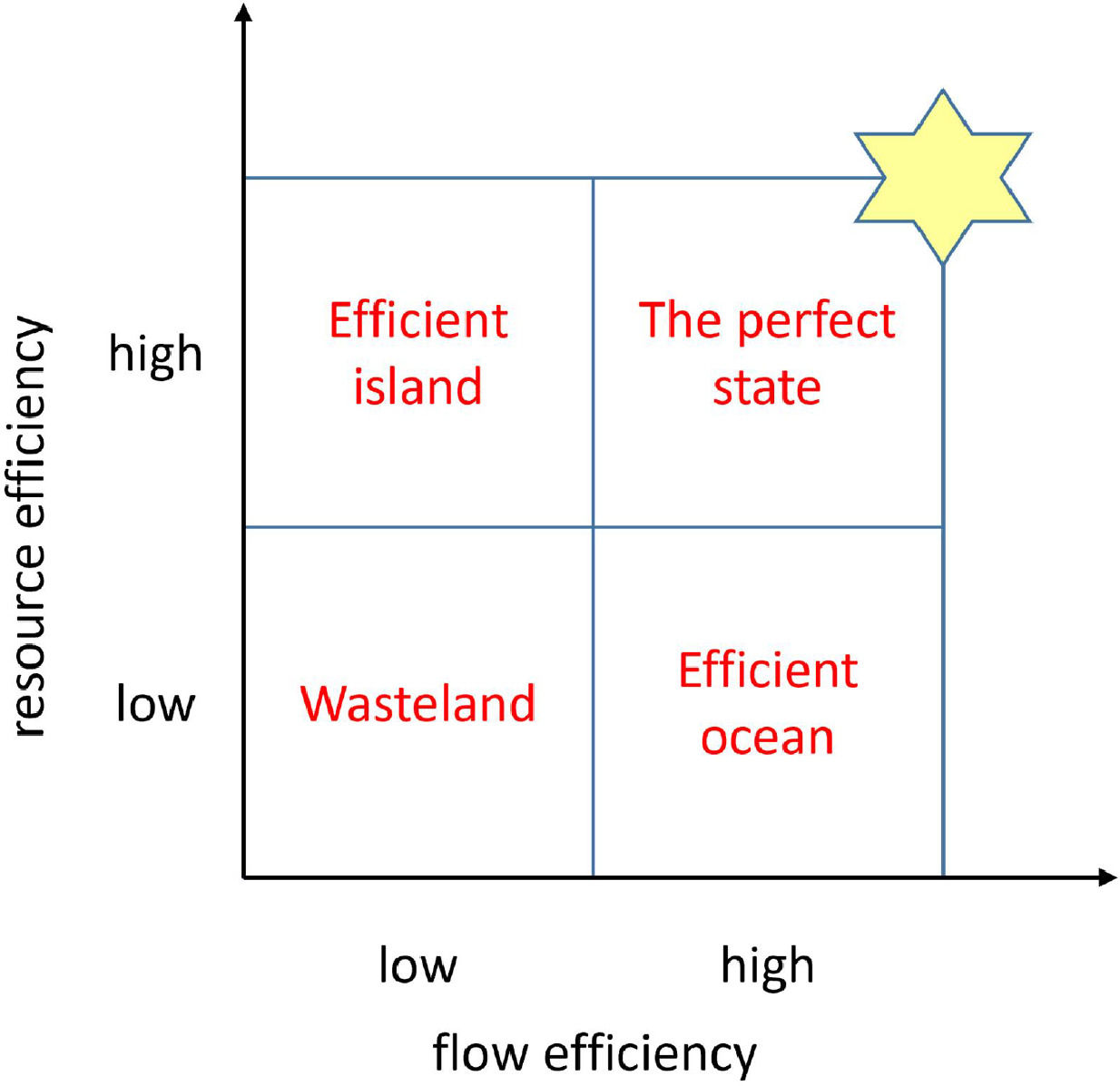
We propose that digital education should adopt the values of pull production systems, which prioritize human participants – students, teachers, school administrators, education policymakers, and parents – and their interest in focusing on long-term educational and financial goals. Previous studies indicate that pull production systems’ principles, methods, and tools can be applied to digital education, potentially enhancing flow and resource efficiency (Fig. 9) (Modig & Åhlström, 2018). LDE can be built based on these principles and pillars. “The most important factors for success are patience, a focus on long-term rather than short-term results, reinvestment in people, product, and plant, and an unforgiving commitment to quality. (Robert B. McCurry, former Executive V.P., Toyota Motor Sales)” (Liker, 2004)

The goal of digital education in a pull system (LDE) is to reach the perfect state where resource and flow efficiency are high. However, according to results presented in various studies (e.g., in Ben-Ari, (1999); Ben-Ari and Yeshno, (2006); Carroll, (1987); Carroll and Rosson, (1986); Csernoch, (2009), 2010; Csernoch et al. (2015), 2021; M. (2023), 2024a, 2024d; Horror Stories, (n.d).; McGill & Klobas, (2005); Nagy & Csernoch, (2023); Panko, (2013a), 2013b; Rattenbury, (2017); Sarkar et al. (2020); Stuermer et al. (2016); Thorne & Ball, (2006), end-user digital education and productivity at present dwell in the wasteland. It has also been found that professionals in an end-user role produce the same errors as common end-users (Csernoch & Csernoch, 2024) (Fig. 10), which implies that digital education builds efficient islands, something detailed by Soloway as early as 1993 (Soloway, 1993). The illusion of digital prosperity implies that we can hardly find examples of efficient oceans where low resource efficiency is paired with high flow efficiency. However, teaching with unplugged and semi-unplugged solutions (Bell & Newton, 2013; Biró & Csernoch, 2017; Csapó, 2017; Gulácsi & Dienes, 2018; Sebestyén et al., 2018) and following the steps of Polya's concept-based problem-solving approach (Polya, 1945, 1956), along with Wolfram (2015, 2020), require much less tools than traditional digital learning-teaching approaches. This finding implies that if unplugged and semi-unplugged tools can be effective then education does not need a huge arsenal of digital tools of the best quality.

An example of an efficient island is where an IT professional cannot create a properly edited CV in a word processor. The CV carries typographical errors from the quantitative group and layout and formatting errors from the quantitative group (Fig. 6) (Csernoch, 2017; Csernoch et al., 2024a, 2024d; Nagy & Csernoch, 2023).
We claim that subject integration should be reconsidered to resolve the wasteland and the efficient island problem. Therefore, we advocate for the support of all three types of subject integration within digital education – (1) traditional subjects are digitally supported, (2) subjects of computer sciences are supported by contents arriving from various subjects, and (3) various sections of computer science (informatics) support each other (Fig. 11). This approach can help prevent efficiency islands, where one aspect of the production process is efficient while others are not. Our findings align with the theory and practice of TPACK (Technological Pedagogical And Content Knowledge) (Angeli & Valanides, 2015; Koehler, 2012; Mishra & Koehler, 2006) introduced in education, and support teachers’ belief in an incremental nature of science (Chen et al., 2014).

In conclusion, our research highlights the critical need to address the illusion of digital prosperity in both digital education and productivity. Understanding the implications of tool-centered approaches and leveraging pull production system values can enhance the effectiveness of digital education and end-user productivity.
HypothesesBased on previously published research results in CET and end-user activities managing digital products/artifacts, the productivity of TPS and LT, and digital sustainability, the following hypotheses are set up.
- [H1]
The principle of TPS (Toyota Production System) can be adapted in LDE (Lean Digital Education).
- [H2]
The 8 wastes of lean can be identified in end-user text and data management.
- [H3]
Pull digital education approaches are more effective than traditional push systems.
This paper presents details that demonstrate the viability of the hypotheses based on the problems we have identified and the theoretical background that can support our ideas to build Lean Digital Education (LDE) (outlined in the previous sections).
The 14 principles of TPSIn order to integrate TPS (Toyota Production System) and LT (Lean Thinking) into digital education, it is essential first to enumerate the principles of TPS and subsequently evaluate our capacity to meet the requisite criteria. Tables 1-4 presents the 14 principles of TPS by sections and their corresponding solutions in LDE. The matches prove that the principles of TPS can be accepted in LDE, allowing the acceptance of the Hypothesis [H1].
The principle of Section Philosophy of TPS and its corresponding principle in LDE.
| # | TPS (Liker, 2004) | LDE |
|---|---|---|
| Base your management decisions on a long-term philosophy, even at the expense of short-term financial goals. | When providing students with opportunities to understand and appreciate science deeply, it is important to develop long-lasting, fundamental computer science knowledge and skills (Chen et al., 2014; Denning, 2013; Lodi & Martini, 2021; Wing, 2006). |
The principles of Section Process of TPS and their corresponding principles in LDE.
| # | TPS (Liker, 2004) | LDE |
|---|---|---|
| Create continuous process flow to bring problems to the surface. | Create continuous process flow in solving tasks with continuous development and debugging (Csapó et al., 2019; 2020; Csernoch, 2014; Csernoch et al., 2015, 2021; Hattie, 2012; Ma & Norwich, 2007; Sebestyén et al., 2022; 2023). | |
| Use pull systems to avoid overproduction. | Tasks should be in the focus, not the tools (Baranyi & Gilányi, 2013; Baranyi et al., 2015; 2024; Csapó et al., 2019; 2020; Csernoch, 2014; Csernoch et al., 2015, 2021; Sebestyén et al., 2022; 2023; Wolfram, 2015; 2020). Teach only fundamental, simple, and necessary tools, which are needed to solve the selected task, and allow space for practice. | |
| Level out the workload (heijunka). | Do not require students to complete “mission impossible” tasks. Tasks should match students’ background knowledge, skills, abilities, and interests. | |
| Build a culture of stopping to fix problems, to get quality right the first time. | Correct documents should be created.Do not allow end-users to create and modify erroneous documents and then bricolage them (Csernoch et al., 2023, 2024a, 2024d; Nagy & Csernoch, 2023; Sebestyén et al., 2022; 2023). Do not leave space for the end-user paradox. | |
| Standardized tasks are the foundation for continuous improvement and employee empowerment. | Set up standards similar to the definition of the properly edited text and the error categories of digital text Csernoch et al., 2023, 2024a; Nagy & Csernoch, 2023). | |
| Use visual control so no problems are hidden (andon). | Utilize digital andons (visual controls) whenever possible, such as displaying non-printable characters in the word processor, the ruler, the Selection pane, and the Animation pane Csernoch et al., 2023, 2024a, 2024d; Nagy & Csernoch, 2023) when they are available. | |
| Use only reliable, thoroughly tested technology that serves your people and processes. | Use the results of scientific research (Malmi et al., 2019) and let go of “folk pedagogy” (Bruner, 1990; Lister, 2008). |
The principles of Section People and Partners of TPS and their corresponding principles in LDE.
| # | TPS (Liker, 2004) | LDE |
|---|---|---|
| Grow leaders who thoroughly understand the work, live the philosophy, and teach it to others. | Prepare teachers, school administrators, education policymakers, parents, etc., to guide students. | |
| Develop exceptional people and teams who follow your company's philosophy | Develop exceptional students and teams. Develop expert teachers (Csernoch, 2017; Hattie, 2012) and researchers. | |
| Respect your extended network of partners and suppliers by challenging them and helping them improve. | Respect your students and partners (teachers, school administrators, education policymakers, parents) and allow them space for problem-solving and creative thinking. |
The principles of Section Problem Solving of TPS and their corresponding principles in LDE.
| # | TPS (Liker, 2004) | LDE |
|---|---|---|
| Go and see for yourself to thoroughly understand the situation (genchi genbutsu) | Collect reliable data and develop yourself; life-long learning is crucial. | |
| Make decisions slowly by consensus thoroughly considering all options; implement rapidly (nemawashi). | Analyze data thoroughly and apply fast and slow thinking in proportion and situations (Kahneman, 2011). | |
| Become a learning organization through relentless reflection (hansei) and continuous improvement (kaizen) | Become a learning organization through relentless reflection (hansei) and continuous improvement (kaizen) |
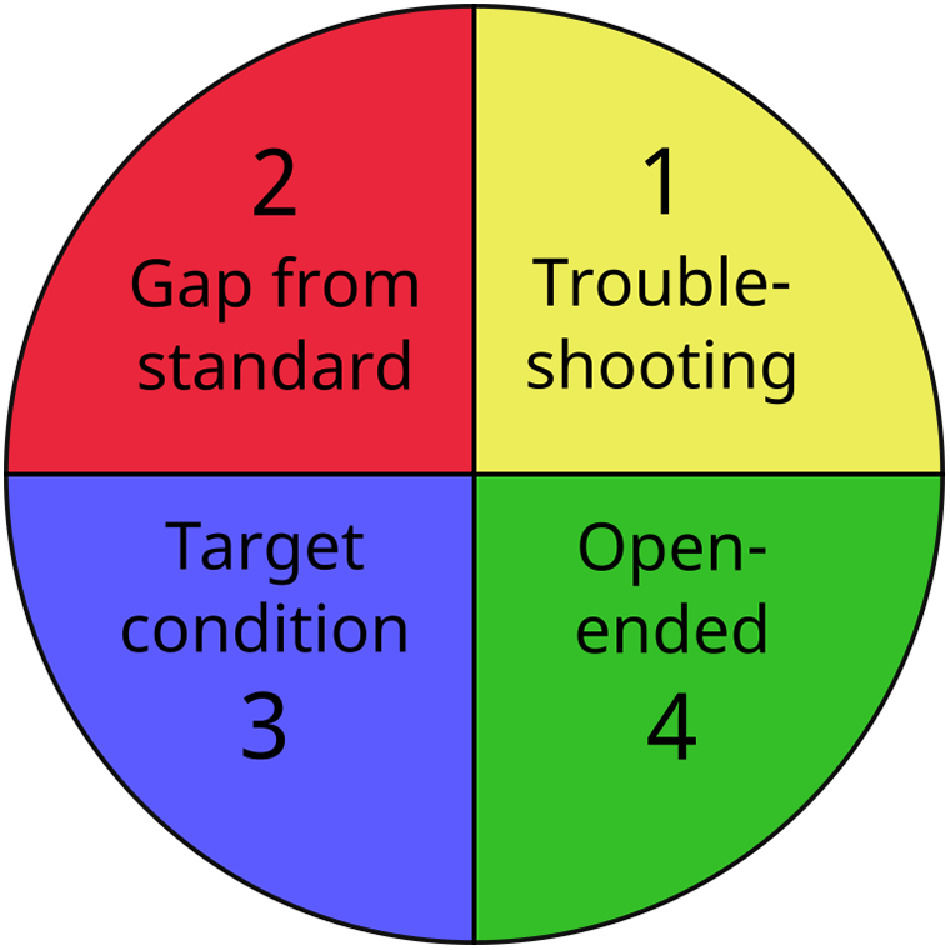
Considering erroneous digital artifacts, we cannot leave unnoticed the typology of the problems. The typology distinguishes four types of problems, setting up two hypernym categories – reactive and proactive – and within each, two hyponym categories – Troubleshooting and Gap from the standard (reactive), Target condition and Open-ended (proactive). In the typology of problems, errors are considered problems that should be solved, and they form the two hyponym categories of reactive problems (Fig. 12) (Smalley, 2018). Depending on the approaches with which errors are handled, they can be categorized as Troubleshooting (Type 1) and Gap from standard (Type 2). With the help of this typology, we can reveal the level at which the different errors are handled, depending on end-users’ background knowledge, skills, abilities, and the qualitative and quantitative errors of the digital artifacts (Fig. 6).

Smalley states, "Troubleshooting is a reactive process of fixing problems by rapid response and short-term corrective actions.” and “Gap from standard problem solving moves us from symptoms to root causes and focuses on solving problems in relation to existing standards and expectations.”
Currently, most end-users react to errors with Type 1 approaches. These approaches are thought to be rapid, but the end-user paradox tells us this is not the case (Csernoch et al., 2023, 2024a; Panko, 2013). Consequently, further analyses are required to reveal how rapid these problem-solving solutions are. However, it is proven that those who are trained with Sprego (Csapó et al., 2019; 2020; Csernoch, 2014; Csernoch et al., 2015, 2021), Webtable→Datatable Conversion (WDC) (Sebestyén et al., 2023) and Error Recognition Model (ERM) (Sebestyén et al., 2022) can systematically reveal the errors of a document, categorize them and search for the root causes. After errors are identified, end-users can correct them to get a properly edited text or datatable, where the sustainability rate of modification is 1, the highest possible value (Csernoch et al., 2024a).
In LDE, one of the target conditions of teaching and training students and end-users is handling errors, reducing waste, and handling reactive problems. A further target condition of LDE is to avoid errors, not just reducing waste but eliminating it. It is proven (Sebestyén et al., 2022) – but needs further clarification – that those trained with ERM learn how to handle errors and the consequences of errors, which leads to the next phase where, in the process of creating a new document, they avoid errors. With this approach, one can reach Type 3 Target condition problem-solving. Smalley states that “Proficiency in Type 3 Target Condition problem solving brings to an organization the ability to not simply survive but also thrive. Type 1 and Type 2 enable [it] to maintain stable operating conditions. The gains of improvement come from Type 3 problem solving.” The measuring system of ANLITA (Csernoch et al., 2023, 2024a, 2024d; Nagy & Csernoch, 2023) (Atomic Natural Language Input Tracker Application) allows us to record end-users’ activities in problem-solving processes to reveal problem-solving strategies.
“Type 4 Open ended problem solving is where activities associated with innovation, creative processes, revolutionary changes, or any ambitious attempts to rethink and overcome the limitations that prevent us from realizing our hopes and aspirations.” The present paper aims to call attention to the limitations of tool-centred, low-mathability (we use existing functions and methods provided by a system, and we apply these tools to solve problems (Baranyi & Gilányi, 2013)), evidence-led innovation (which excludes fundamental innovation because it means only building things that past evidence said would work (Wolfram, 2015)), and push digital education systems and present innovative, more effective and efficient solutions.
In pursuit of our objective, we will not only delve into the theoretical framework but also establish a comprehensive triangulation (Heale & Forbes, 2013; Ma & Norwich, 2007) measurement system utilizing ANLITA (Csernoch et al., 2023, 2024a, 2024d; Nagy & Csernoch, 2023). This system will encompass a combination of objective and subjective evaluation methods to unveil the implications of low- and high-level digital artifacts, shedding light on their respective advantages and drawbacks.
The 8 wastes of lean – mudaPrevious studies revealed that modifying erroneous documents generates various types of waste (NVA). The question arises how natural language (e.g., word processed texts, presentations) or semi-natural language (e.g., spreadsheets, web pages, databases) data sources handled by end-users can be analysed. Semi-natural language data and documents are supported by syntax analysers (e.g., W3C for web pages (Markup validation service 2025.)), and the Excel syntax validator within Excel (Create formulas. Microsoft Support 2025), which can reveal errors that do not match the requirements of the artificial language set up in the background. However, beyond syntax errors, there is hardly any tool that can reveal errors or measure the magnitude and effect of these errors. These tools are primarily limited to spell checkers and AI-supported solutions without any guarantee of correctness.
The European Spreadsheet Risk Interest Group (EuSPRIG) (n.d.) – the World's premier site for information, action, conferences and dialogue on Spreadsheet Risk Management – focuses on spreadsheet errors. The abstracts, presentations, and papers published by EuSPRIG (2024) cover a wide range of spreadsheet errors and the losses caused by these errors (Horror Stories, n.d.; McGill & Klobas, 2005; Panko, 2013a, 2013b; Rattenbury, 2017; Sarkar, 2020; Thorne & Ball, 2006). Sebestyén et al. published a semi-automated solution to check the structure of webtables (Sebestyén et al., 2023) which serves as a semantic validator of web pages containing table(s) (WDC). The same authors presented the ERM method (Error Recognition Model), which guides both students and teachers how to identify, categorize, and correct erroneous natural language digital texts (e.g., word processed texts and presentations) (Sebestyén et al., 2022).
Beyond the supporting learning-teaching approaches, LDE requires a validated measurement system. It is proven that the above-mentioned ANLITA (Csernoch et al., 2023, 2024a, 2024d; Nagy & Csernoch, 2023) can serve as a measuring system, which in the present context is used to reveal whether the eight wastes of lean can be identified in digital artifacts, considering the ecosystem where these artifacts are handled, including the creation and modification processes (Stuermer et al., 2016). The method is borrowed from Ohno (1988), who “spent a great deal of time there [shop floor], learning to map the activities that added value to the product and getting rid of non-value-adding activity.” (Liker, 2004). In the present environment, Ohno's original method is extended to recording these activities (Nagy & Csernoch, 2023) for further analyses and to build a database to share.
The combination of Ohno's original method to detect waste (journey through the shop floor) (Liker, 2004) (Ohno, 1988) and the ANLITA project (Nagy & Csernoch, 2023) (with its outputs) allows us to identify the 8 wastes of lean (TIM WOODS from the initial letters of wastes) in end-user data management (Table 5).
The eight wastes of lean compared to wastes generated in end-user data management.
| Waste | TPS (Liker, 2004) | ecosystem |
|---|---|---|
| Transport | Carrying Work In Process (WIP) long distances, creating inefficient transport, or moving materials, parts, or finished goods into or out of storage or between processes. | Erroneous files sent from colleagues to colleagues to find and correct errors.Working in bees for handling erroneous artifacts (casual movement of humans).Sharing data even when not needed and not compatible. |
| Inventory | Excess raw material, WIP, or finished goods causing longer lead times, obsolescence, damaged goods, transportation and storage costs, and delay. Also, extra inventory hides problems such as production imbalances, late deliveries from suppliers, defects, equipment downtime, and long setup times. | Widely accepted tool-centered, low-mathability learning-teaching methods in computer science (informatics) try to build up knowledge inventories in long-term memory primarily supported by minimal guidance. |
| Motion | Any wasted motion employees have to perform during the course of their work, such as looking for, reaching for, or stacking parts, tools, etc. Also, walking is waste. | Unnecessary mouse movements and keyboard actions are the primary sources of motion waste. |
| Waiting | Workers merely serving to watch an automated machine or having to stand around waiting for the next processing step, tool, supply, part, etc., or just plain having no work because of stockouts, lot processing delays, equipment downtime, and capacity bottlenecks. | The most common waiting waste is staring at the screen without taking any action. This waste usually originates from being lost in a huge software program or not recognizing errors, which generates unexpected behavior of digital artifacts. |
| Overprocessing | Taking unneeded steps to process the parts. Inefficiently processing due to poor tool and product design, causing unnecessary motion and producing defects. Waste is generated when providing higher-quality products than is necessary. | Unnecessary actions are performed, such as redundant selections, using the Save As command but saving the file with the same filename, lack of proper tools handling large amounts of data. |
| Overproduction | Producing items for which there are no orders, which generates such wastes as overstaffing and storage and transportation costs because of excess inventory. | Using digital devices and creating digital content even when not needed.Unrequested and unnecessary task(s) are completed, like over- and incorrect formatting, which leads to the loss of meaning (loss of data) of the original content. |
| Defect | Production of defective parts or correction. Repair or rework, scrap, replacement production, and inspection mean wasteful handling, time, and effort. | Erroneous digital artifacts, including documents and activities, necessitate handling of these documents. |
| Skill | Losing time, ideas, skills, improvements, and learning opportunities by not engaging or listening to your employees. | Ignoring the results of CET.Lack of knowledge, skills, and abilities to handle digital artifacts effectively, often compensated by overconfidence and cascaded group noise. |
The output of the ANLITA project is the following (Nagy & Csernoch, 2023), where minor differences are allowed in accordance with the target conditions of the testing.
- •
A text file recording all the keyboard and mouse activities.
- •
A video file, recording the screen.
- •
Documents presented, handled, modified, and saved by the participants in the testing process.
- •
Self-assessment values, where participants evaluate their knowledge in the requested field.
“The first question in TPS is always What does the customer want from this process? (Both the internal customer at the next steps in the production line and the final, external customer.) This defines value. Through the customer's eyes, you can observe a process and separate the value-added steps from the non-value-added steps. You can apply this to any process manufacturing, information, or service.” (Liker, 2004) Considering digital artifacts, customers are those who want to collect information from data and/or who want to manage (create, handle, modify) these data. Table 5 presents the comparison of the eight wastes of TPS (Liker, 2004) and their correspondents in an ecosystem.
The ANLITA project serves as a digital expansion of Ohno's original ‘surveillance system.’ While Ohno's method can identify waste from unnecessary transport or conveyance through a physical journey on the shop floor, ANLITA, in its current stage of development, still needs to provide us with this data. However, ANLITA is capable of detecting all other types of waste through its outputs and the triangulation method, which utilizes both qualitative and quantitative data sources (Ma & Norwich, 2007) (Heale & Forbes, 2013).
End-user lean digital education (EU-LDE) house diagramAnalysing digital learning-teaching materials – course books, user manuals, guides, help tools, official tests, and competitions – revealed that the widely accepted and reigning approaches prefer low-mathability methods and solutions (Baranyi & Gilányi, 2013; Baranyi et al., 2015; 2024; Wolfram, 2015; 2020), focusing on both hardware and software tools. It was also found that these solutions are error-prone, a finding which is in complete accordance with wastes generated in push production systems in industry. Previous results also proved that high-mathability (based on the existing means of the system, developing new programs and functions for solving new problems (Baranyi & Gilányi, 2013)), innovation-led approaches (i.e. highly productive in achieving outcomes (Wolfram, 2015)) generate less waste and are more reliable. Based on these findings, we plan to set up the conditions and the theory of a pull digital education system, which would be groundbreaking in digital education and productivity.
Principle 3, the Use of pull systems to avoid overproduction (Liker, 2004) (Table 2), implies that both overproduction and its necessary connection to inventory must be avoided to reduce/eliminate waste. In building up knowledge which primarily focuses on tools (including both hardware and software), and introduces low-mathability approaches (Baranyi & Gilányi, 2013; Baranyi et al., 2015; 2024; Wolfram, 2015; 2020), push systems are even less effective in education than in industry. In industry, it “only” involves the task of building and maintaining huge warehouses and storage places with its consequences (Table 5). However, long-term memory does not work like a warehouse. It cannot be loaded through a funnel with a huge amount of data that can wait patiently to be withdrawn in the near and/or distant future (Sweller et al., 2011). This finding implies that buying, possessing, and teaching tools cannot lead to effective and efficient data management.
The purest form of pull is one-piece flow, which is in complete accordance with completing tasks (solving Type 3 Target Condition problems). Each task (problem) is unique, and only those tools that are necessary to solve it must be taught. At this point, it must be mentioned that the Toyota Production System is not a zero-inventory system. It relies on stores of materials that are replenished using pull systems (Liker, 2004). In the learning-teaching process, schemata can be stored in long-term memory (Kirschner et al., 2006; Sweller et al., 2007, 2011), which can be activated by fast thinking to operate efficiently and efficiently (Kahneman, 2011). If schemata are not available, then slow thinking operates (Kahneman, 2011, Panko, 2013).
As is shown in Fig. 1, one of the two pillars of TPS is Just-in-Time, and without a pull system, JIT would never have evolved (Liker, 2004). “JIT is a set of principles, tools, and techniques that allows a company to produce and deliver products in small quantities, with short lead times, to meet specific customer needs. Simply put, JIT delivers the right items at the right time in the right amounts. The power of JIT is that it allows you to be responsive to the day-by-day shifts in customer demand, which was exactly what Toyota needed all along.” (Liker, 2004).
“Where it is not possible to create a one-piece flow, the next best thing is to design a pull system with some inventory.” (Liker, 2004). The following approach outlines the method LDE can employ to establish a comprehensive digital education system designed to attract users. Long-term memory serves as inventory where schemata are stored to be retrieved, a process which is clearly detailed in the work of Polya from 1945. Polya's methodology is widely accepted in traditional school subjects, but computer science (informatics), and especially end-user computing, has remained untouched. This aversion to Polya's concept-based problem-solving approach (Csernoch, 2014; 2017; Csernoch et al., 2023, 2024a, 2024d; Nagy & Csernoch, 2023) might explain both the paradox of the end-user and the digital illusion.
Research has indicated that problem-solving strategies characterized by high-mathability (pull) approaches, which focus on end-users, on their tasks and digital artifacts (Baranyi & Gilányi, 2013; Baranyi et al., 2015; 2024; Stuermer et al., 2016; Wolfram, 2015; 2020) within the broader digital ecosystem, are more effective than those with low-mathability (push) solutions (Csernoch et al., 2015, 2021; 2023, 2024a, 2024d, 2024e; Sebestyén et al., 2022; 2023). This finding verifies the effectiveness of high-mathability problem-solving approaches in enhancing the digital experience for end-users – Hypothesis [H3].
At present, end-user LDE (EU-LDE) stands on 3 + 1 pillars, which is in complete accordance with the TPS principles (Fig. 7) and the TPS house built on these principles (Fig. 1). The three pillars are Sprego, WDC, and ERM, introduced along with the four types of problems (discussed earlier in the present paper). In contrast, the fourth pillar is an objective measurement system (introduced in the same section) MEDT (Measuring the Entropy of Digital Text) (Csernoch et al., 2023), which allows us to trace wastes and measure the effectiveness of the different learning-teaching approaches, focusing on the sustainability issues of end-user computing.
Pull digital education systems’ further trump is practice. The three pillars of EU-LDE leave space for practice as described in TPS. “Many good American companies have respect for individuals, and practice kaizen and other TPS tools. But what is important is having all the elements together as a system. It must be practiced every day in a very consistent manner not in spurts in a concrete way on the shop floor.” (Fujio Cho, President, Toyota Motor Corporation) (Liker, 2004).
While push digital education systems are convinced that presenting and/or discovering tools once in the course of the learning-teaching process is enough (Figs. 2 and 3) (Kirschner et al., 2006; Sweller et al., 2007), pull systems select tasks (Type 3 problems) in which students can practice previously introduced material (with subject integration and TPACK in focus (Angeli & Valanides, 2016; Koehler, 2012; Mishra & Koehler, 2006) while kaizen (Csernoch & Csernoch, 2022; Kato & Smalley, 2011; Maurer, 2013, 2014; Narusawa & Shook, 2009; Papp & Csernoch, 2022) is applied to introduce novel knowledge items. With this method, pull systems develop processes step-by-step and provide opportunities to build up knowledge (schemata) in long-term memory. The emphasis is on the processes which allow space for individual development. “Be hard on the process, but soft on the operators. (Rother, 2010 p. 141)”.
As is shown in Fig. 13, the EU-LDE house has 3 + 1 pillars. The 3 pillars stand for methods which were developed by our research team. First, these methods were tried out in closed educational environments, primarily in small groups preparing talented students for competitions. When the approach was found to be effective in these groups – namely many more students got to the final round in algorithm-oriented office competitions than in the previous years – it was introduced in classes. Similar results were found in heterogeneous classes. The approach was found to be effective not only in talented student groups, but also in normal classes where students can be burdened with various problems (e.g., ADHD, difficult social and family backgrounds, autism, being talented). Following these experiments, we introduced the methods in teacher education, and then those pre- and in-service teachers learned the methods and tried them out in various schools. In these schools we were able to prove the effectiveness of these methods by the comparison of experimental and control groups, in pre-, post-, and delayed post-testing phases (Csapó et al., 2019; 2020; Csernoch et al., 2015, 2021, 2024b; Sebestyén et al., 2022; 2023; Takács & Bubnó, 2022).

The fourth pillar – beyond the experimental vs. control groups teaching and experiments – represents a measuring system designed by our research group. In this scenario, several testing processes are carried out in various groups of participants, focusing on text and data management. The participants solve problems both on paper (unplugged) and computer, while their problem-solving processes are recorded in text and video format. The analyses of these outputs – the unplugged solutions, the modified documents, the self-assessment values, and the log files – provide data to reveal end-users’ problem-solving strategies, to trace waste generated in these processes, to find the root causes of waste (Biggs & Collis, 1982a, 1982b; Csernoch et al., 2023, 2024a, 2024b, 2024d; Nagy & Csernoch, 2023) and to generate ideas to increase the level of understanding of the students (Biggs & Collis, 1982a, 1982b; Csernoch et al., 2015, 2021).
Implementing a pull digital education systemIn our context, the definition of Stuermer et al. covers both the digital tools and the participants handling these tools under the umbrella term of digital ecosystem (Stuermer et al., 2016). Based on this definition, the gap between tools and the people for whom these devices are created started to narrow (Konys, 2020; Tucker, 2022). However, traditional low-mathability (tool-centred) digital learning-teaching approaches do not allow us to reach similar goals expressed in TPS: creating high-quality digital artifacts at the lowest possible cost (machine resources), in the shortest possible time (human resources), considering safety issues (data protection and validity), with high morale (digital ecosystem).
One further aspect of digital sustainability is the proportion of the use of digital devices. At different proportions, all four types of problems allow space for unplugged and semi-unplugged solutions, meaning that solving digital problems does not necessarily require the use of digital devices (Bell & Newton, 2013; Biró & Csernoch, 2017; Csapó, 2017; Gulácsi & Dienes, 2018; Sebestyén et al., 2018).
In push digital education and data-management systems, when a problem arises, end-users plunge into the computer and try to apply slow thinking methods (Kahneman, 2011; Panko, 2013) without any consideration of the steps of concept-based problem-solving (Polya, 1945, 1956) (Table 6). This tool-centred approach uses both human and machine resources endlessly without any proof that correct solutions will be found. Table 6 also reveals that Step 3, Carrying out the plan, has the greatest probability that a computer is needed. In contrast, the other steps can be completed without a computer (unplugged) (Bell & Newton, 2013; Biró & Csernoch, 2017; Csapó, 2017; Csernoch et al., 2024e; Gulácsi & Dienes, 2018; Sebestyén et al., 2018) or with partial computer use (semi-unplugged) (Biró & Csernoch, 2017; Csapó, 2017; Csernoch et al., 2024e; Gulácsi & Dienes, 2018; Sebestyén et al., 2018). Considering the effectiveness of unplugged, semi-unplugged, or plugged-in solutions we can significantly reduce our computer use.
The four steps of Polya's problem-solving approach.
| # | How to solve it | To do (Polya, 1945) |
|---|---|---|
| Understanding the problem | What is the unknown? What are the data? What is the condition? Is it possible to satisfy the condition? Is the condition sufficient to determine the unknown? Or is it insufficient? Or redundant? Or contradictory?Draw a figure. Introduce suitable notation.Separate the various parts of the condition. Can you write them down? | |
| Devising a plan | Find the connection between the data and the unknown.You may be obliged to consider auxiliary problems if an immediate connection cannot be found.You should eventually obtain a plan of the solution. | |
| Carrying out the plan | Carrying out your plan of the solution, check each step. Can you see clearly that the step is correct? Can you prove that it is correct? | |
| Looking back | Examine the solution obtained.Can you check the result? Can you check the argument?Can you derive the result differently? Can you see it at a glance?Can you use the result, or the method, for some other problem? |
Jidoka (autonomation) also supports digital sustainability by stopping the process and addressing the problem (handling digital artifacts) as it is exposed, which is in complete accordance with Polya (1945, 1956) (Table 6). All three pillars of EU-LDE are built on automation, where digital artifacts work alone. However, when an error is detected, human interaction is needed (autonomation = automation with a human touch) (Krafcik, 1988; Liker, 2004; Modig & Åhlström, 2018; Ohno, 1988; Rother, 2010; Womack, 1990; Womack & Jones, 2003). In some instances, this may involve additional effort to enhance automation processes or in specific scenarios, addressing issues through manual intervention (e.g., Sebestyén et al., 2023).
Detecting waste in a course book taskThe present section details how waste can be detected in a tool-centred (push system) informatics course book. The selected task (Varga et al., p. 28) is meant to teach how to remove multiple Space and Enter characters from a Word document, both of which are qualitative→layout errors according to the standard (the definition of the properly edited text) and the error categories presented in Fig. 6 (Section 3.3). The problem is adequate (Nagy & Csernoch, 2023), which explains its selection.
The first sign of a push system is that the task arrives from a Grade 9 course book (Varga et al., 2020), and students have been studying natural language digital text management since Grade 3 (Lénárd et al., 2022). Prior to this task, the absence of handling errors in the system is evident. As cited in Smalley, (2018), Ohno emphasizes our awareness of this fact as “Having No Problems is the Biggest Problem of All.”. It is also remarkable that one of the most useful andons (visual management tools) in text management is the displaying of non-printable characters (Barnhill, 2017; Curts, 2017; Dodlapati et al., 2010; Kenyon, 2019). However, officially, this task is the first and the last appearance of these characters in the series of informatics course books from Grade 3 to Grade 11 (Abonyi-Tóth et al., 2021a, 2021b, 2022a, 2022b; 2023; Lénárd et al., 2020; 2022; 2023; Varga et al., 2020). Downgrading errors and non-printable characters leaves space for creating erroneous digital artifacts, reproducing errors, and cascading group noise (Csernoch et al., 2024a, 2024d, 2024e).
The task works with a text, written instructions, and a figure:
- •
an erroneous text uploaded on the official website of the course book (Szabálytalan.docx)3
- •
a description and instructions (Fig. 14),
 Fig. 14.
The description and the instructions related to the incorrect Szabálytalan.docx Word document in a Grade 9 course book (Varga et al., 2020).
- •
a screen shot with the document and the Find and Replace window (Fig. 15).


The file name of the erroneous document (Szabálytalan) does not follow the general file naming conventions since it consists of a special Hungarian character, which is not compatible with coding systems different from Central European. This error might cause problems in file transporting processes through different coding and operating systems and handling files in various software environments. Furthermore, the instructions do not include the extension of the file (docx), which they should, since extension plays a fundamental role in the file handling processes.
The source of the instructions and Szabálytalan.docx is dubious since it is available on the internet and created in 20154 (created 01/07/2015, last modified 18/20/2020) while the course book was published in 2020 (Szabálytalan.docx created 14/02/2020, last modified 14/02/2020). What is sure is that both the instructions of the course book along with the errors in the instructions and the text of the Szabálytalan.docx are identical word for word with the hibajavitas_karakter_bekezdes_formazas.docx file without any reference in any of the documents. Further verbatim versions of the Szabálytalan.docx can be found on the internet with various dates of creation.
Using sources without reference is one of the greatest and most challenging problems of the digital era. Consequently, we must pay attention to clearly present sources, check the validity of the sources, and teach students how to handle data collected from various sources. Handling sources is even more crucial in learning-teaching materials.
One further transport waste must be mentioned in the analysed task. The original document (Szabálytalan.docx) is severely modified, and vulnerable to modifications. Despite these facts, the course book does not mention that the file should be saved with a new file name (RNVA). This lack of warning might cause repeated download of the original file when an error (incorrect step and its result) is detected in the course of modification, which is highly probable (detailed in this section connected to other wastes).
InventoryStudents have been studying natural language text management since Grade 3 (Lénárd et al., 2022). All the course books since then have introduced the same tools (e.g., Figs. 4, 22, 25, 27, 29), with some extensions in special cases. This finding implies that even the authors of the course books need to be convinced that students have learned these tools. Even in industry and production, inventory is one of the most severe wastes because it helps hide problems. However, trying to build a huge knowledge inventory of digital tools is impossible (Kahneman, 2011; Kirschner et al., 2006; Sweller et al., 2007, 2011). Tool centered knowledge items (data) cannot just be funneled into long-term memory. The dubious originality hibajavitas_karakter_bekezdes_formazas.docx document mentioned in the previous section was created by PC-School,5 and clearly demonstrates that tools are not enough to create correct documents. The document violates all six error categories presented in Fig. 6. Previously published documents created by teachers of informatics lead us to the same conclusion (Csernoch & Csernoch, 2024).
MotionFocusing on tools allows space for slow thinking in situations in which fast thinking should operate. It has already been proven that this solution leads to serious losses in spreadsheeting (Panko, 2013). However, the same applies to digital text management. In the present situation, the escape sequence of the Enter character (^p) should be entered both in the Find what: (in Hungarian: Keresett szöveg:) and the Replace with: (in Hungarian: Csere erre:) fields (Fig. 15) (RNVA). The instructions do not mention it, but Fig. 15 clearly shows that the authors of the book used the More→Special→Paragraph Mark pass (the window in Fig. 15 is cropped) to insert the ^p escape sequence (NVA) instead of typing it (RNVA). Unnecessary mouse movements, following the pass, can be avoided by typing these characters (Fig. 16).

Another source of motion waste is the incorrect algorithm for deleting incorrect Space and Enter characters. Based on the instructions in the course book, a four-step algorithm can be set up (Table 7). However, with this algorithm, only some of the incorrect paragraphs can be deleted. A fifth step, the repetition of the second step, is required to delete all the paragraphs without any content (NVA).
An algorithm based on the instructions of the course book for deleting incorrect Space and Enter characters.


Furthermore, the instructions do not mention that with this method, the first and last incorrect Space and Enter characters of the document cannot be removed. End-users must check the beginning and the end of the document (RNVA). This checking process might be another source of motion waste if end-users (students) do not know the shortcuts (key combinations) that move the cursor to the beginning and the end of the document, which is extremely probable since the Grade 6 course book (Abonyi-Tóth et al., 2021a p. 7) teaches that with the Home and End keys, ‘we can move to the beginning and end of the text’. Unfortunately, this statement is not true for an editable Word document, where the Home and End keys move the cursor (we do not move, only the cursor is moved) to the beginning and end of the actual line (Ctrl+Home and Ctrl+End move the cursor to the beginning and end of the document, respectively). In Table 7 and Table 8, the number of arrows indicates the number of replacements, which should be multiplied by 2 (clicking on Replace All and OK buttons) to calculate the actions in the replacement process.
A correct algorithm for deleting incorrect Space and Enter characters.
One further source of motion waste is the selection of the Replace All command and the OK button on the information panel carried out by mouse clicks. These buttons can be activated from the keyboard with the Alt+A hotkey (marked by underline formatting) and the Enter key, respectively.
At the end of the document, the replacement of EnterEnter → Enter is not completed (two Enters are left), while the loop runs into an infinite loop. This bug of Word causes further motion waste.
One further motion waste must be mentioned here, even though it is not directly linked to the analysed task. The Grade 6 course book (Abonyi-Tóth et al., 2021a) is mentioned in connection with the keys and keyboard shortcuts used to move the cursor. However, to find this section of the course book is extremely tiresome, since the book (a PDF file) cannot be searched – the automated search does not work in this file.
WaitingStudents need an explanation to understand the double role of Enter (a character in the text, a control key in dialog and information panels). The concept of escape sequence needs to be introduced in the course books, consequently students are expecting some explanation. Further explanation would help students understand the situation since the phrase “Similarly, we can eliminate repeated paragraph marks” would not be enough in view of the knowledge gap mentioned in the previous sections.
The waiting process becomes longer as we advance in the instructions when it is stated that “as well as paragraph + space → paragraph and space + paragraph → paragraph marks.” This expression implies that the opening and closing Space characters at the beginning and end of the paragraph, respectively, must be deleted. However, we already know that minimal guidance does not help students to build up knowledge in long-term memory (Kahneman, 2011; Kirschner et al., 2006; Sweller et al., 2007, 2011). Consequently, presenting a tool without any explanation causes waiting and delays in the process.
Another source of waiting is that students need to learn the difference between the ‘paragraph mark’ and the ‘paragraph character’, and the course book does not cover this information. Along with all other waiting waste, when a student selects the incorrect character from the list, the replacement does not work, so he or she calls for help from the teacher, and the other students wait until the teacher provides assistance.
OverprocessingThe presented Szabálytalan.docx file is a makeup (fictitious) document (generated by the =rand() function available in Word, with 3 and 6 as arguments) where the first section (Fig. 18, Lines 6–23) is copied 23 times with various numbers of Space characters. It is a completely meaningless text. Furthermore, the errors in the document are also fictitious and forced. The authors of the course book created these errors instead of presenting a real-world document that is easy to find on the internet or in the school (students’ and teachers’ digital artifacts) (Csernoch, 2010; Csernoch & Csernoch, 2024; Csernoch et al., 2024a, 2024d; Nagy & Csernoch, 2023). Creating this makeup document is overprocessing waste, considering the activities carried out by the authors.
Imitating the centre alignment of the title (Line 1) and the indentation of a paragraph (Lines 4, 6, 12, 18) with multiple Spaces is quite frequent (Nagy & Csernoch, 2023) (Fig. 10) and even forced in one of the tasks in the Grade 6 book (Abonyi-Tóth et al., 2021a) (Fig. 17). These errors are acceptable as presenting errors and examples. However, changing the ‘Spacea’ string to the ‘SpaceSpaceA’ string by the authors of the document is rather irrational (fake redundancy), generating overprocessing waste.

A task forcing the use of multiple Space characters in the Grade 6 book (Abonyi-Tóth et al., 2021a p. 22).

A thorough analysis of the document might reveal this fake redundancy and should be corrected in advance of the deleting (eliminating) instructions (Fig. 14, Table 7, Table 8).
OverproductionConsidering the activities of the students, they are obliged to carry out activities that do not appear in real-world documents. Furthermore, the algorithm needs to be corrected, which also requires unnecessary steps (repetition of deleting empty paragraphs (paragraphs without content), handling the capital ‘A’ characters in the middle of the sentences). These activities of the students lead to overproduction waste.
DefectCreating and modifying erroneous natural language digital text is a waste (Csernoch et al., 2023, 2024a, 2024d; Nagy & Csernoch, 2023) and generates the end-user paradox (Csernoch et al., 2023, 2024a, 2024d). However, the course book has several additional errors in this task, which should have been avoided. The quality of the figure is extremely low (Fig. 15). Such low-quality figures should not be published (Figs. 22, 23, 27), especially not in informatics course books where one of the subjects is handling figures and graphical content (Figs. 24, 26, 28).
Another problem with the figure presented in the course book (Fig. 15) is that it needs to follow the instructions (algorithm) (Table 7). When the empty Enter characters are about to be deleted, the multiple Space characters should not be there, as is shown in Fig. 19 (Fig. 15 vs. Fig. 19).

There is one further sentence in the instructions that is incorrect: “Similarly, we can eliminate repeated paragraph marks, as well as paragraph + space → paragraph and space + paragraph → paragraph marks. (These should also be repeated until no further replacements are necessary.)” (Fig. 14). As the algorithms in both Tables 6 and 7 indicate, when deleting the Space characters at the beginning and end of the paragraphs, there is no repetition. These commands are carried out only once.
Considering terminology, the first paragraph of the instructions mentions the “Replace function”. However, Replace is not a function but a command. Incorporating computer science-based informatics into the educational curriculum necessitates precise identification of activities by both educators and instructional materials.
SkillsThe analysis of the selected task revealed the need for more skills on the part of the authors and the reviewer of the course book. It seems that they fell into the category of ‘folk teachers’, who do not feel (1) the necessity of testing the effectiveness of their methods (Ohno, 1988), but just dump them on others, and (2) ignore CET developments. The analysis of the course books also reveals that the authors are not aware of students’ backgrounds knowledge (they do not listen to their students and do not read course books for previous grades). The authors try to focus on tools, but they even need to improve in that. One serious consequence of low-quality course books is that most of the teachers follow them before questioning their content. This approach leads to cascaded group noise (Kahneman et al., 2022), which repeats errors and tries to silence those who discover these errors.
Muda, mura and muriBeyond the eight wastes (muda), where no value-added activities (NVA) are carried out (wasteful activities), there are two additional categories, mura and muri. The strongest connection between them is that both mura and muri drive and lead to muda. The three categories are mentioned in the industry as 3 M or 3Mu (Liker, 2004), and they work together as a system (Fig. 20). To eliminate a muda, one must check whether mura and/or muri is present, and there is a high probability that the elimination of it implies the elimination of muda.

Both mura and muri can be avoided through the Just-In-Time ‘kanban’ (to signal to the previous step when its parts need to be replenished (Liker, 2004)) systems (Csernoch, 2014; Csernoch et al., 2024c; Sebestyén et al., 2023) and other pull-based strategies that limit overproduction and excess inventory, which are the focuses of the present paper.
Mura – unevennessMura means unevenness, non-uniformity, and irregularity. In the long run, the most efficient way to use things and ourselves (our resources) is through consistent, even usage. The presented course books are examples of uneven loads. There are cases when
- •
the cognitive load is extremely high (e.g., Figs. 2, 3, 14, 15),
- •
there is almost nothing to do (e.g., Fig. 27), and students should be familiar with these concepts and solutions at this age/grade,
- •
students are requested to follow the instructions unthinkingly (e.g., Figs. 23, 29) (Csernoch et al., 2024e),
- •
students are flooded with data (e.g., Fig. 30).
In general, “For most people, computers have more possibility than they have real practical utility.” (Carroll & Rosson, 1986) which leads to various paradoxes, detailed in Carroll and Rosson, (1986).
Handling erroneous digital artifacts also generates mura, which leads to the end-user paradox (Csernoch et al., 2023, 2024a, 2024d), stating that the less trained end-users are, the more errors they make, and the more resources are required to modify their documents, which is one of the focuses of the present paper.
Muri – overburdening people or equipmentIn industry “Muri is pushing a machine or person beyond natural limits. Overburdening people results in safety and quality problems. Overburdening equipment causes breakdowns and defects.” (Liker, 2004).
The course books mentioned in the present paper and many similar ones around the world (Csernoch et al., 2023) overload both students and teachers. Teachers are especially overburdened because they are supposed to correct the errors in the course books, explain to students the missing CS concepts, set up correct algorithms, and search for real-world data to handle. Parents are also involved in muri. Have your children ever had a presentation and word processing homework given in advance of studying it properly in school? The answer is yes. Teachers cannot realize the cognitive load that these tasks require, similar to those presented in Figs. 2 and 3. When students encounter challenges in completing these rigorous tasks independently, they often seek assistance from their parents. In turn, when parents feel overwhelmed, they may turn to the school for support. Moreover, the vicious circle closes. Consequently, the whole education system is involved in muri.
There is another aspect of muri, when no one realizes that overburden is present, and erroneous digital artifacts are created and accepted without recognizing the errors (Ben-Ari, 1999; Ben-Ari & Yeshno, 2006; Carroll, 1987; Carroll & Rosson, 1986; Csernoch, 2009, 2010; Csernoch & Csernoch, 2022; 2024; Csernoch et al., 2015, 2021; 2023, 2024a, 2024d, 2024e; Papp & Csernoch, 2022; Horror Stories, n.d.; McGill & Klobas, 2005; Nagy & Csernoch, 2023; Panko, 2013a, 2013b; Rattenbury et al., 2017;Sarkar et al., 2020; Stuermer et al., 2016; Thorne & Ball, 2006). This results in the propagation of errors.
Further examplesThe example presented in this section clearly shows that one short paragraph of an informatics course book (Varga et al., 2023) can generate the eight wastes of lean (muda). Furthermore, the series of these books (Grades 3–11, (Abonyi-Tóth et al., 2021a, 2021b, 2022a, 2022b; 2023; Lénárd et al., 2020; 2022; 2023; Varga et al., 2020)), respectively) can generate both mura and muri, leading to muda. The analysis of these course books is beyond the scope of the present paper; however, one example is selected from each book to demonstrate further errors related to push education systems focusing on end-user activities and artifacts (Appendix: Figs. 21-30).
DiscussionAddressing our hypothesisHypothesis 1 states that the principle of TPS, lean philosophy, can be adapted to digital education. The paper details these principles and argues that beyond production, services, and administration, digital education is in great need of revolutionary ideas where instead of tools, humans and their problems (tasks) are at the center of attention. In education prior to the widespread use of digital tools, students and teachers were considered as the primary concern of education. However, digital tools can be rather distracting and overwhelming, as is clearly expressed by Wolfram 2020, in complete accordance with Ohno (1988), Wing (2006), and Bortollotti et al. (2010). The comparison of TPS with LDE, introduced in the present paper, reveals that digital education can be based on the TPS principles (Fig. 7), a finding which proves H1.
Hypothesis 2 considers end-user text and data management, stating that these activities generate huge waste, where all the 8 types of muda along with mura and muri can be detected in the processes of end-users creating and modifying digital artifacts. The detailed analysis revealed that all the waste types are present in these activities, but mostly remain unnoticed or ignored, which proves H2
The comparison of the reigning push digital educational approach with the proposed pull system revealed that the focus of digital education can be changed. While the push system focuses on the tools, including both hardware and software, in the hope of building up huge tool and knowledge inventories, in the center of a pull system are people, and respect for them (Sugimori et al., 1977). A pull system, such as LDE, allows space for considering humans’ cognitive load, supports the building of schemata (schemata ≠ knowledge inventory) and consequently applying fast and slow thinking effectively and efficiently, encouraging subject integration, expressiveness, and usefulness.
Beyond building up LDE, we must consider its effect on and connection to lean thinking. In the present paper EU-LDE is detailed in connection with subject integration where digital education and digitally supported education should and can be seen in its entirety. However, digital education and LDE might have further effects on lean thinking by expanding to areas untouched at present. LDE might also affect education in general, where tools are involved and where introducing concepts precedes practice and experience.
Potential biasesThe most troubling biases of LDE are that it is revolutionary and unique. The greatest challenge is to find partners – teachers, schools, administration, education policy makers – who are ready to accept this philosophy. It is not easy to find teachers who are open to teaching CS-based, expressive, useful informatics to everyone at their level. Furthermore, the approach might seem to be offensive since the target population is billions of end-users, mostly overconfident end-users (Csernoch et al., 2024b; Dunning, 2011; Gibbs et al., 2013; 2017; Kruger & Dunning, 1999; Kun et al., 2023; Máté & Darabos, 2017; Raković et al., 2019), who are already in the system and generate their waste in a great quantity. To convince these end-users to find more effective solutions is one of the greatest challenges of our project. However, industry faces similar challenges when dealing with lean transformation (Bicheno & Holweg, 2009; Sisson & Elshennawy, 2015), which implies that when analyzing these experiences, we might adapt methods and tools.
One further issue is that LDE is not as spectacular as teaching robotics and flashing tools; on the contrary, it is almost invisible. Robotics and similar approaches might be as effective as handling the end-user digital artifacts presented in this paper, while the latter is less attractive but related to more activities. Furthermore, robotics and programming small digital devices might help students to develop their computational thinking skills, but stay isolated – building efficiency islands, discussed in Section 4.2 (Modig & Åhlström, 2018) – and this knowledge is not transferred to end-user data management, a problem which emerged as early as the 90 s but has not yet been solved (Soloway, 1993). As Soloway put it in 1993, schools should adopt a “whole programming” approach. He meant by “whole programming” a system, where
- •
programming is ubiquitous, and should be
- ○
expanded to end-user computing
- ○
socially sanctioned intellectual advances for everyone
- ○
embedded in a rich cognitive context
- ○
- •
creating a computational medium requires
- ○
making programming easier to learn and do
- ○
expressiveness and usefulness
- ○
Soloway's programming approach can be seen as one of the predecessors of Wing (2006) when declaring in 2006 that computational thinking (CT) should be the fourth fundamental skill along with the 3Rs – Reading, wRiting, and aRithmetic. Our research in lean management (including production, services, and administration) is in complete accordance with Soloway and Wing and revealed that schools must accept the wholeness of CT, and education must focus on the values of and respect for students and end-users (Ohno, 1988; Sugimori et al., 1977), and the learning-teaching process must be expressive and useful. Focusing on tools and selling hardware and software serves only the values (profit) of huge companies, instead of students and end-users. As was also clearly expressed by Soloway (1993), the school should adopt a “whole programming” approach, which in the light of LDE implies that not only digital education but digitally supported education should be introduced and supported. As with the 3Rs, the omnipresence of CT must be achieved, for which LDE can provide the principles.
In general, the population is more data-driven than robotics-driven, which is clearly presented in the list of required skills of the future employees (Özarslan, 2023) (Fig. 8). The lean approach in the background of our proposal is expressed briefly by Womack & Jones (2003 p. 15): “lean thinking is lean because it provides a way to do more and more with less and less – less human effort, less equipment, less time, and less space – while coming closer and closer to providing customers with exactly what they want.” Our customers are students and end-users, who need to handle real digital data to solve their problems in schools and workplaces. “Lean thinking also provides a way to make work more satisfying by providing immediate feedback on efforts to convert muda into value.” (Womack & Jones, 2003 [pp:15]) Creating error-free digital artifacts has the same effect, and the wide variety of data can serve a wide variety of students and end-users even in the training phase, and knowledge gained during training can be immediately transferred to practice.
Finally, folk pedagogy takes its toll (Burner, 1990; Lister, 2008). Teachers – without finding proof of the effectiveness of their methods – stubbornly insist on using and spreading their dubious methods. The same is true for the authors and reviewers of course books and educational materials.
Future worksBased on our EU-LDE house diagram (Fig. 13) with the principle adapted from TPS (Figs. 1 and Fig. 7), the validated methods (Sprego, WDC, ERM), the measurement system (MEDT), and the forecasting results from pretesting processes (Csernoch et al., 2023, 2024a, 2024d; Nagy & Csernoch, 2023), we can gather strong evidence – using the data collected in further projects – to show that end-user data management is less effective than is widely and strongly believed.
We plan to conduct tests on different samples considering various age groups and communities, with a focus on:
- •
general education at elementary, secondary, and tertiary levels,
- •
workplaces where data management plays a crucial role in effectiveness and efficiency,
- •
students taught in pull and push digital education systems for working with experimental and control groups,
- •
different countries and nationalities.
By conducting tests under these conditions, we aim to make comparative analyses to reveal similarities and differences between the target groups. These results can help us to identify differences between low- and high-mathability learning-teaching approaches, which are based on the theoretical background of the push and pull production system in industry. We also plan to find an explanation for why digital education theories have a limited impact on education while effective and efficient approaches in the industry are more widely accepted. We plan to introduce our effective pull digital education system to schools, primarily targeting teachers and, through them, general education.
We are also open to monitoring the development of our research group and the methods and analytical tools we use. The continuous improvement of this approach would increase the effectiveness of both the learning-teaching processes and end-users’ data management processes, and the quality of digital artifacts (documents).
ConclusionsThe purpose of this paper is to shed light on the underlying issues that have yet to emerge in end-user digital education and productivity. It aims to dispel the illusion of digital prosperity that obscures these problems or, at the very least, to initiate a discussion about them. According to Ohno “Having No Problems is the Biggest Problem of All”. Analysis of end-user activities, digital artifacts created by end-users and IT professionals in an end-user role, and informatics course books revealed that there are problems.
The current accuracy of natural language digital text and spreadsheet documents is less than 5%, with many errors going unnoticed by end-users. Frequent reactive problem-solving is often required to rectify these errors. By utilizing the Error Recognition Model and sustainability indices, we can elevate the problem-solving process to proactive level. We aim to establish conditions that promote proactive problem-solving solutions rather than just reacting to errors. Incorporating pull digital education approaches based on industry results will help us achieve this goal. Moving towards the Type 3 Open ended (proactive) problem-solving will enable us to view tasks and problems as target conditions, requiring effective and efficient methods and tools. Ultimately, our research group is pursuing Type 4 Innovative (proactive) problem-solving solutions, which are innovative and demand new ideas and an open mindset for improvement. Our goal is to equip teachers with this novel approach, enabling them to educate their students and colleagues in turn.
The issue outlined in the proposal extends beyond our borders; it is a challenge faced by the global digital community without a full understanding of its scale. The approach outlined in this document is wider than language or region. The availability of digital tools has minimal impact as the LDE methods demonstrated are diverse and can be implemented with or without digital resources. Given that the approach and most associated methods and tools have been thoroughly tested and proven to be effective and efficient, the proposed project can be classified as low-risk. The main challenge lies in identifying schools where teachers in unison are willing to enhance their computational thinking skills in order to acquire essential computer science knowledge and effectively apply TPACK.
It is acknowledged that acquiring fundamental computer science knowledge is challenging and requires a high level of computational thinking. However, developing computational thinking skills is a gradual process. If educators and students are receptive to significant changes, the incorporation of value-added activities in digital problem-solving can enhance productivity and reduce or eliminate waste.
Our study found proof that the principle of TPS can serve both digital education and digitally supported education effectively and efficiently. The adaptation of these principles allows us to think in terms of long-term achievements, such as the development of the computational thinking of both students and teachers. The pull system, introduced as one of the methods within LDE, does not leave space for creating erroneous digital artifacts and implementing ineffective digital processes and activities. The focus is on the participants of the education system, primarily on students and teachers, along with their supporting team, including parents, administration, education policy makers, etc. We have found proofs that these goals of LDE can be achieved through problem-solving, involving problems that match the interests, the background knowledge, and the age of students, and by targeting the continuous improvement and learning of the participants.
CRediT authorship contribution statementMária Csernoch: Writing – review & editing, Writing – original draft, Visualization, Validation, Supervision, Resources, Project administration, Methodology, Investigation, Formal analysis, Data curation, Conceptualization.


ChatGPT
Task. Find the word processor on the school computer, open it, and freely explore its features! If you get stuck, ask your teacher for help! Think about how you could use the application to write a homework assignment on an environmental studies topic in an attractive and accurate way. Discuss your ideas with your classmates!
DeepL
Task. Find the word processor on your school computer, open it up, and explore its possibilities. If you get stuck, ask your teacher for help. Think about how you could use the app to write an essay on a topic related to environmental studies that is both attractive and correct. Share your ideas with your peers!
ChatGPT
Task. Work in small groups! Try out all the tools you learned about in this lesson! Brainstorm, and on one of your group members' computers, create a (short) document with text, images, and notes about the most recent environmental studies material!
DeepL
Task. Work in small groups! Try out all the tools you have learned in this lesson. Make a (short) document with text, pictures and notes on one of your computers for the latest environmental lesson.
https://www.tankonyvkatalogus.hu/storage//csatolmanyok/digit-kult9.zip. (accessed: April 02, 2024)
https://www.pcschool.hu/images/wordmintak/hibajavitas_karakter_bekezdes_formazas.docx (accessed: April 02, 2024)
https://www.pcschool.hu/ (accessed: April 02, 2024)
https://www.tankonyvkatalogus.hu/storage/csatolmanyok/digitalis-kultura-6.zip (accessed: April 02, 2024)
