





Knowledge-hiding (KH) behaviors undermine innovation and collaboration, making it critical to understand their antecedents and identify effective countermeasures. Drawing on social information processing theory and social identity theory, this study develops and empirically tests a dual mediation model that links authentic leadership (AL) to employee KH behavior via psychological safety (PS) and relational identification (RI). On the basis of a two-wave survey of 337 knowledge-based employees in China, the results show that AL significantly reduces KH behaviors, both directly and indirectly through enhanced PS and RI. These findings reveal key psychological mechanisms through which AL fosters a more transparent and collaborative work environment. This study contributes to the literature on leadership and knowledge management, providing practical guidance for organizations seeking to promote knowledge sharing.
In the constantly changing world of organizational behavior and management, effective knowledge management and employees' knowledge sharing practices are becoming more vital to an organization's competitive advantage. The development of a workplace culture that facilitates proactive knowledge exchange, open collaboration, and innovation is crucial. Most employees, however, resist knowledge sharing and tend to hide knowledge because they view it as a limited resource essential for maintaining their competitive advantage and organizational status (Černe et al., 2013). Despite the widespread concern about the prevalence of KH and its negative effects in academia and practice (Anand et al., 2022), current research has not yet fully clarified its underlying antecedents and potential underlying mechanisms. Understanding these factors is essential for reducing KH behaviors and promoting employee–organization co-development.
Available studies indicate that people are skilled at strategically hiding knowledge while maintaining the appearance of cooperation (Connelly et al., 2012). This behavior contributes to tensions in workplace relationships, degradation in job satisfaction, and decreases in trust, ultimately undermining organizational performance and innovation. Given these consequences, understanding the motivations of KH (especially those of a knowledge-based workforce) and formulating targeted knowledge management strategies remain critical to boosting innovation, sustaining competitiveness, and ensuring the long-term success of an organization. The triggers of employee KH behavior have emerged as a key area of academic research.
With leadership style having evolved as a pivotal determinant in understanding the root causes of KH, it has attracted much attention from researchers (Men et al., 2020; Muhammad et al., 2024). The effects of various leadership styles (ethical, authoritative, and self-interested leadership) on KH have been systematically examined in existing research. For example, by fostering integrity and ethical behavior among employees, ethical leadership emphasizes “ethical management”. In contrast, self-interested leadership focuses on “demand management” by motivating employees to achieve collective goals (Zhang et al., 2024). Knowledge-based leadership identifies “knowledge management” as a priority to enable knowledge sharing and organizational learning (Cheng & Chen, 2024). In addition, entrepreneurial orientation increases the efficiency of knowledge utilization and dissemination within firms, thereby promoting innovation and improving overall competitiveness (Hernández-Perlines et al., 2024). As employees’ self-awareness and the need for value recognition continue to increase, these externally driven leadership approaches are becoming less effective at eliciting positive emotions and thus struggle to meet contemporary organizations’ growing demand for emotional resonance and genuine interaction.
AL refers to a leadership style in which leaders increase self-awareness and internalized morality while promoting relational transparency to facilitate the mutual development of both leaders and employees (Avolio & Gardner, 2005). Compared with other leadership styles that have been linked to knowledge hiding—such as ethical leadership, servant leadership, and humble leadership—AL offers unique advantages in curbing negative behaviors because it directly addresses employees’ relational risk and epistemic risk. Nevertheless, some scholars have cautioned that the conceptual foundations of AL remain fragile and that its effectiveness may vary across cultural and organizational contexts (Alvesson & Einola, 2019). In particular, the role of AL in suppressing negative behaviors, such as knowledge hiding, and the underlying mechanisms remain insufficiently understood.
To address this gap, the present study draws on social identity theory and social information processing theory to capture complementary psychological mechanisms through which AL influences KH. Specifically, relational identification and psychological safety are incorporated as key mediating variables to reveal the internal pathways linking AL and KH. This integrated perspective not only opens the “black box” of how AL affects KH but also provides richer explanatory power than relying on a single theoretical lens does. By clarifying these underlying mechanisms, this study contributes to both leadership and knowledge management research and offers practical insights for organizations aiming to reduce knowledge hiding.
The structure of this paper is as follows: Section 2 presents the literature review and research hypotheses. Section 3 details the research design, including the data collection strategies, variable measurement, and measurement validation procedure. Section 4 reports the data analysis and key results. Section 5 provides a discussion of the findings. Finally, Section 6 concludes by outlining the limitations of this study and suggesting directions for future research.
Literature review and hypothesesAL and KHKH refers to the intentional concealment or withholding of information or knowledge from colleagues within an organization (Catherine et al., 2012). Connelly et al. (2012) classify KH into three types: evasive, rationalized, and playing-dumb hiding. Evasive hiding involves deceiving individuals requesting information by providing false data or delaying responses without a sincere intention to assist. Rationalized hiding consists of justifying the withholding of knowledge through seemingly reasonable explanations. Playing-dumb hiding includes feigning ignorance or misunderstanding a knowledge request to avoid sharing information (Men et al., 2020; Venz & Nesher Shoshan, 2022). Although KH may provide short-term benefits, such as maintaining competitive advantages within a team, it has the potential to disrupt knowledge flows, hinder innovation, diminish trust, and ultimately compromise long-term organizational performance (Connelly et al., 2012).
Previous studies have identified multiple antecedents of KH, including workplace stressors (Connelly et al., 2012), organizational ostracism (Zhao et al., 2016), psychological ownership (Peng, 2013), leadership (Michalová et al., 2024), and leader–member exchange (Zhao et al., 2019). Among these, leadership style is a critical determinant. Positive leadership approaches, such as ethical, servant, and humble leadership, can significantly reduce KH, highlighting the pivotal role of leaders in promoting knowledge-sharing behaviors (Abdillah et al., 2022; Al Hawamdeh, 2022; Men et al., 2020; Muhammad et al., 2024). However, research examining the relationship between AL and KH remains limited.
Authentic leadership emphasizes self-awareness, an internalized moral perspective, balanced information processing, and relational transparency (Walumbwa et al., 2008). AL leaders possess high levels of self-awareness, relational transparency, strong ethical standards, and balanced information-processing abilities. These qualities enable leaders to establish open and trustworthy leader–subordinate relationships, fostering an organizational climate that encourages self-development and proactive behaviors. By modeling transparency and proactively sharing knowledge and ideas, AL leaders foster an open and humble learning environment that promotes knowledge sharing. Additionally, AL improves employees’ social identification with leaders and strengthens their levels of trust and positive emotions toward the organization, thereby suppressing knowledge-hiding behaviors (Agote et al., 2016).
Nevertheless, some scholars have critically examined AL, noting that it is often overidealized and that “authenticity” itself may produce paradoxical or negative outcomes (Alvesson & Einola, 2019). For example, leaders who over-disclose personal emotions or rigidly adhere to personal values may undermine follower trust or conflict with organizational goals (Li & Peng, 2023). Moreover, the effects of AL are context dependent and may vary across cultural and organizational settings (Banks et al., 2016). These studies indicate the need to further explore the mechanisms and boundary conditions through which AL influences KH.
On the basis of the above analysis, this study proposes the following hypothesis:
Hypothesis 1: Authentic leadership is negatively associated with employee knowledge hiding.
PS is conceptualized as the subjective evaluation by individuals of the possible consequences resulting from assuming interpersonal risks in the workplace (Edmondson, 1999; Edmondson & Lei, 2014). PS depicts a work environment in which candor is perceived to be expected and feasible (Edmondson & Bransby, 2023). It holds critical importance in facilitating open communication, teamwork, and innovation within teams and organizations. Numerous studies have explored how PS works at the individual, group, and organizational levels as a mechanism for learning and knowledge transfer (Edmondson & Bransby, 2023). It has been established that PS promotes the dissemination of knowledge, particularly in circumstances characterized by elevated interpersonal risk (Li & Peng, 2022; Liu et al., 2021; Rivera et al., 2021).
Employees are more likely to hide information when they perceive the absence of PS (for example, when they believe that sharing knowledge may be detrimental to their own interests). In contrast, employees on high-trust teams are more likely to assist one another, develop a collaborative environment, and reduce KH behaviors (Men et al., 2020). Leadership style serves as a crucial external factor affecting employees' PS, which is the core psychological mechanism that affects employees' behavior in knowledge sharing or KH (Lin et al., 2020). AL contributes to the reduction of perceived risk to employees, fostering a safe organizational atmosphere (Bulent et al., 2024). Similarly, PS is widely recognized as a crucial factor in elucidating employees' knowledge management behavior. Employees may exhibit negative knowledge behaviors (Serenko & Bontis, 2016).
AL operates notably effectively in promoting knowledge dissemination. Employees frequently regard ALs as exemplars of integrity and appropriate conduct. ALs foster qualities such as interpersonal trust, mutual respect, and fairness in teams (Liu et al., 2015), which reinforce employees' PS, thus mitigating their concerns about the individual risks associated with knowledge-sharing-related behaviors. Consequently, employees are more inclined to participate in knowledge-sharing behaviors, thereby decreasing the likelihood of KH (Jiang et al., 2019). These findings are further extended by suggesting that the psychological safety of employees is linked to leadership and KH behavior (Arain et al., 2022; Lin et al., 2020).
From the social information processing perspective, ALs are believed to influence the decision-making process of employees by addressing their PS concerns. AL reduces employees' anxiety about the possible negative consequences of knowledge sharing by creating an environment of trust and openness, thus promoting knowledge sharing through PS. Therefore, we propose that PS plays a mediating role in the relationship between AL and employee KH behavior.
Hypothesis 2: PS plays a mediating role in the relationship between AL and KH.
RI refers to the process of developing a sense of connection, belonging, and attachment within social or organizational contexts. As described by social identity theory, it represents the degree to which individuals define themselves through interpersonal relationships (Sluss & Ashforth, 2007). This concept incorporates Confucian relational self-notion, emphasizing the importance of relationships and roles in shaping individual identity. RI significantly inhibits KH behaviors. Employees with strong organizational and leadership identification perceive themselves as indispensable members. This motivates individuals to act in accordance with the organization’s best interests and to prioritize organizational goals over personal interests (Cui et al., 2024). Since KH erodes trust and collaboration, employees with stronger RI are more motivated to avoid potentially harming the organization. Therefore, these individuals are intrinsically motivated to engage in knowledge sharing, maintain organizational harmony, facilitate innovation, and consolidate collective success.
The pivotal role of AL in the development of RI can be effectively elucidated through the application of social identity theory (Ashforth & Mael, 1989). This theory posits that individuals derive self-awareness from their social group memberships, with behavior influenced by their level of group identification. ALs, featuring self-awareness, relational transparency, internalized ethics, and balanced processing, intensify employees' sense of belonging by exemplifying organizational values and demonstrating ethical behaviors. ALs cultivate trust in the form of consistent ethical behavior and transparent interactions, thus improving employee identification and RI on an individual basis (Banks et al., 2016). Employees progressively perceive these leaders as trustworthy entities and symbolic embodiments of the organization’s core values. This awareness increases employees' identification with the leader, which extends to identification with the organization itself, thus animating the identity-based mechanisms presented in social identity theory. Through the internalization of leaders' values and behaviors as personal norms, employees develop closer identification with collective goals and norms, thereby increasing their psychological attachment to the organization.
This consistency in identity alleviates the cognitive and emotional burden associated with organizational hypocrisy or impression management by fostering a culture of transparency and ethical clarity. Employees in such environments, where they experience a reinforced sense of organizational identity, are less inclined to participate in knowledge hiding. Conversely, they are more inclined to share knowledge in alignment with their social identities as contributing and trusted members of the organization.
Empirical research provides evidence in favor of this identity-based mechanism. Niu et al. (2018) confirmed that RI serves as a mediator in the relationship between AL and employee innovation behavior, highlighting how identity contributes to pro-organizational outcomes (Niu et al., 2018). Similarly, Zhao et al. (2019) demonstrated that RI serves as a mediating pathway through which AL inhibits KH (Zhao et al., 2019). These findings underscore that ALs facilitate the formation of an organizational culture with embedded relationships through the activation of social identity processes, thereby strengthening ethical behavior, knowledge exchange, and innovation.
In summary, as a potent intrinsic motivator fostered by AL, RI has the capacity to inhibit KH. By cultivating a sense of belongingness and alignment with organizational objectives, employees are more likely to engage in behaviors that are advantageous to the organization. Therefore, it is posited that RI plays a mediating role in the relationship between AL and KH. On the basis of this reasoning, the following hypothesis is proposed:
Hypothesis 3: RI mediates the relationship between AL and KH.
According to social identity theory, individuals derive their self-concept from membership in social groups, thereby influencing their behaviors and attitudes (Ashforth & Mael, 1989). A stronger sense of group identity formed by individuals leads to a greater likelihood of individuals internalizing organizational goals as their own, improving teamwork, and adjusting their behaviors accordingly. Authentic leaders foster relational identification in organizational settings by demonstrating self-awareness, transparent communication, fairness, and ethical integrity. These attributes foster trust and support, thereby increasing employees’ identification with their leader. When employees cultivate strong RI, they are more likely to perceive themselves as integral parts of the organization and to participate in pro-social behaviors, such as knowledge sharing, within leader–member exchanges (Liu et al., 2016) Conversely, employees with high levels of psychological safety are less likely to hide knowledge, as they feel less compelled by competitive or defensive motives (Connelly et al., 2012). On the basis of these theoretical foundations, this study proposes a chain mediation model in which authentic leadership reduces knowledge hiding through the sequential mediating roles of relational identification and psychological safety. Accordingly, the following hypothesis is proposed:
Hypothesis 4: RI and PS sequentially mediate the relationship between AL and KH. Specifically, AL enhances employees’ RI, which in turn increases their PS, ultimately leading to a reduction in KH behaviors.
This study employed a two-wave questionnaire survey methodology utilizing nonprobability convenience sampling. The participants were primarily employees of firms located in Beijing, Tianjin, Hebei, and Shandong, China, with a focus on knowledge-intensive industries such as the internet, finance, and medicine. In this study, knowledge-intensive industries are characterized as sectors that depend significantly on specialized knowledge, skills, and innovation to generate value. These firms typically employ a high proportion of knowledge workers, exhibit a substantial demand for knowledge, and depend critically on knowledge for their operational performance. Data were collected through an online questionnaire.
Prior to conducting the survey, the senior managers of the companies were contacted, and support was obtained from their human resources departments. To minimize common method variance, data collection was conducted in two separate phases. In the first stage (T1), employees' perceptions of AL, PS, and RI, as well as their demographic information, were evaluated. In the second phase (T2), the KH behaviors of the same employees were measured. The two phases were separated by three months to help minimize potential spurious correlations due to time effects and ensure study validity.
Participants were notified that the survey was anonymous and was strictly for academic study. To facilitate data matching, they were required to provide a four-digit code. In the first phase, 426 questionnaires were collected. In the second stage, 349 valid responses were obtained, culminating in a dataset of 337 matched samples with a valid response rate of 79.1 %.
Measurement instrumentsThis study adopted a well-established scale from existing studies to measure the key constructs. All the variables were measured using a 5-point Likert scale (1 = strongly disagree, 5 = strongly agree).
AL: AL was measured using the 16-item scale developed by Walumbwa et al. (2008). A sample item is “My leader is guided by internal moral standards in his actions.” In the current study, the scale demonstrated good internal consistency, with a Cronbach’s alpha coefficient of 0.854.
PS: PS was measured using the 5-item scale developed by Edmondson (1999). A sample item is “I am not afraid to demonstrate myself at work.” The scale demonstrated acceptable reliability, with a Cronbach’s alpha coefficient of 0.859.
RI: The RI was measured using the scale developed by Sluss and Ashforth (2007). A representative item is “My relationship with my immediate supervisor is an important component of my work.” The internal consistency of the scale was good in the present study, with a Cronbach’s alpha coefficient of 0.810.
KH: KH was measured using a 4-item scale developed by Peng (2013). A sample item is “I do not share my personal knowledge and experience with others.” The scale demonstrated high internal consistency, with a Cronbach’s alpha coefficient of 0.835.
Control variables: Based on existing studies (e.g., (Connelly et al., 2012; Zhao et al., 2019), individual demographic factors such as age, gender, and education level were included as control variables, as they may affect employees' knowledge behavior.
Measurement validation procedureStatistical analyses were conducted using SPSS 26.0, AMOS 26.0, and HLM 6.0. The main procedures were as follows: First, descriptive statistics, reliability analysis, and correlation analysis were performed using SPSS 26.0 to evaluate the basic characteristics and internal consistency of the data. Second, Harman’s one-factor test was conducted in AMOS 26.0 to assess the potential impact of common method variance (CMV), and confirmatory factor analysis (CFA) was employed to examine the discriminant and structural validity of the measurement model. Finally, hierarchical linear modeling (HLM) was applied using HLM 6.0 to test the cross-level hypotheses and mediating effects proposed in the research model. The robustness of the mediation effects was further verified using the bootstrap method.
Data analysis and resultsCommon method varianceIn this study, procedural and statistical methods were adopted to minimize the potential impact of CMV. First, participants were informed before data collection that the survey was strictly for academic study and that all the responses would be kept strictly confidential. The aim was to minimize social approval bias and encourage honest responses. Second, the two-stage survey design adopted separated the measurement of the independent and dependent variables in time. This temporal separation effectively reduces common method bias (Podsakoff et al., 2003). Third, the presence of CMV was statistically assessed by conducting a Harman one-way test through exploratory factor analysis. The results indicated that the maximum variance explained by a single factor before rotation was 33.15 %, which is well below the generally accepted threshold of 50 %. This finding indicates that CMV is not a serious concern in this study (Fuller et al., 2016).
Confirmatory factor analysisFollowing the recommendations of Anderson and Gerbing (1988), a confirmatory factor analysis (CFA) was conducted prior to hypothesis testing to examine construct validity and ensure the discriminant validity of the study's key variables(Anderson & Gerbing, 1988). The analysis was performed using AMOS 26.0.
The hypothesized four-factor measurement model included the following latent constructs: AL, PS, RI, and KH. The CFA results indicated that the four-factor model provided a good fit to the data (as shown in Table 1, χ²/df = 1.557, GFI > 0.90, CFI > 0.90, TLI > 0.90, RMSEA < 0.08). These indices show that the model has strong discriminant validity.
Comparison of competing measurement models.
Note: AL = Authentic Leadership; PS = Psychological Safety; RI = Relational Identification; KH = Knowledge Hiding. GFI = Goodness-of-Fit Index; CFI = Comparative Fit Index; TLI = Tucker-Lewis Index; RMSEA = Root Mean Square Error of Approximation.
To further evaluate the uniqueness of the constructs, the four-factor model was compared with several alternative models: the fit indices of two three-factor models (combining AL and RI into a single factor; combining RI and PS into a single factor) and a two-factor model (combining AL and RI into one factor and PS and KH into the other factor) were compared and tested. As shown in Table 1, the four-factor model demonstrated superior performance over all alternative models, thereby confirming that the four constructs are empirically distinct and supporting the discriminant validity of the measurement model.
Descriptive statistics and correlation analysisThe means, standard deviations, and correlation coefficients of the main variables of this study, which initially reveal the interrelationships among the variables, are presented in Table 2. AL is significantly and positively correlated with PS (r = 0.522, p < 0.01) and significantly and positively correlated with RI (r = 0.459, p < 0.01), indicating that the higher the level of AL is, the higher the level of psychological security and relational identity of employees. Additionally, AL is significantly and negatively correlated with KH (r=−0.371, p < 0.01). Similarly, RI is significantly negatively related to KH (r=−0.758, p < 0.01), and PS is also significantly negatively related to KH (r=−0.517, p < 0.01). These results provide empirical support for the hypothesized relationships, suggesting that AL may be a key factor in reducing KH through its positive influence on PS and RI. This finding lays a solid foundation for hypothesis testing and structural modeling in subsequent studies.
Descriptive statistics and correlations among the variables.
Note: SD = standard deviation. **p < 0.01, *p < 0.05. The square root of the AVE value for each variable is shown in bold on the diagonal. Gender: (0) Male; (1) Female; Age: (1) Under 25; (2) 26–35; (3) 36–45; (4) 46–55; (5) Over 55; Education: (1) College or below; (2) Bachelor's degree; (3) Master's degree; (4) Doctorate; Organizational tenure: (1) <1 year; (2) 1–3 years; (3) 4–6 years; (4) 7–9 years; (5) 10 years or more.
Furthermore, as shown in Table 2, the differentiation validity of the constructs was further assessed using the Fornell–Larcker criterion (Fornell & Larcker, 1981). Specifically, the average square root of variance extracted (AVE) for each construct and its correlation with the other constructs were compared. The results show that the square root of each AVE exceeds the corresponding interconceptual correlation coefficient, which supports the conclusion that each construct shares more variance with its indicator than it does with other constructs. This provides evidence of good discriminant validity for the measurement model (Fornell & Larcker, 1981).
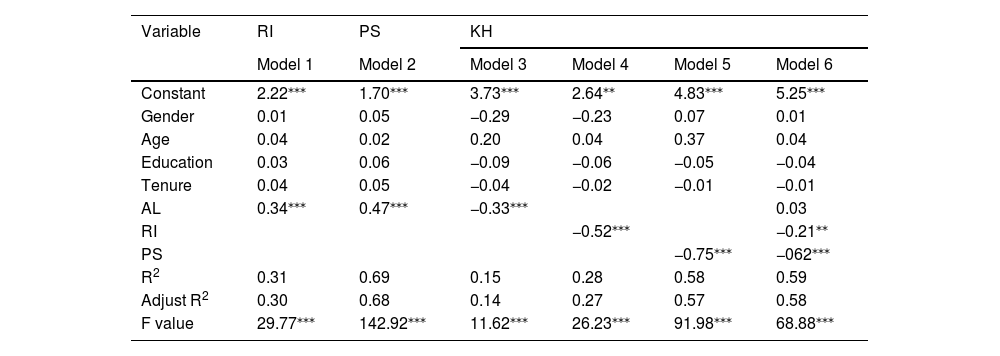
Hypothesis testingMain effect testTo test Hypothesis H1, which posits that AL has a negative effect on employees' KH behavior, a linear regression analysis was employed. A direct effect model (Model 3) was constructed, incorporating control variables such as gender, age, education, and organizational tenure. The findings presented in Figure 3 demonstrate that AL has a significant negative effect on KH behavior (β = –0.33, p < 0.01). The results substantiate Hypothesis H1, which indicates that AL significantly inhibits employees' KH behavior.
Mediation effect testThis study followed Baron and Kenny’s (1986) causal step approach to test for mediating effects by examining the dual mediation model (Baron & Kenny, 1986). As shown in Table 3, after controlling for gender, age, education, and organizational tenure, AL is significantly positively influenced by the effect of AL on RI (Model 1, r = 0.34, p < 0.001) and PS (Model 2, r = 0.47, p < 0.001). Furthermore, both RI (Model 4, r = −0.52, p < 0.001) and PS (Model 5, r = −0.75, p < 0.001) significantly and negatively impact KH. The results indicated that further mediation analyses could be conducted to explore the mediating mechanisms involved.
Results of the main effects and mediation effects test.
Note: ***p < 0.001, **p < 0.01, *p < 0.05; N = 337.
Finally, the dual mediating effects of RI and PS were t examined. In Model 3, Model 6 was constructed with RI and PS as independent mediating variables. The results indicated that both RI and PS had a significant effect on employees' KH behavior (β=−0.21, p < 0.01; β=−0.62, p < 0.001), whereas the direct effect of AL on KH behavior was no longer significant (β=0.12, ns). This finding indicates that the dual mediation model fully mediated the relationship between AL and employees' KH behavior, thus supporting Hypothesis H4.
Furthermore, this study adopted the bootstrap method (Efron, 1992) with 5000 resamples to assess the significance of the mediating effect. The results in Table 4 indicate significant indirect effects of RI (Effect = 0.211, 95 % CI [0.042, 0.183]) and PS (Effect = 0.172, 95 % CI [0.016, 0.055]), as neither confidence interval includes zero.
The results of the mediating effect of RI and PS on the relationship between AL and KH (N = 337).
Note: **p < 0.01; N = 337.
Additionally, the total mediating effect through RI and PS is significant (Effect = 0.126, 95 % CI [0.023, 0.067]), as the confidence interval does not include zero. This result suggests that both RI and PS significantly mediate the relationship between AI and KH, thereby confirming the presence of a chain mediation effect. Thus, Hypothesis 4 is reaffirmed.
DiscussionThis study examines the relationship between AL and employees' KH behavior on the basis of social identity theory and social information processing theory.
First, as hypothesized, AL is significantly negatively related to KH. This finding is consistent with previous findings that AL reduces KH behavior in teams (Cheng & Chen, 2024; Men et al., 2020; Muhammad et al., 2024). AL fosters the development of a shared identity among team members, expands their collective knowledge base, and facilitates mutual learning and skill acquisition. Such an environment reduces the perceived need for KH and nurtures a culture of openness and continuous learning. While the direction of this effect is consistent with expectations, it is important to note that in highly competitive or performance-pressured teams, the influence of authentic leadership may be constrained. In these contexts, the authenticity of leaders may not be sufficient to entirely counteract employees’ propensity to conceal information—an important nuance that warrants further empirical investigation.
Second, the results indicate that RI mediates the relationship between AL and KH. This finding indicates that AL decreases KH and directly and indirectly increases employees' sense of belonging and alignment with organizational values. These results are consistent with the findings of Edú-Valsania et al. (2016), who reported that leaders who exhibit greater self-awareness, balance, ethics, and transparency are more likely to foster a strong sense of work team identity among their employees (Edú-Valsania et al., 2016). PS also mediates this relationship, supporting previous arguments that PS is a key link between leadership and KH (Men et al., 2020; Wang et al., 2018). Interestingly, RI and PS together play a chain mediating role between AL and employee KH behavior. Specifically, RI not only independently mediates the negative effects of AL on KH but also has a further serial mediating effect through PS.
Finally, the cultural context of this study warrants careful consideration. Organizational culture strongly shapes individuals’ cognitive patterns. Although this study was conducted in China, which has traditionally been characterized by high power distance, collectivism, and hierarchical structures (Hofstede, 2001), recent decades have experienced considerable cultural diversification. The pursuit of self-actualization and equality among younger generations is increasingly reshaping traditional values. These changes may have intensified the effects of authentic leadership, as transparency and relational emphasis are more likely to increase trust, while collectivist inclinations reinforce alignment with common objectives. In environments characterized by low power distance or greater individualism, expectations concerning equality and autonomy may modify these interactions. Therefore, cross-cultural research is essential for determining whether the mechanisms observed in this study are universal or culturally specific.
Theoretical implicationsThis study contributes significantly to the knowledge management literature by examining the underexplored relationship between AL and KH. While prior research has largely focused on leadership’s role in promoting knowledge sharing (Edú-Valsania et al., 2016), this study focuses on KH, offering a more balanced perspective on how leadership influences knowledge behaviors. We provide empirical evidence of the AL–KH relationship and propose a theoretical framework for understanding how KH can be mitigated, thereby enhancing knowledge flow and optimizing knowledge management practices. This extends the theoretical understanding of how authentic leadership influences KH and improves the antecedent framework associated with it.
By integrating social identity theory and social exchange theory, this study reveals dual psychological and relational mechanisms, identifying RI and PS as chain mediators. The findings show that authentic leaders can directly influence subordinates and indirectly facilitate knowledge flow by fostering a supportive relational climate. This multi-theoretical integration surpasses previous research that focuses on single factors, such as trust or psychological safety. It provides a dynamic and integrative perspective on the complex effects of leadership on knowledge management outcomes (Khizar et al., 2024; Serenko & Bontis, 2016) and clarifies the transmission mechanisms and boundary conditions of AL’s influence on KH.
Finally, by focusing on the Chinese context, we validate the effectiveness of AL in high power-distance, collectivist, and relationship-oriented cultures, where hierarchical structures and Guanxi networks significantly influence resource distribution and decision-making processes. While confirming AL’s applicability in this context, we acknowledge that cultural and organizational differences may moderate these effects, indicating potential directions for future research across various organizational and cultural settings.
Managerial implicationsThis study offers practical and actionable recommendations for reducing knowledge hiding and fostering knowledge sharing within organizations.
First, organizations should cultivate authentic leadership by incorporating 360-degree feedback, personality assessments, and behavioral interviews in executive selection and providing targeted interventions such as leadership workshops, executive coaching, and cultural initiatives that promote trust and transparency. Second, leaders should actively practice authentic leadership through respectful and supportive interactions, regular one-on-one meetings, open team discussions, autonomy in project planning, and timely constructive feedback. These practices increase employees’ psychological safety and sense of belonging, thereby reducing knowledge hiding. Finally, in promoting knowledge-sharing behaviors, firms should focus on fostering employees’ sense of identification. By reinforcing authentic leadership behaviors, employees’ perceived identification can be strengthened, which in turn can facilitate knowledge sharing. Collectively, these measures strengthen trust and loyalty, promote knowledge flow, and contribute to a sustainable competitive advantage.
Limitations and future researchThis study has several limitations. First, owing to resource and practical constraints, convenience sampling was employed, which may limit the external validity and generalizability of the findings. Future research could adopt probability-based sampling to enhance the methodological rigor and robustness of the results. Second, the sample was drawn from 65 Chinese companies, which limits the diversity of the sample. Given the potential differences in regional culture and organizational contexts, the generalizability of the findings across different cultural and organizational settings requires further validation. Future studies could expand the research across broader regions and cultural contexts to improve generalizability. Third, the boundary conditions of AL on KH remain underexplored. While this study focused on relationship identification and psychological safety as mediators, future research could examine potential moderators (e.g., job autonomy and a trust climate), adopt experimental or longitudinal designs, and extend to hybrid or remote work settings to investigate the mechanisms and boundary conditions of AL effects more comprehensively. Finally, although this study revealed that AL helps reduce employees’ KH behaviors, AL may function as a “double-edged sword,” potentially producing contradictory or negative effects in certain contexts. Future research could further explore the potential negative effects of AL on employees’ knowledge behaviors.
CRediT authorship contribution statementXintian Li: Writing – review & editing, Methodology, Data curation, Conceptualization. Peng Peng: Writing – review & editing, Writing – original draft, Conceptualization.
The authors declare that they have no known competing financial interests or personal relationships that could have appeared to influence the work reported in this paper.
This research received no external funding.
