



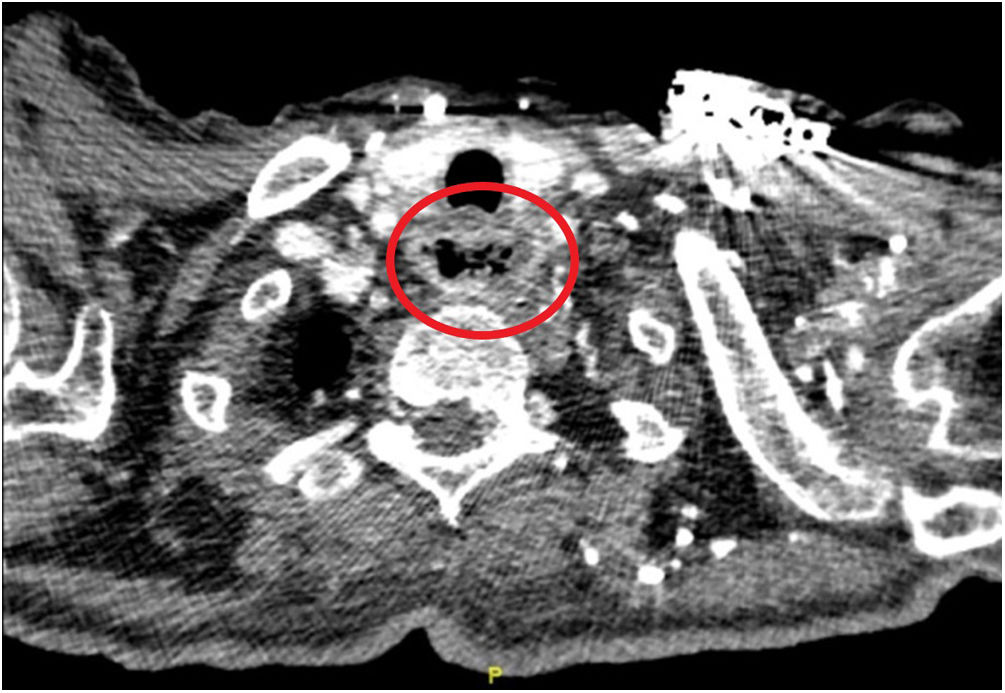


A 77-year-old man on anticoagulation with apixaban for atrial fibrillation and advanced frontal dementia attended the Accident and Emergency Department due to vomiting blood and dysphagia. The initial endoscopy was inconclusive due to a mass with clots, which prevented the examination of the oesophageal lumen. A computed tomography scan showed a para-oesophageal collection and thickening and narrowing of the oesophageal lumen, suggesting neoplasia (Fig. 1). A second endoscopy was requested, in which a blister was found embedded in the upper oesophageal sphincter (Fig. 2). It was extracted with foreign body forceps using a variceal ligation cap. After extraction, two deep contralateral ulcers were identified in the cervical oesophagus, the probable origin of a peri-oesophageal abscess (Fig. 3).


A more detailed history revealed that the patient had started treatment with oral calcium days before.
The differential diagnosis of the origin of a peri-oesophageal abscess should include the ingestion of foreign bodies, especially in older adult patients with an impaired cognitive level.1,2 Although not in our case, computed tomography is usually diagnostic.3,4
If an overtube is not available, the use of the ligation cap for removal can be helpful to protect the oesophageal mucosa.

