


metricas
covid
Gastroenterología y Hepatología (English Edition) Identifying the gastric atrophic border according to Kimura-Takemoto classificat...
Journal Information
Vol. 46. Issue 7.
Pages 557-559 (August - September 2023)
Vol. 46. Issue 7.
Pages 557-559 (August - September 2023)
Image of the month
Full text access
Identifying the gastric atrophic border according to Kimura-Takemoto classification by using high-definition endoscopes and a new virtual chromoendoscopy modality
Identificando el borde atrófico según la clasificación de Kimura-Takemoto usando endoscopios de alta definición y un nuevo sistema de cromoendoscopia virtual
Visits
441
Pedro Genaro Delgado-Guillenaa,b,
Corresponding author
pgdg20@gmail.com

Corresponding author.
, Juan Antonio Borrallo-Cruza, Cristina Valeria Sánchez-Jaraa, Juan Luis Gutiérrez-Ciercoc, Sara Pabón-Carrascoc, Adrián Murube-Jiménezc, Gema Vinagre-Rodrígueza, Duc T. Quachd
a Gastroenterology Department, Hospital de Mérida, Badajoz, Spain
b Universidad de Barcelona, Barcelona, Spain
c Pathology Department, Hospital de Mérida, Badajoz, Spain
d Department of Internal Medicine, University of Medicine and Pharmacy at Hochiminh City, Ho Chi Minh, Viet Nam
This item has received
Article information
Full Text
Bibliography
Download PDF
Statistics
Figures (2)
Additional material (1)
Full Text

Gastric atrophy (GA) is the first premalignant condition described in the path towards gastric adenocarcinoma. Gastric biopsies are recommended by current western guidelines to grade histological severity. Patients with severe histologic GA (i.e., OLGA III/IV) are considered to have increased risk of gastric cancer.1

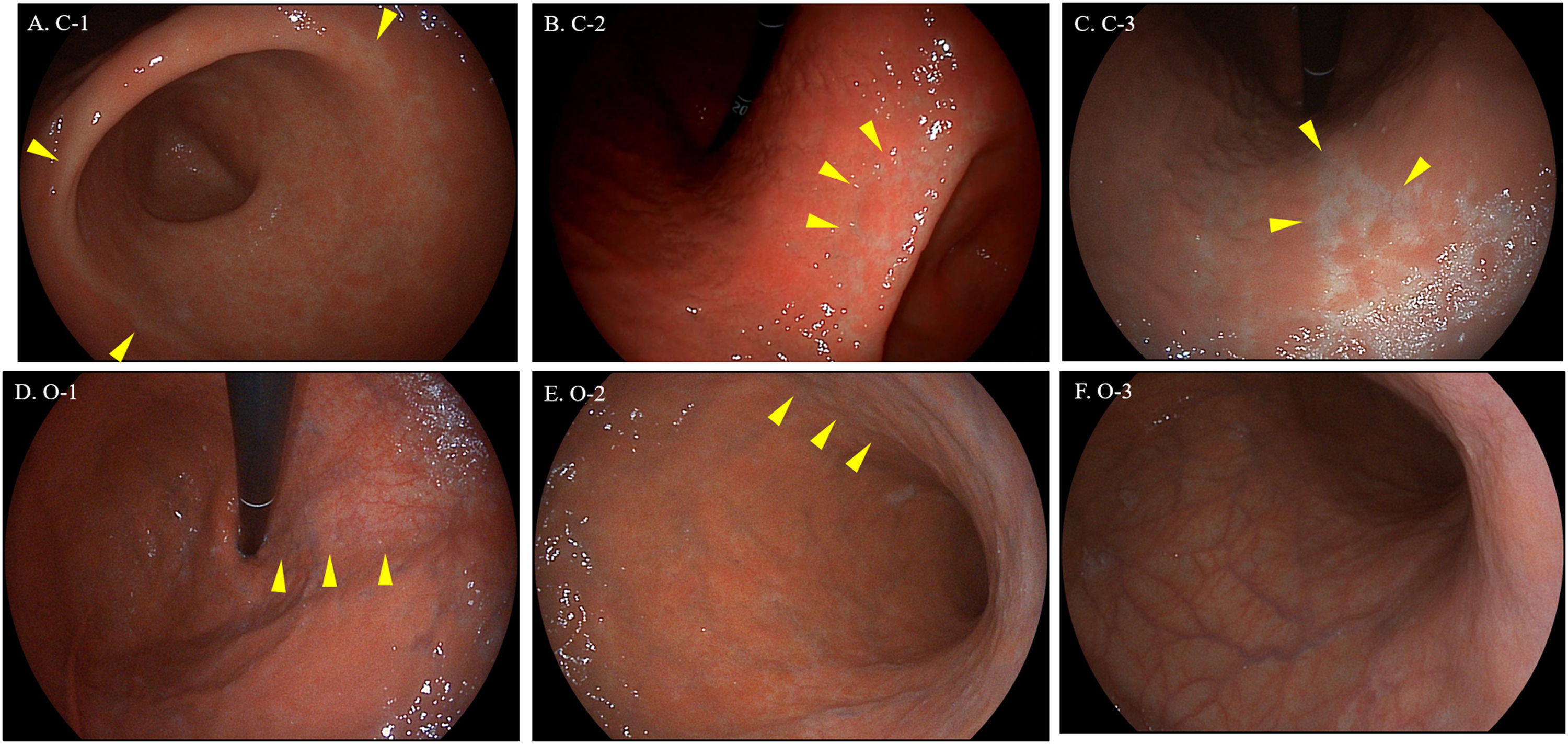
The Kimura-Takemoto classification is a visual scale commonly used in eastern countries to assess GA endoscopically. It classifies GA into two main types based on the location of atrophic border: the closed types (C-1, C-2 and C-3) and the opened types (O-1, O-2 and O-3).2 Despite a moderate agreement among expert endoscopists, the severity of GA according to this classification has shown a correlation with histology,3 and most important, it is also related with gastric cancer risk in eastern populations.4 Although few studies have been carried out in Europe,3 it could be useful to select patients who deserve mapping gastric biopsies in our daily practice.5

High-definition and SFI (Spectral Focused Imaging) technology developed by SonoScape (Medical Corp, Shenzhen, China), improves the atrophic border identification by increasing the contrast between mucosa and vessels: the red becomes redder, and the white becomes whiter. This classification and advantages of SFI are shown in Figs. 1, 2, and video (supplementary material).

Figure 1.

Kimura-Takemoto classification with High-Definition White-Light endoscope by SonoScape. (A) C-1: atrophic border is identified in antrum or incisura angularis. (B) C-2: atrophic border reaches to the distal area of lesser curvature of gastric body. (C) C-3: atrophic border reaches to the proximal area of lesser curvature of gastric body. (D) O-1: atrophic border no longer lies on the lesser curvature, but instead between the lesser curvature and anterior wall. (E) O-2: atrophic border affects anterior wall of the gastric body. (F) O-3: atrophic border affects the greater curvature of gastric body (in this case atrophy affects all gastric body). Arrowheads indicate the atrophic border.

Figure 2.

SFI virtual chromoendoscopy by SonoScape has an optical phase followed by digital processing. In the optical phase, the blue-violet light is intensified at 415nm where the hemoglobin light absorption peaks. The digital processing then sharpens and de-noises the image, while increasing the brightness and further the contrast. (A) C-1; (B) C-2; (C) C-3; (D) 0–2. Arrowheads indicate the atrophic border.


Appendix A
Supplementary data

The following are the supplementary data to this article:

(26.44MB)

References
[1]
M. Rugge, E. Savarino, M. Sbaraglia, L. Bricca, P. Malfertheiner.
Gastritis: the clinico-pathological spectrum.
Dig Liver Dis, 53 (2021), pp. 1237-1246
[2]
K. Kimura, T. Takemoto.
An endoscopic recognition of the atrophic border and its significance in chronic gastritis.
Endoscopy, 1 (1969), pp. 87-97
[3]
S. Kono, T. Gotoda, S. Yoshida, I. Oda, H. Kondo, L. Gatta, et al.
Can endoscopic atrophy predict histological atrophy? Historical study in United Kingdom and Japan.
World J Gastroenterol, 21 (2015), pp. 13113-13123
[4]
S. Xiao, Y. Fan, Z. Yin, L. Zhou.
Endoscopic grading of gastric atrophy on risk assessment of gastric neoplasia: a systematic review and meta-analysis.
J Gastroenterol Hepatol, 36 (2021), pp. 55-63
[5]
D.T. Quach, T. Hiyama, H.M. Le, T.S. Nguyen, T. Gotoda.
Use of endoscopic assessment of gastric atrophy for gastric cancer risk stratification to reduce the need for gastric mapping.
Scand J Gastroenterol, 55 (2020), pp. 402-407
Copyright © 2022. Elsevier España, S.L.U.. All rights reserved
Download PDF
Article options
Tools
Supplemental materials