


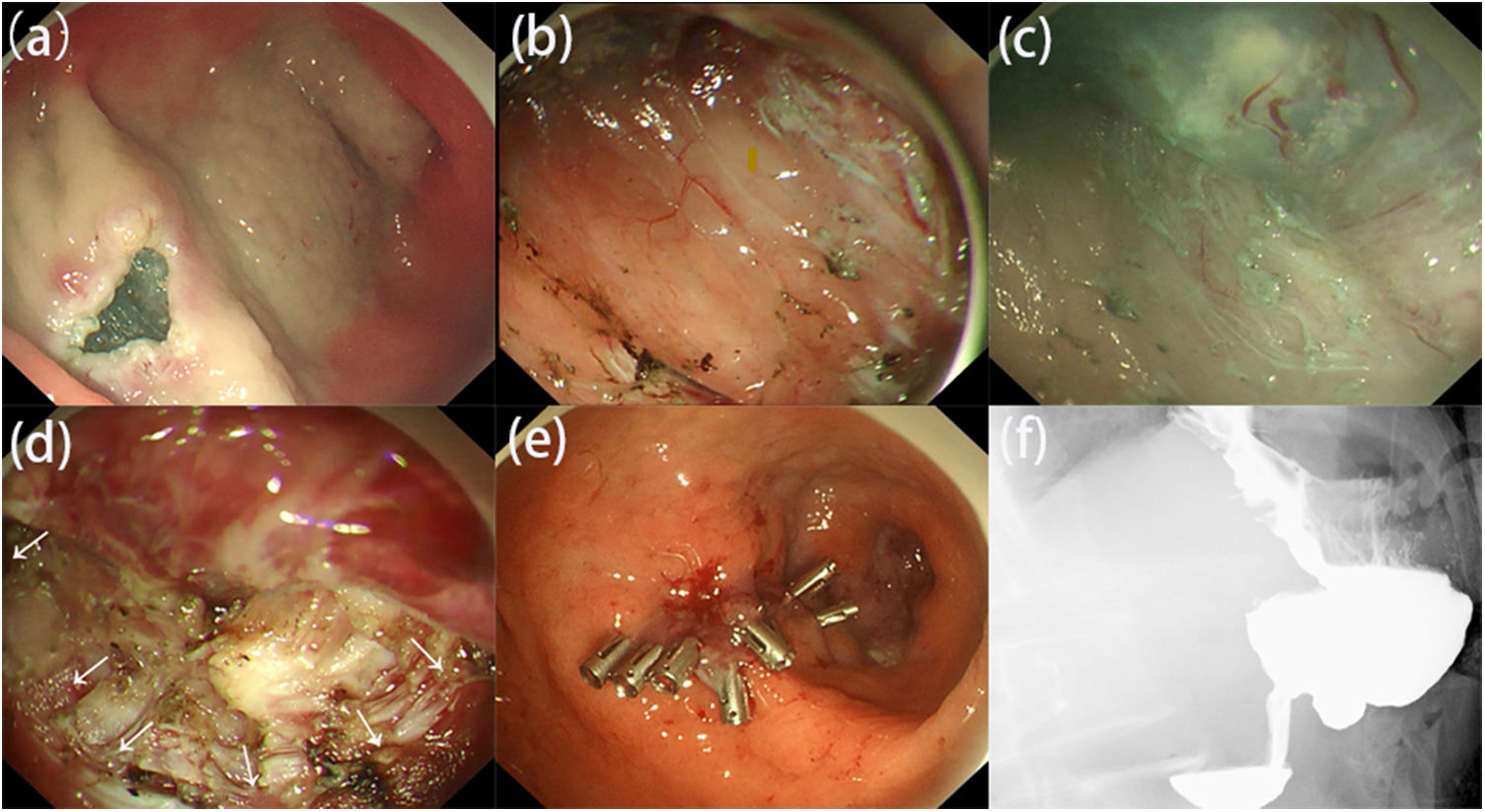
A 63-year-old man presented with nausea and postprandial fullness for 4 years, and adult idiopathic hypertrophic pyloric stenosis (IHPS) was suspected (Fig. 1). Under patient's informed consent, endoscopic radial pyloromyotomy was performed (Fig. 2). The patient underwent general anesthesia. After submucosal injection, a triangle tip knife was used for mucosal entry 5cm proximal to the pylorus. A wide submucosal tunnel was created up to the duodenal bulb, with adequate exposure of the pyloric ring. Radial pyloromyotomy of the circular muscle was performed. The muscle was cut from the lower edge of pyloric ring to 1cm proximal to the pyloric ring. The tunnel entry was closed using endoscopic clips. After the procedure, the endoscope passed the pylorus easily. No significant complications were observed. Barium study after 1 month showed a normal gastric emptying. During 8-month follow-up, his symptoms improved significantly, and more than 6-kg weight gain was recorded.


Endoscopic radial pyloromyotomy for adult idiopathic hypertrophic pyloric stenosis. (A) Mucosal entry 5cm proximal to the pylorus. (B) Creation of a wide submucosal tunnel up to the duodenal bulb. (C) Adequate exposure of the pyloric ring. (D) Radial pyloromyotomy of the circular muscle. (E) Closure of the tunnel entry with endoscopic clips. (F) Rapid passage of barium from stomach into the duodenum after radial pyloromyotomy.
Endoscopic pyloromyotomy has been reported as an effective treatment for IHPS.1,2 However, symptoms recurrence may develop. Herein, we presented a novel method of endoscopic radial pyloromyotomy, which allows adequate pyloromyotomy, helping to achieve favorable clinical outcome. In addition, full-thickness myotomy is not required, reducing the risk of bile reflux.
FundingThere are no funders to report for this submission.
Authors’ contributionsXuelian Li and Liansong Ye collected the data and drafted the manuscript. Feng Pan revised the manuscript. All authors approved the final manuscript.
Conflict of interestsAll authors disclose no conflict of interest.