
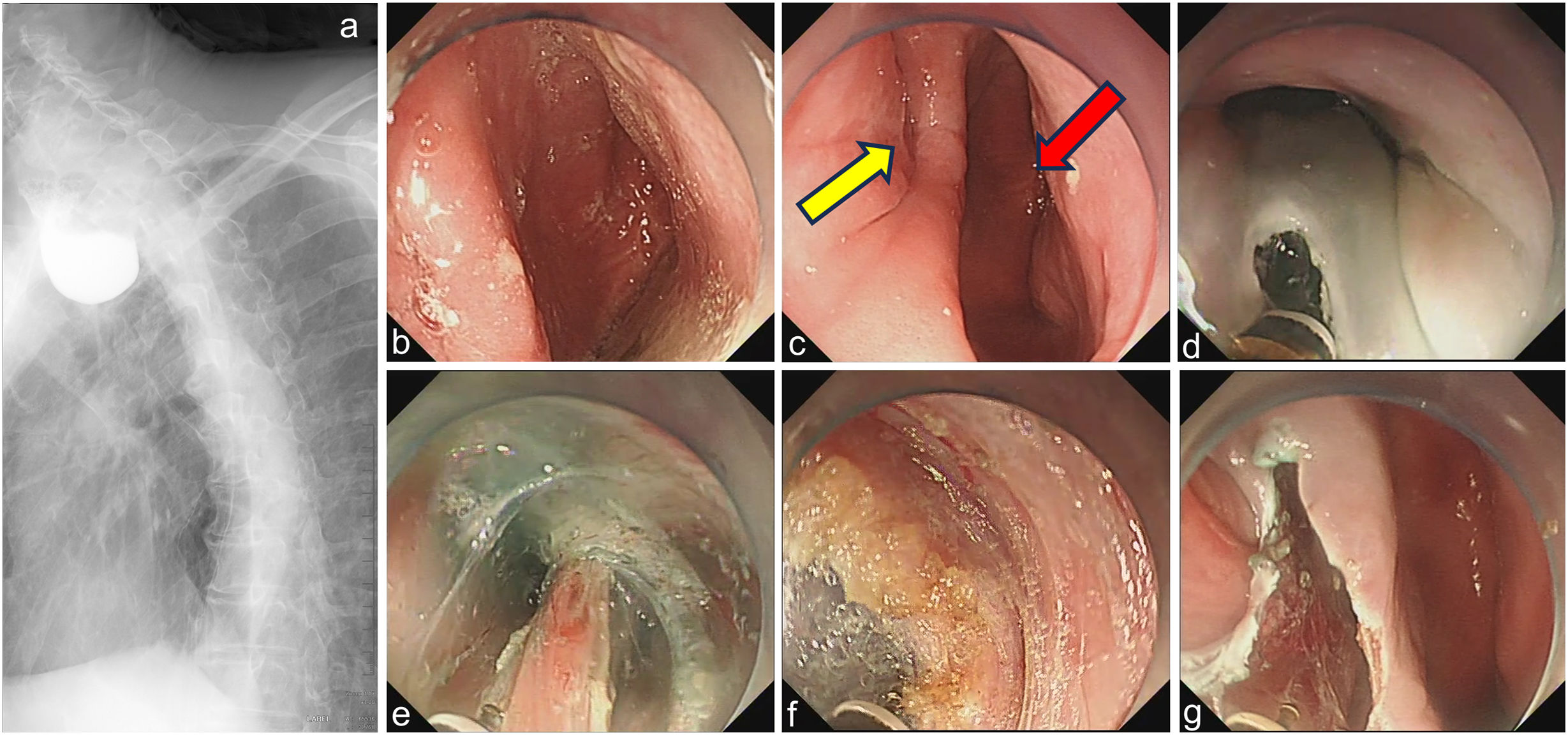
An 84-year-old male with decadal dysphagia demonstrated a large Zenker's diverticulum harboring food debris on endoscopy (Fig. 1a–c). Z-POEM was performed with luminal debridement, followed by mucosotomy, submucosal tunneling, and complete cricopharyngeal myotomy (Fig. 1d–f). Critical intraoperative finding: a large residual mucosal septum – a documented recurrence risk factor1 – persistently obstructing the lumen (Fig. 1g).

Esophagram and standard Z-POEM. (a) Large Zenker's diverticulum; (b) food debris retention within the diverticular sac; (c) luminal view after debridement (yellow arrow: true esophageal lumen; red arrow: diverticular orifice); (d) mucosal incision initiated 2cm proximal to the septal base; (e) bilateral submucosal tunneling along the septum; (f) completed cricopharyngeal myotomy; (g) residual mucosal septum obstructing the true lumen (asterisk).
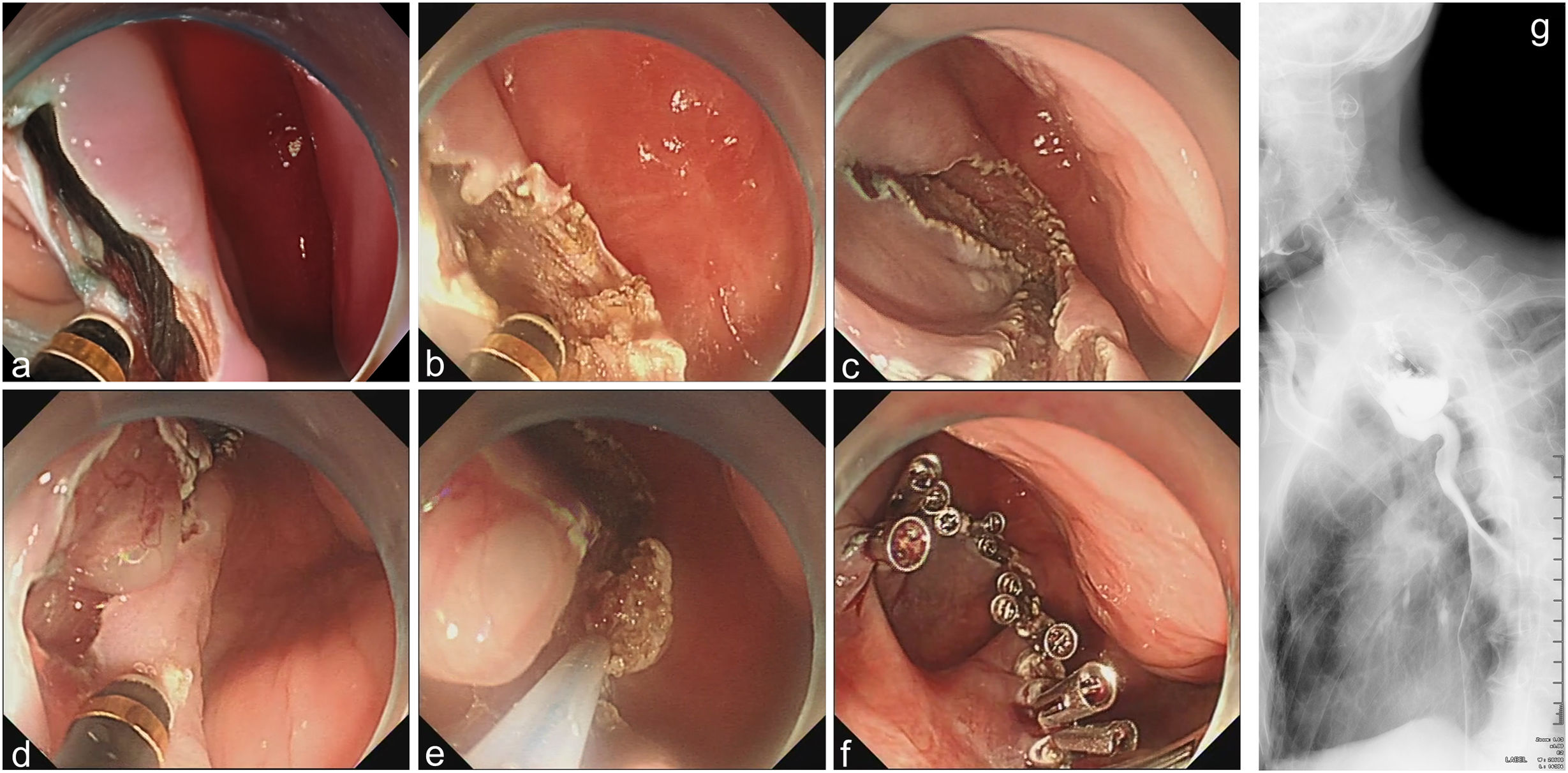
To address this, transection of the residual mucosal flap was extended to the diverticular base using a Disposable High-Frequency Incision Knife (MK-T-2-195. Nanjing Micro-Tech Medical) (Fig. 2a and b). Mobile septum resection yielded irregular margins (Fig. 2c). Small protruding flaps underwent cold snare polypectomy (Captivator™ II, Boston Scientific). For larger flaps (>10mm), initial incision was performed using incision knife (MK-T-2-195. Nanjing Micro-Tech Medical), followed by snare resection (Captivator™ II) (Fig. 2d and e). The mucosal defect was closed with six through-the-scope clips (Resolution™ Clip, Boston Scientific) (Fig. 2f). Postoperative esophagram on day 7 confirmed unimpeded barium passage (Fig. 2g). At the 3-month follow-up, the patient demonstrated complete resolution of dysphagia with absence of reflux symptoms, accompanied by a 2.3kg body weight gain.

Modified Z-POEM. (a) Bilateral mucosotomy; (b) full-thickness septotomy extending to the diverticular base; (c) irregular mucosal margin with >1mm serration; (d) precise incision of protruded septal remnants using incision knife; (e) resection with snare; (f) complete mucosal closure using clips; (g) postoperative day-7 esophagram confirming diverticular resolution and absence of contrast extravasation.
This modified technique ensures adequate post-procedural luminal patency, mitigates mucosal flap prolapse risk, enhances esophageal-diverticular communication, and optimizes food transit efficiency. Notably, for patients with large diverticula, adjunctive residual mucosal flap resection during Z-POEM may be warranted.
CRediT authorship contribution statementZhongshang Sun and Fazhen Xu collected the clinical data and drafted the manuscript.
Xiaozhong Yang analyzed the data and guided the manuscript writing.
Aijun Zhou edited and analyzed the video.
Bing Hu revised the manuscript for intellectual content.
Feng Pan and Liansong Ye designed the study and are the article guarantors.
All authors read and approved the final manuscript. This paper did not based on any previous communication or meeting.
Informed consentWritten informed consent was obtained from the patient to publish these images.
FundingNone declared.
Conflict of interestThe authors declare they have no conflicts of interest.