



El dolor lumbar crónico representa un problema de salud global. Los abordajes de fisioterapia incluyen la terapia manual, el ejercicio terapéutico y la educación al paciente. Sin embargo, también existen factores psicoemocionales y sociales que desempeñan un papel relevante en su percepción y progresión.
El objetivo del presente estudio consistió en analizar la relación entre la autoeficacia y la confianza en el movimiento en individuos con dolor lumbar crónico inespecífico y compararlas con controles sin dolor lumbar.
Materiales y métodosSe realizó un estudio observacional de casos y controles en 30 sujetos con dolor lumbar crónico inespecífico y 30 sujetos asintomáticos. Los instrumentos empleados fueron la escala OPTIMAL-confianza (0-100, a menor confianza mayor puntuación) y el cuestionario de autoeficacia en dolor crónico (0-100, a mayor autoeficacia mayor puntuación). Se efectuó un análisis descriptivo, así como asociaciones entre variables mediante el software SPSS® v26 (p<0,05).
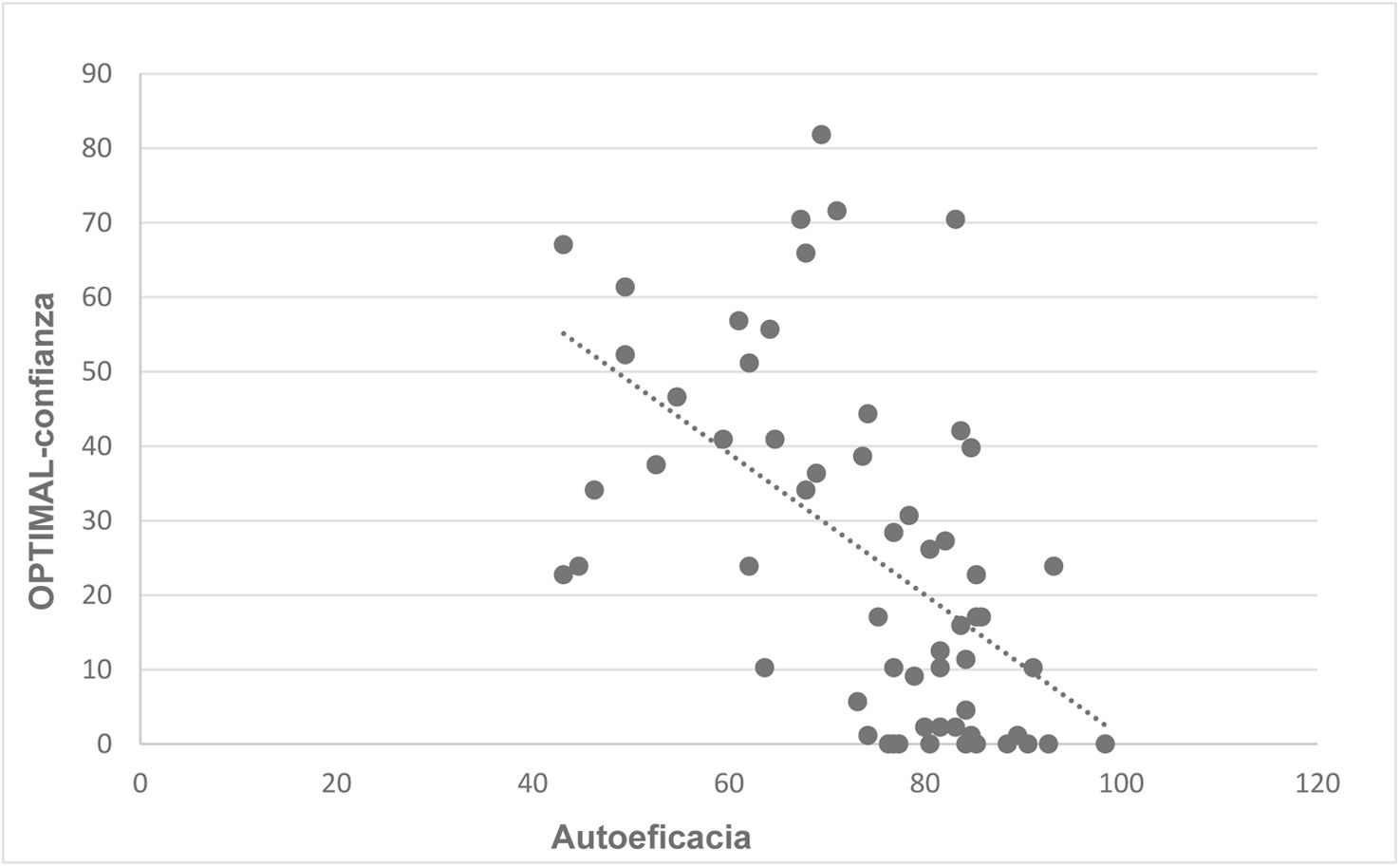
ResultadosSe incluyeron 60 participantes, con una media de edad de 54,72±13,96 años. Los individuos con dolor presentaron menor autoeficacia (68,51±14,46 vs. 79,98±9,86) y menor confianza en el movimiento (39,24±24,29 vs. 11,78±11,50) respecto a el grupo control, con diferencias significativas (p<0,05). Además, se observó una correlación directa, moderada y significativa entre autoeficacia y la confianza en el movimiento (−0,55; p<0,001).
ConclusionesLos hallazgos sugieren que los individuos con dolor lumbar crónico inespecífico presentan menor autoeficacia y confianza en el movimiento, resaltando la importancia de incluir estos factores en estrategias de educación en fisioterapia.
Chronic low back pain is a global health problem. Physiotherapy approaches include manual therapy, therapeutic exercise, and patient education. However, psycho-emotional and social factors also play a relevant role in the perception and progression of pain.
The aim of this study was to analyze the relationship between self-efficacy and movement confidence in individuals with nonspecific chronic low back pain and compare them with asymptomatic controls.
Materials and methodsA case-control observational study was conducted with 30 subjects with nonspecific chronic low back pain and 30 asymptomatic subjects. The instruments used were the OPTIMAL-confidence scale (0–100, with higher scores indicating lower confidence) and the Chronic Pain Self-Efficacy Questionnaire (0-100, with higher scores indicating greater self-efficacy). A descriptive analysis and association tests between variables were performed using SPSS® v26 software (P<.05).
ResultsA total of 60 participants were included, with a mean age of 54.72±13.96 years. Individuals with pain showed lower self-efficacy (68.51±14.46 vs. 79.98±9.86) and lower movement confidence (39.24±24.29 vs. 11.78±11.50) compared to the control group, with statistically significant differences (P<.05). Furthermore, a moderate, significant inverse correlation was observed between self-efficacy and movement confidence (r=−0.55; P<.001).
ConclusionsThe findings suggest that individuals with nonspecific chronic low back pain present lower self-efficacy and movement confidence, highlighting the importance of incorporating these factors into physiotherapy education strategies.
Artículo
Si ya tiene sus datos de acceso, clique aquí.
Si olvidó su clave de acceso puede recuperarla clicando aquí y seleccionando la opción "He olvidado mi contraseña".