






Bibliometric analysis allow the quantitative evaluation of the characteristics of a scientific publication.
ObjectiveTo perform a bibliometric analysis of original articles in the journal Enfermería Intensiva from 2001 to 2020.
ResultsThe journal Enfermería Intensiva has published, between 2001 and 2020, 438 works, of which 259 are original articles (59.1%). These original articles are mostly quantitative studies (76.1%), with an average of 30.5 bibliographic references (SD 13.9), 4.9 citations (SD 1.7) in the Web of Science and Scopus repertoires, and 15,489.5 visits/downloads (median 9090 and interquartile range 4567–15,260) according to information on the magazine's website. These originals have been signed by 1345 authors, which represents a collaboration index of 5.2. 78.0% of the authors are sporadic, having published only one work. Most of the articles come from authors who work in institutionally located in hospitals and university centers, and geographically in the Communities of Madrid, Cataluña, Navarra and Andalucía.
ConclusionsThere is little international, regional and institutional collaboration, producing the highest level of collaboration between authors from the same center. The journal has established itself in the panorama of scientific nursing research in Spain and shows bibliometric indicators similar or even superior to other publications in its environment.
Los análisis bibliométricos permiten evaluar cuantitativamente las características de una publicación científica.
ObjetivoRealizar un análisis bibliométrico de los artículos originales de la revista Enfermería Intensiva de 2001 a 2020.
ResultadosLa revista Enfermería intensiva ha publicado, entre 2001 y 2020, 438 trabajos, de los cuales 259 son artículos originales (59,1%). Estos artículos originales son en su mayoría estudios cuantitativos (76,1%), con una media de 30,5 (DE 13,9) referencias bibliográficas, 4,9 (DE 1,7) citas en los repertorios Web of Science y Scopus, y 15.489,5 visitas/descargas (mediana 9.090 y rango intercuartílico 4.567–15.260) según información de la web de la revista. Estos originales han sido firmados por 1.345 autores, lo que supone un índice de colaboración de 5,2 (DE 0,7). Un 78,0% de los autores son esporádicos al haber publicado un solo trabajo. La mayoría de los artículos pertenecen a autores procedentes de hospitales y centros universitarios, situados geográficamente en las Comunidades de Madrid, Cataluña, Navarra y Andalucía.
ConclusionesExiste una escasa colaboración internacional, autonómica e institucional, produciéndose el mayor nivel de colaboración entre autores de un mismo centro. La revista se ha consolidado en el panorama de la investigación científica de enfermería en España y muestra unos indicadores bibliométricos similares o incluso supriores a otras publicaciones de su entorno.
The journal Enfermería Intensiva has been published continuously since 1988, with a total of 32 volumes (120 issues and more than 700 articles) in 2021. With the initial issue of May 1988, a long-standing project of the Spanish Society of Intensive Care Nursing and Coronary Units (SEEIUC), which first emerged at the XII national meeting held in Pamplona 2 years earlier, became a reality: to create an organ for the dissemination of the Society and an appropriate means of communication for all associates, and all nurses in the area of critical care.1 As stated on its website, the journal still upholds these principles and presents itself as the Society's organ of expression and as an “excellent means of communication for all nurses working in intensive care units or any other place where the critical patient is cared for”.2 It is indexed in different national and international databases and repositories: Index Medicus/Medline, CINAHL, Index de Enfermería, International Nursing Index, Índice Médico Español, Cuiden, Bibliomed, Scopus, and Emerging Sources Citation Index. The journal publishes the prizes awarded to the best papers presented at the SEEIUC conferences and congresses every year, in article format.3
For years, bibliometric analyses have been used to study the scientific production4–9 of authors, groups, and institutions to evaluate, describe, and compare it with that of other authors, groups, or institutions, and to analyse trends that serve to consider new perspectives. However, bibliometric studies on one or several publications can also be useful to describe, categorise, and compare with other publications of similar characteristics.10
The present study is an update of and complement to previous studies that have analysed the scientific production of intensive care nursing, such as that of Asiaín and Marín11 on scientific production in nursing between 1978 and 1987, years before the journal appeared; that of Marín Fernández et al.12 on the following five-year period (1988–1992), which already provided data from the journal Enfermería Intensiva together with those from 5 other Spanish nursing journals, and that of Gálvez Toro,6 a study of 12 nursing journals.
The main objective of this article was to perform a bibliometric analysis of the journal Enfermería Intensiva over the last 20 years (2001–2020) based on the study of its original articles. Specific objectives include identifying original articles in the set of published documents, determining their proportion with respect to other papers, classifying original articles by type of study, quantifying the number of signatures and authors, and describing their geographical and institutional affiliation, and identifying the number of references, citations, and downloads/visits per article.
Material and methodDesign and scopeBibliometric study of the journal Enfermería Intensiva, focusing on original articles published between January 2001 (volume 12, issue 1) and December 2020 (volume 31, issue 4). The original articles were catalogued as papers with research results in the area of critical care and underwent a peer review process, which guarantees their originality and quality. Papers published in the journal in the editorial sections, review articles, letters to the editor, commentaries, or special articles, as well as those directly related to the formative objective of the journal, such as tests and self-evaluations, were excluded from this study.
Data collectionThe website of the journal Enfermería Intensiva2 was used to access and obtain the articles included in this analysis, using the library's institutional subscription to access the full texts of articles that were not open access. The following variables were considered for each original article: authors (name and surname), author's sex, place of work (institution, autonomous community, and country), literature references, citations in the Web of Science (collected on its website on 25/07/2021) and in Scopus (collected on its website on 25/07/2021), and visits/downloads (consulted on the journal's website: https://www.elsevier.es/es-revista-enfermeria-intensiva-142, on 18/07/2021). The original articles were classified by type of study (qualitative, quantitative, or mixed) after reading the methodology section of each study. The productivity index (logarithm of the number of articles published), the transience index (number of authors who have only published one article), and the collaboration index (average number of authors/paper) were calculated, and Lotka's law was applied to the authors' production, which postulates that the number of authors is inversely proportional to the number of papers.
Data analysisThe statistical exploitation started with a descriptive analysis. Qualitative variables are described in absolute and relative frequencies. Quantitative variables with normal distribution are summarised by their mean, standard deviation, and minimum and maximum values, while clearly non-normal variables are summarised by their median and interquartile range. The association between the number of citations, the number of authors per publication and the number of visits was made using Spearman's correlation (rho) to determine the trend and assess the level of concordance. All analyses were performed using Stata Intercooled for Windows version 16 (StataCorp. 2019. Stata Statistical Software: Release 16. StataCorp LLC, College Station, TX, USA) and a significance level of 5% was used.
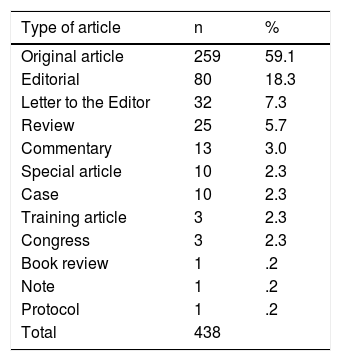
ResultsBetween 2001 and 2020 the journal Enfermería Intensiva published a total of 438 papers (Table 1), which is an average of 5.5 (SD 1.4) papers per issue/fascicle and 21.9 (SD 5.4) papers per year. Of these, 259 (59.1%) are original articles (productivity index = 2.4) and 25 (5.7%) are review articles. Tests and self-assessment papers (n = 105) and papers in the information or agenda sections (n = 16) were not included. Original articles and editorials were documents published consistently over these 20 years (Fig. 1), but the same was not true for other typologies: the first case studies appeared in 2012, letters were not published regularly until 2015 and review articles until 2012, and tests and self-assessment documents, frequent in the early years, disappeared from 2013.
Types of papers published in Enfermería Intensiva (2021–2020).
| Type of article | n | % |
|---|---|---|
| Original article | 259 | 59.1 |
| Editorial | 80 | 18.3 |
| Letter to the Editor | 32 | 7.3 |
| Review | 25 | 5.7 |
| Commentary | 13 | 3.0 |
| Special article | 10 | 2.3 |
| Case | 10 | 2.3 |
| Training article | 3 | 2.3 |
| Congress | 3 | 2.3 |
| Book review | 1 | .2 |
| Note | 1 | .2 |
| Protocol | 1 | .2 |
| Total | 438 |

Original articles constitute the largest group, with an average of 3.2 (SD 0.5) papers per issue/article and 12.9 (SD 2.1) per year. Their number ranges from a minimum of 9 originals in 2001 to a maximum of 16 in 2009 and 2014. The proportion between originals and the other papers has been variable over these 20 years: in 2008 and 2011 originals accounted for 80% of all papers, in 2020 this dropped to 39.4%, and since 2012 it has remained below 59.1%, which is the average value. Of the original papers, 23.2% (n = 60), have been previously awarded a prize at the annual SEEIUC conferences and congresses.
The study types of the original articles (Table 2) are distributed among 197 (76.1%) quantitative studies, 26 (10.0%) qualitative studies, and 21 (8.1%) procedures or protocols. Quantitative studies are mostly observational (87.8%) and experimental (12.2%). The observational studies are mainly descriptive (n = 169), with a small number of analytical studies (n = 4).
Distribution of original articles of Enfermería Intensiva (2001–2020) by study type.
| Study type | n | % |
|---|---|---|
| Quantitative | 197 | 76.1 |
| Observational | 173 | 87.8 |
| Analytical | 4 | 2.3 |
| Descriptive | 169 | 97.7 |
| Experimental | 24 | 12.2 |
| Quasi-experimental | 7 | 29.2 |
| Clinical trial | 17 | 70.8 |
| Qualitative | 26 | 10.0 |
| Phenomenological | 13 | 50.0 |
| Participatory action research | 5 | 19.2 |
| Grounded theory | 4 | 15.4 |
| Other | 4 | 15.4 |
| Procedure/protocol | 21 | 8.1 |
| Other | 13 | 5.0 |
| Mixed | 2 | .8 |
| Total | 259 |
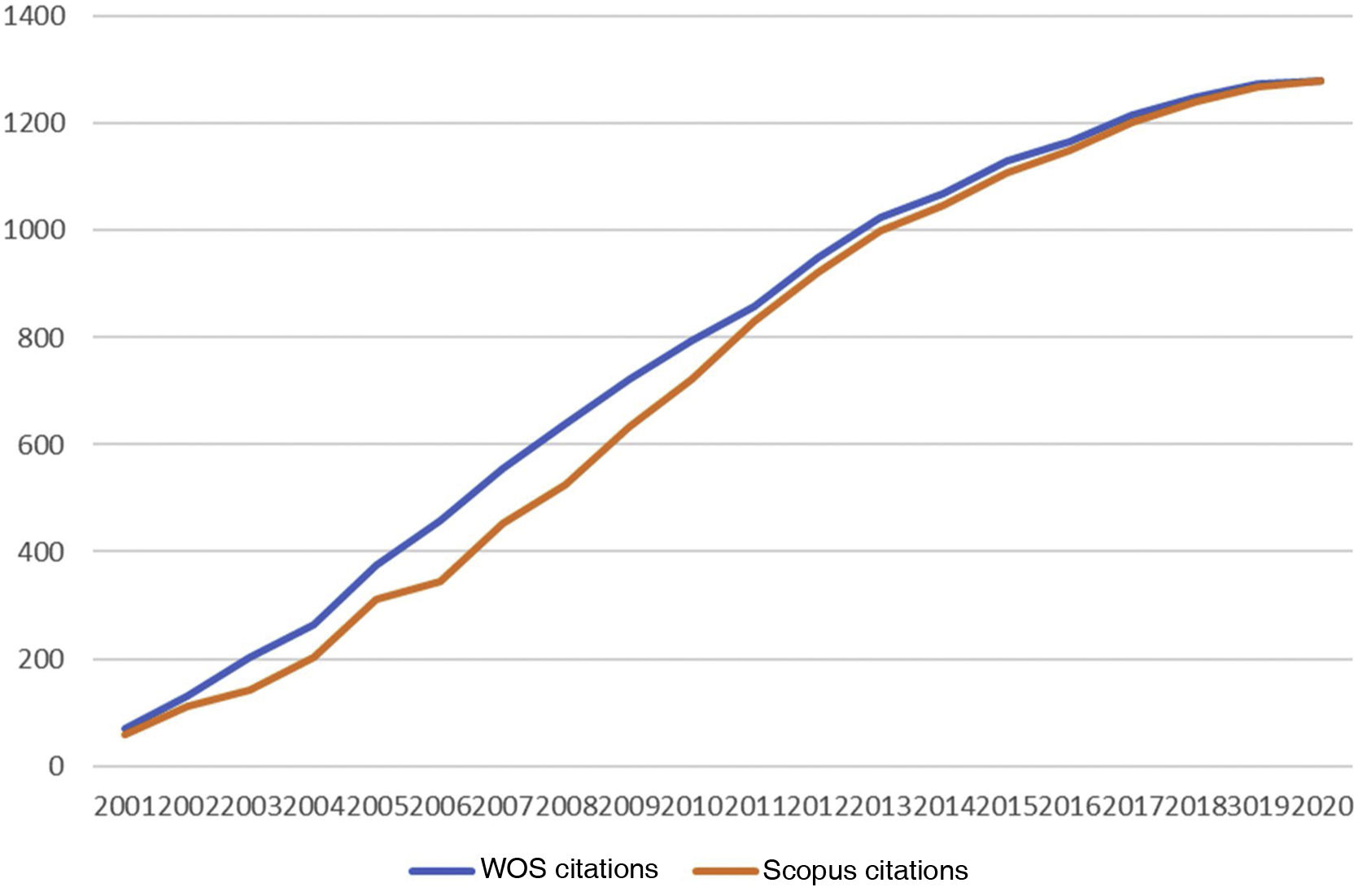
A total of 7913 bibliographical references are included in the 259 original articles, giving an average of 30.5 (SD 13.9) references/article. The minimum number of references per article is 5 and the maximum is 86. Of the articles, 57.1% have between 21 and 40 references, and 20.5% have more than 40. The citations received by these 259 articles, according to the Web of Science – as of 25/07/2021 – (Fig. 2) amounted to 1280, with an average of 4.9 (SD 1.7) citations/article. There were 41 (15.8%) articles that had not yet received any citations, 42 (16.2%) had received one citation and 30 (11.6%) had received more than 10 citations. The maximum number of citations received by an article in Web of Science was 36. Citations received in Scopus – as of 25/07/2021 – (Fig. 2) were 1279, with an average of 4.9 citations/article. There were 34 (13.1%) papers that had not yet received any citations, 44 (17.0%) had received one citation, and 34 (13.1%) had received more than 10. The maximum number of citations received by an article in Scopus was 29. With regard to the number of visits or downloads, the journal's website showed – as of 18/07/2021 –) that all the original articles had received a total of 4,010,872 visits. This represents a median of 15,485.9 visits/article, with a range of 23 and 244,055 visits/article.

There is a positive and moderate correlation (rho = .74; P < .0001) between the number of citations reported by Web of Science and Scopus, indicating that the journal has similar representativeness in both resources (Fig. 3). As can be seen in Figs. 4 and 5, there is constant growth in the number of citations received in Web of Science and Scopus, and in the number of visits/downloads of the original articles.


The 259 original articles were signed by 1345 authors, giving an average (or collaboration index) of 5.2 (SD .7) authors per article. This collaboration index (Table 3) ranged from a minimum of 3.9 authors in 2007 to a maximum of 6.4 in 2010. These 1345 signatures correspond to 927 different authors, which indicates that each author has signed an average of 1.45 articles (SD .2) over these 20 years. A total of 741 authors have signed one article (transience index = 79.9%) (Table 4), while 103 (11.1%) have signed 2 papers, and 34 (3.7%) have signed 5 or more articles. Only 10 authors (.5%) have signed 10 or more papers. Of the transient authors, 208 (28.1%) have been awarded prizes at SEEIUC conferences and congresses. Of the remaining non-transient authors, 311 (33.5%) have been awarded a prize once and 40 (12.9%) have been awarded a prize twice or more times. Finally, if Lotka's law is applied to the relationship between authors and number of articles (Fig. 6), it can be seen that the real straight line of the journal (Fig. 6a) is lower than the theoretical straight line formulated by this law, considering the number of 741 transient authors as the starting point. If it were considered (Fig. 6b) that the initial number of transient authors were half (n = 370), the ideal line established by this law and the hypothetically real line would be almost identical.
Chronological distribution of the number of signatures and the collaboration index of original articles in Enfermería Intensiva (2001–2020).
| Articles | Signatures | Collaboration index | |||
|---|---|---|---|---|---|
| n | % | n | % | ||
| 2001 | 9 | 3.5 | 52 | 3.9 | 5.8 |
| 2002 | 12 | 4.6 | 57 | 4.2 | 4.8 |
| 2003 | 10 | 3.9 | 55 | 4.1 | 5.5 |
| 2004 | 11 | 4.2 | 68 | 5.1 | 6.2 |
| 2005 | 11 | 4.2 | 46 | 3.4 | 4.2 |
| 2006 | 10 | 3.9 | 58 | 4.3 | 5.8 |
| 2007 | 14 | 5.4 | 55 | 4.1 | 3.9 |
| 2008 | 16 | 6.2 | 76 | 5.7 | 4.8 |
| 2009 | 16 | 6.2 | 79 | 5.9 | 4.9 |
| 2010 | 14 | 5.4 | 90 | 6.7 | 6.4 |
| 2011 | 16 | 6.2 | 80 | 5.9 | 5.0 |
| 2012 | 12 | 4.6 | 63 | 4.7 | 5.3 |
| 2013 | 10 | 3.9 | 58 | 4.3 | 5.8 |
| 2014 | 17 | 6.6 | 70 | 5.2 | 4.1 |
| 2015 | 14 | 5.4 | 71 | 5.3 | 5.1 |
| 2016 | 13 | 5.0 | 75 | 5.6 | 5.8 |
| 2017 | 13 | 5.0 | 66 | 4.9 | 5.1 |
| 2018 | 13 | 5.0 | 70 | 5.2 | 5.4 |
| 2019 | 15 | 5.8 | 78 | 5.8 | 5.2 |
| 2020 | 13 | 5.0 | 78 | 5.8 | 6.0 |
| Total | 259 | 1345 | 5.2 | ||

Of the set of authors, 7 out of 920 are corporate or group authors; the rest were considered individual authors. We observed that 612 are women (66.5%) and 196 are men (21.3%), and due to a lack of data it was not possible to identify the sex in 112 (12.2%) articles. Some 39.3% (n = 364) of the authors are in the category of main author, corresponding author, or last author.
By geographical affiliation (Table 5), more than 90% of the authors (839 individual authors and 7 collective authors) belong to Spanish institutions and 8.2% to foreign institutions (n = 77). The geographical affiliation of 4 authors is unknown. By regional distribution, most authors belong to institutions located in Madrid (n = 231), Catalonia (n = 223), Navarra (n = 65), and Andalusia (n = 53). The non-Spanish authors are mainly from Latin American countries, such as Colombia (n = 31) and Mexico (n = 17).
Geographical distribution of authors and institutions of the original articles in Enfermería Intensiva (2001–2020).
| Authors | Institutions | |||
|---|---|---|---|---|
| n | % | n | % | |
| National | 839 | 91.6 | 151 | 79.1 |
| Madrid | 231 | 27.5 | 31 | 20.5 |
| Catalonia | 223 | 26.6 | 38 | 25.2 |
| Navarra | 65 | 7.7 | 5 | 3.3 |
| Andalusia | 53 | 6.3 | 17 | 11.3 |
| Valencian Com. | 46 | 5.5 | 11 | 7.3 |
| Balearic Islands | 35 | 4.2 | 5 | 3.3 |
| Murcia | 34 | 4.1 | 8 | 5.3 |
| Castilla-La Mancha | 30 | 3.6 | 6 | 4 |
| Asturias | 28 | 3.3 | 7 | 4.6 |
| Basque Country | 27 | 3.2 | 6 | 4 |
| Castilla y León | 15 | 1.8 | 4 | 2.6 |
| Cantabria | 15 | 1.8 | 3 | 2 |
| Canary Islands | 11 | 1.3 | 3 | 2 |
| Galicia | 11 | 1.3 | 2 | 1.3 |
| Extremadura | 8 | 1 | 2 | 1.3 |
| Aragón | 4 | .5 | 2 | 1.3 |
| Rioja | 3 | .4 | 1 | .7 |
| International | 77 | 8.4 | 40 | 20.9 |
| Colombia | 31 | 40.3 | 10 | 25 |
| Mexico | 17 | 22.1 | 8 | 20 |
| Brazil | 6 | 7.8 | 5 | 12.5 |
| United Kingdom | 6 | 7.8 | 3 | 7.5 |
| Argentina | 4 | 5.2 | 4 | 10 |
| Chile | 4 | 5.2 | 3 | 7.5 |
| Cuba | 4 | 5.2 | 1 | 2.5 |
| Canada | 3 | 3.9 | 3 | 7.5 |
| Germany | 1 | 1.3 | 1 | 2.5 |
| Australia | 1 | 1.3 | 2 | 5 |
| Total | 916 | 191 | ||
Geographically, as with the authors, most of the institutions are located in Spain (79%), mainly Catalonia (25.2%), Madrid (20.5%), and Andalusia (11.3%); and most of the institutions outside Spain are also located in Latin American countries, such as Colombia (25.0%) and Mexico (20.0%). By institutional affiliation (Table 5), the 927 authors belong to 191 centres, with uneven participation: 124 institutions (64.9%) sign one article, 48 (25.1%) sign between 2 and 5 articles, and 19 sign (9.9%) more than 5 articles. Only 2 institutions appear in more than 20 articles. Most of the institutions to which the authors belong are hospitals (58.1%) and universities (27.2%). To a lesser extent, they belong to research centres (7.8%), health centres (3.1%), and management centres (1.3%).
Institutional collaboration is rare, 160 (61.8%) articles are signed by a single institution. In cases of institutional collaboration, the most frequent combination is between a hospital and a university (55.5%) and between 2 hospitals (15.2%). At the territorial level, there is intra-regional collaboration in 72 articles (31.8%) involving 2 or more institutions. National and international collaboration is very rare: in 13 (5.01%) articles institutions from 2 or 3 autonomous communities collaborate, and in 7 articles (2.7%) institutions from different countries participate. There is collaboration between authors (Table 6) in almost all the original articles (93.1%), as 18 papers (6.9%) are written by a single author. Of the 241 articles signed by several authors, 2 authors participate in 100 (38.6%), between 3 and 5 authors participate in 104 (40.2%), and more than 10 authors participate in 8 (3.1%).
DiscussionThe journal Enfermería Intensiva has published more than 400 papers in 20 years, more than half of which are original, which indicates a constant trajectory of editorial effort channelling the research of professionals dedicated to the care of the critically ill patient. It can be seen that in its early years the journal maintained a bifocal editorial line aimed at research (originals) and the training of its professionals/readers, while in the last decade it has diversified into a more complete editorial line, giving greater importance to letters to the editor or review articles, and less to self-evaluation works related to continuing education. The journal's interest in research is also reflected by the fact that the percentage of original articles with respect to the total number of papers is 59.1%, in parameters similar to those of other Spanish nursing journals, such as ENE,13 or even higher, such as Enfermería Científica, Enfermería Clínica, Index de Enfermería, and Rol de Enfermería,9,14,15 which indicates the journal’s growing interest in publishing original articles. Part of this constant production may be due to the flow received from the SEEIUC from its congresses. However, this figure is lower when compared with other foreign journals, such as the Journal of Advanced Nursing, with 83.5% of originals over 40 years of publication,10 but also when compared with global nursing production, which shows 68.0% of originals between 1970 and 2018, according to Scopus data.16
The journal has a high percentage of quantitative studies (76.1%) compared to qualitative studies, in line with the data provided by the international nursing journals with the highest impact.17 This trend could be because the papers presented at SEEIUC3 congresses are mainly quantitative studies.
The low number of references per paper has been a constant in national nursing publications in past decades,9,15,18 perhaps due to the scarce documentation available,18,19 but there has been a notable improvement in Spanish journals as a whole20,21 in recent years. This is also reflected in Enfermería Intensiva, whose average number of references is even higher than that of other studies.12,22 However, although the number of references per article is acceptable compared to national parameters, it is lower than in other international journals, such as Nursing Research20,23 or Journal of Advanced Nursing.10,20 The increase in the number of references per paper compared to previous decades may be due to the greater accessibility to information resources in hospitals and faculties, and because nurses have accessed master's and doctoral studies, which has facilitated greater knowledge in the search for and identification of relevant information.
The average number of citations received in international repositories is low, but it is important to remember that this is a journal that until a few years ago was published exclusively in Spanish and that the presence of Spanish nursing journals in these repositories is insignificant.24 This does not reflect its relevance on the national scene, where it is considered a reference journal for publication in intensive care.12,22 As some authors have highlighted,5 its not being included in the Journal Citation Reports detracts from the journal's curricular attractiveness, as authors direct their manuscripts to other journals with an impact factor, which may affect its visibility and readership. Finally, use of the journal according to the number of visits/downloads is acceptable, which implies that this published content is used in clinical practice and in training and teaching.
The collaboration index of 5.2 is similar in the intensive care setting,22 but higher than that of other nursing journals, such as ENE, Index de Enfermería, or Enfermería Clínica,13,14,25–27 and other publications in other fields of health sciences.28 This may be due to the correlation between the journal and the SEEIUC congresses, because, as flagged up in a study of the papers presented at the Society's congresses between 1998 and 2005,3 the collaboration index in these papers was 4.87.
The average number of papers per author is identical to that reported in other studies,29 although the transience index is much higher than that reported in other nursing journals, such as Enfermería Científica, Rol de Enfermería, or Metas de Enfermería,12,13,26 but similar to that of other health science journals.30 This high transience is also corroborated by the comparison between the 2 graphs applying Lotka's law.
In terms of gender, the perception of the nursing profession as traditionally feminine is reflected,31 as two thirds of the authors are women. This is also found in other examples in the literature, although in a smaller proportion.32
The geographical affiliation of 90% of the authors to Spain is logical because the publication is in Spanish, and reflects international isolation, which is also frequent in other similar publications22,26,33; although in recent years there has been a greater openness, mainly towards the Spanish-American sphere, as reflected in other national journals such as Index de Enfermería.14 More authors and institutions originating from communities such as Madrid, Catalonia, Navarra, or Andalusia reflects the distribution in Spanish literature.9,26 This could be due to several factors, for example these regions have a greater number of professionals and institutions, a stronger relationship with the SEEIUC, or greater research activity.
The nurse authors are typically affiliated to hospitals and universities, corresponding to the data presented in other studies,13,17,26,32 although in some cases university affiliation is significantly higher34 or even higher than that of hospitals.14
Finally, the scarce international or interregional collaboration seems to be endemic, as reflected in the scarce international repercussion of Spanish nursing research35; this is a deficit common to other publications, which have also detected scarce institutional collaboration outside their more local geographical framework.14,22 Institutionally, the more frequent collaboration between hospital and university22,27 is also logical given that, on the one hand, these are the two types of institutions with the greatest scientific output in the journal and, on the other, the dual affiliation (healthcare/teaching) of many of the researchers.
In the articles as a whole, a high level of collaboration between authors can be appreciated, especially within the same organisation. This would indicate a certain consolidation of institutional work teams in intensive care and a tendency towards teamwork which, as some authors highlight,36 is usually related to higher quality of work and greater productivity.
ConclusionsBibliometric indicators are merely indicators of scientific activity, enabling us to measure its production, circulation, and readership, but do not describe the quality or objective importance of a journal. However, based on these parameters, the indicators produced by the journal between 2001 and 2020 in the context of Spanish nursing research can be considered very positive.
The journal has established itself on the national scene as a benchmark in critical care research, and has committed to publishing a constant number of original articles, which represents an effort given its specialisation. In the main it publishes quantitative research (descriptive observational studies and clinical trials).
The bibliographic support of the articles is remarkable, because the average number of references per paper is in many cases higher than the average of other national nursing journals, but still lower than the data reflected in international publications.
The number of citations received is moderate and biased by the bibliometric sources used, as it does not reflect all citation of Spanish nursing; however, the number of downloads or visits received is notable.
The collaboration index is higher than that of other national publications and the journal is within the usual standards of productivity, with a high transience index.
Most of the authors and institutions signing the papers are Spanish. There is significant international isolation, although this has improved in recent years with the presence of Spanish-American authors.