







To determine the clinical and functional characteristics and to compare the survival of a group of patients with multiple pathologies with PEG versus another group with similar characteristics of comorbidity and nutritional status, fed orally.
MethodA retrospective cohort study of hospitalized patients at the Costa del Sol Hospital (2016−21) was conducted. The inclusion criteria were multi-pathological patients belonging to categories E and G, defined in the Assistance Process of the Ministry of Health, with dysphagia and nutritional risk. All patients with PEG were included. The non-PEG group was obtained with simple random sampling. Dysphagia was evaluated with the volume-viscosity clinical examination method. Analytical parameters, survival, PROFUND index and nutritional risk were also evaluated. Statistical analysis and a Cox multivariate regression model (95% CI) were performed with a significance level of P < .05.
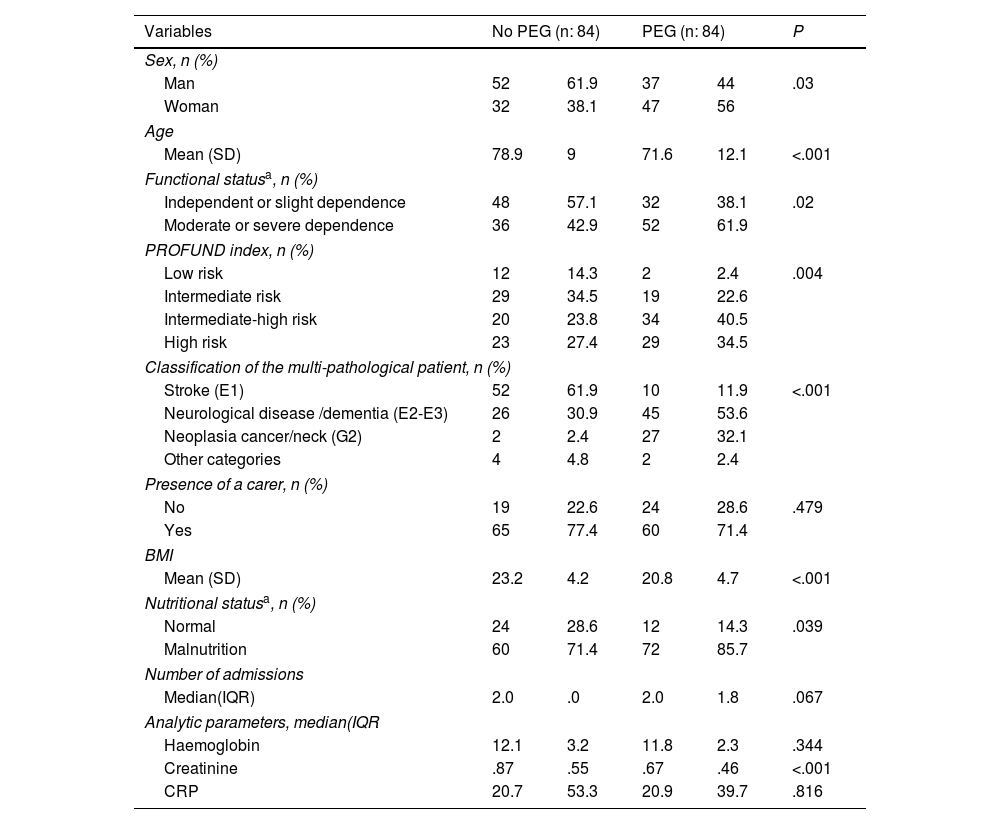
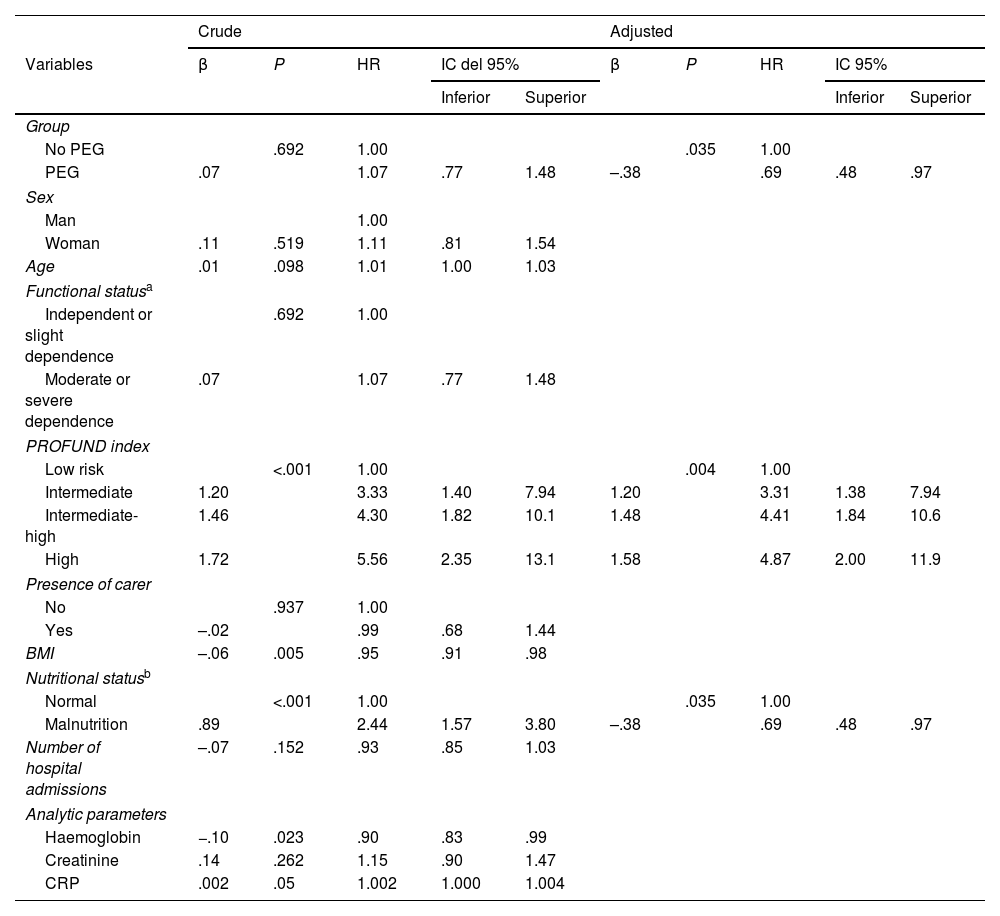
ResultsA total of 1928 patients with multiple pathologies were categorized, almost 30% with dysphagia. 84 patients were fed by PEG. Of the 434 orally fed subjects, 84 were selected, a total sample of 168 patients. The most frequent diagnoses were neurological disease and/or dementia versus stroke in the non-PEG group. Both groups presented malnutrition in more than 70% and an intermediate-high PROFUND. Adjusting the groups with nutritional status and the PROFUND index, the PEG group had a better prognosis (P = .035).
ConclusionsThe adjustment of the studied population with the PROFUND index and its nutritional status determines a longer survival of patients with PEG.
Conocer las características clínicas y funcionales y comparar la supervivencia de un grupo de pacientes pluripatológicos con PEG frente a otro grupo con características similares de comorbilidad y estado nutricional, alimentados por vía oral.
MétodoSe realizó un estudio de cohortes retrospectivo de pacientes hospitalizados en el Hospital Costa del Sol (2016−21). Los criterios de inclusión fueron pacientes pluripatológicos, según se define en el Proceso Asistencial de la Consejería de Salud, con disfagia y riesgo de desnutrición. Se incluyó a todos los pacientes portadores de PEG, el grupo no PEG se obtuvo con un muestreo aleatorio simple. La disfagia se evaluó con el método de exploración clínica de volumen-viscosidad, se evaluaron parámetros analíticos, supervivencia, índice PROFUND y riesgo nutricional. Se realizó análisis estadístico y modelo de regresión multivariada de Cox (IC 95%) con un nivel de significancia de P < ,05.
ResultadosSe categorizaron 1928 pacientes pluripatológicos, casi el 30% con disfagia. 84 pacientes fueron alimentados con PEG. De los 434 alimentados por vía oral, se seleccionaron 84, quedando una muestra total de 168 pacientes. Los diagnósticos más frecuentes fueron enfermedad neurológica y/o demencia frente al ACV en el grupo no PEG. Ambos grupos presentaron desnutrición en más de un 70% y un PROFUND intermedio-alto. Ajustando los grupos con el estado nutricional y el índice PROFUND, el grupo PEG tuvo mejor pronóstico (P = ,035).
ConclusionesEl ajuste de la población estudiada con el índice PROFUND y su estado nutricional, determina una mayor supervivencia de los pacientes portadores de PEG.

