




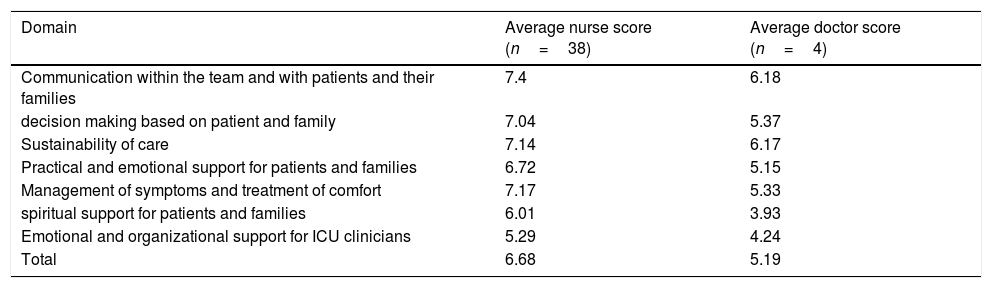
The high mortality in intensive care unit (ICU) requires health workers to be able to provide palliative care so that patients die in peace and help the patient's family face the grieving process. The implementation of palliative care must be organized and assessed for the quality of its implementation. The aim was to describe the quality of palliative care in ICU “X” Hospital. The research used Mixed Methods. The first was the quantitative with descriptive research. The sample was 38 nurses and 4 doctors to obtain data on the quality of palliative care with The Self-Report Questionnaire (0–10). The second of qualitative methods to deepen quantitative data with achieved data saturation in 5 nurses and 2 doctors. Retrieval of data from May to July 2019. The results were the quality of palliative care performed by nurses had a score of 6.68, for doctors were 5.19. The lowest score (5.29) was found in the emotional support, and organizational domain for ICU clinicians for nurses with the theme of the role of coworkers and the desire to act alone, for doctors the lowest score (3.93) was spiritual support for patients family with the theme of the absence of operational standards of spiritual support procedures and knowledge and experience of spiritual support. The conclusion is the quality of palliative care services performed by nurses has a score of 6.68 and for doctors was 5.19.

