



The term RIME (reactive infectious mucocutaneous eruption) was coined in 2019 to refer to a rare group of para-infectious mucocutaneous eruptions, encompassing both viral (SARS-CoV-2, influenza, herpesvirus) and bacterial aetiologies.1 Among the bacterial is Mycoplasma pneumoniae, which, in 6.8% of those infected, can be associated with this manifestation, previously called MIRM (Mycoplasma-induced rashand mucositis).2 There is a variant without skin involvement, called RIME sine rash,3 as in the case described below.
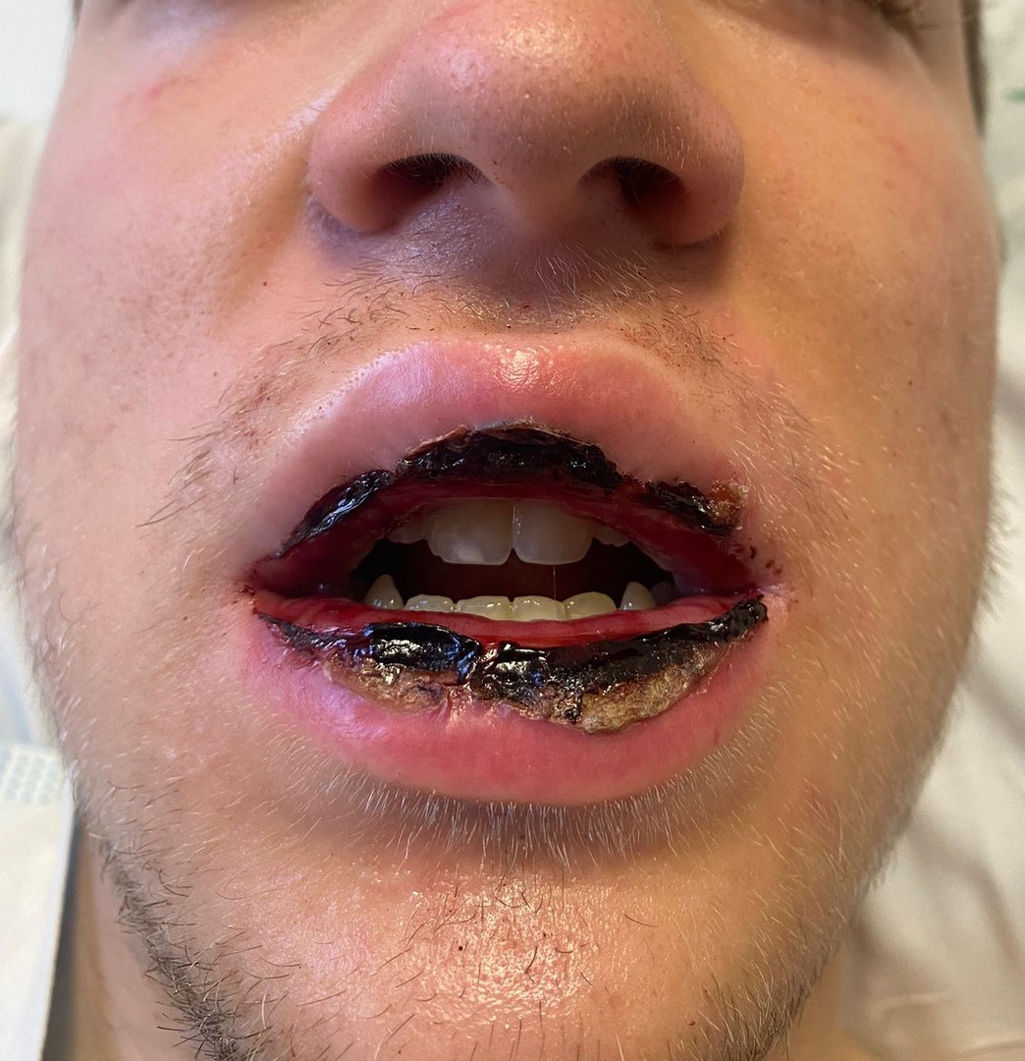
We present the case of a 19-year-old male with no relevant medical history who presented with a fever of 5 days' duration followed by the appearance 48 h later of necrotic lesions on the lower lip, and subsequent extension to the entire oral mucosa, causing inability to swallow due to severe odynophagia and difficulty in opening his mouth. He had no relevant epidemiological history or drug use. On examination, crusty necrotic lesions with an erythematous background were found on the inner portion of the upper and lower lips (Fig. 1) and, on the soft palate, flat, erythematous punctate lesions, which extended to the oropharynx. No other skin lesions were identified except for an erythematous macular lesion on the glans of less than a centimetre in size. Tests performed initially showed an elevation of C-reactive protein (CRP; 142 mg/l) and leucocytosis with neutrophilia (11,900/mm3 with 79% neutrophils), and a normal chest X-ray. The patient was admitted for nutritional support treatment and investigation with the following analytical tests: autoimmunity (anti-epidermal basement membrane, anti-epidermal intercellular substance, antinuclear antibodies, extractable nuclear antigen; all negative), viral serologies (Epstein-Barr virus, cytomegalovirus, hepatitis B and C viruses, human immunodeficiency; negative) and exudate study by polymerase chain reaction (PCR) (influenza A, respiratory syncytial virus and SARS-CoV-2, negative). Blood cultures were negative and punch biopsy of the lesions was performed. Finally, bacterial serologies were negative for Chlamydophila pneumoniae but positive IgM for M. pneumoniae. The patient was started on broad-spectrum, then subsequently targeted, antibiotic therapy and systemic corticosteroids, with clinical and analytical improvement, being discharged from hospital after regaining oral tolerance. Subsequently, the buccal mucosa biopsy performed showed data of spongiosis and inflammatory exocytosis associated with reactive epithelial changes, chronic perivascular inflammatory infiltrate and granulation tissue, with negative direct immunofluorescence. After the patient's discharge, full clinical recovery was confirmed and serology showed the appearance of IgG with persistence of IgM for M. pneumoniae. The final diagnosis was RIME sine rash associated with M. pneumonia infection.

This condition predominantly affects males with an average age of 12 years.4 Although the pathophysiology is not fully understood, a multifactorial immune mechanism is postulated: mimicry between the MP P1 adhesin and keratinocyte antigens, which may lead to the development of a cross-reaction and autoantibodies against the antigens present in the mucosa; the formation and deposition of immune complexes; the polyclonal activation of plasma cells; and genetic susceptibility.1 Diagnosis is clinical, generally beginning with a prodromal picture (fever, cough, general malaise) followed by the appearance of mucocutaneous lesions one week later, generally polymorphic with a predominance of vesicles and blisters. Diagnostic criteria4 have been proposed for the classic, severe and RIME sine rash forms, the latter variant being: mucocutaneous rash affecting <10% of the body surface; involvement of at least two mucous membranes; mild skin involvement in the form of vesiculobullous lesions, target lesions or rash; and clinical and analytical findings compatible with atypical pneumonia. Although the reason for the different clinical presentations is unknown, it is thought that the presence of multiple genetic subtypes of M. pneumoniae could show different patterns of tissue tropism and so result in the diversity.4
In the event of clinical suspicion, it is essential to rule out the recent introduction of any drug that could induce conditions such as Stevens-Johnson syndrome/toxic epidermal necrolysis (SJS/TEN). It is also recommended to determine C-reactive protein and erythrocyte sedimentation rate and perform chest X-ray, nasopharyngeal swab for respiratory viruses and serology for M. pneumoniae, C. pneumoniae and herpesvirus. Antibodies to M. pneumoniae are often present at the time of clinical symptoms due to the long incubation period. Demonstration of a four-fold increase in titre between a sample from the acute phase and one from the convalescent phase, or titres greater than or equal to 1/32, provides a sensitivity of 90% and a specificity of 88%.5 Molecular techniques also show high sensitivity and specificity, but they have the limitation of being unable to differentiate colonisation from infection. Skin biopsy, although not showing specific findings, is useful for the exclusion of autoimmune blistering diseases. Differential diagnosis should include drug-induced epidermal necrolysis (SJS and TEN), Kawasaki disease, pemphigus vulgaris, Behçet's disease, and hand-foot-and-mouth disease.6
The course of the disease is generally benign with complete recovery, although it is not uncommon for associated comorbidity related to difficulty swallowing (dehydration, weight loss) and neuropsychiatric disorders.7 In up to 10% of cases, mucosal sequelae may appear, mainly ocular.4 Recurrence is rare, although there is variability between different series both in prevalence (8–38% of cases)5,8 and in predisposing clinical characteristics.8,9 Recurrent episodes are associated with shorter recovery times and a lesser or equal degree of mucosal involvement compared with initial episodes.10
In terms of treatment, there are currently no clear guidelines, mainly being supportive, prioritising ensuring nutrition and hydration, protection of mucous membranes and pain control. If mucosal involvement is extensive, systemic corticosteroids may be administered (prednisone/methylprednisolone 1 mg/kg/day for 5–7 days).7 Although the use of antibiotics is recommended, there is no evidence in this regard as, although they reduce infectious complications, their role in the healing of mucocutaneous lesions is unknown.5 Intravenous immunoglobulins, ciclosporin or TNF-〈inhibitors have also been used, although there is no evidence to support them.2
FundingNo funding.

