







The main objective of this study is to develop a tool capable of synthesizing images of the ganglion cell layer (GCL) that simulate glaucoma progression using generative antagonistic networks (GANs).
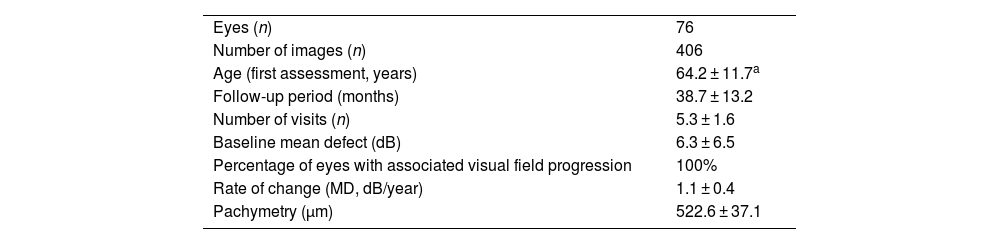
Material and methodsThe dataset includes 406 GCL images of 76 eyes with glaucoma and progression, recorded by a spectral domain optical coherence tomograph (OCT). The Pix2Pix model, a conditional antagonistic generative network, was used to transform the current GCL images into images representing glaucoma progression. A total of 70% of the samples were used for training and 30% for model testing. The structural similarity coefficient was used to analyze the similarity between the real and generated images, and finally, an expert's opinion was used to assess the originality of the generated images.
ResultsThe synthesized images successfully replicate glaucoma lesion patterns, with good generalizability and reproducibility. The results show a mean structural similarity between 0.76 and 0.78 in the different tests. The test with the expert obtained an accuracy of 57% in distinguishing between real and generated images.
ConclusionsThe system developed can generate synthetic images of the GCL with a high similarity to the real ones, demonstrating the effectiveness of the model in synthesizing images that represent the evolution of glaucoma.
El principal objetivo es el desarrollo de una herramienta capaz de sintetizar imágenes de la capa de células ganglionares (GCL) que simulan la evolución del glaucoma utilizando Redes Generativas Antagónicas (GANs).
Material y métodosEl conjunto de datos lo forman 406 imágenes de la GCL de 76 ojos con glaucoma y progresión, registradas por un Tomógrafo de Coherencia Óptica (OCT) de tipo dominio espectral. Se usó el modelo Pix2Pix, una red generativa antagónica condicional, para transformar las imágenes actuales de la GCL en imágenes que representan la progresión del glaucoma. Se usó el 70% de las muestras para el entrenamiento y el 30% para la prueba del modelo. Se utilizó el coeficiente de similitud estructural para analizar la similitud entre las imágenes reales y generadas, y por último, se recurrió a la opinión de un experto para que valorara la originalidad de las imágenes generadas.
ResultadosLas imágenes sintetizadas replican con éxito los patrones de lesión del glaucoma, con una buena capacidad de generalización y reproducibilidad. Los resultados muestran una similitud estructural promedio entre el 0.76 y el 0.78 en las diferentes pruebas. La prueba con el experto obtuvo una exactitud del 57% en distinguir entre imágenes reales y generadas.
ConclusionesEl sistema desarrollado es capaz de generar imágenes sintéticas de la GCL con una alta similitud a las reales, demostrando la efectividad del modelo en la síntesis de imágenes que representan la evolución del glaucoma.

