Abstracts of the 2025 Annual Meeting of the ALEH
More infoEarly detection of liver fibrosis in Metabolic Dysfunction–Associated Steatotic Liver Disease (MASLD) is crucial for preventing progression to cirrhosis. The Agile-3+ and Agile-4 scores are designed to identify advanced fibrosis and cirrhosis, respectively, but their performance in Latin American populations is unknown. This study aimed to validate Agile-3+ and Agile-4 scores in predicting advanced fibrosis and cirrhosis in a well-characterized cohort of Latin American patients.
Materials and MethodsMulticenter cross-sectional study with 770 patients from 10 centers across Brazil, Argentina, Chile, and Mexico, all diagnosed with MASLD per 2023 criteria. Liver fibrosis was assessed by vibration-controlled transient elastography (VCTE). Scores (FIB-4, Agile-3+, Agile-4) were calculated from biochemical and clinical data. Diagnostic accuracy for detecting advanced fibrosis (≥F3) and cirrhosis (F4) was evaluated using ROC curves and Youden index.
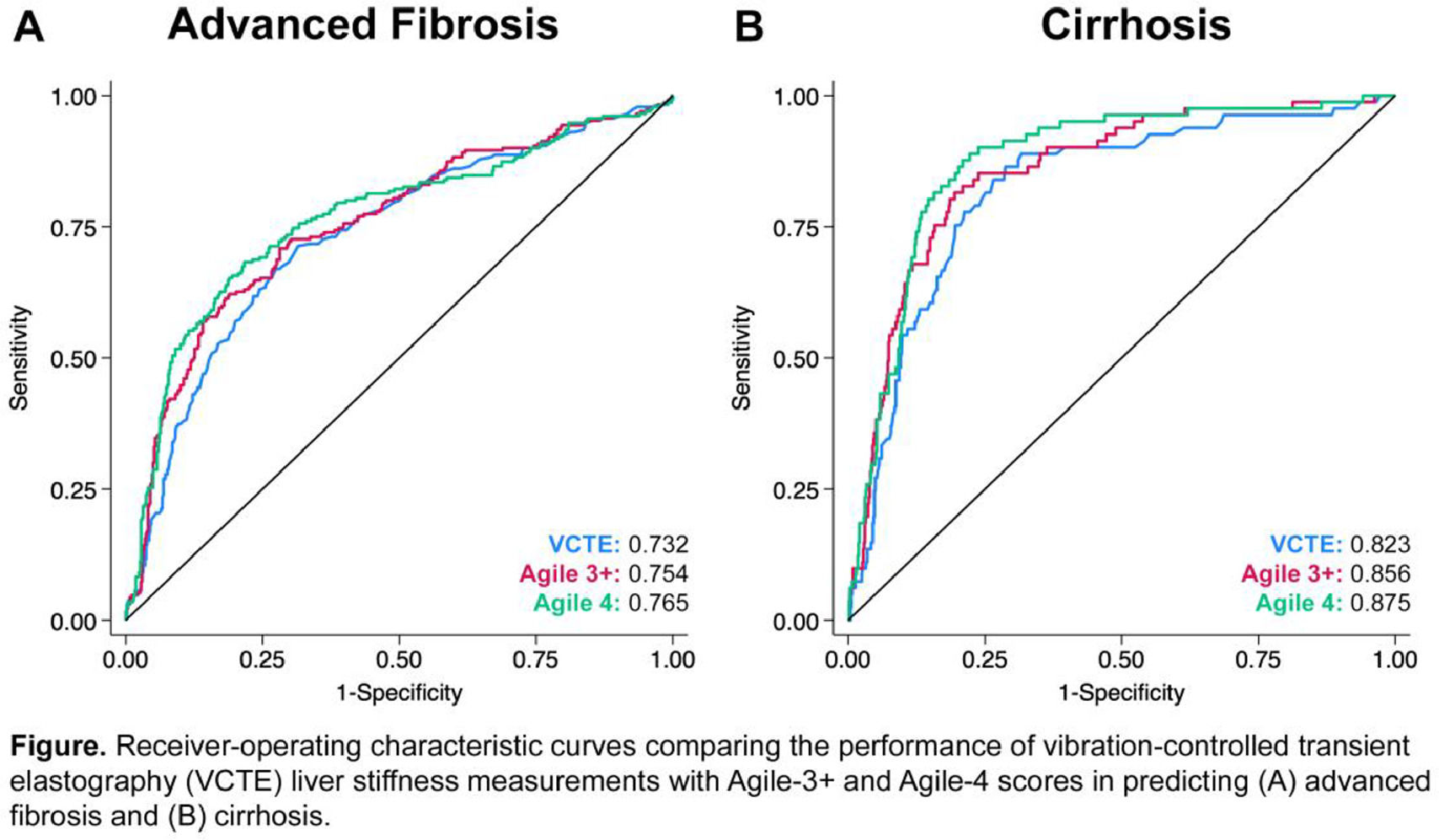
ResultsMedian age was 59 years; 60% were men. Median BMI was 33.3 kg/m2; 69.6% had type 2 diabetes. Median liver stiffness was 9.1 kPa; 29.9% had advanced fibrosis, and 10.5% cirrhosis. Agile-4 outperformed VCTE stiffness in predicting advanced fibrosis (AUROC 0.765, p=0.037) and demonstrated superior accuracy for cirrhosis (AUROC 0.875, p=0.003) (Figure 1). The optimal cut-offs for Agile-4 were ≥0.159 (rule out cirrhosis with 90% sensitivity) and ≥0.366 (rule in cirrhosis with 90% specificity).
ConclusionsIn this Latin American MASLD cohort, Agile-4 score demonstrated superior noninvasive rule-out performance for advanced fibrosis and cirrhosis. Incorporating these thresholds into VCTE algorithms could reduce unnecessary biopsies and improve streamline MASLD care pathways.