Abstracts Asociación Mexicana de Hepatología (AMH) 2024
More infoObesity, global epidemic, can cause metabolic dysfunction-associated steatohepatitis (MASH) and cardiovascular diseases. Pirfenidone (PFD) has anti-inflammatory and anti-fibrotic properties. We investigated the effects of PFD on metabolic hormones expression and myocarditis in a mouse MASH model and its effect on H9c2 cells viability under glucolipotoxicity.
Materials and PatientsTwenty-week-old male C57BL/6J mice were divided into two groups: one group was fed a normal diet (ND, 3.1 kcal/g plus normal water, n=7), while the other group was fed a high-fat, high-carbohydrate diet (HFHC, 5.1 kcal/g plus water containing 2.31% fructose, 1.89% sucrose; n=14) for 16 weeks. At week 8, seven HFHC mice were administered PFD at a dosage of 300 mg/kg/day by gavage. Insulin tolerance tests (ITT), dry chemistry analysis, ELISA, histological staining (Hematoxylin-Eosin and Masson's Trichrome), and morphometric analyzes of the tissues were evaluated. H9c2 cells were treated with the following concentrations: 100 μM, 200 μM, 400 μM PA (PA), 15 mM, 30 mM glucose, and 0.3 mM, 0.5 mM, 1 mM 1.5 mM PFD. H9c2 cells viability under glucolipotoxicity were evaluated by MTT assay and Oil red O staining. The data were analyzed using one-way ANOVA followed by Tukey's post-hoc test in Graphpad Prism v10.0.
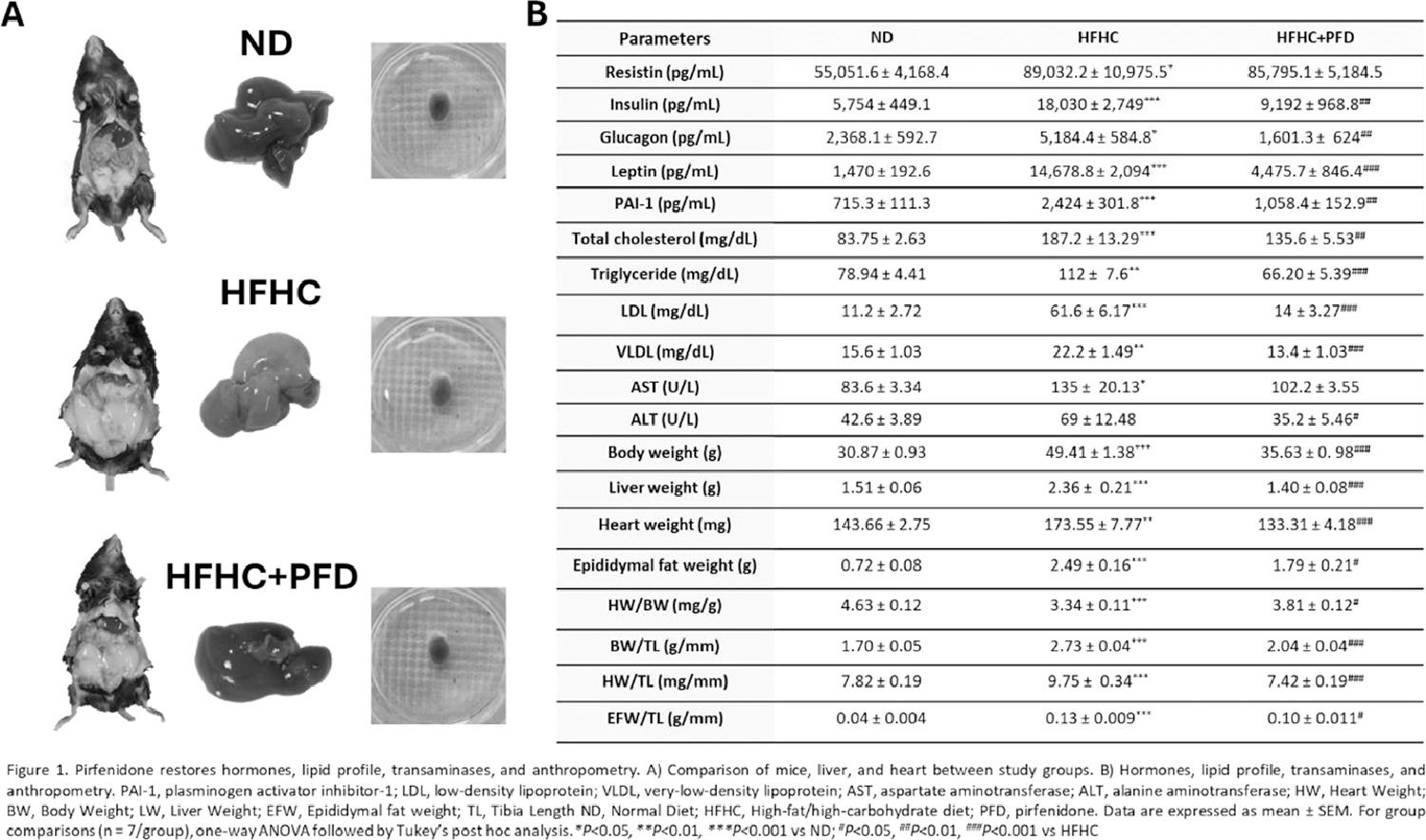
ResultsHFHC mice developed MASH, myocarditis and fibrosis (P≤0.05). Additionally, resistin and AST levels significantly increased (P≤0.05). PFD prevented elevated parameters in HFHC mice (P≤0.05), such as body weight, epididymal fat weight, liver weight and heart weight; including body weight/tibia length ratio, heart weight/tibia length ratio and epididymal fat weight/tibia length ratio; hormone levels: insulin, glucagon, leptin, and plasminogen activator inhibitor-1 (PAI-1); lipid profile: total cholesterol, triglycerides, LDL, and VLDL; adipocyte hypertrophy, inflammatory foci, and fibrosis in liver and cardiac tissues. Additionally, PFD reduced ALT expression and tibia length (P≤0.05). The heart weight/body weight ratio decreased in HFHC mice (P≤0.05), PFD recovered this ratio (P≤0.05). H9c2 cells treated with 400 μM PA showed 50% cell viability (P≤0.05), all other concentrations of the compounds had cell viability > 60% (P≤0.05), including H9c2 cells treated with 150 μM PA, 15 mM glucosa, and 1 mM PFD (P≤0.05). H9c2 cells treated with 150 μM and 200 μM PA showed a significant increase in intracellular lipid accumulation (P≤0.001), and H9c2 cells treated with 150 μM PA and 1.5 mM PDF showed a tendency to reduce intracellular lipid levels.
Conclusions: PFD restores the expression levels of metabolic hormones, which are involved in lipids and carbohydrates metabolism, improving lipid and aminotransferases levels, thus preventing myocarditis and fibrosis in MASH mice. These findings suggest the potential of PFD for the prevention of myocarditis and fibrosis in obesity-induced MASH mice.